
宁波银行

Search documents
催化不断 这一领域掀起涨停潮!融资客大手笔加仓多只海外机构调研股
Zheng Quan Shi Bao Wang· 2025-09-29 08:05
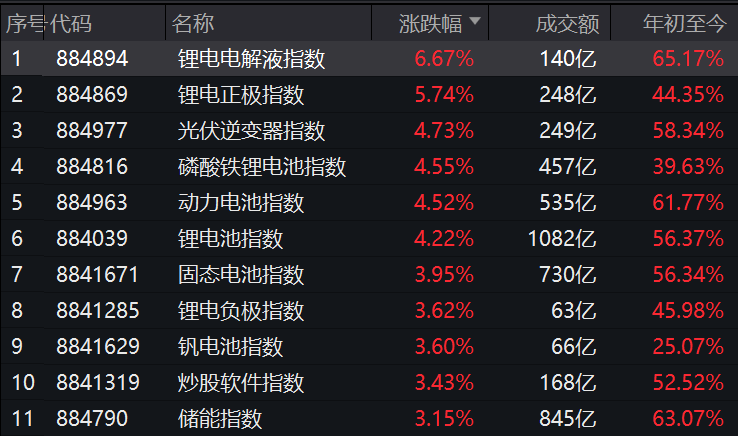
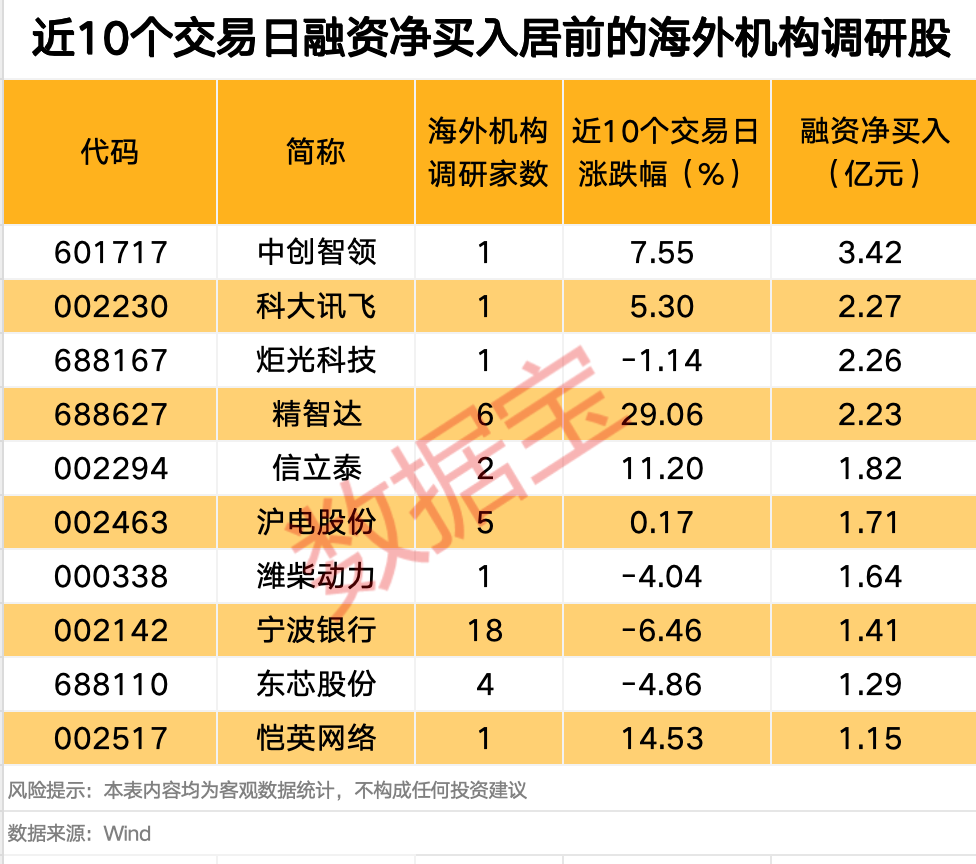
Group 1 - The latest overseas institutional research shows that 57 companies were visited by foreign institutions in the past 10 trading days, with a focus on companies like Shenzhen South Circuit and Zhongkong Technology [3][5] - Shenzhen South Circuit received attention from 29 overseas institutions, highlighting its capacity expansion through technology upgrades and new projects in Nantong and Thailand [3] - Zhongkong Technology was visited by 20 overseas institutions and recently won two major projects from Sinopec, which are expected to significantly increase annual output and revenue [3] Group 2 - The lithium battery sector is experiencing strong performance, with various sub-sectors such as sodium-ion batteries and solid-state batteries showing significant gains [2] - The lithium battery electrolyte index increased by 6.67% with a year-to-date growth of 65.17%, indicating robust market demand [2] - The average stock price of companies that received overseas institutional research rose by 3.11% over the past 10 trading days, with notable gains from companies like Demingli and Jingzhida [5][6] Group 3 - The funding situation shows that over half of the companies that received overseas institutional research saw an increase in financing, with several companies receiving net purchases exceeding 100 million yuan [5][6] - Notable net purchases include Zhongchuang Zhiling with 342 million yuan, indicating strong investor interest [6] - The overall market sentiment remains positive, particularly in sectors related to technology and lithium batteries, driven by ongoing developments and institutional interest [1][2]





资产质量十五年:上市银行不良出清与拨备压力观察
Guoxin Securities· 2025-09-29 05:22
Investment Rating - The report maintains an "Outperform" rating for the banking industry, expecting improvements in the fundamental outlook for the next year [2][105]. Core Insights - The stability of asset quality in the banking sector is attributed to the gradual exposure and clearing of non-performing loans over the past 15 years, with different sectors experiencing issues at different times [1][12]. - Banks have actively adjusted their loan structures to mitigate risks, reducing exposure to sectors with rising non-performing loans [1][66]. - The impact of non-performing loans on profit statements has been minimized due to proactive provisioning strategies, including excess provisioning in previous years [1][69][70]. - Non-credit asset risks have also been largely cleared or are at minimal levels, contributing to overall stability in the banking sector [1][90]. Summary by Sections Asset Quality and Non-Performing Loans - The report highlights that the overall non-performing loan generation rate for listed banks has stabilized around 0.7%, which is still considered high compared to historical peaks [2][12]. - Different banks exhibit varying levels of asset quality pressure and provisioning capabilities, with larger banks and some city commercial banks performing better [2][93]. Investment Recommendations - The report suggests focusing on banks with strong asset quality and low provisioning pressure, such as Chengdu Bank, Changsha Bank, Zhangjiagang Bank, and Ruifeng Bank [2][105]. - It also recommends high-quality cyclical stocks like Ningbo Bank and Changshu Bank, which are expected to show early signs of recovery [2][105]. Loan Sector Analysis - The manufacturing and retail sectors have seen a clearing of non-performing loans, with their rates returning to levels seen in 2010 [26][30]. - The real estate sector's non-performing loan rate peaked in 2023 but has since shown signs of recovery, although it remains elevated [35][37]. - Retail loan risks are currently rising, with various types of personal loans experiencing increased non-performing rates [50][53]. Provisioning and Profit Stability - Banks have historically maintained excess provisions, which can be utilized to smooth profits during periods of rising non-performing loans [69][75]. - The current provisioning levels are deemed adequate to support stable profits for the next few years, with estimates suggesting that existing provisions could release at least 800 billion yuan in net profit [81][90].
融资客大手笔加仓多只海外机构调研股
Zheng Quan Shi Bao Wang· 2025-09-29 05:09
Group 1 - The core viewpoint of the article highlights that in the recent 10 trading days (from September 15 to September 26), a total of 421 companies were investigated by institutions, with the majority being from securities companies, followed by fund companies and overseas institutions [1] - Among the companies that received overseas institutional research, ShenNan Circuit was the most focused on, being visited by 29 overseas institutions [1] - The average stock price of companies that received overseas institutional research increased by 3.11% over the past 10 trading days, with notable gainers including DeMingLi, JingZhiDa, and WoDe [1] Group 2 - More than half of the stocks that were investigated by overseas institutions saw an increase in financing, with 10 stocks receiving net purchases exceeding 100 million yuan [1] - ZhongChuangZhiLing received the highest net purchase amount of 342 million yuan, followed by KeDaXunFei and JuGuangKeJi [1][2] - The table provided lists specific companies, their overseas institutional research counts, stock price changes, and net financing amounts, indicating significant interest and investment activity in these stocks [2]

宁波银行将在10月1日-10月2日暂停个人养老金理财业务
Jin Tou Wang· 2025-09-29 03:17
2025年9月28日,宁波银行(002142)发布公告称,因系统维护升级,宁波银行将于2025年10月1日8 时-10月2日12时暂停个人养老金理财业务,届时个人养老金理财投资账户开户、产品购买及赎回等均将 暂时停止服务。 ...

上市银行不良出清与拨备压力观察
Guoxin Securities· 2025-09-29 02:04
Investment Rating - The industry is rated as "Outperform the Market" [2][3] Core Viewpoints - The stability of asset quality in the banking sector is attributed to the gradual clearing of non-performing loans across various sectors over the past 15 years, which has mitigated the impact on bank financial statements [1][2] - Banks have proactively adjusted their loan structures to reduce risk exposure, particularly by decreasing the proportion of loans to sectors experiencing rising non-performing loans [1][2] - The impact of non-performing loans on profit statements has been minimized due to banks' preemptive provisioning strategies, which have allowed for smoother profit reporting [1][2] - Non-credit areas of non-performing assets have also been cleared or are at a minimal level, contributing to the overall stability of bank risk profiles [1][2] Summary by Sections Non-Performing Loan Exposure and Clearing - The banking sector has experienced a 15-year process of risk resolution, with non-performing loans being gradually exposed and cleared [12] - The manufacturing and retail sectors have seen significant reductions in non-performing loans, achieving a return to levels similar to those seen in 2010 [26][30] Real Estate Sector - The real estate sector's non-performing loan ratio peaked in 2023 but has since shown signs of recovery, although it remains elevated [35][37] - The overall impact of real estate risks on bank loan portfolios is limited due to the relatively small proportion of real estate loans compared to total loans [37][38] City Investment Loans - The non-performing loan ratio for city investment loans has been declining since 2023, aided by debt reduction efforts [41][44] Retail Loans - Retail loan categories, including personal housing loans and credit card loans, are currently experiencing rising non-performing rates, indicating ongoing risk exposure [50][53] Other Loan Categories - Other loan categories, such as utilities and miscellaneous public loans, have minimal impact on overall bank risk due to their low non-performing rates [60][63] Loan Structure Adjustments - Banks have actively adjusted their loan structures in response to risk exposures, shifting focus towards lower-risk personal loans [66][68] Provisioning Strategies - Banks have utilized provisioning to smooth profit impacts from non-performing loans, with historical data indicating a capacity to release significant net profits from existing provisions [81][82] Investment Recommendations - The report suggests focusing on banks with strong asset quality and low provisioning pressure, such as Chengdu Bank and Changsha Bank, while also recommending cyclical stocks like Ningbo Bank and Changshu Bank for potential recovery [105]
银行渠道本周在售纯固收理财产品榜单(9/29-10/5)
2 1 Shi Ji Jing Ji Bao Dao· 2025-09-29 01:16
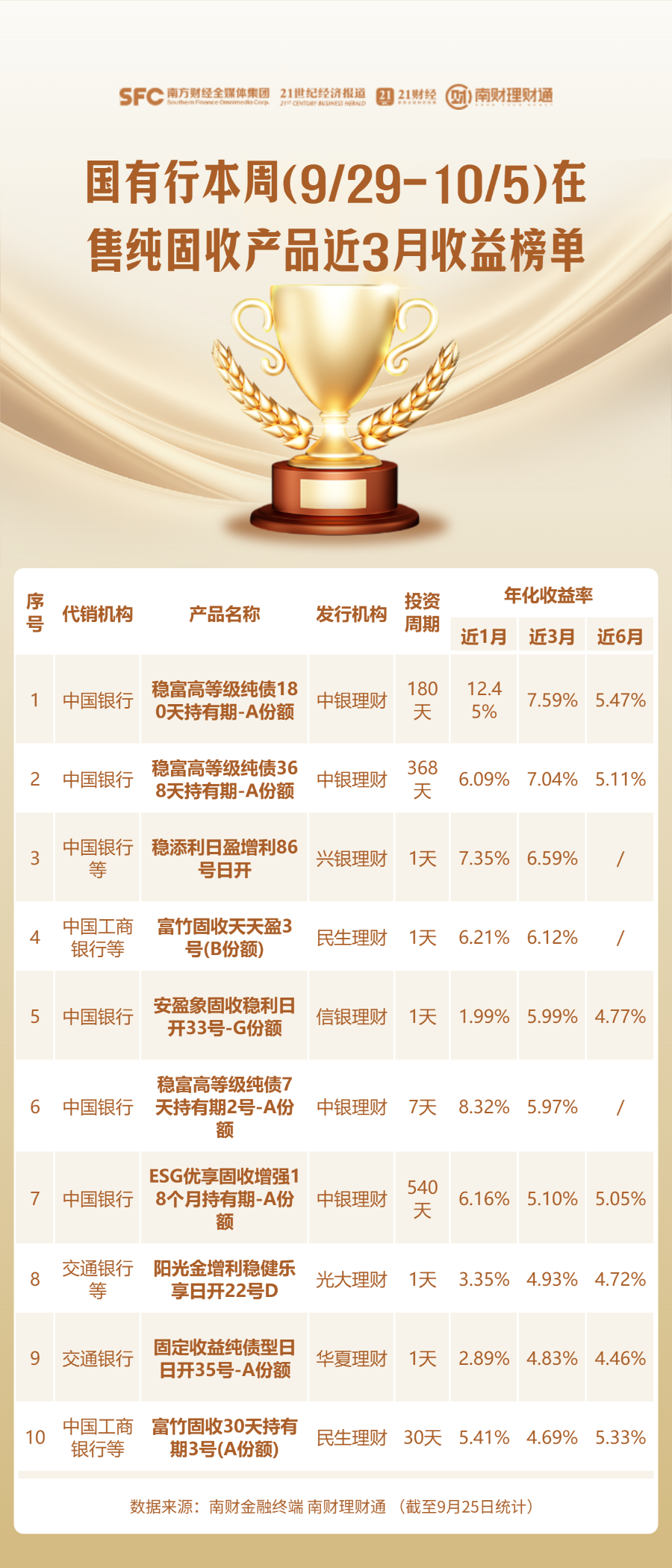
Core Viewpoint - The article discusses the diverse range of bank wealth management products available, emphasizing the need for investors to carefully select and identify suitable options based on performance metrics and product types [1]. Group 1: Product Selection and Performance - The article highlights a weekly performance ranking of wealth management products, focusing on those with strong performance in the categories of pure fixed income, "fixed income +", and mixed products [1]. - The ranking criteria include product type and performance stability, requiring products to have been established for at least three months to ensure sufficient performance data [1]. - The performance metrics displayed include annualized returns over the past month, three months, and six months, with a focus on the three-month annualized return for recent market performance [1]. Group 2: Distribution Channels - The article lists 28 distribution institutions, including major banks such as Industrial and Commercial Bank of China, Bank of China, and Agricultural Bank of China, among others [2]. - It notes that the availability of products may vary due to factors such as sold-out quotas or differences in product listings for different customers, advising investors to refer to the actual displays on bank apps [2]. Group 3: Performance Data - The article provides specific performance data for various wealth management products, including annualized returns for different time frames, such as 7.59% for a product from Bank of China over a 180-day period [5]. - It includes a detailed table of products with their respective annualized returns for the past month, three months, and six months, showcasing the competitive landscape of fixed income products [7][10].
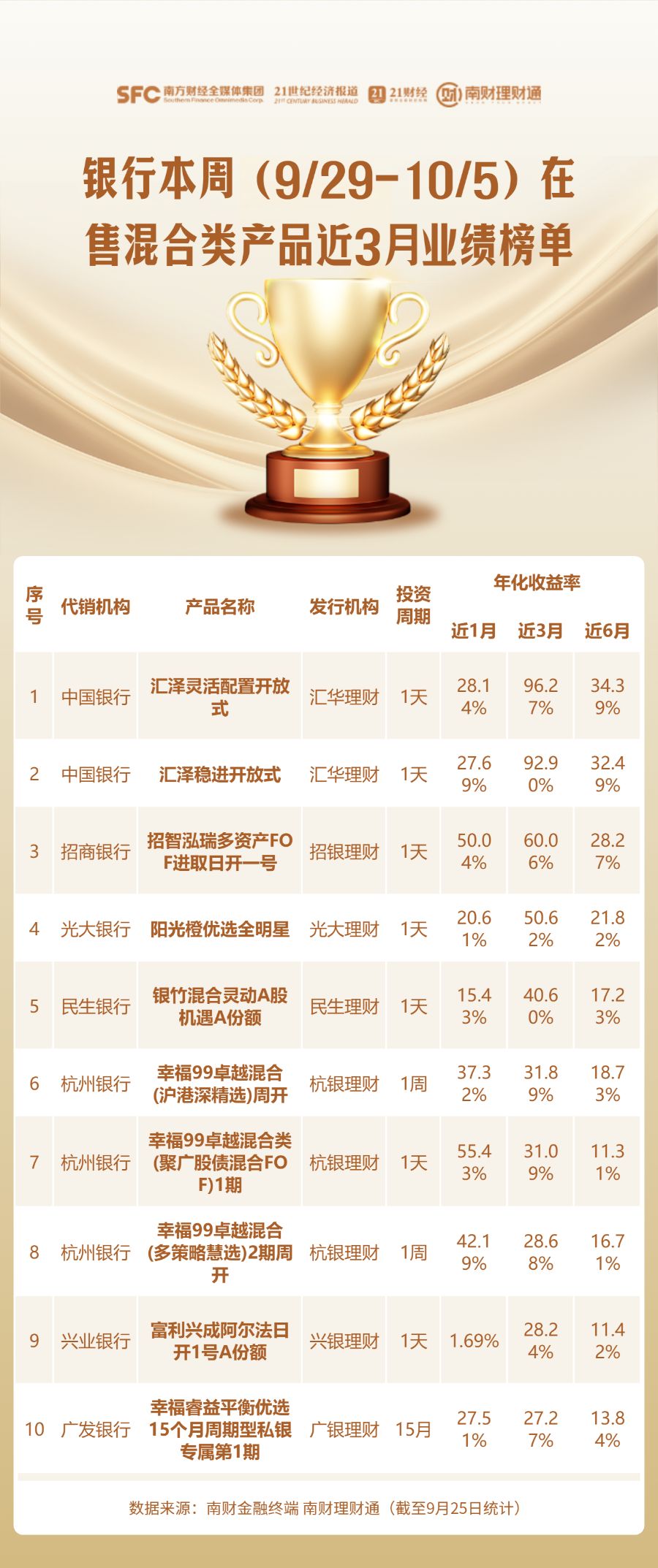
银行渠道本周在售混合类理财产品榜单(9/29-10/5)
2 1 Shi Ji Jing Ji Bao Dao· 2025-09-29 01:16
Core Viewpoint - The article discusses the challenges investors face in selecting bank wealth management products due to the overwhelming variety of similar-sounding products, and it aims to provide a performance ranking of these products to assist investors in making informed choices [1]. Group 1: Product Selection Criteria - The ranking of wealth management products is based on two main criteria: product type, focusing on pure fixed income, "fixed income plus," and mixed products, and performance stability, requiring products to have been established for at least three months to ensure sufficient performance data [1]. - The sample selection includes RMB public wealth management products, and the ranking reflects annualized performance over the past month, three months, and six months, sorted by the three-month annualized yield [1]. Group 2: Performance Ranking - The article highlights a list of top-performing mixed products from various banks, including: - Bank of China: "Huiyang Flexible Allocation Open" with a three-month annualized yield of 34.3% [4]. - China Merchants Bank: "Zhaozhi Team Rui Duo Asset FO" with a three-month annualized yield of 28.2% [4]. - Everbright Bank: "Sunshine Orange Preferred All-Star" with a three-month annualized yield of 21.8% [4]. - The ranking includes a total of 10 products, showcasing their respective yields and performance metrics [4]. Group 3: Distribution Channels - The ranking is based on data from 28 distribution institutions, including major banks such as ICBC, Bank of China, and Agricultural Bank of China, among others [2]. - It is noted that the availability of products may vary due to factors like quota exhaustion or differences in product listings for different customers, thus investors are advised to refer to the actual displays on the banks' apps [2].


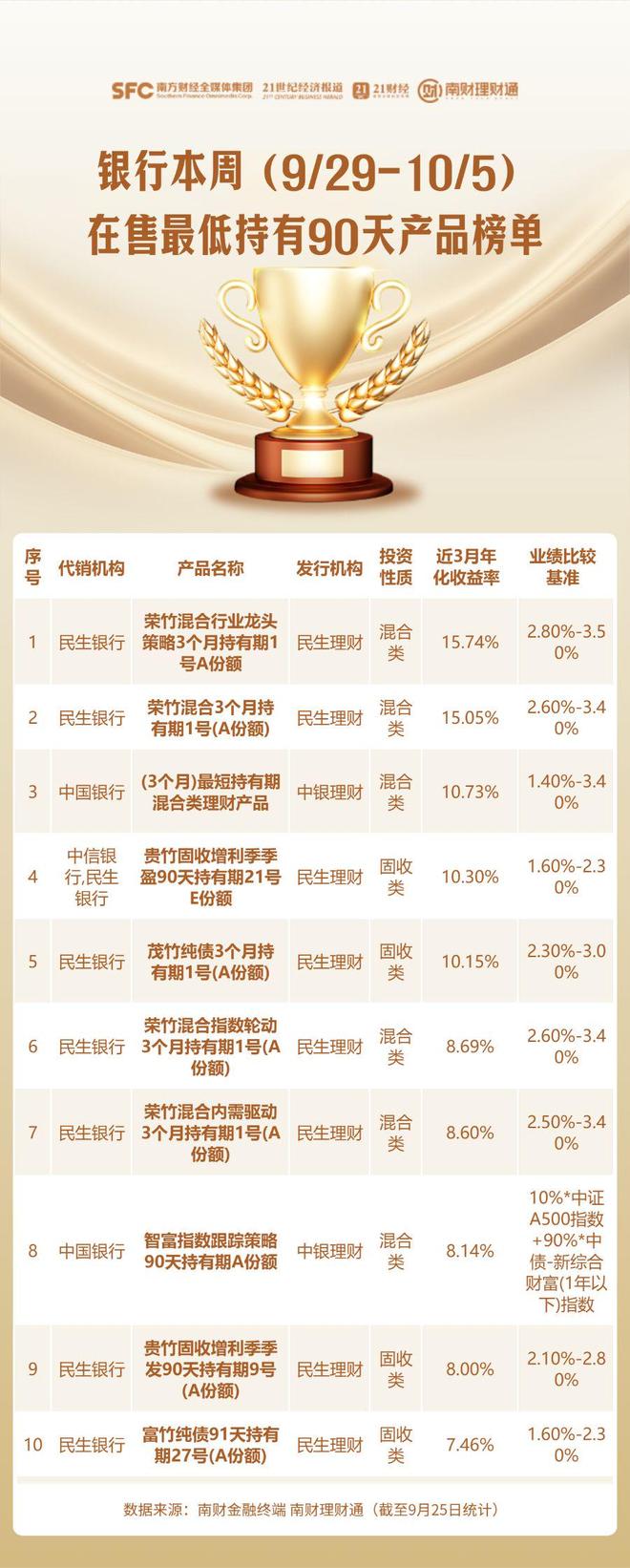
银行渠道本周在售最低持有期理财产品榜单(9/29-10/5)
2 1 Shi Ji Jing Ji Bao Dao· 2025-09-29 01:08
Core Insights - The article focuses on the performance of bank wealth management products with varying minimum holding periods, specifically highlighting the annualized returns of products with holding periods of 90 days, 180 days, and 365 days [1][5][8] Group 1: 90-Day Holding Period Products - The top-performing product is from Minsheng Bank, with an annualized return of 15.74% [4] - Other notable products include Minsheng Bank's Rongzhu Mixed Fund at 15.05% and Bank of China’s mixed product at 10.73% [4] Group 2: 180-Day Holding Period Products - Minsheng Bank's Kyoto is a unique product with a return of 9.19%, leading the 180-day category [6] - Other significant products include Minsheng Bank's Rongmen Mixed Anti-Inflation Fund at 9.04% and Bank of China's mixed product at 7.43% [6][7] Group 3: 365-Day Holding Period Products - The top product in this category is Minsheng Bank's Jinzhuhua FOF with an impressive return of 45.26% [9] - Other notable products include Bank of China's mixed product at 9.50% and another mixed product at 9.41% [9]

上市银行“十四五回望”之资负结构与息差变迁
CMS· 2025-09-28 15:09
Investment Rating - The report maintains a recommendation for the banking industry [3] Core Insights - The report provides a comprehensive analysis of the asset-liability structure and interest margin changes of 42 A-share listed banks during the "14th Five-Year Plan" period, highlighting a shift towards corporate loans on the asset side and a stronger retail focus on the liability side [12][14] - The asset-liability structure indicates a significant increase in the proportion of corporate loans, rising from 57.02% to 63.22% from the end of 2020 to mid-2025, while the proportion of demand deposits decreased from 41.94% to 30% [12][14] - The report notes a decline in both asset yield and interest margin, with the yield on interest-earning assets dropping from 4.43% to 3.32% and the net interest margin decreasing from 2.23% to 1.53% during the same period [14][15] Summary by Sections Overall Asset-Liability Structure and Interest Margin Changes - The asset-liability structure shows an increase in loan-to-earning asset ratio from 54.19% to 56.49%, with corporate loans making up a larger share of total loans [14][15] - The average yield on interest-earning assets decreased significantly, with the loan yield falling from 5.34% to 3.82% [15] - The net interest margin for listed banks remains higher than that of commercial banks, despite a decline [14][15] Changes in Each Banking Sector's Asset-Liability Structure and Interest Margin - City commercial banks experienced a more significant increase in the proportion of corporate loans, with their interest margin narrowing less compared to other banks [18] - The report highlights that the proportion of deposits in interest-bearing liabilities for state-owned banks decreased, while it increased for rural commercial banks [18] - The decline in interest-bearing liabilities' cost rate was most pronounced in city commercial banks, leading to a smaller reduction in their interest margin [18]





红利专题:红利底色,以稳待胜 - 银行Q4投资展望
2025-09-28 14:57
Q&A 银行板块近期承压主要由于市场风险偏好提升,科技成长板块吸引资金, 以及公募和保险资金流出,银政宝等交易因素也构成压制。 四季度保险资金新增保费将推动配置银行等红利资产,银行分红现金流 对险资具吸引力。大股东和产业资本持续增持城商行,反映对未来盈利 的乐观预期。 三季度银行贷款需求偏弱,贷款增速放缓。息差方面,预计 2026 年长 期限存款到期将改善负债端,LPR 降幅收窄减轻资产端重定价压力,息 差降幅有望收窄,城商行息差压力或小于大行。 债券市场调整可能给银行非息收入带来压力,银行或需兑现存量浮盈以 稳定增长。中报显示银行兑现非息收入意愿较强,预计三季度不会出现 大幅滑坡。 预计 2025 年银行业绩总体平稳,大行利润增速有望回正,城商行维持 较快增速。2026 年更多城商行息差有望趋稳或小幅回升,支撑经营基 本面。 红利专题:红利底色,以稳待胜 - 银行 Q4 投资展望 20250928 摘要 四季度银行板块可能会迎来一些催化因素。首先是保险资金,每年年底保险公 司有新增保费进来,为明年的资产布局提前做准备,这将推动险资配置红利资 产,其中银行是核心资产。此外,四季度银行板块分红现金流对险资有吸引 ...