
江淮汽车

Search documents
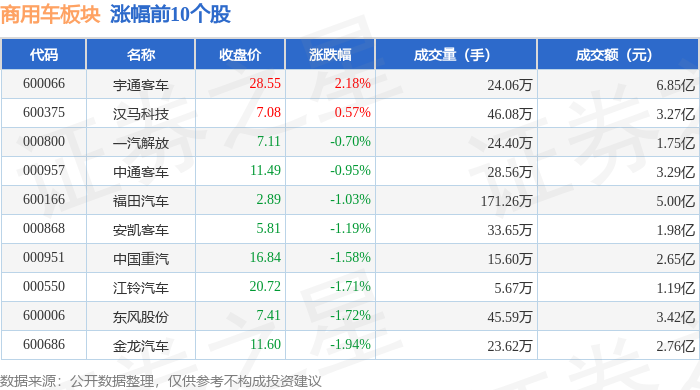
商用车板块9月18日跌1.84%,江淮汽车领跌,主力资金净流出13.77亿元
Zheng Xing Xing Ye Ri Bao· 2025-09-18 08:52
Market Overview - The commercial vehicle sector experienced a decline of 1.84% on September 18, with Jianghuai Automobile leading the drop [1] - The Shanghai Composite Index closed at 3831.66, down 1.15%, while the Shenzhen Component Index closed at 13075.66, down 1.06% [1] Stock Performance - Yutong Bus (600066) saw an increase of 2.18% with a closing price of 28.55 and a trading volume of 240,600 shares, amounting to 685 million yuan [1] - Jianghuai Automobile (600418) led the decline with a drop of 4.43%, closing at 55.20 with a trading volume of 1,173,600 shares, totaling 658.4 million yuan [3] - Other notable declines include China National Heavy Duty Truck (000951) down 1.58% and Dongfeng Motor (600006) down 1.72% [1][3] Fund Flow Analysis - The commercial vehicle sector saw a net outflow of 1.377 billion yuan from institutional investors, while retail investors contributed a net inflow of 796 million yuan [4] - Yutong Bus had a net inflow of 117 million yuan from institutional investors, while China National Heavy Duty Truck experienced a net outflow of 23.28 million yuan [4] Summary of Key Stocks - Yutong Bus: Closing price 28.55, trading volume 240,600, net inflow from institutions 117 million yuan [1][4] - Jianghuai Automobile: Closing price 55.20, trading volume 1,173,600, net outflow from institutions 314.93 million yuan [3][4] - China National Heavy Duty Truck: Closing price 16.84, trading volume 156,000, net outflow from institutions 4.98 million yuan [4]


东兴证券:8月车市销量持续增长 插混车型成出口增长主力
Zhi Tong Cai Jing· 2025-09-18 07:45
Core Insights - The domestic automotive market showed strong performance in August, with significant growth in pure electric vehicle (EV) sales, while the growth of plug-in hybrid (PHEV) and range-extended vehicles slowed down due to subsidy policies favoring smaller pure EVs [1][3] - The export of new energy vehicles (NEVs) performed robustly, with PHEV exports growing faster than domestic sales, driven by better economic and intelligent features compared to traditional fuel vehicles [1][4] Domestic Market Performance - In August, domestic vehicle sales reached 2.245 million units, a month-on-month increase of 11.3% and a year-on-year increase of 15.6% [3] - Sales of Chinese brand passenger vehicles were 1.766 million units, showing a year-on-year growth of 21% [3] - NEV sales in August totaled 1.171 million units, a year-on-year increase of 18.3%, accounting for 52.1% of total domestic vehicle sales [3] - For the first eight months, domestic vehicle sales reached 16.836 million units, a year-on-year increase of 12.3% [3] Export Market Performance - In August, total vehicle exports were 611,000 units, with a month-on-month increase of 6.2% and a year-on-year increase of 19.6% [4] - NEV exports reached 224,000 units, a year-on-year increase of 100% [4] - Among NEVs, pure electric vehicle exports were 143,000 units, showing a year-on-year growth of 63.4% [4] - For the first eight months, total vehicle exports were 4.292 million units, a year-on-year increase of 13.7% [4] Investment Strategy - The domestic automotive market is characterized by accelerated electrification and the strong rise of independent brands, with intelligent features being a key driver of sales growth [5] - The focus of competition is shifting towards the intelligent sector, with leading companies in data, training facilities, and intelligent driving ecosystems expected to capture more market share [5] - Companies like Huawei are leveraging their ICT expertise to enhance their competitiveness in the automotive sector, particularly in intelligent vehicle development [6] Beneficiary Companies - Companies benefiting from deep cooperation with Huawei include Seres, JAC Motors, BAIC Blue Valley, SAIC Motor, and Changan Automobile [6] - Component suppliers with competitive advantages in cost, research, and market presence are also highlighted, including Chuanhuan Technology, Ningbo Gaofa, Kehua Holdings, New Coordinates, and Zhongyuan Neipei [6]

江淮汽车下半年开局产销双下滑,项兴初上任后仍在持续亏损
Nan Fang Du Shi Bao· 2025-09-18 07:27
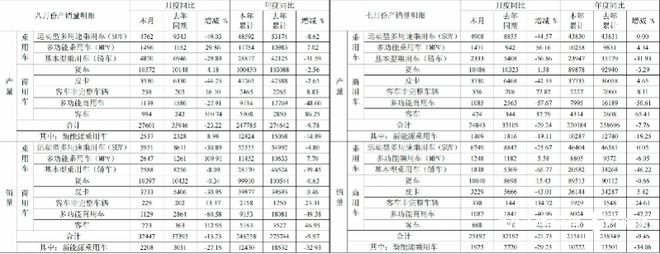
Core Viewpoint - Jianghuai Automobile (600418.SH) has reported a decline in both production and sales for August, continuing a poor performance into the second half of the year, with significant drops in both passenger and commercial vehicle segments [1][2][3] Production and Sales Performance - In August, the production of SUVs decreased by 49.03% year-on-year, while sales fell by 30.89%. The production of sedans dropped by 29.89%, with sales down by 8.09%. For commercial vehicles, pickup production fell by 44.23% and sales by 30.95%, while multi-functional commercial vehicle production decreased by 27.91% and sales plummeted by 60.58% [2] - In July, the production of SUVs decreased by 44.57% year-on-year, with sales down by 23.67%. Sedan production fell by 56.86%, and sales dropped by 65.77%. For commercial vehicles, pickup production decreased by 42.33% and sales by 43.01%, while multi-functional commercial vehicle production fell by 57.67% and sales by 40.96% [2] - Total production for July was 24,843 units, down 29.24% year-on-year, while total sales were 25,197 units, down 21.73%. In August, total production was 27,601 units, down 23.22%, and total sales were 32,447 units, down 13.23% [2] Financial Performance - For the first half of the year, Jianghuai Automobile reported a revenue of 19.36 billion yuan, a decline of 9.1% from 21.30 billion yuan in the same period last year. The net profit attributable to shareholders was -772.81 million yuan, a drop of 356.89% compared to a profit of 300.83 million yuan in the previous year [8][9] - The company’s cash flow from operating activities also saw a significant decline, dropping by 5,292.95% to -3.15 billion yuan from 61 million yuan in the same period last year [11] - The cumulative total sales for the year until August have decreased by 9.97% compared to the previous year [3] Challenges and Strategic Moves - Jianghuai Automobile's luxury vehicle project, "Zun Jie," launched the S800 model priced between 708,000 and 1,018,000 yuan, but the contribution to overall performance remains uncertain due to intense competition in the luxury car market [5][8] - The company has faced continuous losses, with cumulative losses exceeding 10 billion yuan in recent years, and the net profit has been negative since 2017 [8][12][13] - The management transition has not yet reversed the declining trend in performance, with the company struggling to regain its competitive edge in the rapidly evolving automotive market [12][13]
崔东树:1-8月商用车国内销量同比增长8% 政策推动下表现相对较强
Zhi Tong Cai Jing· 2025-09-18 07:00
Core Insights - The domestic commercial vehicle market is experiencing a strong growth trend, particularly in the new energy vehicle (NEV) segment, driven by policy support and increasing demand for vehicle upgrades [1][2][10] - In August, domestic commercial vehicle sales reached 246,000 units, a year-on-year increase of 14%, while the cumulative sales from January to August 2025 reached 2.01 million units, up 8% compared to the previous year [7][10] - The penetration rate of new energy commercial vehicles is expected to reach 30% by August 2025, significantly higher than the 23% recorded in the same month of the previous year [13][15] Commercial Vehicle Market Analysis - The commercial vehicle market is showing a recovery after a period of decline, with 2025 projected to see a total of 2.85 million units sold, nearly flat compared to 2024 [6][10] - The sales of new energy commercial vehicles are projected to reach 579,000 units in 2024, representing an 84% year-on-year increase [11][12] - The market is characterized by a strong performance in the truck segment, particularly in heavy and light trucks, while the bus segment is also seeing growth due to electrification [15][19] New Energy Vehicle Insights - The penetration rate of new energy commercial vehicles has increased from approximately 3% in 2019-2021 to 25% in the first eight months of 2025 [2][13] - The sales of new energy commercial vehicles from January to August 2025 reached 500,000 units, marking a 55% year-on-year increase [11][12] - The demand for new energy vehicles is particularly strong in the truck and bus segments, with truck penetration at 23% and bus penetration at 63% as of August 2025 [15][19] Competitive Landscape - Major players in the commercial vehicle market include Beiqi Foton, SAIC-GM-Wuling, and Dongfeng Motor, with Beiqi Foton leading in light truck sales [16][19] - The market is witnessing a shift towards new energy vehicles, with companies like Geely and Chery making significant strides in the light truck segment [22][24] - The competitive structure is evolving, with traditional fuel vehicles requiring effective policy support to maintain market share amidst the growing dominance of new energy vehicles [2][15]




8月新能源轻卡销近1.8万辆史上最高!TOP4超2000辆,奇瑞暴涨104倍排第几?| 头条
第一商用车网· 2025-09-18 06:48
Core Viewpoint - The domestic new energy light truck market has shown remarkable growth, achieving a record monthly sales of 17,700 units in August 2025, marking a 91% year-on-year increase and extending a continuous growth streak to 20 months [4][6][33]. Sales Performance - From March 2025, new energy light truck sales have consistently exceeded 10,000 units monthly, with June recording the highest single-month sales of 16,600 units [1][2]. - In August 2025, the total sales of new energy light trucks reached 17,700 units, representing a 21% month-on-month increase and a 91% year-on-year increase [4][6]. - The overall light truck market sold 56,600 units in August, with new energy light trucks accounting for 31.27% of the total, up from 27.00% the previous month [9]. Market Trends - The new energy light truck market has seen a cumulative sales figure of 105,300 units from January to August 2025, reflecting a 94% year-on-year growth [26][31]. - The penetration rate of new energy light trucks in the overall light truck market reached 23.11% in the first eight months of 2025, significantly higher than the 17.73% recorded for the entire year of 2024 [9]. Regional Insights - All 31 provincial-level administrative regions in China have seen new energy light truck registrations, with Guangdong leading with over 35,300 units, accounting for 33.48% of the national total [12][14]. - The top cities for new energy light truck registrations include Shenzhen, Guangzhou, Zhengzhou, and Chengdu, among others [14]. Company Performance - The leading companies in the new energy light truck market for August 2025 include: - Yuan Cheng with 3,252 units sold (18.36% market share) - Foton with 2,908 units (16.41% market share) - SAIC Yuejin with 2,779 units (15.69% market share) - Jianghuai with 2,177 units (12.29% market share) [3][23]. - Notably, Chery Commercial Vehicles achieved a staggering 10,400% year-on-year growth in sales [3]. Fuel Type Analysis - Pure electric vehicles remain the dominant technology in the new energy light truck market, accounting for 92.31% of sales from January to August 2025, an increase from the previous year [17]. - In contrast, fuel cell light trucks have seen a decline in sales, with only 664 units sold, a 46% decrease year-on-year [20]. Conclusion - The new energy light truck market has demonstrated strong growth, with significant increases in both sales and market penetration. The trend is expected to continue, raising questions about the sustainability of this growth and the potential for future sales targets [33].



江淮、蔚来合资公司正式注销!
鑫椤锂电· 2025-09-18 03:50
Core Viewpoint - Jianglai Advanced Manufacturing Technology (Anhui) Co., Ltd. has changed its registration status from active to cancellation, indicating a significant shift in its operational status and future prospects [1][3]. Company Overview - Jianglai Advanced Manufacturing Technology (Anhui) Co., Ltd. was established in March 2021 with a registered capital of 510 million RMB. The company was co-owned by NIO Inc. and Anhui Jianghuai Automobile Group Co., Ltd. [2]. Cancellation Announcement - The company announced its cancellation in June 2023, with the reason being a resolution to dissolve. The announcement period was from June 10 to July 24 [3]. Historical Context - NIO's partnership with Jianghuai dates back to 2016, where Jianghuai produced NIO's vehicles under a contract, requiring the vehicles to carry the "Jianghuai Automobile" branding. This partnership was crucial for NIO to achieve product mass production without having its own manufacturing qualifications [3]. Transition to Independent Manufacturing - By the end of 2023, NIO acquired production equipment and assets from Jianghuai, gaining independent manufacturing qualifications. This transition indicates that NIO will no longer rely on the contract manufacturing model [4]. Future Prospects - The dissolution of the joint venture is seen as a natural progression, as NIO has secured its manufacturing capabilities, while Jianghuai is pursuing a new luxury brand collaboration with Huawei, suggesting positive future trajectories for both companies [4].


8月轻客销3.5万辆增12%获“5连增”!长安居首 大通/江铃份额超20%拼前二 | 头条
第一商用车网· 2025-09-18 03:17
Core Viewpoint - The light commercial vehicle (LCV) market in China has shown a consistent growth trend, achieving a year-on-year increase of 12% in August 2025, with total sales reaching 44,700 units, marking the fifth consecutive month of growth for the LCV segment [3][22]. Market Performance - In August 2025, the LCV market sold 34,700 units, reflecting a month-on-month increase of 5% and a year-on-year increase of 12%, although the growth rate compared to the previous month has narrowed from 16% [3][5]. - The LCV segment accounted for 77.59% of the total bus market in August, a slight decrease from 79.23% in the previous month. The cumulative market share for LCVs from January to August 2025 reached 79.91%, up from 77.18% in the entire year of 2024 [3][5]. Historical Trends - An analysis of the LCV sales trends over the past five years indicates a fluctuating pattern of increase and decrease, with August 2025 achieving the highest sales volume in five years, although the increase compared to previous years is modest [5][22]. - The cumulative sales from January to August 2025 reached 280,800 units, the highest in five years, representing an increase of over 18,000 units compared to the same period last year [5][16]. Company Performance - In August 2025, the top three companies in the LCV market were Changan, SAIC Maxus, and Jiangling, each capturing over 20% of the market share, with respective shares of 28.04%, 21.50%, and 21.31% [12][14]. - Among the top ten companies, five experienced sales growth while five saw declines. Notably, Changan, SAIC Maxus, Jiangling, Xiamen Golden Dragon, and Yutong reported year-on-year sales increases of 52%, 26%, 9%, 217%, and 23%, respectively [12][14]. Cumulative Sales and Market Share - From January to August 2025, the cumulative sales of the top ten LCV manufacturers showed six companies with sales exceeding 10,000 units, with Changan, Jiangling, and SAIC Maxus leading the market shares at 28.66%, 21.64%, and 20.63%, respectively [20][18]. - The market share of Changan, Jiangling, and SAIC Maxus has increased significantly compared to the previous year, with Changan's share rising by 4.12 percentage points [20][22]. Future Outlook - The LCV market has experienced a consistent growth trend since April 2025, with a cumulative year-on-year increase of 7% as of August, raising questions about the sustainability of this growth momentum moving forward [22].




从“单点创新”到“聚合发展” 首届聚合智能产业发展大会召开
Zhong Guo Qi Che Bao Wang· 2025-09-18 02:20
Core Insights - The integration of the automotive, intelligent robotics, and low-altitude flying industries is becoming a consensus, driven by shared technologies and applications [1][4][9] Group 1: Industry Collaboration - The first Aggregated Intelligent Industry Development Conference was held in Wuhan, focusing on collaborative innovation among the three industries [3] - The establishment of the Aggregated Intelligent Industry Committee and the Aggregated Intelligent Industry Innovation Center marks a significant step towards fostering collaboration [3] Group 2: Technological Synergy - All three industries share a common foundation in AI technology, leading to a convergence of technical and application aspects [4][5] - The electric aviation sector is leveraging electric vehicle technology, indicating a strong technical link between the two [4] - Intelligent robotics is drawing on AI algorithms and cloud infrastructure similar to those used in smart vehicles, showcasing a parallel development trajectory [4] Group 3: Cost Reduction and Supply Chain Efficiency - The interconnectedness of the three industries can significantly lower development costs by reusing components across different applications [5] - Approximately 90% of the supply chain for robotics is derived from the automotive sector, highlighting the potential for cost efficiency [5] Group 4: Differentiated Development Needs - Despite the potential for integration, the three industries exhibit distinct development stages and requirements, necessitating a tailored approach to their growth [6][7] - Variations in battery and motor requirements across the industries indicate the need for specialized solutions despite shared supply chains [7] Group 5: Strategic Development Initiatives - The focus on manufacturing capabilities within the automotive supply chain can enhance competitiveness in robotics and low-altitude flying [9] - Companies are encouraged to explore international markets, leveraging the advantages of the aggregated "three major components" [9] - A shift from single-industry thinking to a more integrated approach is essential for maximizing resource utilization and minimizing waste [9][10] Group 6: Talent Development and Education - The need for interdisciplinary education and talent cultivation is emphasized to support the evolving demands of the integrated industries [10] - Initiatives to create a comprehensive talent development ecosystem, including K12 to higher education, are being proposed [10]

国内市场销量持续增长,插混车型成出口增长主力 | 投研报告
Zhong Guo Neng Yuan Wang· 2025-09-18 01:55
Core Insights - The automotive industry in China shows strong growth in both production and sales, with significant increases in electric vehicle (EV) sales, indicating a robust market trend towards electrification [1][2][3]. Production and Sales Data - In August 2025, total automotive production and sales reached 2.815 million and 2.857 million units, respectively, with month-on-month increases of 8.7% and 10.1%, and year-on-year increases of 13% and 16.4% [1][2]. - For the first eight months of 2025, total automotive production and sales were 21.051 million and 21.128 million units, reflecting year-on-year growth of 12.7% and 12.6% [1][2]. - New energy vehicles (NEVs) saw production and sales of 1.391 million and 1.395 million units in August, with year-on-year growth of 27.4% and 26.8% [1][2]. Domestic Market Performance - Domestic automotive sales in August reached 2.245 million units, with a month-on-month increase of 11.3% and a year-on-year increase of 15.6% [3]. - Chinese brand passenger car sales were 1.766 million units, showing a year-on-year increase of 21% [3]. - NEV sales in the domestic market were 1.171 million units, with a year-on-year growth of 18.3%, accounting for 52.1% of total domestic automotive sales [3]. Export Performance - In August, automotive exports totaled 611,000 units, with a month-on-month increase of 6.2% and a year-on-year increase of 19.6% [4][5]. - NEV exports reached 224,000 units, reflecting a year-on-year increase of 100% [4]. - Among NEVs, pure electric vehicle exports were 143,000 units, showing a year-on-year growth of 63.4% [4][5]. Investment Strategy - The domestic automotive market is characterized by accelerated electrification and the strong rise of domestic brands, driven by policy support and technological innovation [5]. - The focus of competition in the automotive industry is shifting towards intelligent technology, with leading companies in data and technology expected to capture more market share [5]. - Companies with strong partnerships in the intelligent automotive sector, such as those collaborating with Huawei, are identified as potential beneficiaries [6].
特斯拉机器人催化不断,带动汽车板块估值重塑 | 投研报告
Zhong Guo Neng Yuan Wang· 2025-09-18 01:04
Core Insights - In August 2025, the automotive production and sales reached 2.815 million and 2.857 million units respectively, with month-on-month growth of 8.7% and 10.1%, and year-on-year growth of 13% and 16.4% [2][3] - For the week of September 1-7, 2025, retail sales of passenger cars were 304,000 units, a year-on-year decrease of 10% and a month-on-month decrease of 4%, while wholesale sales were 307,000 units, a year-on-year decrease of 5% but a month-on-month increase of 9% [2][3] Weekly Market Performance - During the week of September 8-12, 2025, the CS automotive index rose by 0.21%, while the CS passenger vehicle index fell by 0.37%, and the CS commercial vehicle index decreased by 1.06% [2] - The CS automotive parts index increased by 0.72%, and the CS automotive sales and service index rose by 4.23%, while the electric vehicle index fell by 0.08% and the smart vehicle index increased by 1.36% [2] - The Shanghai Composite Index rose by 1.66% and the CSI 300 Index increased by 1.93%, indicating that the CS automotive index underperformed these indices by 1.72 percentage points and 1.45 percentage points respectively, with a year-to-date increase of 23.76% [2] Cost Tracking and Inventory - As of September 10, 2025, the prices of float glass, aluminum ingots, and zinc ingots changed year-on-year by -9.4%, +7.1%, and -5.2% respectively, and month-on-month by -6%, +0.5%, and -1.1% [3] - The inventory warning index for automotive dealers in August was 57.0%, showing a year-on-year increase of 0.8 percentage points and a month-on-month decrease of 0.2 percentage points [3] Market Focus - Key developments include partnerships in autonomous driving, such as Horizon Robotics collaborating with Hello to accelerate Robotaxi deployment, and the launch of new models like the all-new Wanjie M7, which saw over 100,000 pre-orders within an hour [3] - The Ministry of Industry and Information Technology and other departments issued a joint plan for stabilizing growth in the automotive industry for 2025-2026 [3] Investment Recommendations - In the medium to long term, the focus is on opportunities in incremental components driven by the rise of domestic brands and electric intelligence [4] - Recommended companies include Leap Motor, JAC Motors, and Geely for strong new product cycles, and companies like Kobot, Huayang Group, and Junsheng Electronics for smart technology [4]





