OPPO

Search documents
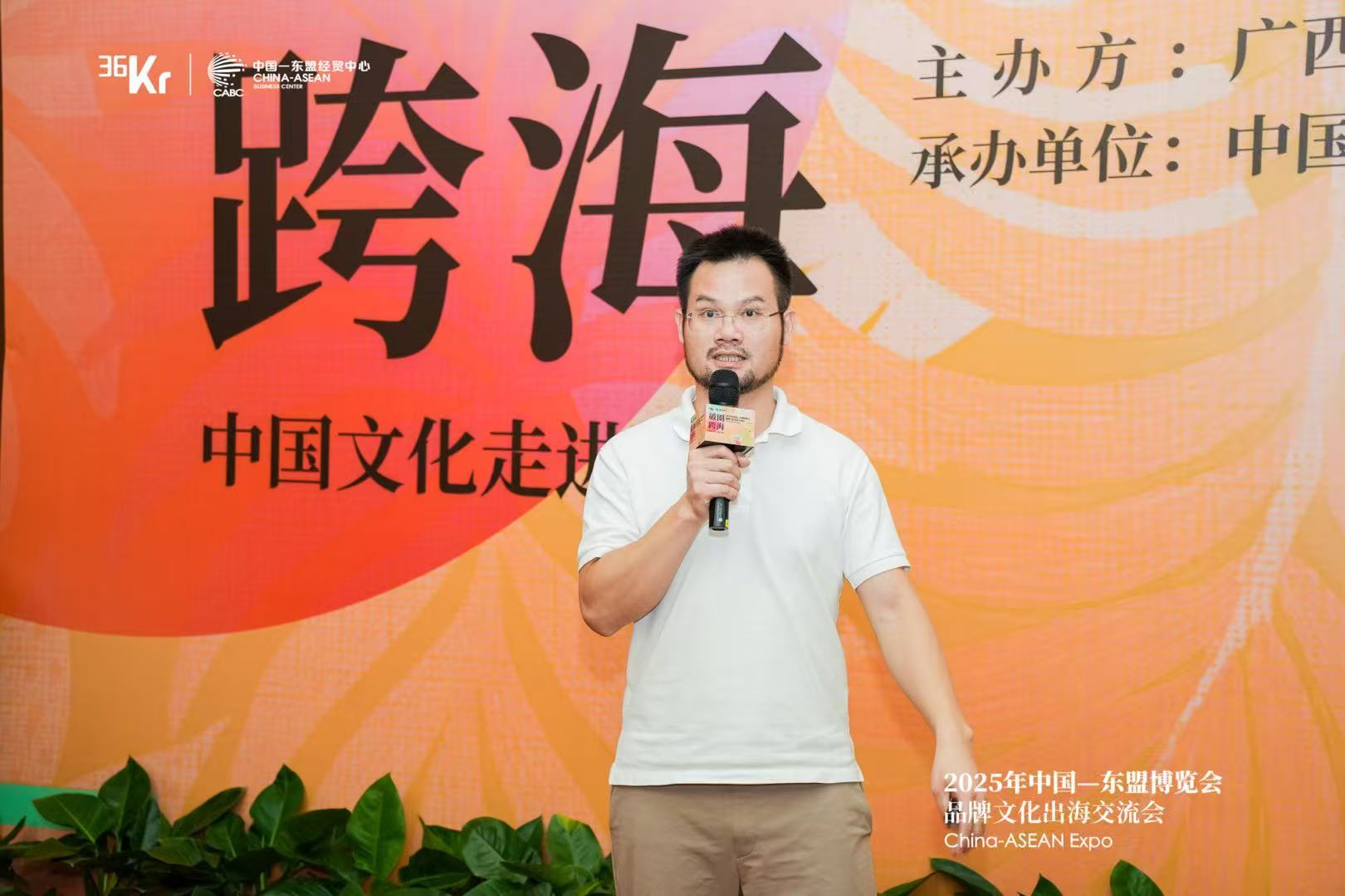
杭州微念新供给事业部总经理杨叶护:中国地方美食产业全球化的新密码| 2025中国—东盟博览会品牌文化出海交流会
3 6 Ke· 2025-09-25 06:50
Core Insights - The narrative of Chinese enterprises' globalization has evolved from merely exporting products to offering culturally rich experiences and identities [1][9] - The recent event hosted by 36Kr focused on the theme of cultural export, gathering representatives from various sectors to discuss new paths, challenges, and opportunities for Chinese culture in the global market [1] Group 1: Globalization Trends - Chinese companies are increasingly seeking to expand into emerging markets like Southeast Asia and the Middle East to find a "second growth curve" amid domestic market saturation [3][4] - The food export from China to Southeast Asia is significant, with an estimated value of approximately 20 billion RMB in 2023, while the Southeast Asian restaurant market is projected to grow from 190 billion USD to 349 billion USD by 2029 [5] Group 2: Key Success Factors - Successful internationalization requires companies to "go out" and address localization challenges to thrive in foreign markets [4] - A pyramid model outlines the key elements for globalization: strategic reasons for expansion, differentiated operational models, and three supporting systems: global processes, adaptable organizational structures, and capable teams [5][6] Group 3: Case Studies and Models - Notable brands like Haidilao and Bawang Tea have successfully expanded overseas, with Haidilao establishing Singapore as its second-largest market after the U.S. [6] - The rapid growth of brands like Pop Mart and TCL in international markets is attributed to strategic location choices and sponsorship of major events [6][7] Group 4: Cultural and Market Adaptation - The ASEAN region serves as a crucial launchpad for Chinese companies due to cultural similarities and the rise of digital platforms like TikTok, which facilitate cultural influence [7] - The standardization of local delicacies, such as Liuzhou snail noodles, is essential for successful globalization, supported by government initiatives to enhance the industry [8]

高通推出第五代骁龙8至尊版移动平台 小米、vivo等手机品牌将搭载
Zheng Quan Shi Bao Wang· 2025-09-25 06:38
Core Insights - Qualcomm has launched the world's fastest mobile SoC, the fifth-generation Snapdragon 8 Gen 2 mobile platform, enhancing user experience with improved multitasking, application switching, and gaming performance [1] - The platform features advanced AI capabilities, enabling personalized AI assistants that can understand user behavior and provide contextual recommendations while ensuring data privacy [1] - The Snapdragon 8 Gen 2 is the first mobile platform to support advanced professional video codec recording, empowering creators with professional-grade video production capabilities [1] Snapdragon 8 Gen 2 Features - The third-generation Qualcomm Oryon CPU shows a 20% performance increase, making it the fastest in its class [1] - The new Adreno GPU architecture enhances graphics performance by 23%, improving experiences in graphically intensive games [1] - The Hexagon NPU's performance has increased by 37%, contributing to overall efficiency and processing power [1] OEM Partnerships - Major global OEMs and smartphone brands, including ZTE, Xiaomi, Vivo, Sony, Samsung, and others, will incorporate the Snapdragon 8 Gen 2 in their flagship products, which are set to be released in the coming days [2] Snapdragon X Series Launch - Qualcomm introduced the Snapdragon X2 Elite Extreme and Snapdragon X2 Elite, the fastest and most efficient Windows PC processors available [2] - The Snapdragon X2 Elite Extreme is designed for high-end PCs, capable of handling AI experiences, data analysis, and professional media editing [3] Performance Metrics of Snapdragon X2 Elite Extreme - The Snapdragon X2 Elite Extreme outperforms competitors by up to 75% in CPU performance at the same power consumption [3] - The new Adreno GPU architecture offers a 2.3 times improvement in performance per watt compared to previous generations [3] - The Hexagon NPU supports 80 TOPS AI processing capability, enabling concurrent AI experiences on Windows 11 AI+ PCs [3] Snapdragon X2 Elite Features - The Snapdragon X2 Elite provides strong multitasking capabilities for resource-intensive workloads, with a performance increase of up to 31% at the same power consumption compared to previous platforms [3] - It also reduces the power required for equivalent performance by 43%, allowing users to leverage its features even without a power connection [3] - Devices featuring the Snapdragon X2 Elite are expected to launch in the first half of 2026 [3]

ColorOS 16系统相册上新AI人像补光功能 官方称“出门自带反光板”
Feng Huang Wang· 2025-09-25 06:06
Core Points - OPPO and OnePlus announced the new AI portrait enhancement feature in the Color OS 16 system, claiming it can "bring a reflector on the go" and "one-click fix for bad photos" [1] - The OPPO Find X9 series will be launched on October 16, featuring the Dimensity 9500 flagship chip and the new generation Tide Engine, along with the ColorOS 16 system [1] - The new device will utilize a small matrix camera DECO and will be available in four color options: Velvet Titanium, Glossy Titanium, Frost White, and Mist Black [1] - The Velvet Titanium variant will feature a new velvet process, with a nearly bezel-less perfect flat screen and a metal right-angle edge design, enhancing the overall quality [1]
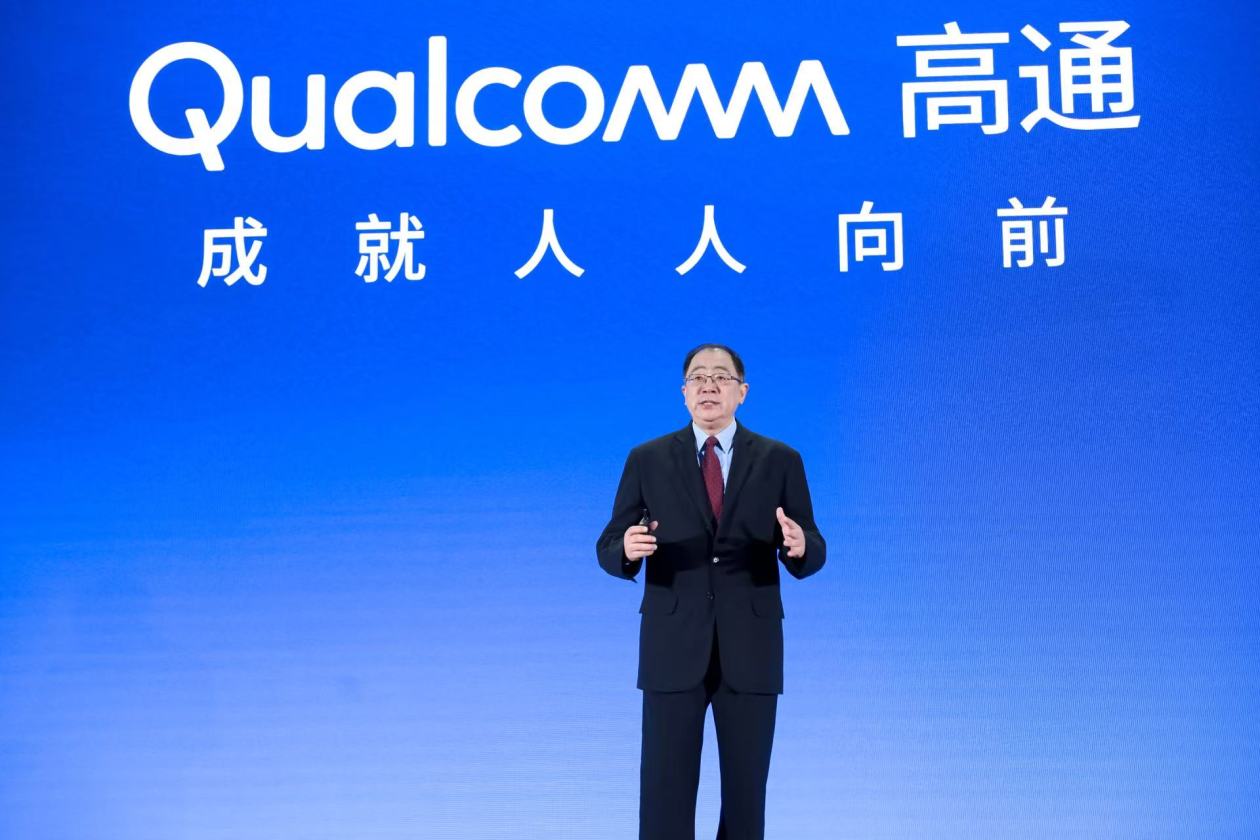
高通孟樸:携手三十年,以AI加速开启智能未来新篇章
Huan Qiu Wang· 2025-09-25 05:18
Core Insights - Qualcomm's 2025 Snapdragon Summit in China marks its 40th anniversary and 30 years of partnership with the Chinese industry, emphasizing the deep connection and collaboration established over the years [1][2] - The launch of the "AI Acceleration Plan" during the summit aims to drive the future of AI and connectivity, showcasing Qualcomm's strategic response to industry transformations [7][8] Group 1: Historical Context and Achievements - Qualcomm began its journey in China during a pivotal time for the telecommunications industry, establishing a CDMA center in Beijing in 2001, which became a significant milestone in its local engagement [2] - The company has played a crucial role in the evolution of mobile communication technologies in China, from 3G to 5G, supporting local brands to achieve global recognition [2][4] Group 2: Product and Brand Development - The introduction of the "Snapdragon" brand in 2012 and the new "Qualcomm Leap Dragon" brand in 2025 reflects the evolution of Qualcomm's product offerings, catering to both consumer and industrial applications [3] - Qualcomm's product matrix now spans from smartphones to industrial IoT, demonstrating its adaptability to market demands and commitment to digital transformation [3][4] Group 3: Ecosystem and Industry Collaboration - Qualcomm has expanded its ecosystem from smartphones to various sectors, including automotive and IoT, with significant contributions to over 210 vehicle models in the smart automotive space [4] - The "5G IoT Innovation Plan" initiated in 2020 has fostered collaboration with over 70 partners, resulting in more than 150 industry application cases across multiple sectors [4] Group 4: Social Responsibility and Community Impact - Qualcomm's initiatives in education and healthcare, such as the STEM education program benefiting over 300,000 students, highlight its commitment to social responsibility [5] - The "Wireless Care" program has reached over 1.5 million people, showcasing the company's dedication to leveraging technology for equitable resource distribution [5] Group 5: Future Directions and Strategic Initiatives - The "AI Acceleration Plan" focuses on enhancing AI capabilities across various devices, aiming to create a seamless intelligent ecosystem [7] - Qualcomm's strategic vision aligns with industry trends, emphasizing a shift from smartphone-centric to AI-centric experiences, indicating a proactive approach to future technological advancements [7][8]
借道“无障碍”,AI助手可能在盯着你
创业邦· 2025-09-25 04:27
Core Viewpoint - The article emphasizes that 2025 will be a pivotal year for AI Agents, highlighting the shift from traditional language models to more versatile AI Agents capable of performing complex tasks through simple natural language commands [4][6]. Group 1: AI Agent Development - The rise of AI Agents is driven by the increasing capabilities of mobile devices, with predictions indicating that by 2027, global AI mobile penetration will reach approximately 40%, with an expected shipment of 522 million units [9]. - Major tech companies, including Apple, are launching their own AI models, such as Apple Intelligence, while domestic manufacturers like Xiaomi and OPPO are also entering the market with their versions [9]. - The challenge lies in overcoming app isolation, as different applications typically prevent data sharing, necessitating either API agreements or the use of accessibility permissions to enable AI operations [11]. Group 2: Security and Privacy Concerns - The use of accessibility permissions raises significant privacy risks, as AI applications can potentially access sensitive information, including payment passwords and chat records [6][12]. - There are two main technical paths for AI Agent development: an interface model that requires cooperation between app developers and a non-interface visual solution that utilizes system-level permissions [11]. - The article notes that while the interface model is safer, it is also more complex and costly due to the need for adaptation across different devices [12]. Group 3: Market Potential and Growth - The AI Agent market is projected to grow from $5.1 billion in 2024 to $47.1 billion by 2030, with a compound annual growth rate of 44.8% [17]. - A survey indicated that over half of respondents have encountered data privacy and security issues, with 60.09% believing that AI could uncontrollably collect and process personal information [17]. Group 4: Regulatory and Industry Response - The article suggests that proactive measures are essential for managing AI risks, with companies needing to enhance their awareness of privacy issues [19]. - Recommendations include defining the minimum data required for specific functions and establishing data quality management standards to ensure data integrity and security [19][21]. - Regulatory bodies are encouraged to adopt agile governance strategies to address the rapid evolution of technology and its associated risks, ensuring a balance between user protection and innovation [21].

在国际顶尖标准下,中国制造如何做到全球头部?
Yang Shi Wang· 2025-09-25 03:37
Core Insights - A Chinese aluminum alloy technology company has successfully broken through the stringent manufacturing standards traditionally dominated by Japanese and German firms, showcasing a shift in China's manufacturing from "scale-oriented" to "standard-oriented" [1] Group 1: Manufacturing Standards - International giants set the highest manufacturing standards in the consumer electronics sector, requiring aluminum suppliers to meet strict environmental, precision, and efficiency criteria [2] - Environmental requirements include extremely low levels of heavy metals in wastewater and VOC emissions that exceed international standards [2] - Precision standards demand high consistency and reliability in strength, hardness, toughness, and anodizing effects [2] - Efficiency standards emphasize large-scale production while maintaining high environmental and precision standards, necessitating a complete restructuring of the manufacturing system [2] Group 2: Smart Manufacturing Systems - The company's breakthrough is attributed to strategic investments in smart manufacturing systems, deploying automated control systems and industrial internet platforms for data-driven management and real-time optimization [3] - AI algorithms are used to dynamically adjust current efficiency in key processes, significantly improving energy efficiency and reducing losses [3] - The overall operational efficiency has reached internationally advanced levels, showcasing the comprehensive benefits of smart manufacturing [3] Group 3: New Competitive Logic in Chinese Manufacturing - The company's practices reflect the transformation direction of Chinese manufacturing, focusing on increasing R&D investment with 721 patents, including 68 invention patents [4] - The company has contributed to national standards and has gained certification for automotive aluminum products from German automakers, entering the supply chains of brands like Porsche and BMW [4] - By standardizing processes, the company has achieved a transition from product output to technology output [4] Group 4: Redefining Chinese Manufacturing - In the context of global industrial upgrades, the definition of manufacturing is being restructured, with the company demonstrating new connotations of Chinese manufacturing [5] - Investments in over a billion yuan for solar power systems have resulted in a reduction of approximately 31,448.17 tons of carbon emissions annually [5] - The establishment of an industrial design center combines material science with aesthetic design, leading to the development of new alloy materials with a jade-like texture [5] - Companies like this are redefining China's role in the global value chain from "OEM assembly" to "standard-setting," proving that integrating smart manufacturing with process innovation is essential for gaining a voice in high-end manufacturing [5]

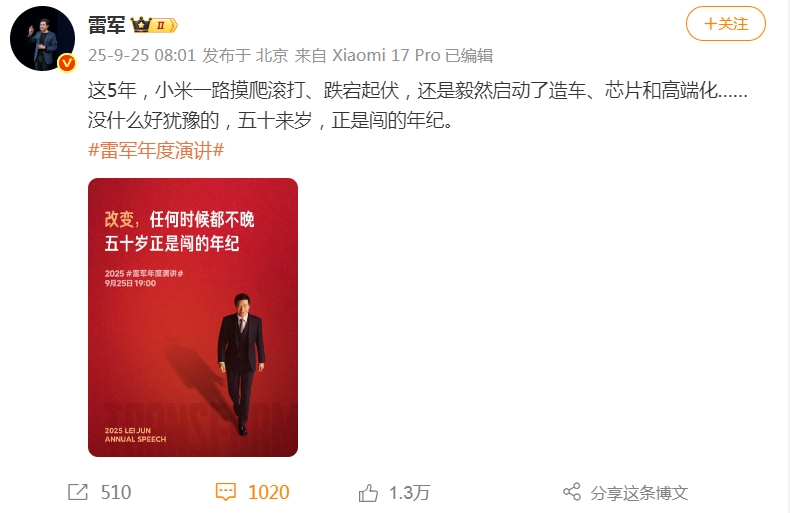
雷军“五十来岁正是闯的年纪”,出生于1969年,和余承东、陈明永同龄
Qi Lu Wan Bao· 2025-09-25 03:18
Group 1 - The core message of the news is that Xiaomi's founder, Lei Jun, reflects on the company's journey over the past five years, emphasizing the bold decisions to venture into car manufacturing and chip development, despite the challenges faced [1][4]. - Lei Jun's annual speech on September 25 will focus on the themes of change, revealing the stories behind Xiaomi's new chip and car initiatives [4]. - The decision to simultaneously pursue car manufacturing and chip development is described as a significant risk, with Lei Jun comparing it to the pressure of supporting two children in college, indicating the high stakes involved [4]. Group 2 - Lei Jun's annual speech was initially planned for June but was postponed to September to align with the launch of the Xiaomi 17 series flagship, which is expected to generate significant attention [4]. - The delay in the annual speech was seen positively by Lei Jun, as it allows for leveraging the publicity from the Xiaomi 17 series launch [4]. - The shared birth year of Lei Jun with other industry leaders like Huawei's Yu Chengdong and OPPO's Chen Mingyong highlights a generational shift in the tech industry [4].

高通新旗舰芯片亮相,雷军确认小米17首发:确实强
Guan Cha Zhe Wang· 2025-09-25 02:45
Core Viewpoint - Qualcomm has launched its new flagship mobile SoC, Snapdragon 8 Elite Gen5, claiming it to be the "world's fastest mobile SoC" [1] Group 1: Product Features - Snapdragon 8 Elite Gen5 features a third-generation Oryon core with a "2+6" CPU cluster architecture, where two super-large cores operate at 4.6GHz and six large cores at 3.62GHz [1] - The integrated Adreno 840 GPU utilizes a "sharded" architecture with dedicated cache for developers, reducing power consumption by up to 10% [1] - Compared to its predecessor, the third-generation Oryon CPU offers a 20% performance increase, while the Adreno GPU enhances graphics performance by 23% [1] Group 2: AI Capabilities - The Snapdragon 8 Elite Gen5 emphasizes personalized AI experiences, featuring a faster Hexagon NPU with a 37% performance improvement over the previous generation, achieving an AI inference speed of 220 tokens per second [1] Group 3: Benchmark Performance - During the Snapdragon Summit, Qualcomm showcased the Snapdragon 8 Elite Gen5's benchmark scores, achieving a single-core score of 3832 and a multi-core score of 12329 on Geekbench 6.4 [2] - The multi-core performance surpasses that of MediaTek's Dimensity 9500 and Apple's A19 Pro, which scored 11217 and approximately 11000, respectively [2] Group 4: Product Launch and Partnerships - The flagship devices featuring the Snapdragon 8 Elite Gen5 are set to launch soon, with Xiaomi's 17 series being the first to debut [2] - Other confirmed devices include iQOO 15 series, OnePlus 15 series, Red Magic 11 series, Nubia Z80 series, and Honor Magic8 series and MagicPad3 Pro [2][3] Group 5: Strategic Collaboration - Xiaomi's executives highlighted Qualcomm as a crucial partner in their high-end strategy, with the Xiaomi 17 series being the first to feature the Snapdragon 8 Elite Gen5 [3]
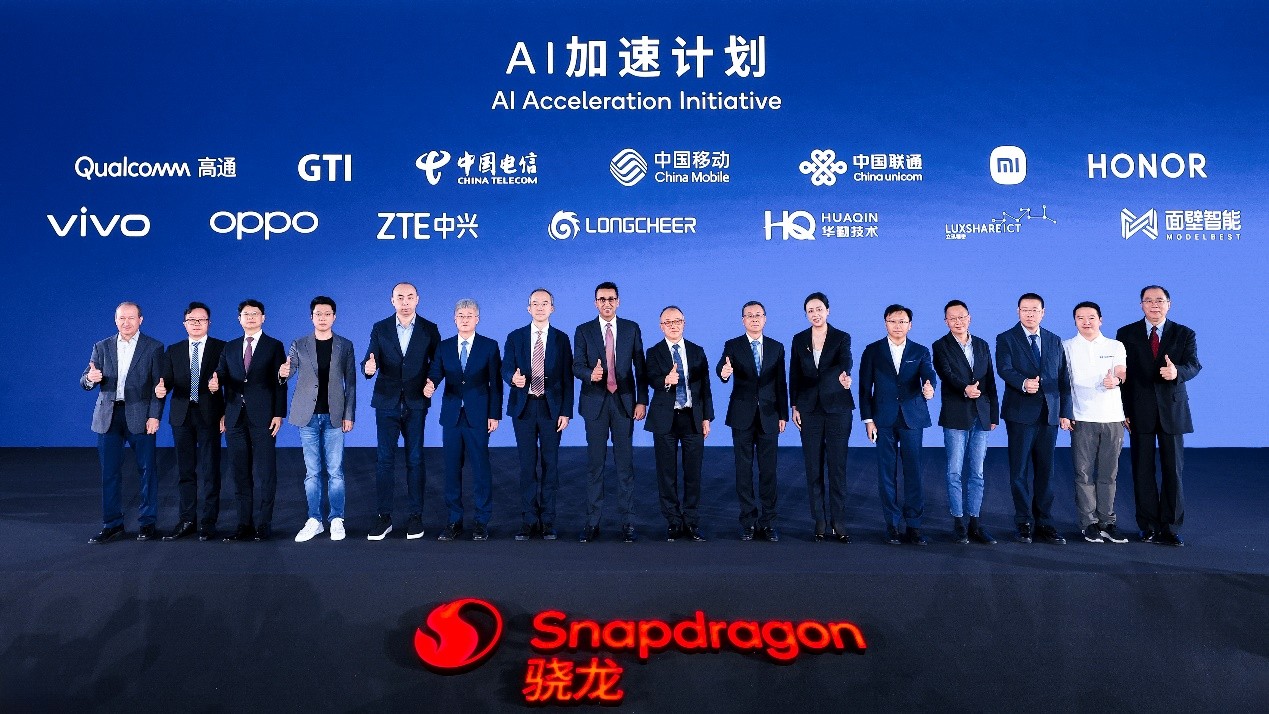
2025骁龙峰会·中国启幕:深耕三十载,高通携伙伴启动“AI加速计划”
Huan Qiu Wang· 2025-09-25 02:15
Core Insights - The 2025 Snapdragon Summit in China marks a significant milestone for Qualcomm, celebrating its 40th anniversary and 30 years of development in China, showcasing over a hundred technological breakthroughs across various sectors [1][3] - Qualcomm emphasizes the importance of collaboration and innovation in driving the future of AI and connectivity, aiming to lead the next era of smart technology [3][5] Group 1: Strategic Developments - Qualcomm's CEO, Cristiano Amon, highlighted six trends driving the future of AI, including the shift from smartphone-centric to agent-centric interfaces and the evolution of computing architectures [7] - The launch of the "AI Acceleration Initiative" aims to enhance AI capabilities across various devices, collaborating with major Chinese partners to explore new applications [5][7] Group 2: Industry Collaboration - The summit featured discussions on the importance of industry collaboration for AI development, with insights from experts emphasizing the need for deep cooperation among technology providers [8][10] - Various industry leaders, including representatives from China Telecom, China Mobile, and ZTE, expressed their commitment to deepen collaboration with Qualcomm in areas such as 6G, AI, and smart devices [18] Group 3: Technological Innovations - The integration of edge AI is seen as a key factor in reshaping industries, with Qualcomm focusing on the synergy between algorithms, hardware, and application scenarios [5][16] - The discussions on embodied intelligence highlighted the need for innovation in communication technologies to support the development of humanoid robots and other advanced applications [13][15]
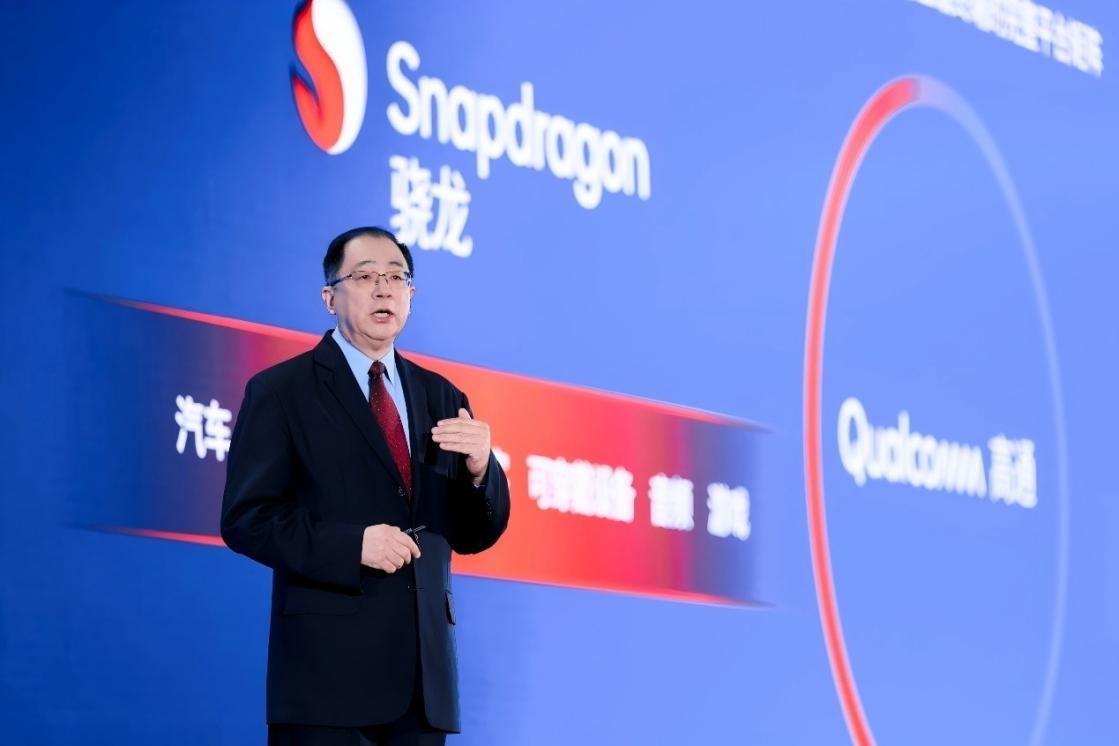
高通携手合作伙伴发布“AI加速计划” 扩展终端侧AI边界
Ren Min Wang· 2025-09-25 01:12
Group 1 - The 2025 Snapdragon Summit officially commenced in Beijing, celebrating Qualcomm's 40th anniversary and 30 years of development in China, with the event held simultaneously in Hawaii and Beijing [1] - Qualcomm launched the "AI Acceleration Initiative" during the summit, aiming to collaborate with China's industrial ecosystem to unlock new capabilities and applications of edge intelligence, accelerating the large-scale implementation of AI across various industries [1][2] - The summit showcased over a hundred technological breakthroughs and experience upgrades in areas such as AI, connectivity, imaging, and gaming across various devices including smartphones, PCs, and automobiles [2] Group 2 - Qualcomm's China President Meng Pu emphasized the importance of collaboration and shared values over the past 30 years, highlighting the evolution of the Snapdragon platform from 3G to 5G and its impact on the automotive industry, supporting over 210 models from numerous Chinese automotive brands [2] - Meng Pu expressed confidence in the future of Qualcomm's cooperation with China, focusing on innovation and collaboration to create a more prosperous next 30 years [2] - Qualcomm's CEO, Cristiano Amon, identified six key trends driving the future of AI, including the shift from smartphone-centric to agent-centric interfaces and the transformation of computing architecture [6] Group 3 - The "AI Acceleration Initiative" was launched in partnership with various companies including GTI, China Telecom, China Mobile, China Unicom, Xiaomi, Honor, Vivo, OPPO, ZTE, and others, aiming to enhance AI capabilities across devices [6][7] - Qualcomm's COO and CFO, Akash Palkhiwala, noted the alignment of Qualcomm's global vision with the Chinese market, focusing on personal AI, physical AI, and industrial AI as the three major trends [7] - The initiative aims to empower smartphones with more AI functionalities, introduce agent AI experiences to more devices, and collaborate with Chinese model providers and developers to explore and implement more AI applications [7]