
广发证券

Search documents
广发证券首席策略分析师刘晨明 备战马年第一波上涨期
Shen Zhen Shang Bao· 2026-02-12 18:47
Core Viewpoint - The A-share market is expected to experience its first wave of upward momentum in the Year of the Horse, with optimism surrounding sectors such as the AI industry chain, space photovoltaics, and non-bank financials [1][2]. Group 1: Market Timing - The spring market rally is anticipated to begin in February, historically the strongest period for such movements, with a 100% probability of small-cap indices rising between the Spring Festival and the National People's Congress [1]. - Previous instances of early spring rallies occurred during economic upturns or policy shifts, with notable years being 2013, 2014, 2015, and 2020 [2]. Group 2: Market Conditions - The release of annual report forecasts has alleviated negative fundamental disturbances, with a record high of companies reporting low expectations or losses in 2025 [2]. - As negative financial news is digested, the market is expected to be in a better position starting in February, allowing for a more favorable trading environment [2]. Group 3: Investment Strategy - The correlation between spring rallies and corporate performance is strong, with recommended sectors including the ByteDance industry chain, space photovoltaics, and non-bank sectors such as brokerage and insurance [2]. - Other sectors to consider for investment include optical modules, semiconductors, humanoid robots, chips, PCBs, and innovative pharmaceuticals, with additional tracking suggested for metals, satellites, storage, chemicals, and power grids [2].

IPO收费新规落地一年 券商投行迈入服务赋能新周期
Shang Hai Zheng Quan Bao· 2026-02-12 17:42
张大伟 制图 ● 《国务院关于规范中介机构为公司公开发行股票提供服务的规定》明确禁止按发行规模递增收费,推 动IPO项目计价方式变革 ● 新规实施一年来,IPO项目的收费方案呈现前所未有的多样性与复杂性,"风险共担"与"服务对价"成 为核心原则 ● 在多位投行从业人员看来,IPO业务收费与规模脱钩,意味着投行不能再通过"IPO成功"或"超大规模 募资"获取更多的超额收益,须通过尽调、辅导、定价等过程服务赢得合理报酬 ◎刘禹希 记者 徐蔚 上海证券报记者获悉,中国证券业协会近日向券商下发了《关于2025年度证券公司廉洁从业和投行业务 收费自律检查情况的通报》。通报称,投行业务收费制度机制有待加强,部分公司存在持续督导费用约 定不明、收费信息报送滞后、内部收费制度更新不及时等问题。 此次通报适逢IPO收费新规落地一年。2025年2月15日,《国务院关于规范中介机构为公司公开发行股 票提供服务的规定》正式施行,明确禁止按发行规模递增收费,推动IPO项目计价方式变革。这一年 间,非线性收费模式渐成主流,投行的角色正从传统的"发行通道"向深度"服务伙伴"转型。 投行收费告别"规模崇拜" 曾经与募资规模线性挂钩的收费模式 ...


别不当回事!金价已发出强烈信号,黄金大风暴将一触即发
Sou Hu Cai Jing· 2026-02-12 16:45
Group 1: Market Volatility - The international gold market experienced extreme volatility in late January 2026, with prices soaring to a historical peak of $5,600 per ounce before plummeting over 20% to below $4,500 within a few trading days [1][2] - The volatility reached a 40-year high, with daily price swings exceeding 5% and some days seeing declines over 10% [1][2] - Major banks, including Industrial and Commercial Bank of China and China Bank, issued risk warnings and adjusted their gold accumulation business policies to manage the heightened volatility [1][2] Group 2: Structural Changes in Pricing Logic - The traditional pricing framework for gold is failing, as the relationship between gold prices and the US dollar index, as well as real interest rates, has weakened since 2026 [3] - Central banks are shifting from tactical gold purchases to long-term strategic reserves, with net purchases expected to reach 755 tons in 2026, significantly above historical averages [3] - The changing macroeconomic landscape, including rising global debt and persistent geopolitical conflicts, is enhancing gold's strategic value as an asset with no sovereign credit risk [3] Group 3: Leverage and Technical Risks - The concentration of leveraged trading and forced liquidations contributed to market turbulence, with high leverage accounts facing pressure due to increased margin requirements set by the CME [6] - Major banks raised margin requirements for gold and silver contracts, exacerbating liquidity issues in the market [6] - The largest gold ETF, GLD, experienced significant outflows, indicating a shift in investor sentiment and potential for further price declines if key support levels are breached [6] Group 4: Divergence Between Physical and Financial Attributes - A notable divergence between domestic and international gold prices has emerged, highlighting internal market discrepancies [7] - The price gap between physical gold consumption and financial derivatives trading is widening, with domestic retail prices remaining firm due to rigid demand [7] - Silver prices exhibited even greater volatility than gold, driven by both industrial demand and speculative trading [7] Group 5: Institutional Behavior and Policy Signals - Institutional investor actions are amplifying market volatility, with $5,000 identified as a critical psychological support level for gold prices [9] - UBS has adjusted its gold price forecasts for the end of 2026, reflecting the chaotic market expectations [9][10] - The nomination of the Federal Reserve chairman is a short-term disruptive factor, with potential implications for interest rate expectations and gold prices [10] Group 6: Irrational Investor Behavior - Emotional trading among investors is exacerbating market volatility, with many investors engaging in blind bottom-fishing after price declines [11] - Historical patterns indicate that significant price drops in gold often precede tightening monetary policies and liquidity crises [11] - Current market conditions resemble those before the 2008 financial crisis, with retail investors heavily investing in gold ETFs [11]

券商出海持续提速,差异化路径成中小机构关键考题
Di Yi Cai Jing· 2026-02-12 14:57
Core Viewpoint - The competition in the overseas market for Chinese securities firms is intensifying, with leading players dominating the Hong Kong IPO market, while many smaller firms struggle to establish a foothold. Group 1: Overseas Expansion Efforts - As of February 11, 2026, four securities firms have disclosed their latest progress in overseas business, including Huatai Securities and GF Securities, which are issuing zero-coupon convertible bonds to support their international operations [2][4] - Northeast Securities and Huawan Securities have received approval to establish and increase capital in their Hong Kong subsidiaries, with each committing HKD 500 million [3][4] Group 2: Competitive Landscape - The "Matthew Effect" is evident in the overseas competition, with leading firms like CITIC Securities and CICC capturing a significant share of the Hong Kong IPO market, accounting for 53.96% of the total fundraising, while smaller firms have less than 1% [5][6] - Head firms have expanded into derivatives and broader international markets, establishing a 24-hour global trading system, while smaller firms face higher barriers to entry and slower internationalization processes [6][7] Group 3: Strategic Differentiation - The industry consensus is that while the pace of overseas expansion varies, it is essential for firms to explore differentiated development paths. Leading firms should leverage their capital strength and extensive client networks, while smaller firms should focus on niche markets or specialized financial products [8][9] - Smaller firms are exploring opportunities in cross-border services, wealth management, and Southeast Asian markets, capitalizing on their understanding of domestic policies and established trust with local enterprises [9]



券商加速“出海”,在下一盘什么棋?
Guo Ji Jin Rong Bao· 2026-02-12 11:53
Core Viewpoint - Domestic securities firms are accelerating their internationalization efforts in response to industry homogenization and to explore new growth points, driven by policy encouragement and recovering market demand [1][10]. Group 1: Recent Developments - Huatai Securities has completed the issuance of HKD 10 billion H-share convertible bonds, providing funding for overseas business development [6][8]. - Huazhong Securities and Northeast Securities have both received approval from the China Securities Regulatory Commission (CSRC) for capital increases in their Hong Kong subsidiaries, with each firm planning to inject HKD 5 million [2][4]. Group 2: Industry Trends - The recent actions of multiple securities firms reflect a broader industry consensus on the importance of expanding overseas markets and enhancing international business [9][10]. - In January, GF Securities announced the successful placement of 219 million new H-shares, raising approximately HKD 39.59 billion, with plans to allocate 70% of the funds to support international business development [9]. Group 3: Opportunities and Challenges - Opportunities include the increasing demand for cross-border financing as Chinese enterprises expand internationally, supported by favorable policies and Hong Kong's status as a global financial hub [10]. - Challenges faced by domestic securities firms include gaps in brand influence, global pricing capabilities, and regulatory complexities in foreign markets, which increase compliance costs and operational difficulties [11].

东吴证券20亿增资东吴香港获批 近期13家券商强力推进海外业务
Ge Long Hui A P P· 2026-02-12 11:51
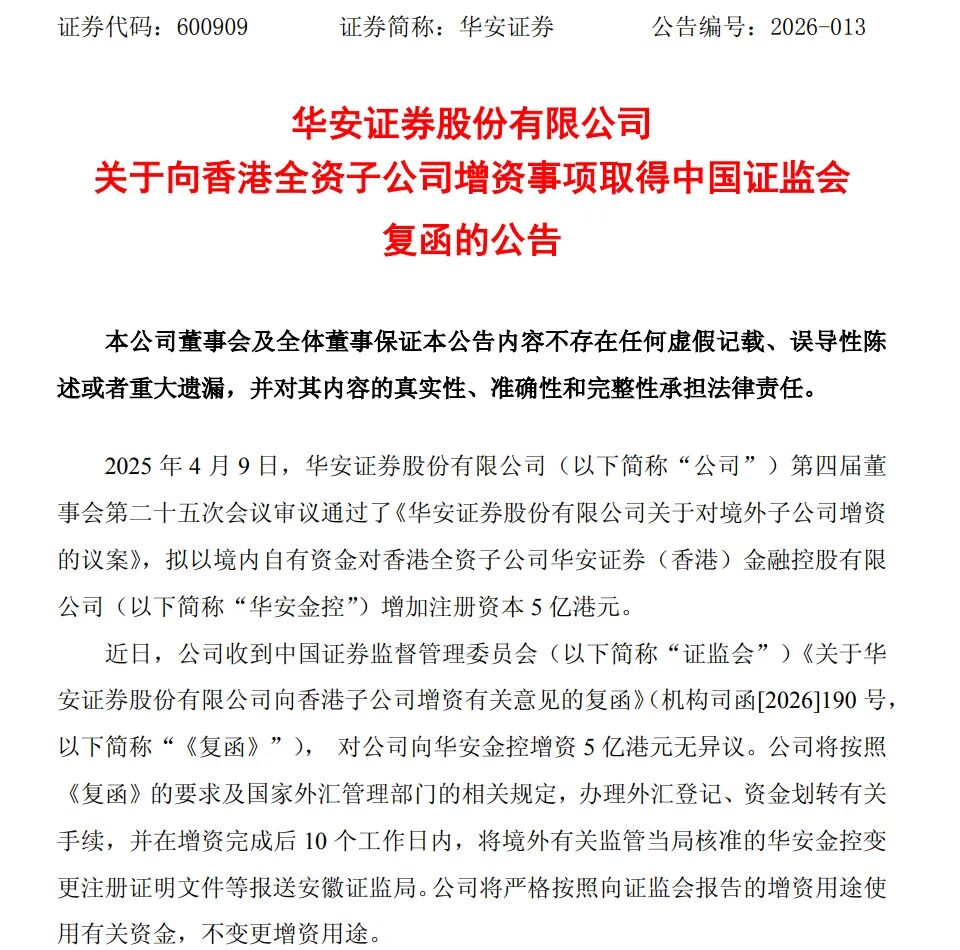
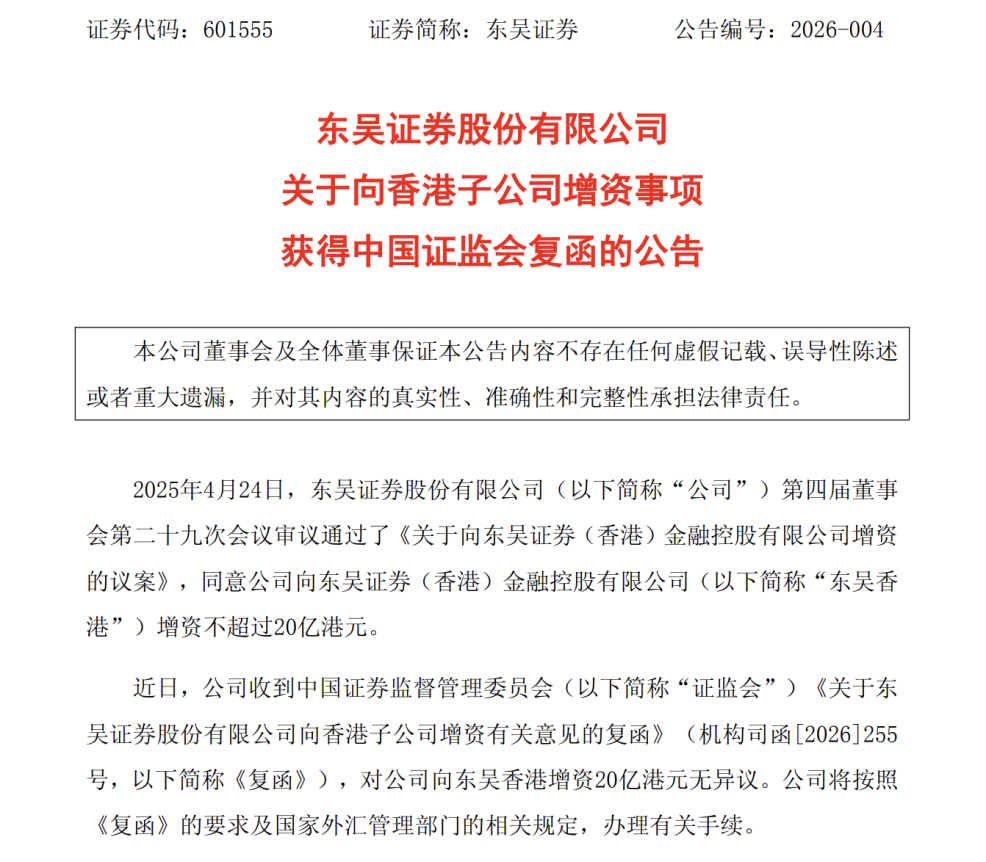
格隆汇2月12日|东吴证券发布公告,公司收到证监会复函,证监会对公司向东吴香港增资20亿港元无 异议。近日多家券商香港业务密集获批:昨日,华安证券获准向其香港全资子公司华安金控增资 5 亿港 元,东北证券亦获准以自有资金出资 5 亿港元在香港设立东证国际。2025 年以来,已有逾 13 家券商加 速推进海外布局,包括华泰证券、广发证券、招商证券、山西证券、中信建投、第一创业、东吴证券、 西部证券、东兴证券、国金证券、华安证券、东北证券,以及今日公告获批的东吴证券。 ...

近期13家券商强力推进海外业务
Xin Lang Cai Jing· 2026-02-12 11:38
Core Viewpoint - Several brokerage firms have recently received approvals for their Hong Kong operations, indicating a trend of accelerated overseas expansion in the industry [1] Group 1: Recent Approvals - Huazhong Securities has been approved to increase its capital by 500 million HKD for its wholly-owned subsidiary Huazhong Financial Holdings in Hong Kong [1] - Dongbei Securities has also been approved to establish Dongzheng International in Hong Kong with its own funds amounting to 500 million HKD [1] Group 2: Industry Expansion - Since 2025, over 13 brokerage firms have accelerated their overseas expansion efforts, including Huatai Securities, GF Securities, and China Merchants Securities among others [1] - The firms involved in this expansion include Shanshi Securities, CITIC Construction Investment, First Capital, Dongwu Securities, Western Securities, Dongxing Securities, Guojin Securities, Huazhong Securities, and Dongbei Securities [1]
又一券商,加码国际业务
Zhong Guo Ji Jin Bao· 2026-02-12 11:20
Core Viewpoint - Dongwu Securities has received a no-objection letter from the China Securities Regulatory Commission (CSRC) regarding its plan to increase capital by HKD 2 billion to its wholly-owned subsidiary, Dongwu Securities (Hong Kong) [1][3]. Group 1: Company Actions - The capital increase of HKD 2 billion was approved by Dongwu Securities' board on April 24, 2025, and is pending approval from state-owned asset regulatory authorities before implementation [3]. - Dongwu Securities has previously increased the capital of Dongwu Hong Kong multiple times, raising its registered capital from HKD 1 million to HKD 7 million in 2018 and further increasing it by HKD 480 million in May 2020 [4]. Group 2: Business Development - Dongwu Hong Kong has been actively developing its brokerage business, focusing on high-net-worth client acquisition and expanding its services in Hong Kong and U.S. stock markets [5]. - As of the end of the reporting period, Dongwu Hong Kong had 9,536 active clients with a total custody share value of HKD 9.6 billion and executed HKD 13.5 billion in Hong Kong stock trading in the first half of the year [5]. Group 3: Financial Performance - In 2024, Dongwu Hong Kong reported a net loss of HKD 49.58 million, but by the first half of 2025, it achieved a net profit of HKD 42.04 million, indicating a turnaround [6]. Group 4: Industry Trends - The recent capital increases by multiple securities firms indicate a trend of accelerated internationalization in the industry, with firms like Huatai Securities and Guangfa Securities also announcing significant capital raises for overseas business development [7]. - The overall international business of mainland securities firms has seen a 20.45% year-on-year increase in total assets, reaching HKD 1.64 trillion as of mid-2025 [7]. - Analysts suggest that the internationalization of Chinese securities firms is shifting from scale expansion to value cultivation, with a focus on providing high-value comprehensive financial services [8].
银行理财,失去的三年
虎嗅APP· 2026-02-12 10:16
Core Viewpoint - The article discusses the decline of bank wealth management products, highlighting their failure to adapt to equity investments, leading to reduced returns and a widening gap with public funds [2][3][5][31]. Group 1: Talent Movement and Industry Trends - The recent hiring of Dai Kang, a former top analyst, by Zhaoyin Wealth Management signifies a shift towards valuing equity investments within the traditionally conservative bank wealth management sector [2]. - As of June 2025, Zhaoyin Wealth Management's equity investments amounted to 66.768 billion yuan, representing about 10% of the total bank wealth management equity investment of 660 billion yuan [2]. Group 2: Performance Metrics - By the end of 2025, the total scale of bank wealth management products reached 33.29 trillion yuan, a year-on-year increase of 11.15%, yet the gap with public funds, which reached approximately 37 trillion yuan, has widened [3][4]. - The average yield of bank wealth management products fell to 1.98% in 2025, a decline of nearly 1 percentage point from 2.94% in 2023, marking the first time it dropped below 2% [5][6]. Group 3: Asset Allocation Issues - Despite a recovering equity market, bank wealth management's allocation to equity assets decreased, with only 0.66 trillion yuan allocated to equities, accounting for just 1.85% of total assets [6][15]. - The heavy reliance on fixed-income assets, which constituted 92.1% of total investments, has made bank wealth management returns highly correlated with bond market performance [11][12]. Group 4: Challenges and Constraints - The conservative nature of bank wealth management clients, primarily composed of risk-averse individuals, limits the willingness to increase equity investments due to low tolerance for volatility [25][26]. - Strict sales channel requirements further constrain banks from increasing equity allocations, as any significant drawdown could lead to product delisting [27][29]. Group 5: Industry Dynamics and Future Outlook - The article suggests that if bank wealth management continues to ignore equity market opportunities, it risks losing its client base and falling further behind public funds [35]. - The disparity in investment research capabilities and client demographics between bank wealth management and public funds is expected to persist, making it difficult for banks to catch up [34].
研报掘金丨广发证券:首予国信证券“买入”评级,公司财富及泛自营构筑高ROE优势
Ge Long Hui A P P· 2026-02-12 07:36
广发证券研报指出,国信证券是老牌综合性券商,盈利韧性凸显,ROE步入提升通道。以自营投资交易 与财富管理为核心驱动、投行与资管为增长点的业务结构,是其高ROA优势的核心支撑。卡位海南政 策高地,深耕大湾区多维协同,奠定长期发展根基。增量资金入市持续,公司财富及泛自营构筑高ROE 优势,叠加政策红利释放,预计公司2026-2027年归母净利润同比+34%、+20%。考虑可比公司估值及 历史估值中枢,给予2026年1.3倍PB,对应合理价值14.47元/股,首次覆盖给以"买入"评级。 ...
