
银行

Search documents
银行业“反内卷”,究竟是在“反”什么?
Jin Rong Shi Bao· 2025-08-12 00:57
Core Viewpoint - The banking industry is experiencing intense competition characterized by price wars and scale wars, leading to a detrimental "involution" that affects both the industry ecosystem and the real economy [1][2]. Group 1: Competition Dynamics - The competition among banks has escalated to unprecedented levels, resulting in a "price war" where loan rates have dropped below 3%, nearing the banks' funding cost limits [1]. - The "scale war" continues unabated, with banks pressured to attract deposits, leading to practices like "manual interest compensation" and "high-interest deposit purchases," which often breach financial compliance [1][2]. - This low-level repetitive competition not only compresses banks' profit margins but also leads to a waste of credit resources, weakening overall innovation and service quality in the banking sector [2]. Group 2: Need for Change - The banking industry requires a "de-involution" movement to alleviate the intense competition and reduce the burden on frontline employees [2]. - Financial regulatory authorities advocate for a shift from "scale-driven" to "value-driven" sustainable development in banking competition, emphasizing the need for banks to enhance their internal capabilities and innovation [2][3]. - Banks should diversify their revenue streams by expanding non-interest income businesses, such as wealth management and consulting services, to reduce reliance on interest margin income [2]. Group 3: Differentiation and Internal Optimization - Different types of banks need to establish clear differentiation in their development strategies, focusing on specific customer groups and business areas to provide unique financial services [3]. - In a competitive environment still influenced by "scale obsession," optimizing internal assessment and incentive mechanisms is crucial, incorporating diverse performance metrics beyond just deposit and loan scales [3]. - Financial regulatory bodies should continuously refine the competitive ecosystem, promoting differentiated competition among various types of institutions and establishing fair and orderly competition frameworks [3][4].
骗贷黑手屡现 金融防线如何筑牢
Bei Jing Shang Bao· 2025-08-11 14:39
Core Viewpoint - The article highlights the increasing prevalence of loan fraud schemes, particularly those involving the fabrication of borrower qualifications and the use of POS machines to create fictitious transactions for cashing out loans. It emphasizes the need for banks to enhance their risk management practices across the entire loan process to combat these fraudulent activities [1][5]. Group 1: Loan Fraud Cases - Recent cases, such as one in Jiangsu, involved fraudsters packaging unqualified individuals as high-income earners to obtain bank credit loans, resulting in over 6 million yuan in fraudulent loans [2]. - In another case, an individual used a fake identity and forged income documents to secure a loan of 250,000 yuan, ultimately profiting over 90,000 yuan from the scheme [3]. Group 2: Vulnerabilities in Bank Risk Management - Analysts point out that banks often rely too heavily on superficial compliance checks, which allows fraudsters to exploit weaknesses in the loan approval process, such as inadequate verification of income and identity [4]. - The lack of thorough monitoring of loan fund usage and insufficient background checks contribute to the success of loan fraud schemes [4][5]. Group 3: Recommendations for Improved Risk Management - Experts suggest that banks should shift from a passive compliance approach to an active risk management model, which includes multi-dimensional verification of borrower information and real-time monitoring of loan fund usage [6]. - Implementing a comprehensive database for sharing information on suspected loan fraud cases among banks is recommended to enhance detection and prevention efforts [8]. Group 4: Regulatory Actions - Regulatory bodies are intensifying efforts to combat loan fraud, including joint operations to target illegal lending practices and the involvement of bank employees in fraudulent activities [7]. - The Beijing Financial Regulatory Bureau has issued warnings about common fraud tactics and is working to hold banks accountable for their role in facilitating loan fraud [7].
女子1997年存2万定期 27年后利息仅4000多元!她将银行告上法庭
Mei Ri Jing Ji Xin Wen· 2025-08-09 22:50
Core Points - The case involves a dispute between a customer, Wei A Po, and a bank regarding the interest earned on a fixed deposit of 20,000 yuan made in 1997, which resulted in only 5,000 yuan in interest by the end of 2024 [1][2] - Wei A Po claims that the bank did not inform her about the lack of automatic renewal for her deposit, which she believed was standard practice, leading her to seek compensation of 28,000 yuan based on what she would have earned with automatic renewal [3][4] - The bank argues that there was no legal obligation to renew the deposit automatically since the original terms did not specify this, and the deposit was treated as a one-year term without automatic renewal [3][4] Summary by Sections Deposit Details - In 1997, Wei A Po deposited 20,000 yuan in a bank with two manually issued certificates [2] - By the end of 2024, she was surprised to find that the interest accrued was less than 5,000 yuan [1][2] Dispute Origin - The bank explained that the manual certificates did not indicate automatic renewal, thus the funds were treated as a regular savings account after maturity [2][3] - Wei A Po contends that she was assured by bank staff that her deposit would be automatically renewed, leading to the current legal dispute [3] Legal Proceedings - After multiple complaints to regulatory bodies and failed mediation attempts, Wei A Po decided to take legal action against the bank for compensation [3][4] - The bank maintained that it had no obligation to renew the deposit automatically due to the lack of explicit terms in the original agreement [3][4] Resolution - A key discovery during the legal proceedings revealed that the bank had initially treated the deposit as automatically renewed until a system upgrade in 2003, which failed to carry over this status [4] - Following this revelation, the bank offered a compensation plan based on the interest that would have been earned had the deposit been automatically renewed, which Wei A Po accepted [5] - The case highlights the evolution of the financial system in China and the importance of clear communication and customer service in banking practices [5]
女子1997年存入2万元定期,27年后利息只有4000多元!她将银行告上法庭,法官查明关键疑点
Mei Ri Jing Ji Xin Wen· 2025-08-09 14:41
Core Viewpoint - The case highlights a dispute between a customer and a bank regarding the handling of a long-term deposit, where the customer expected automatic renewal of the deposit but was instead given minimal interest due to the bank's failure to process the renewal correctly over the years [1][2][4]. Group 1: Background of the Case - In 1997, a customer deposited 20,000 yuan in a bank with a manual deposit slip, expecting it to be automatically renewed [2]. - By the end of 2024, the customer was shocked to find that the bank had only paid less than 5,000 yuan in interest [1][2]. - The bank claimed that the manual deposit slip did not specify automatic renewal, thus the funds were treated as current deposits [2][3]. Group 2: Customer's Argument - The customer argued that the bank had assured her that the deposit would be automatically renewed, leading her to trust the bank with her funds [2][3]. - She believed that other financial institutions would typically handle automatic renewals in similar situations, and the bank's failure to do so violated her rights [2][3]. Group 3: Bank's Defense - The bank maintained that it had no legal obligation to renew the deposit automatically since the terms did not specify such an arrangement [2][3]. - The bank's legal representatives cited the "priority of agreement" clause in the Savings Deposit Regulations to support their position [3]. Group 4: Resolution of the Dispute - An investigation revealed that the bank had initially processed the deposit correctly but failed to transfer the automatic renewal feature when converting from manual to electronic records in 2003 [4]. - After recognizing the oversight, the bank offered a compensation plan based on the interest that would have been earned had the deposit been automatically renewed [5]. - The customer accepted the compensation, reflecting a resolution that acknowledged both legal and social considerations in the context of evolving banking practices [5].


公募基金配置了多少银行股?机构:银行中期行情预计仍未结束
Ge Long Hui· 2025-08-08 11:07
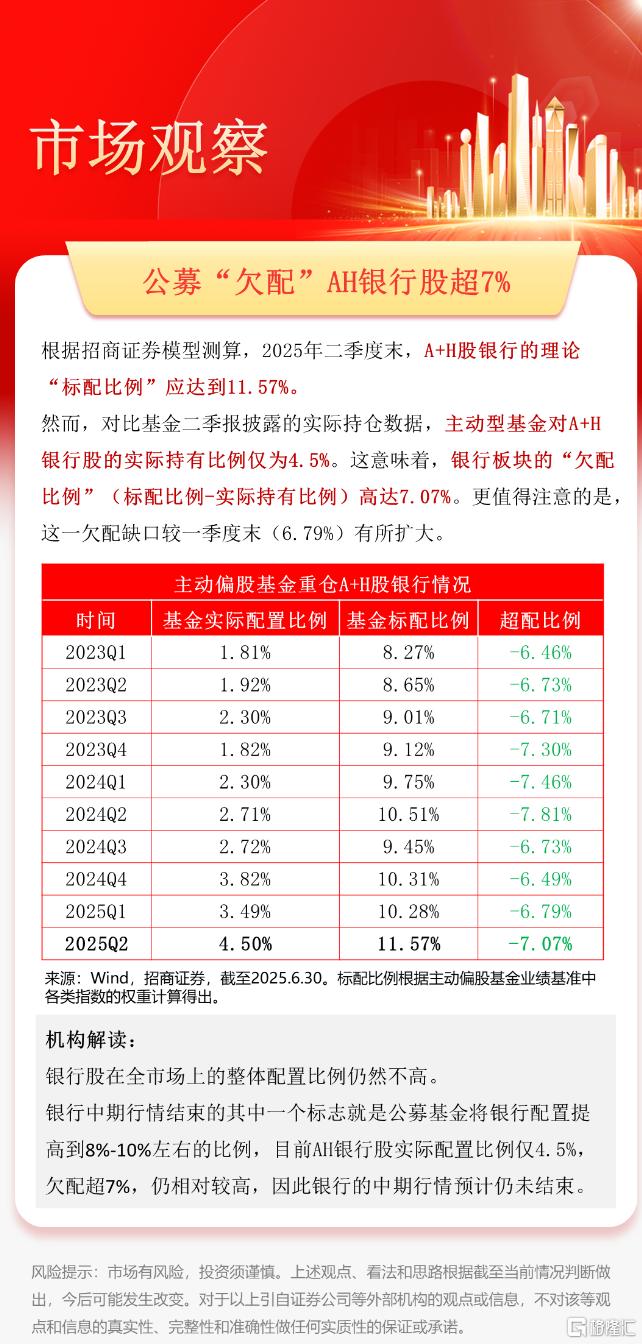
Group 1 - The theoretical "standard allocation ratio" for A+H shares of banks is projected to reach 11.57% by the end of Q2 2025, while the actual allocation by active equity funds is only 4.5%, indicating a significant under-allocation of 7.07% [1][5] - The under-allocation has increased from 6.79% at the end of Q1 2025, suggesting that the mid-term market for banks is not yet over, as institutional investors typically raise their allocation to 8%-10% to signal the end of the mid-term trend [1][5] - The A+H bank stock ETF (517900) has seen its share increase by over 700% this year and has been officially included as a margin trading target [1] Group 2 - The actual allocation ratios for active equity funds in A+H bank stocks have shown a gradual increase from 1.81% in Q1 2023 to 4.50% in Q2 2025, while the standard allocation ratios have also risen from 8.27% to 11.57% during the same period [3][4] - The excess allocation percentage has remained negative, indicating that the actual allocation is still below the standard allocation, with figures ranging from -6.46% in Q1 2023 to -7.07% in Q2 2025 [3][4]
国家外汇管理局: 6月份银行结汇14900亿元
Jin Rong Shi Bao· 2025-08-08 07:56
2025年6月,银行代客涉外收入46485亿元人民币,对外付款44667亿元人民币。2025年1至6月,银 行代客累计涉外收入277347 亿元人民币,累计对外付款268207亿元人民币。 按美元计值,2025年6月,银行代客涉外收入6478亿美元,对外付款6225亿美元。2025年1至6月, 银行代客累计涉外收入38606亿美元,累计对外付款37333亿美元。 责任编辑:杨喜亭 国家外汇管理局7月22日发布的统计数据显示,2025年6月,银行结汇14900亿元人民币,售汇13083 亿元人民币。2025年1至6月,银行累计结汇82135亿元人民币,累计售汇83950亿元人民币。 按美元计值,2025年6月,银行结汇2077亿美元,售汇1823亿美元。2025年1至6月,银行累计结汇 11432亿美元,累计售汇11685亿美元。 ...
我的理财,真的要交税了吗?
Sou Hu Cai Jing· 2025-08-06 21:26
Group 1 - The core point of the article is the recent tax policy changes affecting various investment products, particularly the reintroduction of value-added tax (VAT) on interest income from newly issued government bonds, local bonds, and financial bonds starting from August 8 [8][10]. - The new tax policy is expected to generate additional revenue for the government, estimated to be in the hundreds of millions due to the VAT on these bonds [8][10]. - The article outlines the tax implications for different investment types, including stocks, bonds, funds, and bank deposits, emphasizing that most retail investors will not be significantly impacted by these changes [31][32]. Group 2 - For bonds, newly issued government bonds will now incur a VAT of 3% to 6%, which may affect the net returns for investors holding bond funds [8][10]. - Stocks have different tax rates based on holding periods, with A-shares having a tiered tax rate from 0% to 20%, while overseas stocks are subject to a flat 20% personal income tax [12][14]. - Investment funds and bank deposits currently remain exempt from personal income tax, with the latter's exemption dating back to 2008 [22][30]. Group 3 - The article highlights that insurance payouts are exempt from personal income tax, aligning with the principle of insurance as a protective measure [27][29]. - The tax treatment of various investment products is summarized in a table, providing a clear overview of how different types of income and capital gains are taxed [7][33]. - The article encourages long-term investment strategies, noting that the tax policies favor holding investments over short-term trading [31][32].

北京商报侃股:重板块轻指数将成常态
Bei Jing Shang Bao· 2025-08-04 23:53
Group 1 - The core viewpoint emphasizes the importance of focusing on sector-specific trends rather than overall index movements for long-term investment success [1][2][3] - The innovation drug sector is characterized by significant volatility due to reliance on R&D breakthroughs, clinical trial results, and regulatory changes [1][2] - High-dividend bank stocks are favored for their stable performance, strong cash flow, and attractive dividend yields, making them a safe haven for investors [1][2] Group 2 - Investors are advised to avoid chasing trends and instead adopt a strategy of buying low and selling high based on sector valuations and growth potential [2][3] - Each sector has its own operational patterns and development cycles, necessitating in-depth research into leading companies, industry trends, and competitive landscapes [2][3] - The era of all stocks moving in unison is over, and future investment success will depend on thorough fundamental analysis of individual companies within sectors [3]
新发国债等利息收入恢复征收增值税 新规8月8日起实行,个人投资者买国债不超10万元仍免征
Mei Ri Jing Ji Xin Wen· 2025-08-04 14:21
Core Viewpoint - The Ministry of Finance and the State Taxation Administration announced a policy to reinstate VAT on interest income from newly issued government bonds, local government bonds, and financial bonds starting from August 8, 2025, while maintaining VAT exemption for bonds issued before this date until maturity [1] Group 1: Tax Policy Changes - The new tax policy aims to restore VAT on interest income from newly issued bonds, which is expected to primarily affect institutional investors, while individual investors purchasing bonds up to 100,000 yuan will still enjoy VAT exemptions [1][2] - The adjustment is seen as a move to address market imbalances and reduce tax discrepancies among different types of bonds, enhancing the pricing benchmark role of government bond yield curves [2][3] Group 2: Impact on Financial Institutions - The reinstatement of VAT is projected to increase tax revenue, with estimates suggesting an additional 315.5 billion yuan in tax revenue over a full fiscal year, primarily impacting commercial banks [4] - Banks may face a static increase in tax costs of approximately 232 billion yuan, which could affect their revenue by about 0.4% and pre-tax profit by around 0.95% [8][9] Group 3: Market Dynamics - The anticipated impact on bond yields is estimated to create a spread fluctuation of 5 to 10 basis points between new and old bonds, with the new tax potentially leading to higher issuance costs for new bonds [5][6] - The policy change may prompt banks to reassess their asset allocation strategies, potentially reducing their investment in interest rate bonds in favor of higher-yielding assets [9] Group 4: Broader Market Implications - The tax policy adjustment is expected to enhance market resource allocation efficiency and reduce the tax distortion of financial assets, fostering a more equitable and transparent tax environment [9] - Insurance companies may also experience a minor impact on their cash investment yields, estimated at around 2 basis points, which is relatively small compared to their net investment yield [10]
银行应多方面入手激活农产品消费潜能
Zheng Quan Ri Bao· 2025-08-03 15:13
Group 1 - The core viewpoint of the article emphasizes the need for financial institutions to integrate deeply into the agricultural industry chain to enhance the consumption of agricultural products through a newly released implementation plan by ten departments, including the Ministry of Agriculture and Rural Affairs [1][2] - The plan aims to expand agricultural product consumption by addressing the low standardization and weak brand influence that have historically led to the issue of "quality without premium pricing" [1] - Financial services should be closely tied to quality upgrades, utilizing "green credit" to support organic farming and establishing quality traceability systems, while "brand cultivation loans" can promote geographical indication certification and regional public brand development [1][2] Group 2 - The logistics segment significantly impacts the consumption radius of agricultural products, with high losses often caused by cold chain gaps and capital constraints [2] - Financial institutions can utilize a combination of "project financing + operational subsidies" to reduce the costs of building cold chain distribution centers at production sites, and offer "order loans" and "warehouse receipt pledges" to alleviate funding pressures for fresh e-commerce and community group buying [2] - To activate the consumer market, financial services should evolve from simple lending to a comprehensive empowerment model that integrates finance with various scenarios, such as offering "consumer credit + agricultural product packages" in rural tourism settings [2]
