中国平安

Search documents
港股通1月6日成交活跃股名单
Zheng Quan Shi Bao Wang· 2026-01-06 14:22
Group 1 - The Hang Seng Index rose by 1.38% on January 6, with southbound trading totaling HKD 133.35 billion, including HKD 68.12 billion in buying and HKD 65.24 billion in selling, resulting in a net buying amount of HKD 2.88 billion [1] - The southbound trading through Stock Connect (Shenzhen) had a total trading amount of HKD 52.32 billion, with net buying of HKD 1.90 billion, while the trading through Stock Connect (Shanghai) totaled HKD 81.03 billion, with net buying of HKD 0.98 billion [1] - Active stocks in southbound trading included Alibaba-W with a total trading amount of HKD 94.23 billion, Tencent Holdings with HKD 69.86 billion, and SMIC with HKD 65.23 billion [1] Group 2 - Among the stocks, China Ping An had a net buying amount of HKD 18.40 billion, closing with a price increase of 4.96%, while Alibaba-W had a net buying of HKD 16.19 billion [2] - Xiaomi Group-W, SMIC, and Alibaba-W were among the stocks with the highest consecutive net buying days, with 4 days for Xiaomi Group-W and SMIC, and 3 days for Alibaba-W [2] - The total trading amount for China Ping An was HKD 32.79 billion, with a net buying of HKD 18.40 billion, while Tencent Holdings had a total trading amount of HKD 69.86 billion with a net selling of HKD 8.04 billion [2]






上市险企新旧准则切换所得税切换测算:OCI选择权的两面性,税务追溯对现金流影响有限
ZHONGTAI SECURITIES· 2026-01-06 13:32
Investment Rating - The industry investment rating is "Increase Holding" [2] Core Viewpoints - The tax adjustment for listed insurance companies has a limited overall impact, primarily affecting cash flow rather than profit and loss statements or balance sheets [5][10] - The new accounting standards provide insurance companies with an OCI option, which reduces the impact of interest rate fluctuations on net profit [5] - The average effective tax rate for listed insurance companies has been low, with rates of 10%, 8%, -1%, -6%, 12%, and 17% from 2020 to Q3 2025, indicating a disconnect between tax burdens and actual operating performance [5][12] - The estimated taxable profit difference for listed companies under the new and old standards is projected to be 42 billion in 2023 and 93 billion in 2024, with a significant portion of this difference being attributable to insurance contracts [5][18] Summary by Relevant Sections Tax Adjustment Impact - The tax adjustment is expected to have a minimal effect on operating cash flow, with an average impact of 2.27% across listed insurance companies [5][18] - Specific companies like New China Life and China Life may experience a more significant impact, estimated at around 14% for New China Life [5][18] Financial Performance - The listed insurance companies have seen record high pre-tax profits in the first three quarters of 2025, exceeding the total profits of 2024 [11] - The actual income tax paid has not kept pace with rising profits, indicating a potential for future tax liabilities [12] Recommendations - The report suggests focusing on companies such as China Life (A/H), Ping An (A/H), China Pacific Insurance (A/H), New China Life (A/H), and China Property & Casualty Insurance (A/H) for investment opportunities [5]



史上最强开门红?
表舅是养基大户· 2026-01-06 13:31
Market Overview - The A-share market is experiencing a strong performance, with the Shanghai Composite Index achieving a 13-day consecutive rise, setting a record for the longest winning streak in history [6][10] - The trading volume today reached over 2.8 trillion yuan, marking the highest single-day volume since the fourth quarter of last year, indicating increasing market enthusiasm [10] Sector Performance - The non-ferrous metals sector is leading the market, with a significant increase of over 4%. This sector's performance is driven by strong commodity prices, particularly gold, silver, and copper [12][14] - Zijin Mining, a leading company in the non-ferrous sector, saw its market capitalization exceed 1 trillion yuan, making it the first mining company to reach this milestone in A-shares [16] - The non-bank financial sector has also reached new highs since the 1994 market rally, with major insurance companies continuing to perform well [17][20] Investment Trends - There is a notable influx of funds into the market, with net purchases of financing reaching 19 billion yuan, contributing to a total financing balance of 25.434 trillion yuan, a new historical high [10][23] - The market is witnessing a divergence in sector performance, with the communication sector experiencing a decline while non-ferrous metals continue to rise [13][14] Future Outlook - Predictions suggest that a portion of the influx of funds may gradually be sold off in the early part of the year, with a moderate net sell-off observed [23] - The market's current enthusiasm is reflected in the high trading volume and the performance of key sectors, but caution is advised as certain indicators suggest potential overheating in the market [26]


港股收盘 | 恒指收涨1.38% 大金融股发力走高 有色、智驾概念走势强劲
Zhi Tong Cai Jing· 2026-01-06 12:38
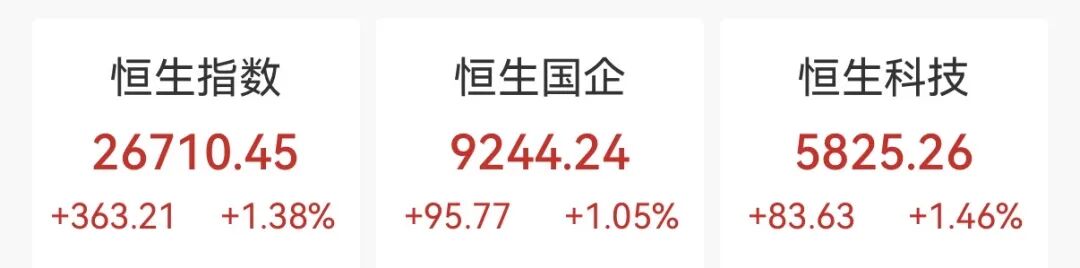
Market Overview - The Hong Kong stock market indices showed strong performance, with the Hang Seng Index rising by 1.38% to close at 26,710.45 points, and a total trading volume of HKD 2,917.58 million [1] - The government policies and support from the "national team" are expected to stabilize the Hong Kong stock index, making it a favorable time for investment [1] Blue-Chip Stocks Performance - China Hongqiao (01378) led the blue-chip stocks with a 6.14% increase, closing at HKD 35.26, contributing 10.84 points to the Hang Seng Index [2] - Other notable performers included JD Health (06618) up 5.41%, China Ping An (02318) up 4.96%, while some stocks like Alibaba-W (09988) and Hengan International (01044) faced declines [2] Sector Highlights - Large technology stocks showed mixed results, with financial stocks, particularly Chinese brokerage firms, gaining momentum [3] - The non-ferrous metals sector performed strongly, with significant gains in gold and copper stocks [4] - The commercial aerospace sector saw a rise, with companies like Goldwind Technology (002202) increasing by over 7% [3][6] Investment Opportunities - The capital market is expected to maintain a strong performance in 2026, with the securities industry likely to continue its upward cycle [4] - Analysts suggest focusing on undervalued brokerage firms for potential gains during the spring market rally [4] Commodity Trends - Recent increases in commodity futures for gold, silver, copper, and lithium carbonate are noted, driven by geopolitical tensions and supply constraints [5] - The aluminum market is particularly affected by supply threats, with prices expected to remain high [5] Autonomous Driving Sector - The autonomous driving sector is gaining traction, with companies like Zhejiang Shibao (002703) and Youjia Innovation (02431) seeing significant stock price increases [5] - NVIDIA's advancements in autonomous driving technology are expected to boost demand for related stocks [6] Notable Stock Movements - Xindong Company (02400) saw a 6.04% increase following the announcement of a large share buyback plan [7] - Hesai Technology (02525) rose 5.9% after being selected as a lidar partner for NVIDIA's platform and announcing plans to double production capacity [8] - Cathay Pacific (00293) faced pressure, with a 2.6% decline due to a share placement by China National Aviation [9]
保险等板块拉动 上证指数连续两天站上4000点
Zheng Quan Ri Bao Wang· 2026-01-06 12:25
Core Viewpoint - The insurance sector has experienced significant growth at the beginning of the year, driven by market sentiment, valuation recovery, and improvements in both the asset and liability sides of the industry [1][2]. Group 1: Market Performance - On January 6, the insurance sector index rose by 3.44%, with a cumulative increase of 9.84% over the first two trading days of the year, leading all sectors [1]. - The Shanghai Composite Index surpassed 4000 points on January 5 and continued to rise by 60.25 points to 4083.67 on January 6 [1]. - The insurance sector index had a cumulative increase of 21.07% in 2025, indicating a continuation of last year's upward trend [1]. Group 2: Factors Driving Growth - The recent surge in insurance stocks is attributed to a combination of market sentiment, valuation recovery, and improvements in the insurance industry's fundamentals [1][2]. - The strong performance of the capital market and the upward movement of the market index have provided robust external support for the insurance sector [2]. - Insurance companies, as significant institutional investors, benefit directly from the stock market's rise, enhancing market expectations for their profitability [2][3]. Group 3: Future Outlook - The average new policy growth rate for listed insurance companies is expected to reach around 30% in the first quarter of this year, driven by the advantages of dividend insurance in a low-interest-rate environment [3]. - The insurance industry is anticipated to see continued growth in premium income and profitability, supported by favorable macroeconomic conditions and active capital markets [4]. - The ongoing transformation of insurance products and the accumulation of low-cost premiums are expected to further enhance profit growth in the industry [3][4].
一则大消息,集体爆发!
Zhong Guo Ji Jin Bao· 2026-01-06 12:24
Market Performance - The Hong Kong stock market indices closed higher, with the Hang Seng Index rising by 1.38% to 26,710.45 points, the Hang Seng Tech Index increasing by 1.46% to 5,825.26 points, and the National Enterprises Index up by 1.05% to 9,244.24 points [1] - Major technology stocks saw gains, with NetEase up nearly 3%, Kuaishou rising over 2%, and Baidu, Tencent, and JD.com each increasing by over 1% [2] Sector Performance - Insurance and brokerage stocks performed strongly, with China Merchants Securities surging by 12%, and leading firms like CICC and CITIC Securities also seeing significant increases [2] - Gold and precious metal stocks led the gains, with Zhaojin Mining up over 7% and Zijin Mining and Zijin Gold International both rising by over 4% [2] Smart Driving Sector - Smart driving concept stocks experienced a significant surge, with Zhejiang Shibao soaring over 21%, Pony.ai rising nearly 7%, and WeRide increasing by over 4% [4] - Other notable performers in the smart driving sector included Youjia Innovation up by 11.24%, and Hesai Technology up by 5.90% [5] NVIDIA Developments - NVIDIA's CEO Jensen Huang announced the launch of the Alpamayo platform at CES, which enables cars to perform "inference" in the real world, with the first vehicles equipped with this technology expected to hit the roads in the US in Q1, Europe in Q2, and Asia later in the year [6] - The introduction of NVIDIA's new AI platform and open models is anticipated to stimulate demand for autonomous taxis and support global economic growth, according to Citigroup analysts [6]
资产负债双轮驱动,A股保险板块两日累计涨超11%
Mei Ri Jing Ji Xin Wen· 2026-01-06 12:11
Core Viewpoint - The A-share insurance sector has experienced a strong rise since 2025, significantly outperforming other financial sectors and the CSI 300 index, driven by policy benefits, improved fundamentals, and favorable market conditions [1][2]. Group 1: Performance and Growth - The five major listed insurance companies in A-shares have shown substantial annual growth rates, with stock price increases of 21.21% for China Ping An, 10.39% for China Life, 26.60% for China Pacific Insurance, 35.87% for China Re, and 46.03% for New China Life in 2025 [2]. - The insurance sector's performance has outpaced that of banks and securities, indicating a robust upward trend in the market [2]. Group 2: Fundamental Support - The strong performance of insurance stocks is attributed to two main factors: better-than-expected growth in new insurance policies and a recovering equity market, which has led to increased investment from insurance funds [3]. - In the first eleven months of 2025, the insurance industry's original premium income reached 5.76 trillion yuan, reflecting a year-on-year growth of 7.6%, with life insurance companies seeing a 9.1% increase [3]. Group 3: Market Dynamics - The "opening red" phenomenon in 2026 is expected to sustain the high demand for insurance products, further supporting the ongoing bullish trend in the insurance market [4]. - The stability of long-term interest rates and increased equity allocation are anticipated to enhance investment returns, while the return of dividend insurance products is expected to optimize the cost structure for listed insurance companies [5]. Group 4: Regulatory and Policy Environment - Recent regulatory adjustments have lowered risk factors for insurance companies, potentially releasing significant capital for investment in the stock market, estimated to exceed 1 trillion yuan if fully allocated [6]. - The insurance sector is expected to see an influx of approximately 600 billion yuan in new capital entering the market in 2026, driven by favorable policies and market conditions [6].

601899,放量狂飙
Zheng Quan Shi Bao· 2026-01-06 11:59
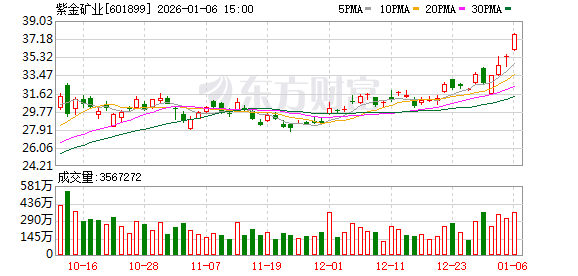
Market Overview - A-shares continued to rise strongly, with the Shanghai Composite Index achieving a 13-day winning streak and reaching a 10-year high, closing at 4083.67 points, up 1.5% [2] - The total trading volume in the A-share market exceeded 2.8 trillion yuan, with over 4100 stocks gaining, and more than 140 stocks hitting the daily limit [2] - The Hong Kong stock market also saw gains, with both major indices rising over 1% [2] Financial Sector Performance - The insurance sector saw significant gains, with New China Life Insurance rising over 6% and China Pacific Insurance up more than 5%, both reaching historical highs [3] - The recovery in long-term interest rates, with the 10-year government bond yield exceeding 1.8%, is expected to drive valuation recovery in the insurance sector [3] - The brokerage sector also performed strongly, with Huahlin Securities and Huatai Securities hitting the daily limit, and Dongfang Fortune rising nearly 6% [3] Commodity Sector Insights - The non-ferrous metals sector experienced a collective surge, particularly cobalt and nickel stocks, with companies like Chang Aluminum and Xiyuan Mining hitting the daily limit [6] - Zijin Mining reached a historical high, closing up over 6% with a trading volume of 131.9 billion yuan [6] Autonomous Driving Sector - The autonomous driving concept saw a significant rise, with Hanxin Technology hitting the daily limit of 30%, and Wanji Technology and Leirwei both reaching 20% gains [8] - NVIDIA's release of an open-source AI model aimed at enhancing autonomous driving technology is expected to stimulate demand for self-driving taxis and support global economic growth [9][10] Future Outlook - Analysts predict that 2026 will be a pivotal year for advanced driving technologies, with expectations for breakthroughs in policies, user acceptance, and business models [10]
2026年格隆汇“下注中国”十大核心资产涨疯啦!
Ge Long Hui A P P· 2026-01-06 11:56
Core Insights - The "Bet on China" top ten core asset portfolio launched by the company has shown strong performance, with a 3.6% increase on January 5, 2026, outperforming the Shanghai Composite Index and Hang Seng Index [1] - The portfolio has continued to rise, with a 2.65% increase on January 6, 2026, further exceeding the performance of major indices [1] - Year-to-date, the portfolio has accumulated a 6.14% increase, significantly surpassing the Shanghai Composite Index's 2.89% and Hang Seng Index's 4.29% [1] Company Performance - Alibaba-W (HK09988) saw a total increase of 7.0% over two trading days [1] - China Ping An (SH601318) increased by 5.8% [1] - WuXi AppTec (HK02268) rose by 4.4% [1] - Tencent Holdings (HK00700) increased by 4.3% [1] - Trip.com Group-S (HK09961) rose by 4.1% [1] - Oriental Fortune (SZ300059) increased by 2.5% [1] - Zhongji Xuchuang (SZ300308) rose by 2.2% [1] - Luoyang Molybdenum (SH603993) increased by 2.2% [1] - Gold ETF (SH518880) rose by 2.1% [1] - Wanhua Chemical (SH600309) increased by 0.9% [1] Future Outlook - The strong performance of core assets is attributed to the company's deep insights into industry trends and the economic pulse of China [2] - The company aims to continue identifying quality assets in the context of China's economic transformation, providing investors with precise asset allocation references [2] - The recent performance is seen as just the beginning of the value release of the core assets [2]
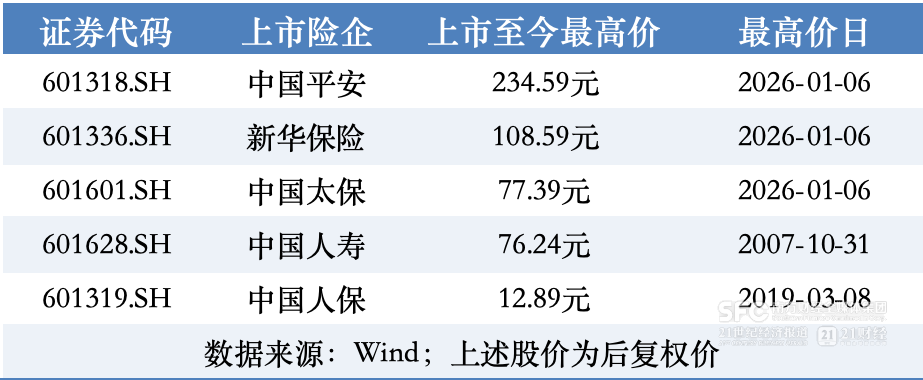
A股五大上市险企集体飘红,多股创历史新高
2 1 Shi Ji Jing Ji Bao Dao· 2026-01-06 11:47
Core Viewpoint - The insurance sector is experiencing a strong performance at the beginning of 2026, driven by a bull market, favorable policies, improved industry fundamentals, and positive institutional outlooks, leading to significant stock price increases and historical highs for several companies [1][3][4]. Group 1: Market Performance - The insurance industry index rose by 3.29%, with major listed insurance companies in A-shares collectively seeing gains [1]. - Multiple insurance stocks reached historical highs on January 6, 2026, including China Ping An, New China Life, and China Pacific Insurance [1]. - The total market capitalization of the five major listed insurance companies reached approximately 3.89 trillion yuan, an increase of about 128.8 billion yuan from the previous trading day [1]. Group 2: Key Drivers - The bull market is identified as a key driver for the insurance stock performance, with strong earnings elasticity and valuation recovery potential in an upward market [3]. - Recent policy adjustments by the National Financial Regulatory Administration, including changes to risk factors and asset-liability management, are expected to enhance the investment capacity of insurance companies [3][4]. - The insurance sector's fundamentals are improving, with expectations for premium income in 2026 to exceed forecasts, driven by a favorable liability environment [4]. Group 3: Financial Metrics - In the first eleven months of 2025, the insurance industry reported original premium income of 5.76 trillion yuan, a year-on-year increase of 7.6%, with life insurance premiums growing by 9.2% [5]. - The total assets of the insurance industry surpassed 40 trillion yuan, with net assets reported at 3.68 trillion yuan [6]. Group 4: Future Outlook - The insurance sector is expected to maintain its upward trend in 2026, supported by strong demand for protection and savings products, as well as ongoing policy support [7][8]. - However, potential risks include the pace of valuation recovery and the sustainability of the liability side, which will depend on product structure optimization and agent channel reforms [8]. - Long-term, the industry is shifting from a "scale-driven" model to a "value growth" model, with leading companies showing resilience due to asset-liability matching advantages [9].