
京东方

Search documents
大力发展数字消费,消费电子ETF(561600)盘中价格再创新高,连续3天净流入
Xin Lang Cai Jing· 2025-09-25 02:01
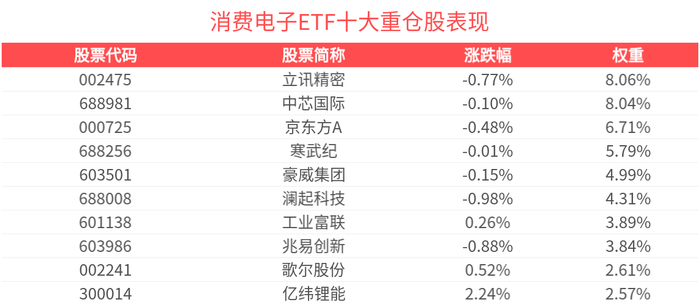
Group 1 - The core viewpoint of the news is the promotion of digital consumption through the development of digital products, particularly in the field of artificial intelligence and consumer electronics [1] - The guidance document emphasizes the need for companies to accelerate research and innovation in AI terminal products, aiming for specific penetration rates of 70% by 2027 and 90% by 2030 for smart terminals [1] - The consumer electronics sector is expected to see significant growth, with a focus on low-priced electronic products that can quickly gain market traction [1] Group 2 - The Consumer Electronics ETF (561600) has seen a recent increase, with a 0.27% rise in the CSI Consumer Electronics Theme Index (931494) as of September 25, 2025 [1] - Notable stock performances include Changying Precision (300115) up by 8.18%, and other companies like Dongsheng Technology (300073) and Huagong Technology (000988) also showing positive gains [1] - The Consumer Electronics ETF has experienced a cumulative increase of 7.62% over the past week [1] Group 3 - The Consumer Electronics ETF has recorded a net inflow of funds, with a maximum single-day inflow of 27.71 million yuan, totaling 51.92 million yuan over three days [2] - The CSI Consumer Electronics Theme Index includes 50 companies involved in component production and brand design, with the top ten stocks accounting for 54.8% of the index [2] - The top ten weighted stocks in the index include companies like Cambricon (688256) and Luxshare Precision (002475), with their respective weightings being 5.79% and 8.06% [2][3]

非遗为桥,深化文明间对话与合作
Bei Jing Ri Bao Ke Hu Duan· 2025-09-25 00:55
Core Insights - The salon focused on the international dissemination of intangible cultural heritage (ICH) amidst globalization and digitalization challenges, gathering over 50 representatives from UNESCO, cultural institutions, universities, and tech companies to discuss future strategies [1][2]. Group 1: Cultural Value and Identity - ICH embodies local social bonds and wisdom, offering a unique path for sustainable development distinct from Western industrial models, as seen in examples like China's 24 Solar Terms and Mexico's Day of the Dead [2]. - The protection of ICH aids in restoring ecological relationships and rebuilding connections between individuals and communities, while also serving as a vital carrier of cultural identity and soft power on the international stage [2]. Group 2: Digital Technology and Innovation - The application of digital technology is crucial for enhancing the visibility and engagement of ICH globally, with examples such as Thai youth utilizing digital tools to revitalize traditions and drive community development [2]. - Companies like BOE Technology Group are implementing digital initiatives to integrate ICH into modern life and promote it on international platforms through projects like the "Million Digital Cultural Experience Scenarios Plan" [2]. Group 3: Future Outlook and Collaboration - Experts at the salon emphasized a human-centered approach to ICH protection, advocating for respect for cultural diversity and local practices, as well as the integration of technology and culture [3]. - There is a call for deeper global cooperation in the field of ICH protection, aiming to create a more diverse, inclusive, and open collaborative mechanism that leverages digital technology to enhance the visibility and impact of ICH in promoting sustainable development [3].

明确提出支持成都做优做强极核功能加快高质量发展 四川需要更大更强的成都
Si Chuan Ri Bao· 2025-09-25 00:22
Core Viewpoint - The recent issuance of the "Opinions on Supporting Chengdu to Enhance Core Functions and Accelerate High-Quality Development" reflects the importance of Chengdu as a major city in China, aiming to strengthen its economic scale, core competitiveness, and functional quality to set a new benchmark for high-quality development and governance in super-large cities [1] Economic Scale and Growth - Chengdu's GDP is projected to exceed 3.2 trillion yuan by the end of the 14th Five-Year Plan period, requiring an average annual increase of over 140 billion yuan from 2025 to 2030 [3] - Chengdu's GDP for 2024 is estimated at 2.35 trillion yuan, significantly higher than Xi'an, which is nearly half of Chengdu's GDP [2] - Chengdu's economic growth has been robust, with a year-on-year GDP growth rate leading among the top ten cities in China [2] Industrial Development and Coordination - Chengdu's economy relies heavily on consumption, contributing over 65% to its economic growth, and it is one of the seven cities in China with a retail sales total exceeding 1 trillion yuan [4] - The city is focusing on enhancing its industrial base, with significant investments in manufacturing, including a major AMOLED production line by BOE, which is expected to make Chengdu a leading flexible display production base [7] - The "two-legged" approach to economic development emphasizes both consumption and industrial growth, addressing the need to strengthen the industrial sector while boosting consumer spending [6][7] Regional Coordination and Urban Development - The "strong county and active district" strategy aims to address economic imbalances within Chengdu, promoting coordinated development across its districts and surrounding areas [8][9] - Chengdu is implementing targeted development plans for its eight county-level cities, enhancing transportation links and economic contributions from these areas [9][10] - The city is fostering collaboration with surrounding regions to enhance resource sharing and economic integration, exemplified by successful partnerships in various industries [10][11]
电子行业半年报:超七成公司盈利 寒武纪、士兰微等扭亏为盈
Xin Hua Cai Jing· 2025-09-24 23:25
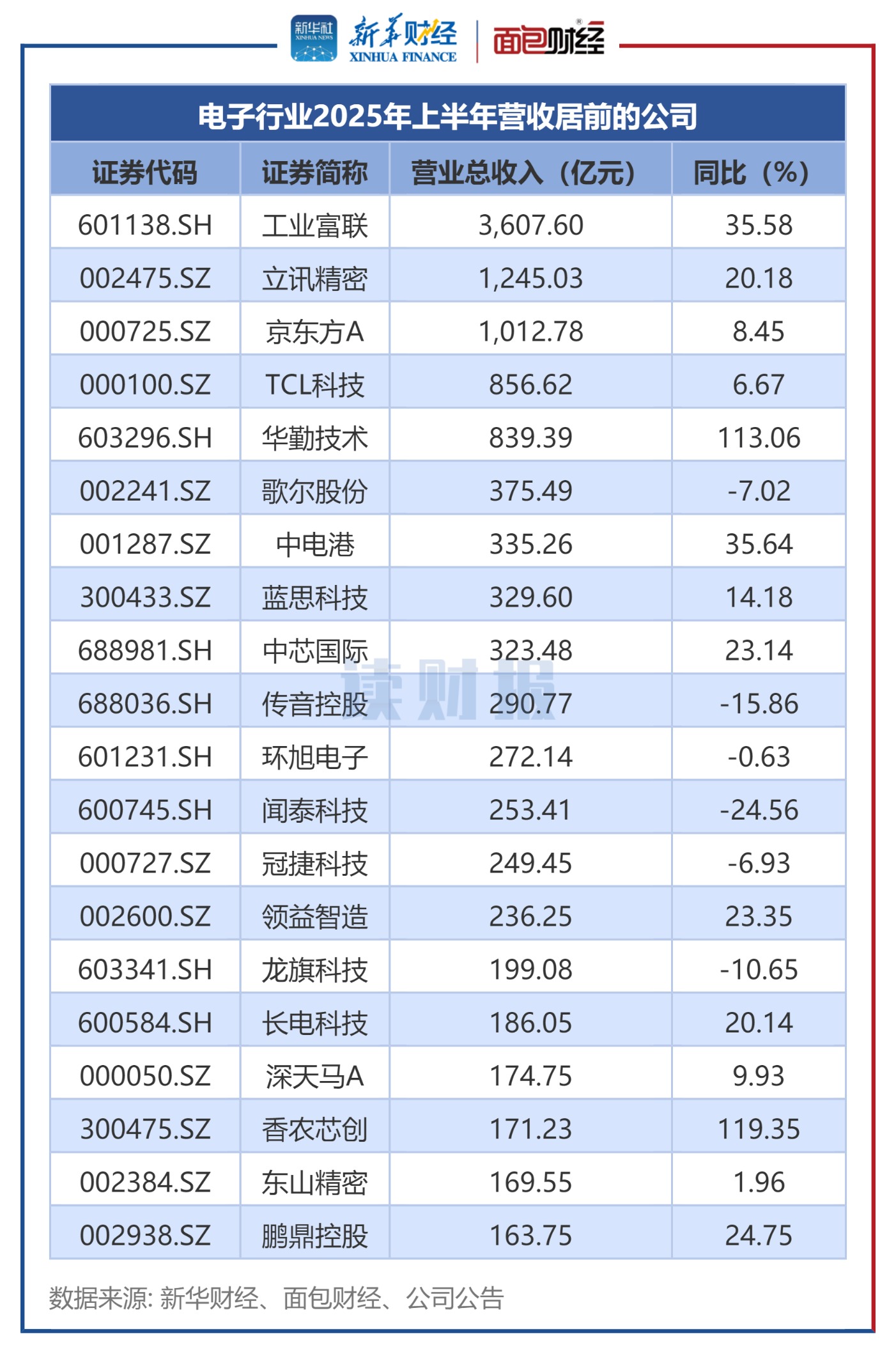
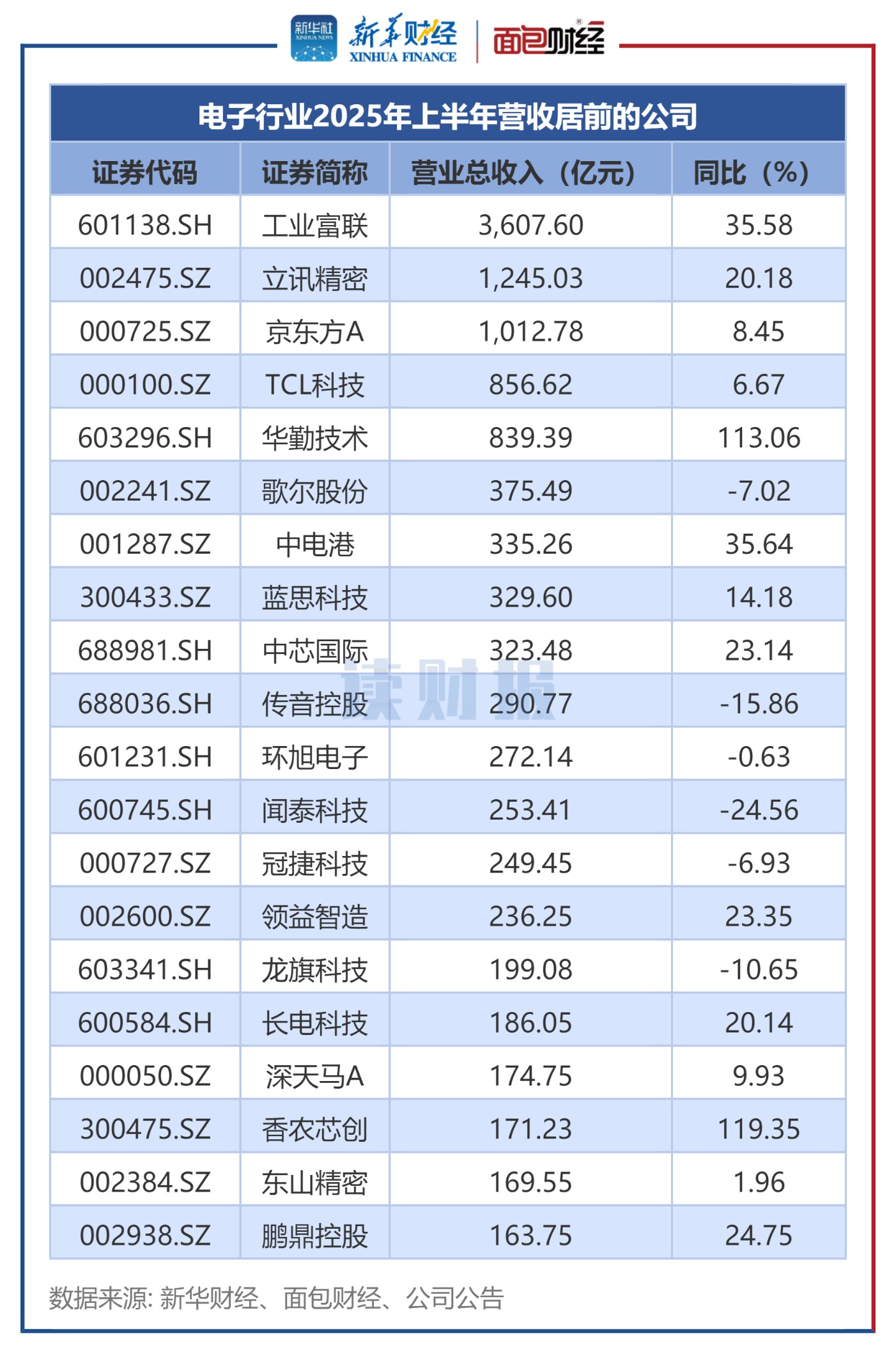
Core Insights - The electronic industry in China is experiencing a significant recovery, with a total revenue of 1,862.283 billion yuan in the first half of 2025, representing a year-on-year growth of 22.11% [1][2] - The net profit attributable to shareholders reached 86.265 billion yuan, marking a year-on-year increase of 33.09% [1][2] - Over 70% of companies in the electronic sector reported profitability, with notable turnarounds from companies like Cambrian and Silan Microelectronics [2][7] Revenue Performance - The top three companies by revenue in the electronic industry for the first half of 2025 are: - Industrial Fulian: 360.76 billion yuan - Luxshare Precision: 124.50 billion yuan - BOE Technology: 101.28 billion yuan [3][4] - Nearly 80% of the companies in the electronic sector achieved year-on-year revenue growth, with Cambrian leading with a staggering growth rate of 4,347.82% [4][5] Profitability Analysis - The average net profit margin for the electronic industry was 25.71%, a slight decrease of 0.37 percentage points year-on-year [1][8] - Industrial Fulian led in net profit with 12.113 billion yuan, significantly higher than its peers [5][6] - More than half of the electronic companies reported a year-on-year increase in net profit, indicating a robust recovery trend [1][2] Margin Trends - The average gross profit margin for the electronic sector decreased to 25.71%, with some companies like Chipone and Zhenray Technology reporting margins exceeding 70% [8][9] - Companies such as Helitai and Nanjiguang showed significant improvements in gross profit margins, indicating operational efficiency [8][10] Turnaround Companies - Several companies successfully turned losses into profits, including: - Cambrian: 2.881 billion yuan in revenue, a turnaround from previous losses - Silan Microelectronics: 6.336 billion yuan in revenue [7][8] - The trend of companies moving from loss to profit reflects a broader recovery in the electronic industry [7][8]





【读财报】电子行业半年报:超七成公司盈利 寒武纪、士兰微等扭亏为盈
Xin Hua Cai Jing· 2025-09-24 23:18
Core Insights - The electronic industry in China is experiencing a significant recovery, with a total revenue of 1862.283 billion yuan in the first half of 2025, representing a year-on-year growth of 22.11% [1][2] - The net profit attributable to shareholders reached 86.265 billion yuan, marking a year-on-year increase of 33.09% [1][2] - Over 70% of companies in the electronic sector reported profitability, with notable turnarounds from companies like Cambrian and Silan Microelectronics [2][7] Revenue Performance - The top three companies by revenue in the electronic industry for the first half of 2025 are: - Industrial Fulian: 360.76 billion yuan - Luxshare Precision: 124.50 billion yuan - BOE Technology: 101.28 billion yuan [3][4] - Nearly 80% of electronic companies reported year-on-year revenue growth, with Cambrian leading with a staggering growth rate of 4347.82%, achieving 2.881 billion yuan in revenue [4][12] Profitability Analysis - The average net profit margin for the electronic industry was 25.71%, a slight decrease of 0.37 percentage points year-on-year [8] - Industrial Fulian led in net profit with 12.113 billion yuan, significantly higher than its peers [5][6] - More than half of the electronic companies reported a year-on-year increase in net profit, indicating a robust recovery trend [1][2] Margin Trends - Companies like Chipone and Zhenray Technology reported exceptionally high gross margins, with Chipone at 86.54%, reflecting a year-on-year increase of 5.36 percentage points [8][9] - Several companies, including Huali Microelectronics and Hu Silicon Industry, reported negative gross margins, highlighting the competitive pressures in the industry [8] Notable Turnarounds - Cambrian and Silan Microelectronics were among over thirty companies that turned losses into profits in the first half of 2025 [1][2][7] - South Polar Light achieved a revenue of 398 million yuan, a year-on-year increase of 244.67%, and a net profit of 73 million yuan, up 982.43% [12]
从“招商内卷”到“育商竞合”:中国区域经济高质量发展的必由之路
Sou Hu Cai Jing· 2025-09-24 15:21
Core Insights - The article discusses the transformation of regional economic development in China, highlighting the shift from "招商内卷" (intense competition for investment) to "育商竞合" (nurturing business cooperation) as a necessary path for high-quality growth [2][25] - Hefei's unique approach to economic development serves as a model for other regions, emphasizing the importance of government as a strategic partner rather than a mere facilitator of investment [8][25] Group 1: Hefei's Economic Model - Hefei's government has adopted a "partner" mentality, investing directly in projects and sharing risks with enterprises, which has fundamentally changed the government-enterprise relationship [8][9] - The city has successfully attracted major investments, such as BOE Technology Group, by not just offering incentives but by actively participating in the projects [8][9] - The "Hefei model" emphasizes a cycle of strategic assessment, state-owned capital leadership, project implementation, equity exit, and sustainable development [9] Group 2: Challenges of Replicating the Hefei Model - The "Hefei model" is difficult to replicate due to the misalignment of short-term performance incentives with the long-term nature of industrial cultivation [14] - Many local governments prioritize immediate economic indicators, which discourages the patience required for nurturing emerging industries [14][15] - There is a significant gap in the capabilities of local governments to engage in modern industrial investment, which requires expertise beyond traditional administrative skills [15][16] Group 3: Keys to Breaking the Homogenization Dilemma - The article outlines five keys to fostering deep business development: 1. Scene-driven innovation, focusing on real-world applications rather than subsidies [19] 2. Ecological thinking, aiming for unique ecological niches rather than complete supply chains [20] 3. Capital empowerment, transitioning from land finance to patient capital that supports long-term growth [21] 4. Data-driven decision-making, utilizing big data and AI for informed industrial strategies [22] 5. Collaborative competition, encouraging cross-regional benefit-sharing mechanisms [23] Group 4: Implications for Regional Economic Development - Hefei's exploration provides a new paradigm for high-quality regional economic development in China, advocating for a shift from resource competition to ecological cooperation [25] - The essence of the Hefei model lies in the transformation of local governments into builders of industrial ecosystems and long-term value creators [25] - The model encourages regions to leverage their comparative advantages to occupy unique positions in the national and global industrial chains, moving away from homogeneous competition [25]

TCL在广州投下全球首创项目 “世界显示之都”诞生“新物种”
2 1 Shi Ji Jing Ji Bao Dao· 2025-09-24 12:21
Core Insights - The new display industry has become a focal point in global technology competition, with increasing penetration in flexible, foldable displays, and AI glasses [2] - Chinese display panel manufacturers have achieved nearly 50% of the global OLED market share in Q2 this year, marking a historical high [2][6] - TCL's investment in the world's first 8.6-generation printed OLED production line in Guangzhou is expected to significantly enhance China's position in the new display industry [3][8] Industry Developments - Major cities like Guangzhou, Hefei, and Beijing are emerging as winners in the new display industry, with TCL's T8 project set to commence in November with an investment of approximately 29.5 billion yuan [3][10] - The competition among leading panel manufacturers is increasingly focused on high-end display technologies like OLED, with Samsung and LG Display shutting down LCD factories to pivot towards OLED [4] - The investment in the T8 project is seen as a critical move for Guangzhou to develop a high-end display industry and to address long-standing issues of high costs and low yield in medium-sized OLED production [8][10] Market Trends - The IT device OLED market is experiencing a "gold rush," prompting accelerated construction and mass production of display production lines, with investments exceeding 50 billion yuan in the first half of the year [5] - Major Chinese panel manufacturers, including BOE and Visionox, have announced investments in 8.6-generation OLED production lines, totaling 63 billion yuan and 55 billion yuan respectively [6] - The T8 project aims to process approximately 22,500 glass substrates monthly, positioning China as a leader in high-generation AMOLED technology [8] Future Outlook - The T8 project is expected to achieve mass production between 2027 and 2028, coinciding with a surge in demand for medium-sized OLEDs, thereby enhancing Guangzhou's display industry ecosystem [12] - The display industry's future will involve deeper integration with various sectors, moving beyond traditional screens to applications like flexible displays and smart glasses [13][14] - Guangzhou's strategy to become a "world display capital" involves attracting major projects and fostering industry clusters, with a focus on technological innovation and market competitiveness [15][16]

千亿资金“竞逐”中尺寸IT面板
经济观察报· 2025-09-24 12:20
Core Viewpoint - The Chinese display panel industry has seen significant investments in the 8.6-generation OLED production lines, totaling approximately 150 billion yuan, driven by the demand for high-end IT panels such as laptops and tablets [2][5][10]. Investment Landscape - Major players like BOE, Visionox, and TCL Huaxing are heavily investing in the 8.6-generation OLED production lines, with investments of 630 billion yuan, 550 billion yuan, and 295 billion yuan respectively [2][3]. - TCL Huaxing's recent announcement of a 295 billion yuan investment contrasts with its previous statement indicating no plans for new 8.6-generation lines [2][3]. Technology Choices - Companies are adopting different technological routes: BOE and Samsung Display are focusing on the mature "evaporation" process, while TCL Huaxing is investing in the "printing" process, and Visionox is pursuing its proprietary "ViP" technology [3][18][20]. - The 8.6-generation line's larger glass substrate size (2290mm x 2620mm) allows for more efficient cutting of mid-size IT panels compared to the previous 6-generation lines [5][6]. Market Dynamics - The shift from LCD to OLED in the high-end IT market was catalyzed by Apple's launch of the OLED iPad Pro, prompting manufacturers to invest heavily in OLED technology [7][10]. - Despite initial optimism, LG Display has expressed caution regarding the demand for 8.6-generation OLEDs, delaying its investment plans until 2026 due to market uncertainties [9][21]. Competitive Strategies - Companies are adopting different strategies based on their financial health and market outlook: - BOE and Samsung Display are betting on established technologies for certainty and speed [15]. - TCL Huaxing and Visionox are seeking to leverage new technologies for cost advantages [18][20]. - Deepinma and LG Display are focusing on maintaining profitability in existing operations while cautiously evaluating new investments [21][22]. Financial Performance - As of mid-2025, major Chinese panel manufacturers reported improved financial results, with BOE achieving a revenue of 101.28 billion yuan, a year-on-year increase of 8.45% [13]. - In contrast, LG Display faced a complex financial situation, with a slight revenue decline despite a significant reduction in losses [13][21]. Conclusion - The competition in the mid-size IT panel market is intensifying, with various companies pursuing distinct paths based on their assessments of technology, market potential, and financial stability [22].

2025全国新一线城市排名出炉:重庆第3,合肥第11,佛山第15
Sou Hu Cai Jing· 2025-09-24 12:12
Core Insights - The latest ranking from the New First-Tier Cities Research Institute for 2025 shows that Chongqing has risen to 3rd place, Hefei remains at 11th, and Foshan ranks 15th, indicating that cities that can effectively integrate industry, population, and consumption will advance more rapidly [1] Group 1: Chongqing - Chongqing's rise is attributed to its acceleration in "smart manufacturing," with the Western Microelectronics Park and Liangjiang New Area contributing significantly [3] - The city produces one out of every four laptops globally, and its rail transit mileage has exceeded 600 kilometers, enhancing its commercial appeal [3] Group 2: Hefei - Hefei continues to be recognized as the "strongest venture capital city," with significant investments from companies like BOE Technology Group, NIO, and Changxin Storage, leading to a new industry output value exceeding 1 trillion [4] - The University of Science and Technology of China contributes over 10,000 graduates annually, resulting in a high net inflow of young talent, while housing prices remain lower than in the Yangtze River Delta [4] Group 3: Foshan - Foshan maintains its position through a dual-driven strategy of "manufacturing + home furnishings," ranking fifth nationally in industrial scale with strong exports in home appliances and ceramics [6] - The connectivity provided by the Nanhai and Shunde subway lines to Guangzhou facilitates a daily cross-city passenger flow of 1.7 million, allowing Foshan to benefit from urban integration [6]

TCL在广州投下全球首创项目,“世界显示之都”诞生“新物种”
2 1 Shi Ji Jing Ji Bao Dao· 2025-09-24 12:12
Core Insights - The new display industry is becoming a focal point of global technological competition, with increasing penetration in flexible, foldable, and AI glasses applications [1] - Chinese display panel manufacturers have achieved nearly 50% of the global OLED market share in Q2 this year, marking a historic high [1] - TCL's investment in the world's first 8.6-generation printed OLED production line in Guangzhou is expected to significantly enhance China's competitive position in the new display industry [2] Industry Developments - TCL's T8 project, with an investment of approximately 29.5 billion yuan, aims to support Guangzhou's strategic position in the global new display industry [2] - Major Chinese panel manufacturers like BOE and Visionox are also investing heavily in OLED production lines, with total investments reaching 63 billion yuan and 55 billion yuan respectively [4] - The overall investment in emerging fields like MLED and silicon-based OLED has exceeded 50 billion yuan in the first half of the year [4] Market Trends - The demand for OLED panels is driven by consumer preferences for high-quality visual experiences in IT products such as laptops and tablets [3] - The competition among leading panel manufacturers is increasingly focused on high-end display technologies like OLED, with Samsung and LG Display shutting down LCD factories to invest in OLED [2] Technological Advancements - TCL's printed OLED technology is the only domestically led technology route in the industry, positioning it as a leader in high-generation AMOLED production [4] - The successful operation of the T8 project is seen as a critical opportunity for Chinese manufacturers to surpass foreign competitors in high-generation AMOLED technology [4] Regional Development - Guangzhou has established itself as a key player in the new display industry, having attracted major companies and built a complete industrial chain covering upstream materials to downstream applications [6] - Despite its strengths, Guangzhou faces challenges in technology iteration and high-end product development compared to cities like Hefei and Shenzhen [7] Future Outlook - The T8 project is expected to enhance Guangzhou's display industry ecosystem and align with the anticipated surge in demand for mid-size OLED applications by 2027-2028 [8] - The integration of display technology with other industries, such as semiconductors and smart vehicles, is seen as a pathway for future growth [9] - The success of the T8 project will be a key indicator of the evolution of the global OLED industry landscape [12]