天弘基金

Search documents
宏利基金拟1000万自购旗下新型浮动费率基金
news flash· 2025-06-07 01:10
Group 1 - The core point of the article is that Manulife Investment plans to invest 10 million yuan in its newly launched floating rate fund, reflecting confidence in the long-term stability of the Chinese capital market [1] - The fund, named Manulife Smart Navigation Mixed Securities Investment Fund, is a new type of floating rate fund product introduced by Manulife Investment [1] - Other asset management companies such as Dongfanghong Asset Management, Tianhong Fund, Bosera Asset Management, China Europe Fund, and Xingzheng Global Fund have also announced their self-purchases since the launch of the first batch of floating rate funds on May 27 [1]
独立管理的产品全部正收益,他是如何做到的?
点拾投资· 2025-06-06 09:39
Core Viewpoint - The article highlights the investment philosophy and strategies of Tian Junwei, a prominent fund manager at Bosera Fund, emphasizing his unique GARP (Growth at a Reasonable Price) investment approach and his ability to generate consistent absolute returns in the public fund sector [1][3]. Group 1: Investment Strategy - Tian Junwei employs a GARP investment framework, focusing on buying growth stocks at reasonable valuations, which involves assessing both the quality and speed of growth [4][6]. - His investment style is characterized by a "middle-ground" approach, balancing between growth and value investing, and he emphasizes the importance of understanding different business models and their sustainability [3][4]. - The core of his strategy is to identify high-quality growth companies that are either in a significant industry growth trend or possess strong competitive advantages [6][7]. Group 2: Portfolio Management - Tian has developed a benchmark-oriented mindset in portfolio management, recognizing that a combination of standard and self-selected actions is essential for achieving sustained excess returns [8][16]. - He believes that excessive deviation from performance benchmarks can amplify both positive and negative market conditions, which is detrimental to achieving good excess returns [8][16]. - The primary source of Tian's excess returns is individual stock selection, as he is known for his ability to identify mispriced investment opportunities through extensive research [8][9][56]. Group 3: Stock Selection Process - Tian's stock selection process involves a dual approach: filtering stocks through financial reports and narrowing down choices based on industry trends [28][29]. - He emphasizes the importance of understanding industry trends to improve stock selection efficiency and success rates, aiming for a balanced portfolio that includes both high-potential "grey horses" and more established companies [29][55]. - His investment philosophy includes a focus on left-side buying, which requires a strong conviction in growth potential that differs from market consensus [31][32]. Group 4: Future Outlook - Tian identifies three promising investment directions: industrial digital transformation, industry safety and self-sufficiency, and emerging and future industries, particularly within the technology sector [57][59]. - He believes that these areas, while not necessarily short-term hot topics, will provide significant investment opportunities over the long term [60].


信用债ETF,正当时
HUAXI Securities· 2025-06-06 06:44
1. Report Industry Investment Rating No relevant content provided. 2. Core Viewpoints of the Report - In recent years, the index - type bond fund market in China has developed vigorously. In 2025, credit bond ETFs have witnessed significant expansion, and the newly issued 8 Shanghai - Shenzhen benchmark - market - making corporate bond ETFs have rapidly grown in scale. The newly listed benchmark - market - making corporate bond ETFs fill the gap in medium - long - term investment options, and credit bond ETFs are expected to continue to expand [1][11]. - Credit bond ETFs have prominent investment advantages, including policy support for expansion and innovation, "T + 0" trading in primary and secondary markets, comparable yields to medium - short - term bond funds with lower volatility, cost advantages, and transparent holdings which are friendly to bank self - operations [2]. - Shanghai - Shenzhen market - making credit bond ETFs offer considerable returns and controllable risks. They show stable long - term return capabilities and are relatively scarce products, making them reliable investment choices in the future [4][6]. 3. Summary by Relevant Catalogs 3.1 Credit Bond Index Funds are in the Initial Stage 3.1.1 Rapid Development of Index Bond Funds since 2024 - Due to factors such as the "asset shortage" in the bond market, declining interest rate centers, and the implementation of commercial bank capital regulations, index bond funds in China have entered a fast - development track since 2024. As of March 31, 2025, the management scale of index - type bond funds reached 1.2 trillion yuan, a 54.7% increase from the end of 2023, accounting for 13.5% of all bond - type funds [12][13]. - Credit bond index funds, as a new track, are in a "blue ocean" state of low stock and high growth. As of the end of March 2025, the scale of domestic credit bond index funds was 143.8 billion yuan (36 in total), accounting for 12.03% of the index - type bond fund scale. The scale has experienced multiple rounds of growth [13]. - Bond ETFs have attracted continuous capital inflows, and their proportion in index - type bond funds has been increasing. As of May 31, 2025, there were 29 bond ETFs with a total scale of about 28.92 billion yuan, nearly 2.7 times the scale at the end of 2023. In 2025, credit bond ETFs contributed significantly to the growth of bond ETFs [17][19]. 3.1.2 The Launch of the First Batch of Benchmark - Market - Making Credit Bond ETFs Fills the Gap - Interest rate bond ETFs have a complete product layout in various varieties and maturities, while credit bond ETFs are fewer in number and need to improve their tracking index varieties. The previously listed short - term financing ETF, corporate bond ETF, and urban investment bond ETF mainly provided medium - high - grade, medium - short - term allocation opportunities [22][23]. - The newly launched benchmark - market - making corporate bond ETFs offer medium - long - term investment options. The average remaining maturities of the constituent bonds of the Shanghai market - making corporate bond index and the Shenzhen market - making credit index are 4.63 years and 3.50 years respectively, and the issuing entities are mainly state - owned enterprises with mostly AAA ratings [23]. 3.2 Credit Bond ETFs Have Prominent Investment Advantages 3.2.1 Policy Supports the Expansion and Innovation of Credit Bond ETFs - In 2025, policies have been introduced to promote the development of credit bond ETFs. The China Securities Regulatory Commission proposed to steadily expand bond ETFs and introduce benchmark - market - making credit bond ETFs. The China Securities Depository and Clearing Corporation allowed credit bond ETFs to pilot margin - trading repurchase in the exchange and exempted the concentration constraints of credit bond ETF collateral [2][24][25]. - On May 29, 2025, 9 credit bond ETFs became the first batch of general pledge - style repurchase collateral, which enhances the product attractiveness of credit bond ETFs and is expected to promote product expansion and increased activity [25][26]. 3.2.2 Credit Bond ETFs Enable "T + 0" Redemption and Trading in the Secondary Market - Bond ETFs can achieve "T + 0" real - time trading in primary and secondary markets, which improves capital utilization efficiency and the liquidity of fund shares. Investors can redeem and trade on the same day, enabling efficient switching between bonds and fund shares [27]. 3.2.3 Credit Bond ETFs Have Comparable Yields to Medium - Short - Term Bond Funds - Although credit bond ETFs generally underperformed active credit bond funds in the past few years, their yields are now comparable to those of active credit bond funds. In most cases in the past 4 years, their returns were higher than those of short - term and medium - short - term bond funds, with significantly lower volatility [28][30]. - In the first quarter of 2025, the performance of the bond market was differentiated. Credit bond ETFs showed relatively weak performance, but overall, the return gap between credit bond ETFs and active credit bond funds is narrowing [30]. 3.2.4 Credit Bond ETFs Have Cost Advantages - The management cost of active credit bond funds is generally high, while credit bond ETFs have lower management and custody fees. As of the end of March 2025, the combined management and custody fees of credit bond ETFs were about 0.22%, 15bp lower than those of active credit bond funds [3][34]. 3.2.5 Credit Bond ETFs Have Transparent Holdings and are Friendly to Bank Self - Operations - Bond ETFs have relatively high transparency in holding information. They publish redemption shares daily, and the index compilation rules and constituent bonds are easily accessible. Compared with active credit bond funds with opaque holdings, credit bond ETFs help banks reduce unnecessary capital consumption under the capital regulations [3][35]. 3.3 Shanghai - Shenzhen Market - Making Credit Bond ETFs: Considerable Returns and Controllable Risks - In 2024, long - term interest rate bond ETFs performed well, while credit bond ETFs had relatively short - duration tracking indexes, with returns ranging from 2.23% to 4.27% and better - controlled drawdowns. In 2025, the bond market was weak, and credit bond ETFs outperformed due to the coupon advantages of underlying assets, with year - to - date returns ranging from 0.34% to 0.83% and controllable drawdowns [4][5]. - From the index perspective, the Shenzhen market - making credit index and the Shanghai market - making corporate bond index have good risk - return characteristics. Their return capabilities are between the 3 - 5 - year and 1 - 3 - year implied AA + credit wealth indexes, and their risk levels are similar to the Wind medium - long - term bond index [5][6]. - The rolling 3 - month investment performance of the Shenzhen market - making credit index and the Shanghai market - making corporate bond index shows that they have relatively high return ceilings compared to indexes with similar volatility [6].
首批浮动费率基金发售正酣::东方红核心价值提前结束募集 易方达嘉实超3亿 交银万家不足亿
Xin Lang Ji Jin· 2025-06-06 04:16
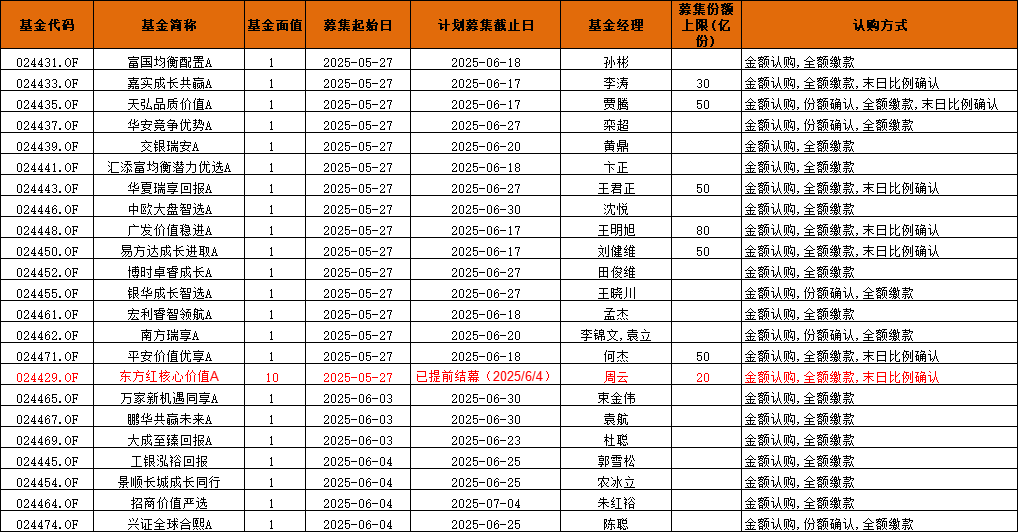
Core Viewpoint - The public fund market is experiencing a new trend with the emergence of floating fee rate funds, which have shown significant differentiation in their fundraising performance [1][2][4]. Fundraising Performance - The fundraising situation for new floating fee rate funds is notably varied, with some funds achieving strong sales and even ending their fundraising early, such as the Oriental Red Core Value Fund, which ended its fundraising on June 4, 2023, ahead of the scheduled date [4][5]. - Specific sales figures include: - E Fund Growth and Progress Mixed Fund sold 433 million RMB through the Bank of China channel - Harvest Growth and Win Fund sold 361 million RMB through the Bank of China channel - Tianhong Quality Value Fund sold 355 million RMB through the Pudong Development Bank channel - Great Wall Ultimate Return Mixed Fund sold 210 million RMB through the Industrial and Commercial Bank of China channel - Wanji New Opportunity Shared Mixed Fund sold 43.08 million RMB through the Industrial and Commercial Bank of China channel - Jiao Yin Rui An sold 59 million RMB through the Pudong Development Bank channel [1][5]. Market Trends - Since the first batch of floating fee rate funds was launched on May 27, 2023, the market has seen a continuous rise in interest, with 124 public funds opening for subscription in May, averaging a subscription period of 20.05 days [2][6]. - In June, despite only four trading days in the first week, 36 new products were launched, with floating fee rate funds being the highlight of the new offerings [2]. Industry Participation - Several well-known fund companies, including Tianhong Fund, Bosera Fund, and Xingzheng Global Fund, have actively participated in launching floating fee rate funds and have invested their own capital to support these new products, indicating confidence in this innovative model [2][6]. Challenges and Future Outlook - The introduction of floating fee rate products represents a significant innovation in the public fund industry, requiring fund companies and managers to adapt to new operational demands, such as real-time tracking of management fees based on holding periods and performance [6]. - The industry anticipates that self-purchase by fund companies may become a new norm, with leading institutions accelerating their involvement in such products, promoting a healthier model focused on investor interests [6].
回调获资金净流入,创新药ETF天弘(517380)连续两日“吸金”,最新基金份额创历史新高
2 1 Shi Ji Jing Ji Bao Dao· 2025-06-06 01:39
Group 1 - The Tianhong Innovation Drug ETF (517380) experienced a decline of 1.68% on June 5, yet it attracted a net inflow of 6.45 million yuan, marking the second consecutive day of net inflows, totaling over 18.2 million yuan [1] - As of the latest close, the fund's shares reached a historical high of 668 million [1] - The ETF recorded a single-day trading volume of 25.09 million yuan, the highest since April 2023 [1] Group 2 - Aijian Securities expressed optimism regarding the trend of Chinese innovative drugs entering global markets, highlighting that the recent ASCO conference showcased significant research achievements [2] - The Chinese pharmaceutical industry is positioned in the global first tier for ADC, bispecific antibodies, and cell therapy, with clear advantages in R&D and production costs [2] - The increasing recognition and influence of Chinese innovative drugs in the global market is expected to accelerate the trend of innovation going abroad, creating a positive feedback loop [2]
国泰海通|固收:纳入质押库即将落地,信用债ETF全解析——被动指数债基系列专题五
国泰海通证券研究· 2025-06-05 22:12
Core Insights - The introduction of general pledged repos for credit bond ETFs is expected to equalize the functional differences between credit bond ETFs and underlying assets, potentially lowering financing costs and enhancing investor returns [1][2]. Group 1: General Pledged Repo Implementation - Nine credit bond ETFs have received approval letters from China Securities Depository and Clearing Corporation, allowing them to be included in the repo collateral pool, with a total scale exceeding 70 billion yuan as of the end of May [1]. - The implementation of general pledged repos is anticipated to release policy dividends, further promoting the growth of credit bond ETFs [1][2]. Group 2: Mechanism and Risk Management - The standard bond system will be adopted for the general pledged repo, with collateral eligibility determined by bond type and rating, while the 2025 guidelines expand the scope but raise rating requirements [2]. - Daily mark-to-market pricing will be used for repo discount rates, and any adjustments in collateral eligibility or discount rates may necessitate timely replenishment of collateral to avoid shortfall risks [2]. Group 3: Benefits of Credit Bond ETFs - Using credit bond ETFs as collateral can enhance convenience and reduce the volatility of discount rates, thereby lowering pledge risks and overall financing costs [3]. - The frequency and magnitude of discount rate adjustments for credit bonds can lead to higher transaction costs during extreme market conditions, making ETFs a more stable option for collateral [3]. Group 4: Performance Differentiation Among Bond ETFs - Performance differentiation may occur among bond ETFs, even those tracking the same index, due to variations in underlying asset liquidity and management strategies [4]. - Index funds may adopt sampling replication methods and exhibit active management characteristics to address liquidity constraints, leading to potential deviations from the index [4].


创新药ETF天弘(517380)大幅回调,机构:三大因素驱动行业进入至少3年的上行周期
2 1 Shi Ji Jing Ji Bao Dao· 2025-06-05 06:33
Group 1 - The pharmaceutical sector has recently experienced a significant pullback, with the innovative drug concept seeing a net outflow of nearly 2.5 billion yuan in A-shares [1] - The Tianhong Innovative Drug ETF (517380) reached a new high for the year before experiencing a substantial decline, dropping 2.75% with a trading volume of 22 million yuan, and most constituent stocks fell nearly 5% [1] - The Tianhong Innovative Drug ETF is the only product tracking the Hang Seng-Hu-Shen-Hong Kong Innovative Drug Selected 50 Index, which includes leading innovative drug companies from the three markets [1] Group 2 - Dongwu Securities predicts that 2025 will mark the explosive growth of China's innovative drug industry, driven by three core factors: significant BD transactions, profitability turning points for leading companies, and an improving policy environment [2] - Guosheng Securities acknowledges short-term trading pullback risks but emphasizes the solid underlying logic and clear trends in the innovative drug sector, maintaining a positive outlook for the innovative drug bull market [2] - The market size of China's innovative drugs is expected to exceed 2 trillion yuan by 2030, with a compound annual growth rate of 24.1% [2]


IM深度贴水环境下,如何在基金投资中应对潜在风险?
Shenwan Hongyuan Securities· 2025-06-05 03:44
1. Report Industry Investment Rating There is no information provided in the content about the report industry investment rating. 2. Core Viewpoints of the Report - Since 2025, the contango of various stock index futures contracts has deepened significantly. As of May 30, 2025, the annualized basis rate of IM futures reached -16.59%, approaching the contango levels after the market decline on April 7, 2025, and during the rapid decline of small - cap stocks from late January to early February 2024 [3][10]. - The reasons for the deep contango of IM02 recently include increased hedging demand due to amplified volatility, profit - taking of long positions after the rebound of spot prices, and a possible significant decline in the scale of structured option products such as snowball - like products [3]. - The current crowding degree of small - cap stocks is relatively high, with high trading activity, elevated valuations, and an increasing number of days with large price fluctuations [3]. - To deal with the potential risks of small - cap stocks in fund investment, investors should identify products exposed to small - cap stocks in advance, pay attention to "pseudo - zero market - value exposure" products, and can choose balanced products with relatively large market - value holdings or products with good investment capabilities in adverse small - cap market environments [3][40]. 3. Summary According to the Directory 3.1 From the Deep Contango of IM to Analyze Small - Cap Stocks - Are Small - Cap Stocks Facing Crowding Risks Again? 3.1.1 IM Futures Contango Situation - The contango of various stock index futures contracts has deepened since 2025. By the end of May, the annualized basis of IH, IF, and IC reached -5.97%, -7.49%, and -12.59% respectively, with significantly higher contango levels compared to the beginning of the year. The annualized basis rate of IM futures was -16.59% as of May 30, 2025 [3][10]. 3.1.2 Reasons for the Deep Contango of IM Futures - **Increased hedging demand due to amplified volatility**: In early April, market volatility increased due to the trade war, with the 1 - month rolling annualized volatility of CSI 1000 exceeding 45%. The ample Alpha in the small - cap market also increased the attractiveness of neutral strategies and short - selling demand [15]. - **Changes in contract volume and structure**: After the index rebounded on April 7, the total futures contract holdings decreased rapidly, likely due to long - position profit - taking, which intensified the contango. As the delivery week approached, short - term contract contango was expected to converge quickly, leading to early roll - over of long - term hedging demand to buy forward contracts and intensifying the contango [18]. - **Decreased demand for structured option products**: Structured option products such as snowball - like products may face a significant decline in scale recently. The notional principal of over - the - counter derivatives linked to stock indices has decreased significantly since October 2024, from 90.963 billion yuan in September 2024 to 54.440 billion yuan in March 2025, which is consistent with the change in contango [21]. 3.1.3 Potential Impact of Deep Contango - Extreme contango or backwardation may be followed by index movements. Extreme backwardation may indicate market panic and could be followed by a rebound. In the past, when the CSI 1000 experienced a short - term decline of over 10% in 10 trading days, the current - quarter IM futures were in a deep contango situation [24]. 3.1.4 Crowding Degree of Small - Cap Stocks - **High trading activity**: Although the crowding degree of small - cap stocks decreased in May, trading activity remained high. The trading volume of CSI 1000 as a proportion of the total decreased from 23.2% in February 2025 to 19.3% in May 2025, and the turnover ratio also declined but remained at a similar level to December 2023. The trading activity of micro - cap stocks increased significantly recently [29]. - **Elevated valuations**: The valuations of small - cap indices are currently at relatively high levels. The PB ratio of the micro - cap stock index has increased significantly, similar to the trend at the end of 2023. The rolling excess return of the micro - cap index is also at a high level [33]. - **Increased frequency of large price fluctuations**: The number of days with large price fluctuations of micro - cap stocks has increased recently. Since 2025, the proportion of days with large upward price fluctuations has also been at a high level [34]. 3.2 How to Deal with Potential Downward Risks of Small - Cap Stocks in Fund Investment? 3.2.1 Dealing with Potential Downward Risks of Small - Cap Stocks in Fund Investment - **Identify exposed products**: Besides products with obvious long - term exposure to small - cap styles, some products that enhance returns by holding micro - cap stocks may also be affected by the decline of small - cap stocks. "Pseudo - zero market - value exposure" products also need attention [40]. - **Adjust fund selection**: Investors can choose balanced products with relatively large market - value holdings to hedge against potential risks, or prefer products with good investment capabilities in adverse small - cap market environments [40]. 3.2.2 Differences Among Small - Cap Style Products - **Degree of market - value sinking**: Different small - cap style products have different degrees of market - value sinking. For example, Noan Multi - Strategy has a more obvious market - value sinking, while others may have small adjustments in market - value styles [47]. - **Turnover rate**: The turnover rates of small - cap style products vary. GF Quantitative Multi - Factor has a relatively high turnover rate, while CITIC Prudential Multi - Strategy has a moderately low turnover rate [47]. - **Portfolio construction method**: Western Securities Event - Driven focuses on industry allocation and makes active industry adjustments, with more concentrated industry and stock holdings. Other products' fund managers make fewer industry adjustments and have more dispersed stock holdings [50]. - **Timing operations**: CITIC Prudential Multi - Strategy has a long - term tendency for timing operations and recently reduced its positions. Other products pay less attention to timing [50].
YiwealthSMI|基金公众号首个10W+!华夏基金27周年讲述四代人的财富故事
Di Yi Cai Jing Zi Xun· 2025-06-05 03:06
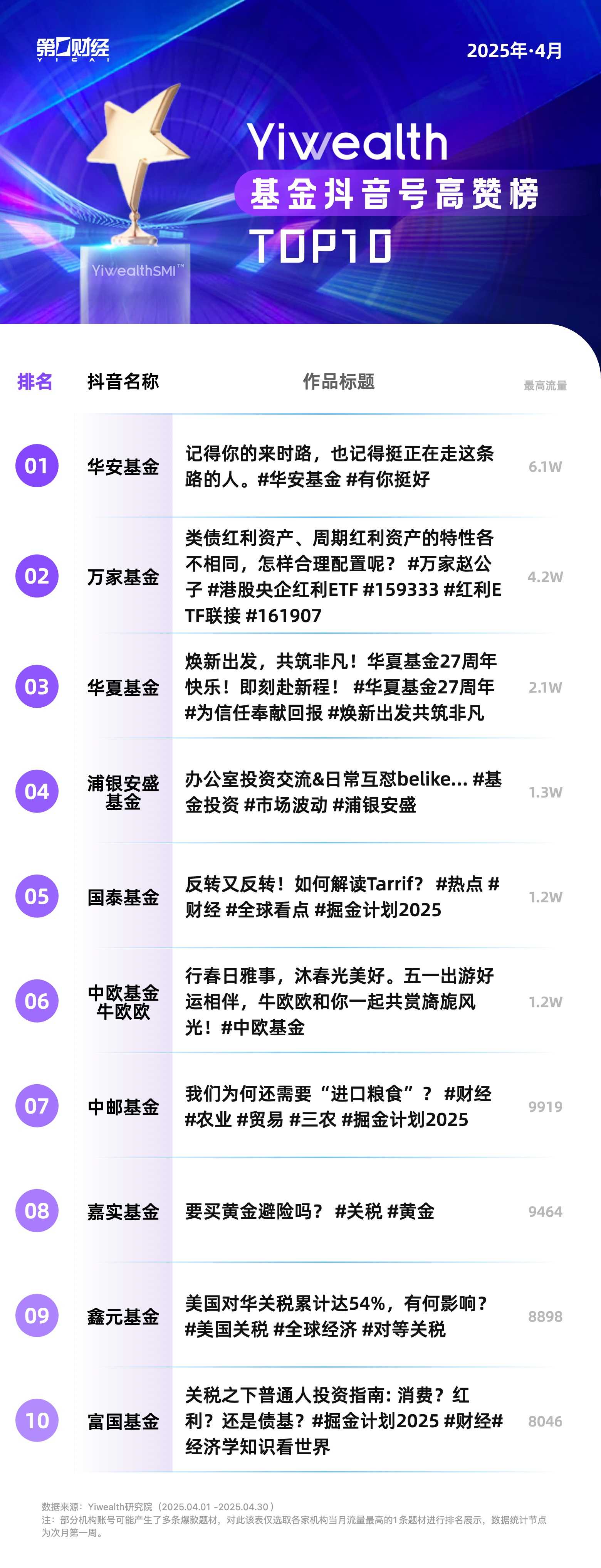
Group 1 - The fund social media index for April 2025 shows stability in the overall rankings, with few changes in the institutions listed [1] - New entrants include Xingzheng Global Fund and Huafu Fund, replacing Yongying Fund and Dongfanghong Asset Management from the previous month [1] - The trending topics on Douyin for funds have shifted with the seasons, highlighting the platform's ability to drive traffic through current events [1] Group 2 - The top content on video platforms includes diverse themes such as financial analysis, brand promotion, and event marketing, indicating a growing demand for varied financial content [2] - Notable performances include Guotai Fund discussing the implications of tariffs and Harvest Fund analyzing the investment value of gold amid market uncertainties [2] - Brand promotions from various funds, such as the 27th anniversary celebrations of Huaxia Fund, showcase their commitment to connecting with different generations of investors [2] Group 3 - The wealth account platform primarily features graphic content, with a notable live broadcast focusing on new product launches [3] - The top article on public accounts is a celebratory piece from Huaxia Fund, which achieved over 100,000 views, demonstrating effective cross-platform promotion [3] - Other popular content includes promotional activities centered around cash rewards, reflecting a strategy to engage users [3]
创新浮动费率基金“火”了,公募真金白银抢筹
Huan Qiu Wang· 2025-06-05 02:36
Core Viewpoint - The recent emergence of innovative floating fee rate funds in China's public fund market signifies a shift towards a more investor-centric model, with major fund companies actively participating and demonstrating confidence in this new approach [1][3]. Group 1: Market Trends - Currently, there are 19 floating fee rate funds available in the market, with participation from well-known fund companies such as Tianhong Fund, Bosera Fund, and Xingzheng Global Fund [1]. - Xingzheng Global Fund announced a commitment of 20 million yuan to its own fund, marking it as the only initiator fund among the first batch of innovative floating fee rate funds [3]. - Other leading institutions like Bosera Fund and Tianhong Fund have also committed 10 million yuan each to their respective floating fee rate funds, indicating a trend of self-investment among fund managers [3]. Group 2: Implications of Self-Investment - The collective self-investment behavior of fund companies and managers signals a strong confidence in the long-term value of these products, aiming to attract more investors [3]. - This trend also indicates that the floating fee rate reform, promoted by regulatory bodies, has moved from a policy framework to practical implementation in the market [3]. - Industry experts believe that self-investment may become the "new normal," pushing the industry towards a healthier model focused on investor interests [3]. Group 3: Challenges and Innovations - The introduction of floating fee rate funds presents new operational challenges for fund companies, requiring upgrades to valuation and accounting systems to accommodate real-time fee calculations [4]. - Fund managers are tasked with stabilizing fund net value performance to ensure a positive interaction between fees and performance over longer holding periods [4]. - The new model also complicates cash flow management for fund companies, as management fees are only finalized upon redemption, necessitating the pre-allocation of higher-than-benchmark fees [4]. - Despite these challenges, the launch of floating fee rate funds is seen as a milestone in the public fund industry, representing a significant innovation in traditional profit models and a move towards prioritizing investor interests [4].