快手

Search documents
63.36亿主力资金净流入,快手概念涨2.49%
Zheng Quan Shi Bao Wang· 2025-12-31 09:32
Group 1 - Kuaishou concept stocks rose by 2.49%, ranking second in the concept sector, with 37 stocks increasing in value [1][2] - Notable gainers include BlueFocus, which hit a 20% limit up, and Liou Co., which also reached the limit up, while Yidian Tianxia, Xuan Ya International, and Zhi De Mai saw increases of 10.23%, 8.20%, and 6.98% respectively [1][2] - The stocks with the largest declines included Online Offline, Qingniao Fire Protection, and Bainacheng, which fell by 5.73%, 4.28%, and 3.48% respectively [1][2] Group 2 - The Kuaishou concept sector attracted a net inflow of 6.336 billion yuan, with 30 stocks receiving net inflows, and 9 stocks exceeding 100 million yuan in net inflows [2][3] - BlueFocus led the net inflow with 2.762 billion yuan, followed by Liou Co. with 2.599 billion yuan, and Yidian Tianxia with 204 million yuan [2][3] Group 3 - In terms of net inflow ratios, Liou Co., BlueFocus, and Capital Online had the highest ratios at 47.49%, 24.74%, and 11.22% respectively [3] - The Kuaishou concept stocks with significant net inflows include BlueFocus, which rose by 20.00% with a turnover rate of 29.54%, and Liou Co., which increased by 9.94% with a turnover rate of 17.00% [3][4]



全域聚势,年货爆发,快手磁力引擎2026年货节营销作战图重磅发布
Jin Rong Jie Zi Xun· 2025-12-31 08:59
Core Insights - The upcoming Lunar New Year presents a significant opportunity for brands to capture consumer attention and build long-term assets, with Kuaishou emerging as a key platform for marketing during this period [1][3] - Kuaishou's user engagement is expected to increase by 14% during the 2025 Spring Festival, with a 26% faster conversion cycle for the R3 demographic and a 101% higher new customer ARPU compared to regular periods, creating fertile ground for business growth [1] Group 1: Marketing Strategies - Kuaishou's "Magnetic Engine" has launched a comprehensive marketing campaign for the 2026 New Year goods festival, providing a full-spectrum operational guide to assist merchants in maximizing their sales [3][4] - The marketing strategy is built on three pillars: "Golden Bull Strategy," "Product Aggregation Strategy," and "Data Management," supported by substantial incentive policies and innovative approaches [4][12] Group 2: Consumer Trends - During the 2025 New Year festival, search volumes for keywords like "New Year snacks," "New Year's Eve dishes," and "food live streaming" surged, with significant GMV growth in categories such as snacks, fresh produce, and gift boxes [4] - The primary consumer demographic consists of families aged 31-40 and 50+, presenting clear growth opportunities for brands [4] Group 3: Implementation Tactics - The "Golden Bull Strategy" focuses on a step-by-step approach to help merchants accurately gauge growth rhythms, utilizing data-driven insights to identify potential bestsellers ahead of the festival [8] - The "Product Aggregation Strategy" integrates various marketing resources, including celebrities and influencers, to create diverse promotional scenarios that enhance brand exposure and consumer engagement [8][11] Group 4: Incentives and Support - Kuaishou's marketing campaign includes attractive policies such as cash subsidies and diverse incentive mechanisms to support merchants of all sizes, aiming to lower operational costs and maximize marketing potential [12][14] - Specific activities like the "Million Points Battle" and "Dividing the Million Prize Pool" are designed to engage active merchants and provide substantial rewards based on their performance during the festival [12][14] Group 5: Overall Impact - Kuaishou's integrated approach combines content-driven marketing, extensive resource exposure, and intelligent tools to facilitate a dual benefit of brand awareness and sales performance during the New Year festival [16]


华人掌舵Meta AI 的格局,已经初步形成了
3 6 Ke· 2025-12-31 08:48
Core Insights - The acquisition of Manus team by Meta signifies a significant shift in leadership and strategy within Meta's AI division, particularly with the rise of Chinese talent in key positions [1][5][21] Group 1: Leadership Changes - Xiao Hong is set to become the Vice President at Meta, reporting directly to COO Javier Olivan, marking a notable transition from entrepreneur to executive [2][21] - Alexandr Wang, co-founder of Scale AI, has been appointed as the Chief AI Officer at Meta, leading the newly established Meta Super Intelligence Lab (MSL) [6][10] - Shengjia Zhao, a prominent figure in AI, has been named Chief AI Scientist at MSL, further solidifying the presence of Chinese talent in Meta's leadership [15][21] Group 2: Organizational Restructuring - Meta's AI business underwent significant restructuring, with MSL becoming the core of its AI operations, absorbing various departments and focusing on closed-source models [10][11] - The restructuring has led to a clear hierarchy where Wang is positioned as the top authority in AI, with Yang Likun now required to report to him [11][12] - The reorganization reflects a strategic shift from open-source to closed-source AI development, as indicated by Yang Likun's departure from Meta [11][12] Group 3: Talent Acquisition and Strategy - Meta has aggressively recruited over 50 AI researchers and engineers from competitors like OpenAI and Google, with a notable proportion being of Chinese descent [12][13] - The company has reportedly offered substantial salaries, with some offers exceeding $200 million, to attract top talent [12][13] - Meta's strategy includes not only talent acquisition but also a focus on developing competitive AI products, particularly in the AI Agent space [20][21] Group 4: Manus Acquisition and Future Prospects - The acquisition of Manus is seen as a strategic move for Meta, allowing the team to operate within a larger ecosystem while maintaining agility [20][21] - Manus, which focuses on AI Agents, is positioned to leverage Meta's resources for growth, indicating a strong alignment with Meta's AI ambitions [20][21] - The integration of Manus into Meta's AI framework highlights the company's commitment to enhancing its capabilities in the competitive AI landscape [20][21]


“人工智能+”:中国AI开源破局,烟火落地
Xin Hua She· 2025-12-31 08:41
Core Insights - The article discusses the rapid integration of artificial intelligence (AI) into daily life in China, highlighting its practical applications across various sectors by 2025, showcasing a shift from experimental technology to everyday utility [1][2][3] Group 1: AI Development and Ecosystem - The "Artificial Intelligence +" initiative is a significant strategic deployment by the Chinese government, aiming to combine digital technology with manufacturing and market advantages, supporting the widespread application of large models and the development of new intelligent terminals [2][3] - China's open-source AI ecosystem is accelerating, with data showing that as of August 2025, the cumulative download of open-source models in China has surpassed that of the United States, indicating global developer interest [2][3] - The emergence of the open-source model DeepSeek-R1 marks a critical milestone in China's AI technology, challenging the dominance of closed-source models from major U.S. companies [3][4] Group 2: Technological Breakthroughs - DeepSeek's open-source approach has led to significant advancements in AI, with its models achieving performance scores close to leading closed-source models, demonstrating the potential of open-source innovation [3][4] - The launch of DeepSeek's open-source initiatives has resulted in a rapid increase in user engagement, with its app reaching over 30 million daily active users within 21 days of launch [5][6] - The performance and quality of Chinese AI models are nearing parity with those of the U.S., as highlighted in the Stanford University AI Index Report [5][6] Group 3: AI in Industry and Daily Life - AI is transforming various industries, enhancing productivity and efficiency, particularly in creative fields, software development, and healthcare, by automating complex tasks and reducing costs [8][13] - The integration of AI into daily life is evident, with applications ranging from health monitoring to educational assistance, making AI a valuable partner in everyday activities [15][16][17] - AI's role in content creation and software development is revolutionizing traditional processes, allowing for rapid production and lowering barriers for small businesses and individual developers [13][19] Group 4: Challenges and Future Directions - Despite the rapid growth of AI, challenges such as technical limitations, ethical concerns, and the need for regulatory frameworks remain, necessitating a collaborative approach to address these issues [19][20][21] - The future of China's AI industry is expected to focus on deepening application scenarios, enhancing open-source ecosystems, and establishing robust ethical and safety standards [22][23]
快手-W(01024.HK)12月31日耗资1972.42万港元回购31万股
Ge Long Hui· 2025-12-31 08:33
Group 1 - Kuaishou-W (01024.HK) announced a share buyback on December 31, spending HKD 19.7242 million to repurchase 310,000 shares [1] - The buyback price per share ranged from HKD 63.30 to HKD 63.75 [1]
快手-W12月31日斥资1972.4万港元回购31万股
Zhi Tong Cai Jing· 2025-12-31 08:33
Group 1 - The company Kuaishou-W (01024) announced a share buyback plan, intending to repurchase 310,000 shares for a total cost of HKD 19.724 million [1] - On December 31, 2025, the company will issue 3,330 shares due to the exercise of options under the employee stock ownership plan prior to the initial public offering [1]
快手-W(01024)12月31日斥资1972.4万港元回购31万股
智通财经网· 2025-12-31 08:29
Group 1 - Kuaishou-W (01024) announced a share buyback of 310,000 shares for a total cost of HKD 19.724 million on December 31, 2025 [1] - Additionally, 3,330 shares will be issued on December 31, 2025, as part of the employee stock ownership plan prior to the initial public offering [1]
世界并非注定如此|我们的四分之一世纪
经济观察报· 2025-12-31 08:27
Core Viewpoint - The article reflects on significant events and transformations over the past 25 years, emphasizing that the world is shaped by unique actions taken by individuals and society, rather than being predetermined [5][13]. Group 1: Historical Context - The turn of the millennium in 1999 was marked by global optimism, with people celebrating the arrival of the new century amidst rapid economic growth and technological advancements [11]. - In 2001, significant figures like Xu Zhiyuan joined the newly founded Economic Observer, reflecting a period of change and the willingness of society to engage with challenging issues [12]. - The early 2000s saw a shift in the perception of migrant workers, with the "Sun Zhigang incident" in 2003 marking a turning point in the acceptance of urban labor [12]. Group 2: Economic Developments - The 2008 financial crisis, triggered by the U.S. subprime mortgage crisis, had profound effects on China, leading to a massive stimulus policy and rapid urbanization that transformed the real estate market [16]. - The Beijing Olympics in 2008 symbolized national pride, while the subsequent rise in housing prices led to government interventions, including purchase restrictions in 2016 [16]. Group 3: Social Changes - The year 2016 was pivotal, with a notable shift towards "consumption downgrade" among households, indicating changing consumer behaviors and market dynamics [20]. - The emergence of new internet giants like Pinduoduo and Kuaishou highlighted the potential of the underserved lower-tier markets [20]. - The COVID-19 pandemic brought about a collective reflection on life and societal pressures, particularly affecting young people's views on family and career [22]. Group 4: Cultural Reflections - A nostalgic trend emerged in 2020, with younger generations romanticizing the early 2000s, despite the ongoing technological revolutions that posed new challenges [23]. - The article concludes with a dialogue between a young journalist and a seasoned observer, emphasizing the role of the younger generation in shaping the future [24].

快手(01024) - 翌日披露报表
2025-12-31 08:24
FF305 翌日披露報表 (股份發行人 ── 已發行股份或庫存股份變動、股份購回及/或在場内出售庫存股份) 表格類別: 股票 狀態: 新提交 公司名稱: 快手科技(於開曼群島註冊成立以不同投票權控制的有限公司) 呈交日期: 2025年12月31日 如上市發行人的已發行股份或庫存股份出現變動而須根據《香港聯合交易所有限公司(「香港聯交所」)證券上市規則》(「《主板上市規則》」)第13.25A條 / 《香港聯合交易所有限公司GEM證券 上市規則》(「《GEM上市規則》」)第17.27A條作出披露,必須填妥第一章節 。 | 第一章節 | | | | | | | | | | --- | --- | --- | --- | --- | --- | --- | --- | --- | | 1. 股份分類 不同投票權架構公司普通股 | | 股份類別 | B | | 於香港聯交所上市 | 是 | | | | 證券代號 (如上市) | 01024 | 說明 | | | | | | | | 多櫃檯證券代號 | 81024 | RMB 說明 | | | | | | | | A. 已發行股份或庫存股份變動 | | | | | | | ...
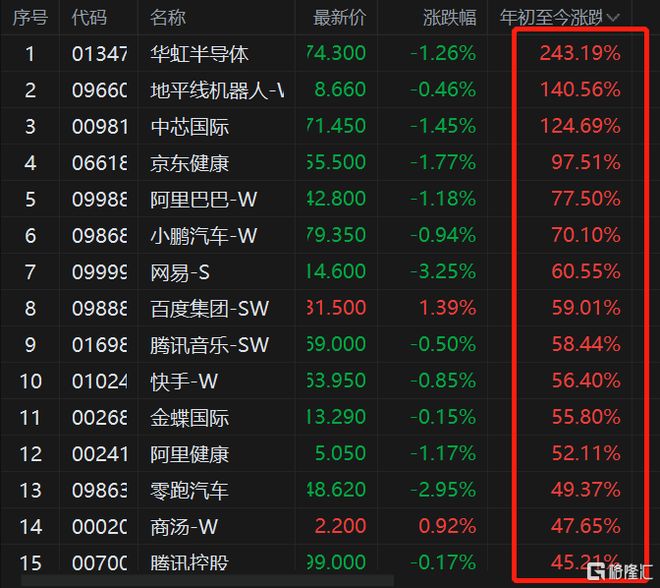
港股25年收官:科指全年累涨23.45%创历史最佳,成份股中芯国际大涨124.69%
Ge Long Hui· 2025-12-31 08:02
Core Viewpoint - The Hong Kong stock market's Hang Seng Technology Index achieved a remarkable annual increase of 23.45% in 2025, marking its best performance since 2020, with 22 out of 30 constituent stocks rising [1] Group 1: Stock Performance - Among the 30 constituent stocks, notable performers included Hua Hong Semiconductor, which surged by 243.19%, Horizon Robotics with a rise of 140.56%, and SMIC increasing by 124.69% [1] - Other significant gainers were JD Health at 97.51%, Alibaba-W at 77.50%, Xpeng Motors-W at 70.10%, Baidu Group-SW at 59.01%, and Tencent Music-SW at 58.44% [1][2] Group 2: Investment Preferences - The first tier of investment preference is in semiconductor manufacturing (Hua Hong, SMIC) and core AI chips (Horizon Robotics), reflecting a strong focus on hard technology and domestic substitution logic [1] - The second tier includes growth sectors such as smart electric vehicles (Xpeng, Li Auto), AI applications (Baidu, SenseTime), and digital health (JD Health), which benefit from industry trends but still face competitive and profitability uncertainties [1] - The third tier consists of value recovery in platform internet giants (Alibaba, Tencent) and mature applications (NetEase, Kuaishou, Tencent Music), with gains primarily driven by profit realization and value reassessment through dividends and buybacks, categorized as "high-quality mature assets" [1]