
中国平安

Search documents
L3级自动驾驶给车险理赔“上难度”
Xin Jing Bao· 2026-01-06 00:34
2025年12月15日,工信部公布我国首批L3级有条件自动驾驶车型准入许可名单;12月23日,北京首批 L3级高速公路自动驾驶车辆专用号牌正式发放;12月26日,我国首批L3级自动驾驶专用正式号牌车辆 在重庆规模化上路通行。 L3级自动驾驶上路,被拉进考场的不只车企,还有保险公司。作为公认的辅助驾驶与自动驾驶的分水 岭,L3级自动驾驶落地给车险业务带来的核心挑战是事故责任结构发生了实质性变化。 "在L2阶段,系统始终被界定为'辅助驾驶',车险逻辑本质仍是'人驾风险管理'。而在L3阶段,只要满足 运行设计域且系统处于接管状态,责任便不再当然归属于驾驶人,这直接冲击了传统车险以个人责任为 中心的制度基础。"北京大学应用经济学博士后、教授朱俊生对新京报记者表示,L3并非L2的简单升 级,而是将重塑车险的底层逻辑。 新京报记者 潘亦纯 需综合车辆控制驾驶员行为等多方面因素 近期,L3级自动驾驶火速落地。L3级对应的是有条件自动驾驶,这意味着在特定条件下,驾驶自动化 系统可以持续执行驾驶任务,驾驶员无需持续关注路况,但必须在系统请求时及时接管。 因此,L3往往被认为是辅助驾驶与自动驾驶的分水岭。从L2跨越至L3,背后是 ...


智通港股沽空统计|1月6日
智通财经网· 2026-01-06 00:28
Group 1 - The top short-selling ratios are led by China Resources Beer (100.00%), BYD Company (100.00%), and Xiaomi Group (75.49%) [1][2] - The highest short-selling amounts are recorded for Ping An Insurance (2.081 billion), Alibaba (1.871 billion), and Xiaomi Group (1.624 billion) [1][2] - The highest deviation values are for BYD Company (43.54%), CIFI Holdings (39.74%), and Xiaomi Group (34.28%) [1][2] Group 2 - The top short-selling amounts table shows Ping An Insurance at 2.081 billion, Alibaba at 1.871 billion, and Xiaomi Group at 1.624 billion [2] - The top short-selling ratios table lists China Resources Beer and BYD Company both at 100.00%, followed by Xiaomi Group at 75.49% [2] - The top short-selling deviation values table highlights BYD Company with a deviation of 43.54%, followed by CIFI Holdings at 39.74% and Xiaomi Group at 34.28% [2]




智通ADR统计 | 1月6日
智通财经网· 2026-01-05 22:28
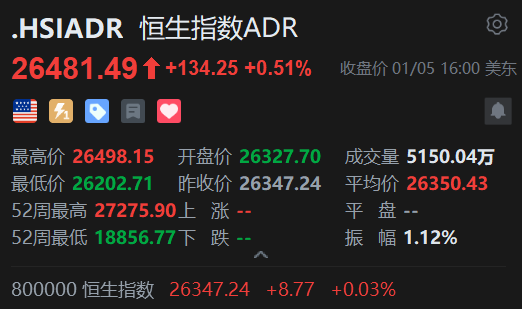
Market Overview - The Hang Seng Index (HSI) closed at 26,481.49, up by 134.25 points or 0.51% as of January 5, 16:00 Eastern Time [1] - The index reached a high of 26,498.15 and a low of 26,202.71 during the trading session, with a trading volume of 51.5 million shares [1] Major Blue-Chip Stocks Performance - HSBC Holdings closed at HKD 126.560, an increase of 1.33% from the Hong Kong close [2] - Tencent Holdings closed at HKD 631.166, up by 1.07% from the Hong Kong close [2] Stock Price Movements - Tencent Holdings (00700) latest price is HKD 624.500, with an increase of HKD 1.500 or 0.24% [3] - Alibaba Group (09988) latest price is HKD 152.800, up by HKD 3.800 or 2.55% [3] - HSBC Holdings (00005) latest price is HKD 124.900, up by HKD 0.600 or 0.48% [3] - China Construction Bank (00939) latest price is HKD 7.670, down by HKD 0.130 or 1.67% [3] - Xiaomi Group (01810) latest price is HKD 39.340, down by HKD 0.940 or 2.33% [3] - AIA Group (01299) latest price is HKD 83.900, up by HKD 0.600 or 0.72% [3] - NetEase (09999) latest price is HKD 222.600, down by HKD 6.200 or 2.71% [3] - Meituan (03690) latest price is HKD 105.400, up by HKD 0.800 or 0.76% [3] - Industrial and Commercial Bank of China (01398) latest price is HKD 6.210, down by HKD 0.130 or 2.05% [3] - Hong Kong Exchanges and Clearing (00388) latest price is HKD 420.200, up by HKD 4.400 or 1.06% [3] - Ping An Insurance (02318) latest price is HKD 68.600, up by HKD 1.800 or 2.69% [3] - Bank of China (03988) latest price is HKD 4.460, down by HKD 0.070 or 1.55% [3] - JD.com (09618) latest price is HKD 113.700, down by HKD 1.400 or 1.22% [3] - Kuaishou Technology (01024) latest price is HKD 73.600, up by HKD 7.350 or 11.09% [3] - BeiGene (06160) latest price is HKD 194.300, up by HKD 9.800 or 5.31% [3]
逾250只“金股” 折射券商布局思路
Zhong Guo Zheng Quan Bao· 2026-01-05 21:00
Core Viewpoint - The A-share market is experiencing a positive start to 2026, with significant attention on Zhongji Xuchuang, which has been highly recommended by multiple brokerages as a key investment target for January 2026 [1][2]. Group 1: Market Performance and Trends - As of January 5, 2026, the A-share market indices collectively rose, marking a strong opening for the year, with the Shanghai Composite Index surpassing the 4000-point mark [5]. - The brokerages' "golden stocks" for January 2026 include over 255 A-share and Hong Kong stocks, indicating a strong investment interest [3][6]. - The performance of the brokerages' "golden stock" indices in 2025 was positive, with the Guoyuan Securities index achieving a cumulative increase of 106.15%, the highest among 34 indices [4]. Group 2: Key Investment Targets - Zhongji Xuchuang has been the most favored stock, receiving recommendations from 10 brokerages, and its stock price surged nearly 400% in the past year [2][3]. - Zijin Mining ranked second in recommendation frequency, with 9 brokerages endorsing it, while several other companies received recommendations from 4 brokerages each, covering various sectors including non-ferrous metals and financial services [3]. Group 3: Sector Focus and Recommendations - The electronics sector remains the most favored, with 31 stocks recommended, followed by machinery and power equipment sectors [3]. - Analysts suggest focusing on sectors with strong fundamentals, such as the AI industry, emerging industries mentioned in the 14th Five-Year Plan, and cyclical price increases in industrial metals [6][7].

逾250只“金股”折射券商布局思路
Zhong Guo Zheng Quan Bao· 2026-01-05 20:05
Group 1 - The core focus of the news is on the performance and recommendations of stocks in the January 2026 "golden stock" list by brokers, with Zhongji Xuchuang being the most favored stock [1][2] - As of January 5, 2026, over 250 stocks have been included in the brokers' "golden stock" list, with Zhongji Xuchuang receiving recommendations from 10 brokers, making it the most recommended stock [1][2] - The brokers' "golden stock" index for 2025 showed positive returns, with the top performer, Guoyuan Securities, achieving a cumulative return of over 100% [1][3] Group 2 - The electronic industry has the highest number of recommended stocks in the January 2026 "golden stock" list, followed by machinery and power equipment sectors [3] - The performance of the brokers' "golden stock" indices in December 2025 was strong, with Guoyuan Securities' index rising nearly 14% [4] - Analysts expect the A-share market to continue its spring rally in January 2026, driven by improved government spending and investment data [4][5] Group 3 - The focus on fundamental verification is expected to increase in January 2026 due to the concentrated disclosure of annual performance forecasts by listed companies [4] - Analysts suggest avoiding stocks that lack performance verification and instead focus on sectors with strong fundamentals, such as AI, emerging industries, and cyclical price increases [5] - The Hong Kong stock market is also gaining attention, with nearly 50 stocks included in the January 2026 "golden stock" list, indicating a growing interest from brokers [5]
2026年首个交易日保险板块涨幅居首 新华保险、中国太保股价创新高
Shang Hai Zheng Quan Bao· 2026-01-05 18:28
Core Viewpoint - The insurance sector in A-shares has shown strong performance, with a 6.17% increase, driven by supportive policies and positive market sentiment towards insurance companies [2] Group 1: Market Performance - The insurance sector index rose by 6.17%, leading the Shenwan secondary industry classification [2] - Individual stocks such as New China Life Insurance increased by 8.87%, China Pacific Insurance by 7.52%, and China Life by 6.09%, all reaching new highs [2] - The overall increase in the insurance sector for 2025 was 26.42% [2] Group 2: Policy Impact - Supportive policies include adjustments to risk factors for insurance company investments and the introduction of the "Insurance Company Asset-Liability Management Measures (Draft for Comments)" aimed at optimizing asset-liability matching [2][3] - The reduction in liability costs through measures like lowering the preset interest rate and promoting dividend insurance has eased pressure on insurance companies [3] Group 3: Investment Opportunities - The increase in equity asset investment ratios and the relaxation of stock investment risk factors have opened up new avenues for insurance capital investments [3] - The first three quarters of 2025 saw the five major listed insurance companies achieve a combined net profit of approximately 426.04 billion yuan, marking a historical high for the same period [3] Group 4: Future Outlook - Market analysts expect continued policy support for insurance companies to enhance asset-liability management, alongside sustained enthusiasm for insurance products from residents [3] - The anticipated "Davis Double Play" effect from earnings growth and valuation increases is likely to keep the insurance sector in focus for investors [3]






没出险续保却“涨了超千元” 消费者遭遇车险保费“逆向”调价
Shang Hai Zheng Quan Bao· 2026-01-05 18:28
Core Viewpoint - The recent increase in car insurance premiums, even for claim-free drivers, is attributed to regulatory changes aimed at reducing aggressive price competition among insurers, which may lead to dissatisfaction among "good drivers" [2][5][7] Group 1: Premium Increases - Many drivers, including those in regions like Hunan and Sichuan, have reported significant increases in their car insurance premiums despite having no claims, breaking the previous norm where premiums would typically decrease for claim-free drivers [2][3] - For example, one driver experienced a premium increase of approximately 46.28%, with the coverage amount decreasing from about 170,000 yuan to 150,000 yuan [3][4] - Insurers are now applying a higher pricing coefficient for car insurance, which affects all drivers regardless of their claim history, leading to a general rise in premiums [4][6] Group 2: Industry Factors - The rise in premiums is influenced by industry-wide measures to prevent excessive low-price competition, which has led to a reduction in discount offerings for car insurance [5][6] - Regulatory changes have also tightened the requirements for insurers regarding commission practices, further limiting their ability to offer competitive pricing [5][6] - The overall cost ratio for the car insurance industry is approximately 97.9%, indicating that many insurers are operating at a loss, particularly smaller firms [6] Group 3: Consumer Impact - The increase in premiums may lead some consumers to forgo purchasing comprehensive insurance, opting only for mandatory liability insurance instead [7][8] - There is a concern that the uniform increase in premiums could undermine the incentive structure for safe driving, potentially leading to a loss of trust in the insurance system [7][8] - Industry experts suggest that clearer communication regarding discounts and pricing structures could help alleviate consumer concerns and maintain confidence in the insurance market [8]

兴证全球沪深300质量交易型开放式指数证券投资基金开放日常申购、赎回业务的公告
Zhong Guo Zheng Quan Bao - Zhong Zheng Wang· 2026-01-05 16:42
登录新浪财经APP 搜索【信披】查看更多考评等级 公告送出日期:2026年1月5日 1 公告基本信息 ■ 注:本基金证券简称为"300质量",扩位简称为"兴全沪深300质量ETF"。 2日常申购、赎回(转换、定期定额投资)业务的办理时间 投资人在开放日办理基金份额的申购和赎回,具体办理时间为上海证券交易所、深圳证券交易所的正常 交易日的交易时间,基金管理人根据法律法规、中国证监会的要求或基金合同的规定公告暂停申购、赎 回时除外。 基金合同生效后,若出现新的证券/期货交易市场、证券/期货交易所交易时间变更、其他特殊情况或根 据业务需要,基金管理人将视情况对前述开放日及开放时间进行相应的调整,但应在调整实施前依照 《信息披露办法》的有关规定在规定媒介上公告。 3日常申购业务 3.1申购金额限制 3.1.1 投资人申购的基金份额需为最小申购单位的整数倍。本基金目前最小申购单位为150万份。基金管 理人可根据市场情况、市场变化以及投资者需求等因素对其进行调整,并在调整实施前依照《信息披露 办法》的有关规定在规定媒介上公告。 3.1.2 基金管理人可设定申购份额上限,以对当日的申购总规模进行控制,具体规定请以基金管理人 ...
银行-保险-券商年度策略
2026-01-05 15:42
Summary of Conference Call Records Industry Overview - **Insurance Industry**: The insurance sector is expected to continue its recovery in 2026, with concerns over interest margin losses easing. Regulatory adjustments have lowered the preset interest rates, and the return on universal insurance products has decreased. Investment returns for insurance stocks are projected to exceed 5%, surpassing the intrinsic value assumptions, indicating a turning point for interest margin losses [1][4]. - **Brokerage Sector**: The brokerage industry is anticipated to benefit from the migration of household deposits, increased market activity, and relaxed regulatory policies. It is expected that the return on equity (ROE) for brokerages will enter an upward cycle from 2025 to 2026, driven by wealth management, investment banking, and international derivatives [1][10]. Key Insights and Arguments - **Investment in A-shares**: Insurance companies are expected to allocate 30% of new premiums to the A-share market annually, resulting in an influx of approximately 300-400 billion yuan, which will support capital market growth and enhance investment returns [1][4]. - **Property Insurance**: The top three property insurance companies maintain a stable market share, with auto insurance being a core growth area. The penetration rate of new energy vehicles is expected to drive an increase in average premiums. China Pacific Insurance anticipates a growth rate of over 4% in auto insurance business, aligning with GDP growth [1][5]. - **Non-auto Insurance Growth**: The non-auto insurance sector is benefiting from increased health insurance coverage, with premium growth expected to approach 10% in 2026 as certain low-base businesses recover. The comprehensive cost ratio for leading insurance companies is projected to stabilize around 97% [1][7]. - **Brokerage Performance Drivers**: Key performance drivers for brokerages include robust growth in wealth management, a recovering investment banking sector, and active proprietary trading. The anticipated improvement in ROE for brokerages could reach 9% under neutral conditions and exceed 10% in optimistic scenarios by 2027 [2][14]. Additional Important Points - **Market Dynamics**: The trend of household deposits moving away from traditional savings products is creating a competitive advantage for participating insurance products, which offer higher returns compared to fixed deposits [1][4]. - **Valuation Recovery**: The insurance sector's valuation is expected to recover significantly, with a potential P/EV (price-to-embedded value) ratio reaching 1.0 in the medium term. The average insurance stock in A-shares has about 40% room for recovery based on 2026 dynamic PEV estimates [8]. - **Recommended Companies**: Key insurance companies to watch include China Ping An, New China Life, China Taiping, China Life, and China Pacific Insurance, with China Ping An being highlighted for its diversified business model and high dividend characteristics [9]. - **Banking Sector Changes**: The banking sector is expected to undergo significant changes driven by policy adjustments, improved fundamentals, and favorable funding conditions, which will support valuation recovery [16]. - **Investment Recommendations**: In the current market environment, it is advisable to focus on stable high-dividend stocks and quality core assets, including major state-owned banks and leading commercial banks [17].
开门红!5家上市险企集体暴走,新华太保再破纪录!展望2026年的保险业...
13个精算师· 2026-01-05 14:53
Core Viewpoint - The insurance sector is experiencing a strong start in 2026, with major companies like Xinhua and China Pacific reaching historical highs, indicating market confidence and potential for growth [2][4]. Group 1: Market Performance - Five listed insurance companies have seen significant stock price increases, with Xinhua Insurance and China Pacific reaching historical highs, while China Life and China Ping An also achieving near five-year highs [3][4]. - The overall market sentiment is positive, as the insurance sector's performance reflects improved asset and liability management, alongside a favorable demographic trend [4]. Group 2: Interest Rate and Regulatory Changes - Analysts predict a new round of interest rate cuts in 2026, which may impact the predetermined interest rates for life insurance products [5][12]. - The introduction of a dynamic adjustment mechanism for predetermined interest rates has begun, with potential further reductions expected in 2026 [8][10]. Group 3: Investment Strategies - Insurance companies are expected to increase their investment in capital markets, with the total investment balance exceeding 37 trillion yuan, marking a historical high [15]. - The stock investment amount reached 3.6 trillion yuan, showing a year-on-year increase of approximately 1.3 trillion yuan, with a growth rate exceeding 55% [15][16]. Group 4: Product Development - The development of participating insurance products is accelerating, with premiums surpassing 700 billion yuan and a year-on-year growth of over 10% [21]. - The shift towards "guaranteed + floating return" products is becoming a focus, as these products are expected to yield better returns compared to traditional insurance products [21][27]. Group 5: Channel Adjustments - The insurance distribution channels are undergoing transformation, with a focus on enhancing the quality of individual agent channels and expanding the bancassurance channel [23]. - In the first half of 2025, the bancassurance channel generated approximately 1 trillion yuan in premium income, reflecting a growth rate of 9.4% [23]. Group 6: Regulatory Developments - New regulations regarding asset-liability management and product innovation are expected to be implemented in 2026, promoting high-quality development in the insurance industry [29][30]. - The introduction of the fourth life table and the implementation of health insurance guidelines are anticipated to drive innovation in personal insurance products [27].
