
奇瑞汽车

Search documents
再次冲击IPO!奇瑞汽车更新港交所招股书,一季度净利润上涨91%
Zhong Guo Jin Rong Xin Xi Wang· 2025-08-29 03:08
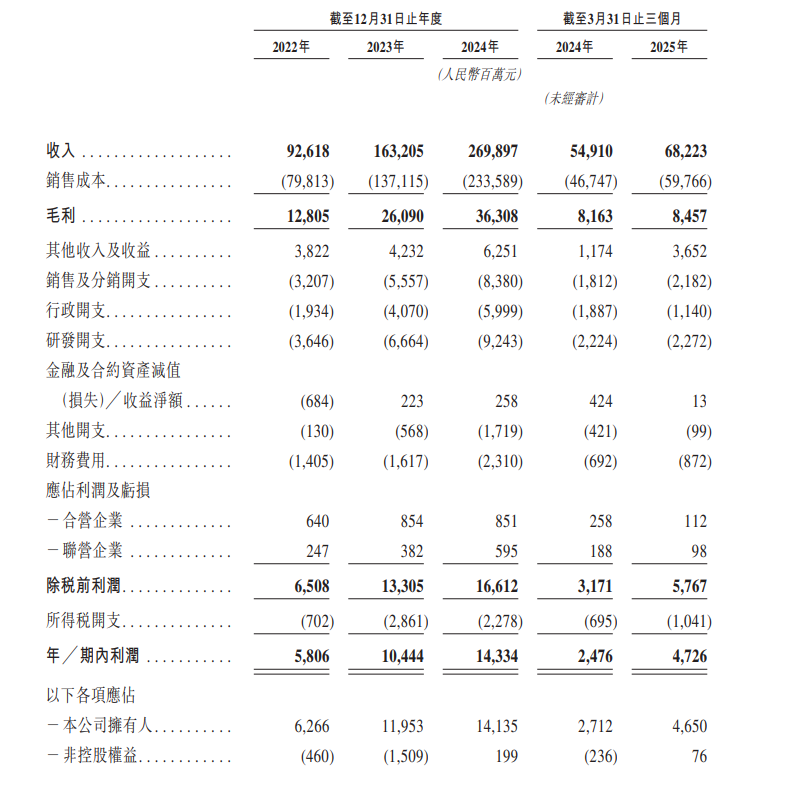
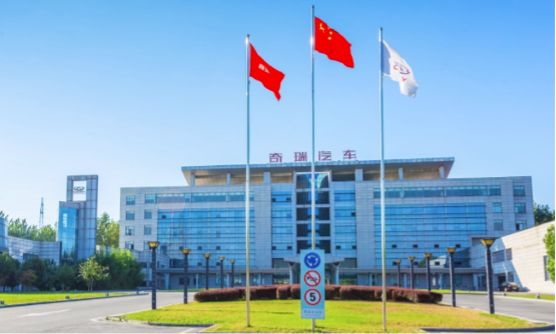
Core Viewpoint - Chery Automobile is progressing with its Hong Kong IPO, planning to issue up to 699 million shares and convert 2.016 billion shares from domestic to overseas listings, with a strong performance in both traditional and new energy vehicle sales [1][4]. Financial Performance - In 2024, Chery's revenue reached 269.9 billion RMB, a year-on-year increase of 65.4%, and net profit was 14.3 billion RMB, up 37.2% [1][3]. - For Q1 2025, revenue rose by 24.2% to 68.2 billion RMB, while net profit surged by 90.9% to 4.7 billion RMB [2][3]. Market Position and Sales - Chery's total vehicle sales exceeded 13 million units, ranking 11th globally and 2nd among Chinese brands in 2024 [1]. - The company achieved a remarkable 277.3% increase in new energy vehicle sales in 2024, with overseas revenue accounting for 37.4% of total sales [4]. Brand Strategy - Chery has established five differentiated brands targeting various market segments, with the Chery brand leading in overall sales [4]. - The company has a robust global dealer network with 6,621 outlets, including 3,663 in China and 2,958 overseas [4]. Use of IPO Proceeds - The funds raised from the IPO will be allocated to expanding the passenger vehicle product line, R&D for next-generation vehicles and advanced technologies, global strategy implementation, upgrading the Wuhu production base, and supplementing working capital [6].

华为云发布CloudVeo智能驾驶云服务 将在全国三大专区完成布局
Yang Guang Wang· 2025-08-29 02:59
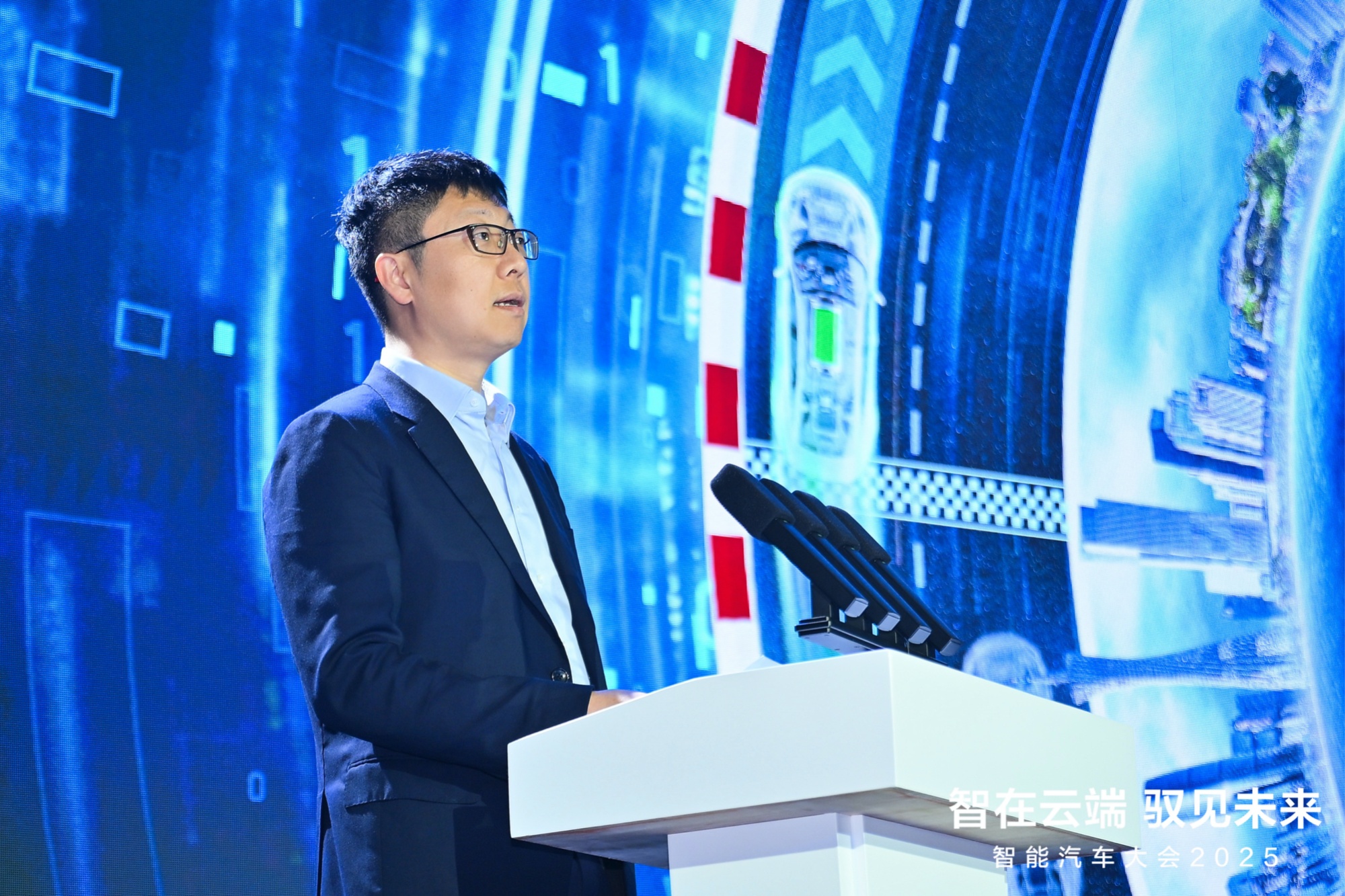
Core Insights - The 2025 Intelligent Automotive Conference successfully convened during the 11th China International Big Data Industry Expo, focusing on new business models, technologies, and ecosystems in the smart automotive sector [1] - Huawei Cloud launched significant solutions in the intelligent driving field, including the CloudVeo intelligent driving cloud service and the establishment of the Gui'an Automotive Zone, enhancing nationwide infrastructure for the smart automotive industry [1][2] - The Chinese automotive industry is transitioning from electrification to intelligence, with the penetration rate of new energy vehicles reaching 44.3% and the installation rate of L2 and above intelligent driving assistance systems at 67.8% in the first half of 2025 [1] Huawei Cloud's Market Position - Huawei Cloud has maintained the top market share in China's automotive cloud sector for three consecutive years, with a computing power scale reaching 300 PFlops [2] - The CloudMatrix 384 super node has been deployed over 40 times in Gui'an, serving numerous leading automotive companies [2][4] Technological Advancements - The CloudMatrix 384 super node is designed to meet the needs of intelligent driving model training, significantly enhancing training efficiency and data processing capabilities [5][6] - The AI-Native intelligent computing storage has improved training efficiency by 20%, data mining efficiency by 10 times, and reduced storage costs by 20% [6] Infrastructure Development - The launch of the Gui'an Automotive Zone marks the establishment of Huawei Cloud's second automotive zone, complementing the Ulanqab zone, and aims to create a nationwide integrated intelligent computing network [7][9] - The multi-zone architecture enhances system reliability, reducing latency by 60% and achieving a 99.9999% availability rate for intelligent driving experiences [9] Collaborative Ecosystem - Huawei Cloud is collaborating with various automotive companies to drive innovation in intelligent driving technology, including partnerships with Changan, GAC Group, and others [10][11] - The CloudDevice technology enables GAC to upgrade in-car screen experiences and reduce core chip costs by 20%, enhancing the overall user experience [11] Industry Trends - The demand for AI computing power in the automotive sector is experiencing explosive growth, driven by the rapid iteration of assisted driving technologies [9][14] - The launch of the "Intelligent Driving Computing Operations White Paper" aims to establish technical standards and development paths for the healthy growth of the industry [14][16]
汽车视点 | C位“易主”,从成都车展透视车市三大变化
Xin Hua Cai Jing· 2025-08-29 02:43
Core Insights - The 28th Chengdu International Auto Show has commenced, featuring nearly 120 automotive brands and over 1,600 vehicles on display, highlighting a significant shift in the automotive industry dynamics in China [1][2] Group 1: Luxury Brands' Absence - The absence of traditional luxury brands such as Porsche, Bentley, and Lamborghini at this year's show marks a notable change, with these brands opting out due to cost control measures [2][3] - Only six luxury brands, including Mercedes-Benz, BMW, and Audi, continue to participate, indicating a shrinking presence of luxury brands at major auto shows [2][3] - The luxury car market is experiencing a downturn, with Porsche's global deliveries down 6% year-on-year, and a staggering 28% decline in the Chinese market, marking the fourth consecutive year of negative growth [3] Group 2: Expansion of Domestic Brands - In contrast to the luxury brands' retreat, domestic brands have significantly expanded their presence, with companies like BYD, Changan, and Chery showcasing their products in dedicated exhibition spaces [4][5] - BYD's pavilion features various brands and innovative technologies, while Changan and Chery also present a wide array of their offerings, reflecting the growing strength of domestic manufacturers [4][5] - The trend of domestic brands adopting "pavilion" formats at auto shows is becoming more common, enhancing brand visibility and showcasing their increasing capabilities [4][5] Group 3: Rise of Regional Auto Shows - Regional auto shows are gaining prominence, with events like the Guangdong-Hong Kong-Macao Greater Bay Area Auto Show surpassing the Chengdu Auto Show in size and influence, indicating a shift in the automotive exhibition landscape [6][7] - The Chongqing Auto Show has also seen growth, with an increase in exhibition area and attendance, becoming a significant platform for industry discussions [7] - These regional shows are evolving beyond mere sales events, integrating local economic and industrial ecosystems, thus becoming vital for brand promotion and investment attraction [7]

奇瑞汽车闯关港交所:已获中国证监会备案,港股有望迎来最大规模车企IPO,即将开启全球化战略新起点
Xin Lang Cai Jing· 2025-08-29 02:31
Core Viewpoint - Chery Automobile's upcoming listing on the Hong Kong Stock Exchange marks a significant step in its global strategy, aiming to raise funds for the development of new energy vehicles and expand its international market presence [3][6]. Group 1: Listing Details - Chery Automobile plans to issue up to approximately 699 million shares for its overseas listing and convert nearly 2.016 billion shares held by 18 shareholders into shares for the Hong Kong market [3][4]. - The company submitted its prospectus to the Hong Kong Stock Exchange on February 28, 2023, with CICC, Huatai Securities, and GF Securities as joint sponsors [4]. - If successful, this IPO will be one of the largest in recent years for an automotive company on the Hong Kong market [4]. Group 2: Financial Performance - In 2024, Chery Group achieved a record sales volume of 2,603,916 vehicles, representing a year-on-year increase of 38.4% [5]. - The company also reported an export volume exceeding 1 million vehicles, reaching 1.144 million, which is a 21% increase year-on-year [5]. - Chery Group ranked 233rd on the 2025 Fortune Global 500 list, with a revenue of $59.6939 billion, marking a significant leap of 152 places from the previous year [5]. Group 3: Strategic Focus - The company aims to balance its traditional fuel vehicle business while accelerating its new energy vehicle initiatives and optimizing its product structure [6]. - The Hong Kong listing is expected to broaden Chery's financing channels, providing ample funds for innovation in new energy research and development [6]. - This move is seen as a new starting point for Chery to enter the international capital market, as stated by Chairman Yin Tongyue [6].
“60天账期”车企执行有差异,有供应商还没拿到钱
Bei Ke Cai Jing· 2025-08-29 02:25
Core Viewpoint - The automotive industry is experiencing a shift towards a standardized payment term of 60 days for suppliers, initiated by 17 major car manufacturers, although challenges remain in fully implementing this commitment [1][6][21]. Group 1: Payment Terms and Supplier Experience - Suppliers report some improvement in payment cycles, but the full realization of the "60-day payment term" is still problematic due to uncertainties in project completion and acceptance processes [2][9][10]. - A survey indicates that 50% of suppliers are concerned about the sustainability of the 60-day payment term, highlighting a gap between policy and execution [11][15]. - The payment speed has shown positive changes, with 83.33% of suppliers noting slight improvements, and 33.33% reporting significant reductions in financial pressure [13]. Group 2: Regulatory and Industry Response - The implementation of the "60-day payment term" aligns with the "Regulations on Ensuring Payment to Small and Medium Enterprises," which took effect on June 1 [6][21]. - The Ministry of Industry and Information Technology (MIIT) is actively promoting compliance with the 60-day payment commitment among major automotive companies, with some firms already achieving significant reductions in payment cycles [22][23]. - Companies like Chery and China FAW have adopted measures to streamline payment processes, with Chery reducing average payment terms to 47 days through various strategies [23]. Group 3: Challenges and Concerns - Despite improvements, suppliers express concerns about potential delays in payment due to ambiguous contract terms and varying interpretations of the payment start date [18][25]. - The use of commercial acceptance bills has not been entirely eliminated, with 66.67% of suppliers indicating that while usage has decreased, it still exists [14]. - Industry experts warn that the shift to shorter payment cycles may pressure manufacturers' cash flow, necessitating better financial management to avoid passing costs back to suppliers [24][27].
C位“易主”,从成都车展透视车市三大变化
Zhong Guo Jin Rong Xin Xi Wang· 2025-08-29 02:19
Core Insights - The 28th Chengdu International Auto Show has commenced, featuring nearly 120 automotive brands and over 1,600 vehicles on display, indicating a significant event in the automotive industry [1] - A notable trend is the collective absence of traditional luxury brands, reflecting a shift in the automotive market dynamics in China [2][3] - In contrast, domestic brands have significantly expanded their presence at the show, showcasing their growing strength and market influence [4][5] Luxury Brands Absence - The absence of luxury brands such as Porsche, Bentley, and Lamborghini at this year's show marks a significant change compared to previous years, driven by cost control measures [2][3] - Only six luxury brands, including Mercedes-Benz, BMW, and Audi, continue to participate, highlighting a decline in luxury brand representation [2] - The luxury car market is experiencing a downturn, with Porsche's global deliveries down 6% year-on-year, and a staggering 28% decline in the Chinese market [3] Domestic Brands Expansion - Domestic brands like BYD, Changan, and Chery have established dedicated exhibition spaces, showcasing their growing importance in the automotive sector [4][5] - BYD's pavilion features advanced technologies such as "God's Eye" intelligent driving demonstrations, indicating a focus on innovation [4] - The trend of domestic brands adopting "pavilion" formats at auto shows is becoming more common, enhancing brand visibility and communication [4] Rise of Regional Auto Shows - Regional auto shows are gaining prominence, with events like the Guangdong-Hong Kong-Macao Greater Bay Area Auto Show surpassing the Chengdu Auto Show in size and influence [6] - The Chongqing Auto Show is also expanding, with increased participation and audience numbers, indicating a growing interest in regional events [6][7] - These regional shows are evolving beyond mere sales platforms, integrating local economic and industrial ecosystems, thus becoming vital for brand promotion and investment attraction [7] Industry Evolution - The automotive industry in China is undergoing a transformation, moving from traditional luxury brands to a focus on domestic brands and technological advancements [7] - The competition landscape is shifting, with a clear trend towards high-quality development centered on technology, ecology, and user experience [7]
奇瑞终获上市「通行证」,尹同跃21年资本长跑将结束
Sou Hu Cai Jing· 2025-08-29 00:11
Core Viewpoint - Chery Automobile is on the verge of completing its long-awaited IPO process, having received approval from the China Securities Regulatory Commission for its overseas listing in Hong Kong, marking a significant milestone in its 21-year journey towards public offering [2][3][11][14] Company Development - Chery plans to issue up to 699 million overseas ordinary shares and convert 2.016 billion shares held by its shareholders into H-shares for circulation [2] - The company has faced multiple setbacks since it first attempted an IPO in 2004, with the latest application submitted to the Hong Kong Stock Exchange in February 2025 [3][11] - The approval from the regulatory body indicates that Chery is close to finalizing its IPO, with only procedural steps remaining at the Hong Kong Stock Exchange [3] Strategic Partnerships and Innovations - Chery has emphasized its commitment to self-research and development, achieving several "firsts" in domestic technology across various automotive sectors [3] - The collaboration with Huawei is a key factor in Chery's strategy, with over 10 billion yuan allocated for joint development of smart electric vehicles, enhancing its technological capabilities [3][5] Sales Performance - In the first half of 2025, Chery's sales reached 44,929 units for its smart brand, a year-on-year increase of 165.3%, indicating strong market performance [5] - The company sold 35.9 million new energy vehicles in the same period, marking a 98.6% increase year-on-year, showcasing its growth in the electric vehicle sector [8] Market Position and Valuation - Chery is expected to achieve a market valuation exceeding 100 billion yuan post-IPO, reflecting both its current business performance and future growth potential [10] - The company is positioned to benefit from the influx of foreign capital into the Hong Kong market, particularly in the new energy vehicle sector, aligning with investor preferences [6][8] Governance and Structural Changes - The transition to full circulation of 2.016 billion previously unlisted shares will resolve historical liquidity issues and enhance corporate governance [6] - Chery's partnerships with international companies like Mercedes-Benz are expected to bolster its technological credibility and attract international investors [6] Future Goals - Chery aims to sell 3.3 million vehicles and achieve revenue exceeding 600 billion yuan by 2025, aspiring to become one of the top ten global automotive brands [14]

融资技术双驱动 自动驾驶商业化持续提速
Zhong Guo Zheng Quan Bao· 2025-08-28 22:06
Group 1 - The autonomous driving industry is rapidly evolving, with a focus on the commercialization of applications like unmanned logistics vehicles, driven by advancements in artificial intelligence and other cutting-edge technologies [1] - Baixin Rhino, an L4 autonomous driving company, recently completed a B+ round of financing, raising nearly 500 million yuan, with funds aimed at product development, AI technology iteration, and expanding commercial scenarios [2] - The number of active unmanned logistics vehicles operated by Baixin Rhino has grown from nearly 100 at the end of 2024 to a current scale of 1,000, covering over 100 cities and serving major logistics companies [2][3] Group 2 - The commercialization of unmanned logistics vehicles is progressing rapidly, with significant growth expected in order volumes as leading manufacturers expand their applications beyond express delivery to retail distribution [3] - The State Council has issued policies promoting the use of intelligent logistics solutions, including unmanned delivery vehicles, indicating strong governmental support for the industry [3] - Industry experts predict that the express delivery sector alone will deploy over 200,000 unmanned vehicles within the next three to five years, marking a significant market expansion [4] Group 3 - Companies are advancing towards higher levels of autonomous driving technology, with Yuanrong Qixing launching a new generation of assisted driving platform, DeepRoute IO 2.0, which features a self-developed VLA model [4][5] - The VLA model is gaining traction among automotive manufacturers, with companies like Li Auto, Xpeng Motors, and Chery integrating it into their vehicles, reflecting the industry's shift towards high-tech solutions [5] - The development of VLA technology is expected to accelerate the application of intelligent driving solutions, as companies transition from traditional automotive roles to technology-driven enterprises [5]
融资技术双驱动自动驾驶商业化持续提速
Zhong Guo Zheng Quan Bao· 2025-08-28 20:17
Core Insights - The autonomous driving industry is rapidly evolving, with a focus on the commercialization of applications like unmanned logistics vehicles, driven by advancements in artificial intelligence and other cutting-edge technologies [1][2]. Group 1: Unmanned Logistics Vehicles - The L4 autonomous driving company, White Rhino, recently completed a B+ round of financing, raising nearly 500 million yuan, with existing investors like SF Express and new investors joining [2]. - The funds will be directed towards the development of vehicle-grade unmanned vehicle products, continuous iteration of AI technology, and expansion into commercial scenarios, aiming for large-scale implementation in last-mile logistics [2]. - White Rhino has expanded its active vehicle fleet from nearly 100 units at the end of 2024 to around 1,000 units currently, covering over 100 cities and serving major logistics companies like SF Express and China Post [2][3]. Group 2: Market Trends and Government Support - The commercial application of unmanned logistics vehicles is progressing rapidly, with significant financing occurring in the sector since 2025, indicating strong market confidence [2][3]. - The Ministry of Commerce and other departments have issued plans to promote smart supply chains, including the use of unmanned delivery vehicles, highlighting government support for the industry [3]. - Major logistics companies, including SF Express and JD Logistics, are actively promoting the use of unmanned delivery vehicles, with over 6,000 units deployed by the end of 2024, delivering over 10 million orders across various scenarios [3]. Group 3: Advanced Driving Technologies - Yuanrong Qihang has launched a new generation of assisted driving platform, DeepRoute IO 2.0, featuring its self-developed VLA (Visual Language Action) model, which is better suited for complex road conditions [4]. - The VLA model is being adopted by various automakers, including Li Auto and Xpeng Motors, indicating a trend towards integrating advanced AI technologies in vehicles [4][5]. - The development of the VLA model signifies a shift in the automotive industry towards higher-level autonomous driving technologies, with companies increasingly transforming into tech-oriented enterprises [5].