
易方达基金

Search documents
四大证券报精华摘要:11月27日
Zhong Guo Jin Rong Xin Xi Wang· 2025-11-27 00:49
Group 1 - China's assets are increasingly recognized as essential for global investors, with a focus on smart allocation strategies rather than the viability of investment [1] - The year 2026 is highlighted as a pivotal moment for overseas capital to reassess and invest in Chinese assets, driven by factors such as declining interest rates and the AI revolution [1] - The Ministry of Industry and Information Technology has launched a plan to enhance the adaptability of supply and demand in consumer goods, aiming for a dynamic balance to stimulate economic growth [2] Group 2 - The technology sector, particularly in areas like AI, semiconductors, and robotics, is experiencing a positive growth trend, with new thematic funds being introduced to cater to investor interests [2][4] - A roadshow in Australia showcased Chinese companies' innovation stories and the potential for high-quality economic development, attracting interest from major investment institutions [3] - The ETF market is expanding rapidly, with new products focusing on innovative sectors being launched and approved, indicating a strong demand for investment in hard technology [4][7] Group 3 - The acquisition of control over Aola by Srypu reflects a trend of consolidation in the analog chip industry, which is seen as necessary for growth and strength in the sector [5] - The GPU market is witnessing significant interest, with institutional investors heavily participating in the subscription process for domestic GPU stocks [6][7] - A surge in mergers and acquisitions among state-owned enterprises indicates a structural shift towards more strategic and synergistic deals, particularly in emerging industries [9] Group 4 - The "human-vehicle-home" ecosystem is rapidly emerging, with major companies like Midea and BYD collaborating to integrate smart technologies across sectors [10]



易方达、华泰柏瑞、永赢、摩根、景顺长城、鹏华、工银瑞信首批7只双创人工智能ETF定档 新一轮发行热潮来袭
Zheng Quan Shi Bao· 2025-11-27 00:18
Core Viewpoint - The launch of the first batch of seven innovative AI ETFs by various fund companies is set to take place on November 28, 2023, following their approval on November 21, 2023, indicating a significant opportunity for investors to engage in the "hard technology" sector and potentially attract new capital to the market [1][2]. Fund Issuance Details - The first batch of seven innovative AI ETFs will have varying fundraising periods, with most companies opting for one to two weeks. Notably, Yongying's ETF will have a rapid three-day fundraising period, ending on December 2, while others will conclude between December 5 and December 12 [3]. - Six out of the seven fund companies have set fundraising caps, with E Fund, Morgan Fund, and Invesco Great Wall each having a cap of 8 billion yuan, while Huatai-PB's cap is set at 5 billion yuan, and Penghua and Yongying have caps of 2 billion yuan and 1 billion yuan, respectively [3]. Market Interest - Institutional investors have shown significant interest in the issuance of these ETFs, indicating a potential surge in demand and a possible issuance boom [4]. Index Tracking - The ETFs will track a new index, the CSI Innovation and Entrepreneurship AI Index, which includes stocks from the Sci-Tech Innovation Board and the ChiNext that meet specific criteria, such as a listing time of over six months and a ranking in the top 30 by average daily market capitalization [5]. - The index aims to represent companies involved in three categories of AI business: foundational resources, technology, and applications, ultimately selecting the top 50 stocks based on market capitalization [5]. Comparative Analysis of AI Indices - Morgan Fund conducted a comparative analysis of four major AI indices, highlighting that the CSI Innovation and Entrepreneurship AI Index includes 50 stocks, with the top three being Zhongji Xuchuang, Xinyisheng, and Hanwujing [6]. - The index has shown a year-to-date increase of over 75%, indicating strong performance and resilience [6]. Strategic Significance - The launch of these ETFs is significant as it aligns with national strategies for AI development, aiming to capture the growth potential of the AI industry while providing a diversified investment tool for investors [8]. - The dual attributes of the index, covering both the Sci-Tech Innovation Board and the ChiNext, enhance its uniqueness and representativeness, making it a valuable tool for investors looking to mitigate individual stock risks [8]. Market Dynamics - Current AI investments are supported by large, cash-rich companies, contrasting with the 1990s tech bubble, suggesting a more stable foundation for growth and commercial viability in the AI sector [9]. - The ongoing demand for AI capabilities, coupled with high data center utilization rates, indicates a robust market environment with limited risks of overcapacity in the short term [9].
两创板块年内领涨 投资该如何抉择?
Jin Rong Jie· 2025-11-27 00:01
Core Insights - The STAR Market and ChiNext have been the standout performers in the A-share market this year, with the STAR 50 Index and ChiNext Index rising by 37.3% and 43.3% respectively as of November 18 [1] Group 1: Market Positioning and Focus - The STAR Market focuses on "hard technology" companies, emphasizing R&D-driven innovation and allowing unprofitable firms with high technical barriers to go public, while ChiNext serves "growth-oriented innovative enterprises" supporting high-tech and traditional industry upgrades [2] - The industry distribution on the STAR Market is more concentrated, with electronics and biomedicine making up 25% and 19% of companies respectively, while the ChiNext has a more diversified industry coverage [2] Group 2: Performance and Investment Timing - The STAR Market tends to show significant performance elasticity during hard technology breakthrough cycles, while ChiNext benefits from a dual-driven model of "new energy + technology" during periods of strong demand in sectors like energy storage and technology upgrades [4] - The STAR Market is more likely to benefit from policies promoting "hard technology" and domestic self-sufficiency, while ChiNext performs better during supply-side reforms and breakthroughs in technologies like solid-state batteries [4] Group 3: Market Sentiment and Trading Activity - The STAR Market typically outperforms during periods of rising risk appetite, such as when the Federal Reserve signals interest rate cuts, while ChiNext has higher trading activity, with an average turnover rate of 5.7% compared to the STAR Market's 3.2% [5] - In periods of high market liquidity, ChiNext's sectors like new energy and electronics are more likely to generate a "wealth effect," driving index growth [5] Group 4: Investment Strategies - Investors with a strong risk tolerance and a long-term view on technology may prefer the STAR Market during clear "hard technology" trends, while those looking to balance new energy and technology may find ChiNext more suitable [5] - For ordinary investors, both markets have high entry thresholds, but they can consider investing through ETFs like the STAR 50 ETF and ChiNext ETF for easier access to core companies in these markets [5][6]
日股ETF反弹,投行提醒:短期波动可能加剧
券商中国· 2025-11-26 23:36
Core Viewpoint - The Japanese stock market has shown a rebound, with the Nikkei 225 index rising by 1.85% to close at 49,559.07 points on November 26. This rebound occurs despite a recent correction from its peak, and there are concerns regarding high premium risks associated with Nikkei 225 ETFs in the A-share market [1][2]. Group 1: Market Performance - On November 26, the Nikkei 225 index closed at 49,559.07 points, reflecting a 1.85% increase [1]. - Despite a decline of over 8% in the net value of four Nikkei 225 ETFs during the month, these funds have seen a cumulative increase of 62.5 million shares [3]. Group 2: Economic Stimulus and Risks - The Japanese government has introduced a supplementary budget of 21.3 trillion yen, approximately 3% of GDP, which is expected to boost economic growth in the short term [4]. - However, there are warnings from Huatai Securities that the lack of monetary policy normalization support for this fiscal stimulus could increase the risk of inflation detachment, potentially raising the risk premium in the bond market and leading to higher volatility in risk assets [2][4]. Group 3: ETF Premium Risks - The E Fund's Nikkei 225 ETF reported a closing price of 1.806 yuan per share on November 25, with a premium of 5.12% over the reference net asset value [3]. - Other Nikkei 225 ETFs also exhibited high premium rates, with the Huazhong Mitsubishi Nikkei ETF at 7.31%, and others at 5.78% and 6.21% [3]. Group 4: Market Volatility Factors - The weakening yen has supported the export-oriented Tokyo Stock Exchange index, contributing to its performance in the third quarter [4]. - Concerns regarding a potential slowdown in the U.S. economy are viewed as a significant challenge for Japanese corporate earnings growth [4].


个人养老金三周年 银行营销重点转向缴存,基金平均回报超13%
2 1 Shi Ji Jing Ji Bao Dao· 2025-11-26 23:17
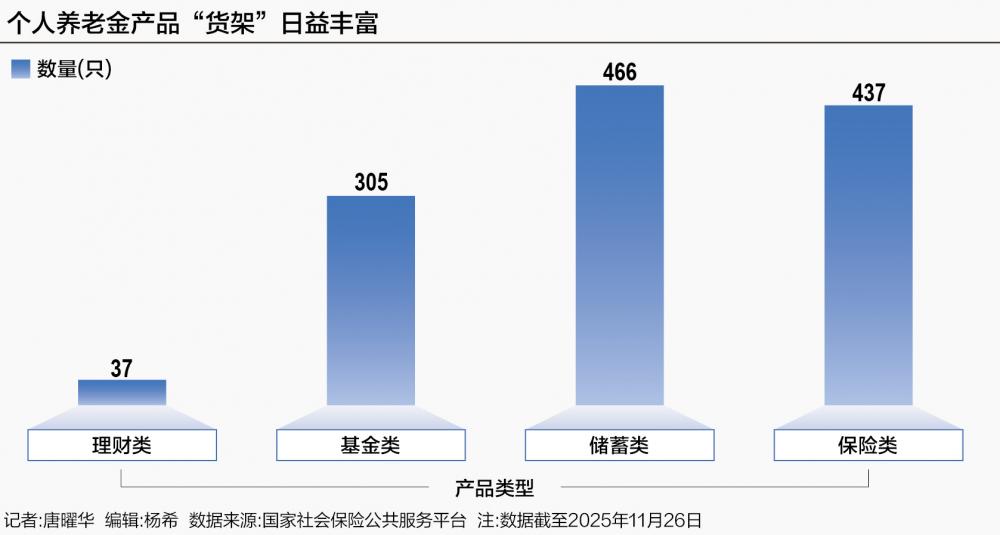
Core Insights - The personal pension system in China is entering its third year since the pilot launch on November 25, 2022, with banks and financial institutions actively promoting pension contributions and related services [1][4][5] Group 1: Marketing Strategies - Banks have shifted their marketing focus from account opening to encouraging contributions, with various rewards for depositors [4] - For instance, China Construction Bank offers up to 656 yuan in benefits for contributions, while Industrial Bank provides chances to win up to 609.68 yuan [4] - Many banks have implemented tiered reward systems for contributions, incentivizing higher deposits with increased rewards [4] Group 2: Product Performance - Personal pension financial products have shown an average return of over 3%, with pension funds averaging a return of 13.54% since inception [1][11] - As of November 26, 2023, the average annualized return for personal pension financial products is 3.47%, with fixed-income products averaging 3.55% [9] - The performance of pension funds has been notably strong, with 305 funds achieving an average return of 13.54% since inception, and some index funds yielding returns as high as 22.21% this year [11][12] Group 3: Product Offerings - The range of personal pension products is expanding, with 37 financial products, 305 funds, 466 savings products, and 437 insurance products available as of November 26 [7] - Starting June 2026, savings bonds will be included in the personal pension product catalog, enhancing investment options for consumers [7] Group 4: Risk Profile - Approximately 67.57% of personal pension financial products are classified as low to medium risk, primarily consisting of fixed-income products [9] - The overall risk profile aligns with the conservative nature of pension investments, catering to investors' lower risk tolerance [9]
首批7只双创人工智能ETF将于11月28日集体首发
Zheng Quan Shi Bao Wang· 2025-11-26 22:58
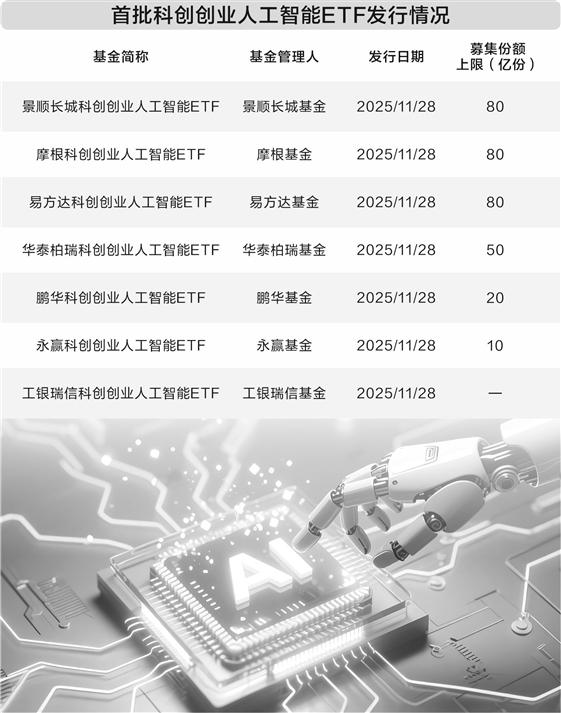
Core Viewpoint - The fund industry is set to witness the launch of a new batch of significant ETFs on November 28, marking the beginning of a competitive fundraising period [1] Group 1: ETF Launch Details - A total of seven AI-focused ETFs from various fund companies, including E Fund, Huatai-PB, Yongying, Morgan Fund, Invesco Great Wall, Penghua, and ICBC Credit Suisse, will be launched simultaneously [1] - These products received approval on November 21 and have a minimum fundraising period of just three days [1] Group 2: Market Implications - The introduction of these ETFs is expected to provide investors with new opportunities to invest in "hard technology" sectors [1] - The launch is anticipated to bring additional incremental capital into the market [1]
精准布局特定产业趋势硬科技投资产品矩阵扩容
Zhong Guo Zheng Quan Bao· 2025-11-26 20:20
Core Viewpoint - The technology growth market, led by sectors such as artificial intelligence, semiconductors, robotics, and innovative pharmaceuticals, is showing positive trends, with a surge in hard technology-themed funds being launched to provide investors with refined tools for investment [1][2]. Group 1: Launch of New ETFs - Seven new AI-themed ETFs and one semiconductor design ETF are set to launch on November 28, with fundraising caps of 10 billion, 20 billion, and 50 billion yuan for different funds [1][2]. - The first batch of AI-themed ETFs includes products from various fund companies, indicating a strong interest in the AI sector [1][2]. Group 2: Expansion in Hard Technology Funds - Multiple hard technology-themed funds focusing on robotics, innovative pharmaceuticals, and semiconductors have been reported, enhancing the investment product matrix in these high-potential areas [2][4]. - The first batch of robotics ETFs will track an index that includes 40 companies related to intelligent robotics, covering key products and technologies in the field [3]. Group 3: Innovative Pharmaceuticals and Semiconductors - New innovative pharmaceutical ETFs have been reported, tracking an index that reflects the overall performance of major companies in the innovative drug sector [4]. - The semiconductor sector is seeing a rich product layout, with several new ETFs and index funds being reported, indicating a growing interest in this area [4]. Group 4: Market Demand and Investment Tools - The emergence of more tool-oriented products reflects a deepening market demand, allowing investors to target specific industry trends more accurately [5]. - These products are expected to guide social capital towards high-quality enterprises in AI and semiconductor sectors, enhancing the role of capital markets in supporting strategic emerging industries [5].
首批7只双创人工智能ETF定档 新一轮发行热潮来袭
Zheng Quan Shi Bao· 2025-11-26 18:55
Core Viewpoint - The fund industry is set to launch a new batch of significant ETFs focused on artificial intelligence, with seven ETFs from various fund companies scheduled for debut on November 28, 2023, following their approval on November 21, 2023 [2][3]. Fund Issuance Details - The first batch of seven AI-focused ETFs will have varying fundraising periods, with most companies opting for one to two weeks. Notably, the Yongying ETF will have a rapid three-day fundraising period, ending on December 2, while others will conclude between December 5 and December 12 [3][4]. - Six out of the seven fund companies have set fundraising caps, with E Fund, Morgan Fund, and Invesco Great Wall Fund each having a cap of 8 billion yuan, while Huatai-PB has a cap of 5 billion yuan, and Penghua and Yongying have caps of 2 billion yuan and 1 billion yuan, respectively [4]. Market Impact - The issuance of these ETFs is expected to attract new incremental funds into the market, particularly in the AI sector, as institutional investors show significant interest in the offerings [4][5]. Index Tracking - The ETFs will track the newly established CSI Innovation and Entrepreneurship AI Index, which includes stocks from the Sci-Tech Innovation Board and the Growth Enterprise Market that meet specific criteria [5][6]. - The index comprises 50 constituent stocks, with the top three being Zhongji Xuchuang, Xinyisheng, and Hanwha Technology, and has shown a year-to-date increase of over 75% [6]. Strategic Significance - The launch of these ETFs aligns with national strategies for AI development, as outlined in the State Council's 2025 action plan, and aims to capture the growth potential of the AI industry across its entire value chain [7][8]. - The dual focus on the Sci-Tech Innovation Board and the Growth Enterprise Market provides a unique investment tool for diversifying risks while capitalizing on high-growth opportunities in the AI sector [8].
摩尔线程获公募组团入局 算力股再续升势波动加大
Zheng Quan Shi Bao· 2025-11-26 18:13
11月25日晚,作为"国产GPU第一股"的摩尔线程中签结果公告。多家机构凭借巨量资金的申购得以获 配,公募基金、社保基金、养老金等机构获配初步配售股数约3858.96万股,占网下最终发行比例的 98.44%,其他类型投资者占比1.56%。 公募基金方面,易方达基金、南方基金获配数量居首,获配额度均超过3亿元。此外国泰基金、华夏基 金和嘉实基金、泓德基金等亦有斩获,产品类型涵盖了主动权益基金、行业指数基金和部分LOF产品。 单只公募产品中,获配额度从几百股到一万多股不等,多只基金均获配15468股,金额约为176.77万 元。 近期,科技股持续高位震荡,主要原因系全球市场充斥着对AI投资回报比的担忧。 "展望后市,我们认为对于AI投资回报比的讨论会长期存在,从而使该领域的波动加大,但并不意味着 产业趋势发生根本改变,故而板块自身仍然能够成为未来的投资主线。此外,我们仍长期看好国产替代 趋势。"国泰基金认为。 富荣基金基金经理郭梁良表示,首先,海外算力中,国内企业在光模块、PCB这两个环节已经证明了自 己在全球的竞争力,业绩确定性和成长性较强,产业链景气度高,估值和业绩匹配程度高,后续增长动 力或将来自2027年 ...
ETF告别“同名混战” 规范命名提升辨识度
Zheng Quan Ri Bao· 2025-11-26 16:40
Core Viewpoint - The ETF market is undergoing a "standardization" transformation, driven by new regulations requiring existing ETFs to include the fund manager's identification in their names by March 31, 2026, impacting a market worth 5.6 trillion yuan [1] Group 1: Standardization and Regulation - The new regulation aims to promote high-quality development of index-based investment in the capital market, standardizing the ETF naming system and breaking the irrational competition over simple naming resources among fund companies [2] - A clear "core formula" for ETF naming has been established, requiring names to follow the structure of "core elements of the investment target + ETF + fund manager name," with enhanced ETFs needing to include an "enhanced" identifier [2][4] Group 2: Market Challenges and Solutions - The ETF market previously faced two main issues: lack of naming standards leading to confusion among similar products and a focus on the underlying index that obscured the fund manager's professional value [3] - The new naming regulations are designed to help investors accurately distinguish products and reduce the risk of misjudgment in information screening and trading [4] Group 3: Shift in Competitive Landscape - The ETF market competition is shifting from "name grabbing" to "brand highlighting," with fund managers needing to rely on their core strengths rather than simply securing catchy names [4] - Future core competitiveness will focus on three aspects: brand reputation, operational capabilities (including low fees and high liquidity), and distinctive positioning for smaller fund companies to create competitive advantages [4]