科大讯飞

Search documents
港股异动 | 天机控股(01520)盘中涨超9% 公司打造“IP+智造”双轮驱动战略 营造长期增长价值空间
智通财经网· 2025-11-13 03:39
Core Viewpoint - Tianji Holdings (01520) has seen a significant stock price increase of over 9% this year, driven by the rising popularity of the Chinese IP "LABUBU" overseas, which has positively impacted related listed companies and the IP economy concept stocks [1] Group 1: Company Developments - Tianji Holdings' stock price rose by 9.32% to HKD 1.29, with a trading volume of HKD 2.9664 million [1] - The company is focusing on three main business segments: IP digitalization, IP merchandise trading, and IP community operations, aiming to build a global digital asset IP identity chain [1] - Recently, Tianji Holdings announced a strategic partnership with iFlytek and the Saudi Ministry of Industry and Mineral Resources, extending its consumer IP business into broader industrial scenarios [1] Group 2: Strategic Initiatives - The company is implementing a dual-driven strategy of "Smart Consumption + Smart Manufacturing," leveraging AI, digitalization, and blockchain technology to enhance the IP value ecosystem and explore incremental business opportunities [1] - The strategy also aims to extend operations into the industrial sector, utilizing advanced technologies to support the intelligent upgrade and globalization of manufacturing [1] - This approach aligns with the trend of deep integration between the digital economy and the real economy, opening up broader long-term growth avenues for the company [1]
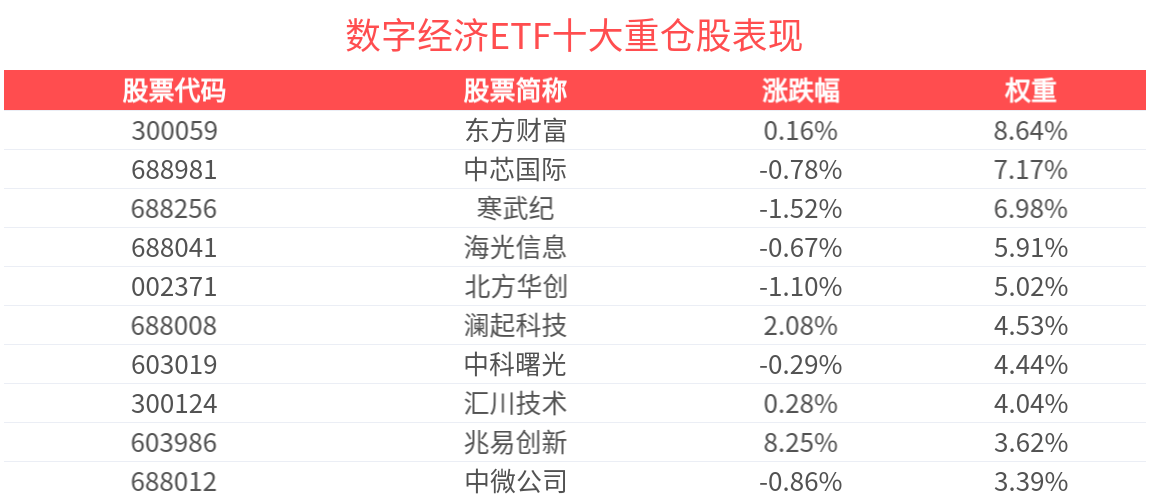
全球GPU市场迎来爆发,数字经济ETF(560800)红盘微扬
Sou Hu Cai Jing· 2025-11-13 02:35
| 股票代码 | 股票简称 | 涨跌幅 | 权重 | | --- | --- | --- | --- | | 300059 | 东方财富 | 0.16% | 8.64% | | 688981 | 中芯国际 | -0.78% | 7.17% | | 688256 | 寒武纪 | -1.52% | 6.98% | | 688041 | 海光信息 | -0.67% | 5.91% | | 002371 | 北方华创 | -1.10% | 5.02% | | 688008 | 澜起科技 | 2.08% | 4.53% | | 603019 | 中科曙光 | -0.29% | 4.44% | | 300124 | 汇川技术 | 0.28% | 4.04% | | 603986 | 兆易创新 | 8.25% | 3.62% | | 688012 | 中微公司 | -0.86% | 3.39% | (以上所列示股票为指数成份股,仅做示意不作为个股推荐。过往持仓情况不代表基金未来的投资方向,也不代表具体的投资建议,投资方向、基金具体持 仓可能发生变化。市场有风险,投资需谨慎。) 截至2025年11月13日 09:59,中证数 ...

AI技术驱动京东“双11”订单量同比增长近60%,“AI应用ETF”——线上消费ETF基金(159793)备受关注
Sou Hu Cai Jing· 2025-11-13 02:29
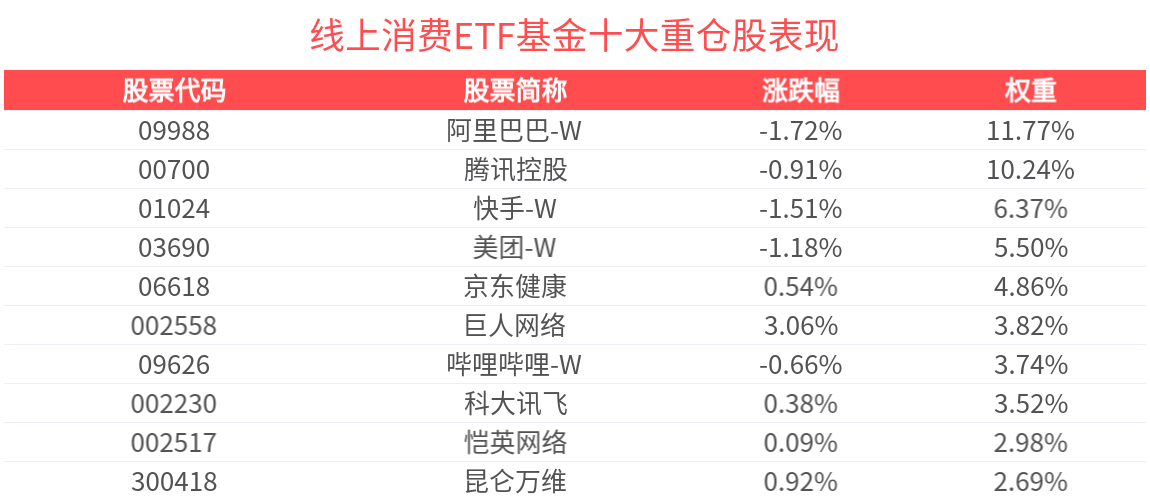
Group 1 - JD's "Double 11" sales reached a new high with order volume increasing nearly 60% year-on-year, showcasing significant growth in core metrics such as order peak, logistics efficiency, and merchant revenue [1] - JD's AI has transitioned from being an "auxiliary tool" to a "productivity tool," with the JoyAI system deeply integrated into JD's super supply chain [1] Group 2 - As of October 31, 2025, the top ten weighted stocks in the CSI Hong Kong-Shenzhen Online Consumption Theme Index accounted for 55.69% of the index, including Alibaba, Tencent, Kuaishou, Meituan, and JD Health [2] - The index reflects the overall performance of companies involved in online shopping, digital entertainment, online education, and telemedicine in the Hong Kong and mainland markets [1][2] Group 3 - The CSI Hong Kong-Shenzhen Online Consumption Theme Index (931481) saw a decline of 0.42%, with component stocks showing mixed performance; Ping An Good Doctor led with a 4.96% increase, while Miniso fell by 2.80% [1] - The Online Consumption ETF (159793) decreased by 0.19%, with a recent price of 1.06 yuan, but has seen a cumulative increase of 6.31% over the past three months [1] Group 4 - The performance of individual stocks within the top ten weighted stocks showed varied results, with Alibaba down 1.72%, Tencent down 0.91%, and JD Health up 0.54% [4] - The weightings of the top stocks indicate their influence on the index, with Alibaba holding the highest weight at 11.77% [4]

商汤科技拟在沙特设AI创新中心,AI人工智能ETF(512930)近3月涨近30%
Sou Hu Cai Jing· 2025-11-13 02:10
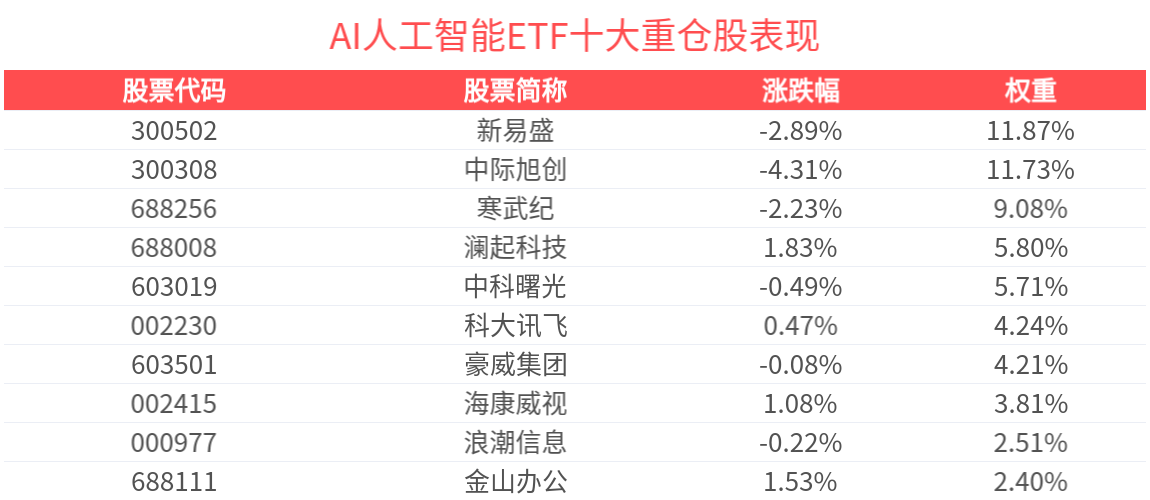
Group 1 - SenseTime announced the establishment of an AI Joint Innovation Center in Saudi Arabia, aimed at enhancing technological cooperation and industrial applications between China and Saudi Arabia, with operations expected to commence in early 2026 [1] - As of November 13, 2025, the CSI Artificial Intelligence Theme Index (930713) decreased by 0.84%, with mixed performance among constituent stocks [1] - The AI Artificial Intelligence ETF (512930) fell by 0.93%, with a latest price of 2.03 yuan, while it has seen a cumulative increase of 29.75% over the past three months [1] Group 2 - The CSI Artificial Intelligence Theme Index tracks 50 listed companies involved in providing foundational resources, technology, and application support for artificial intelligence, reflecting the overall performance of AI-related securities [2] - As of October 31, 2025, the top ten weighted stocks in the CSI Artificial Intelligence Theme Index accounted for 63.29% of the index, including companies like Zhongji Xuchuang and Xinyi Sheng [2][4]
多空博弈,人工智能AIETF(515070)持仓股北京君正大涨超4%
Mei Ri Jing Ji Xin Wen· 2025-11-13 02:06
Core Viewpoint - The global AI industry is experiencing a bearish impact due to recent negative comments, while the domestic AI sector shows resilience, particularly in application stocks [1] Group 1: Market Performance - The AI ETF (515070) saw a slight decline of 0.8%, but stocks like Beijing Junzheng rose over 4%, with other companies such as Stone Technology, Deepin Technology, Qihoo 360, and Dahua Technology performing well [1] - In the third quarter, public funds and northbound capital reached a historical high in their holdings of the communication sector, with AI computing power being a significant contributor to this increase [1] Group 2: Industry Developments - On November 10, Intel's AI infrastructure head Sachin Katti moved to OpenAI, indicating an intensifying competition for AI talent globally [1] - Meituan launched its first AI programming assistant, CatPaw, which focuses on agent collaboration and large-scale code generation, marking a significant step in the domestic "AI + software engineering" sector [1] Group 3: Investment Recommendations - With the decline in inference costs driven by open-source models like DeepSeek, there is a simultaneous release in demand for domestic 1.6T optical modules, liquid-cooled servers, and AI power supplies [1] - It is recommended to pay attention to leading companies in the infrastructure segments such as IDC, servers, and domestic computing chips [1] Group 4: ETF Composition - The AI ETF (515070) tracks the CS AI theme index (930713), selecting component stocks that provide technology, basic resources, and application end stocks, focusing on the midstream and upstream of the AI industry chain [2] - The top ten weighted stocks include leading domestic technology companies such as Zhongji Xuchuang, Xinyi Sheng, Cambrian, Zhongke Shuguang, iFlytek, OmniVision, Hikvision, Lanke Technology, Kingsoft, and Unisplendour [2]




第八届中华设计奖在甬揭晓
Xin Hua Wang· 2025-11-13 01:47
Group 1 - The eighth China Design Award was held in Ningbo with the theme "Intelligent Creation for Future, Design Coexistence" [1] - The gold awards in the product and concept categories were won by iFLYTEK Co., Ltd. for its "iFLYTEK AI Dual-Screen Translator 2.0" and Fu Jen Catholic University for "Smart Traffic Mirror" [1] - The competition featured four categories: cultural innovation, rural revitalization, smart technology, and digital art & interaction, awarding a total of 2 gold, 4 silver, 6 bronze, 12 emerging talent awards, and 181 excellent works [1] Group 2 - The number of entries increased from 3,537 in the first edition to 22,624 in the current edition, with entries from Taiwan rising from 205 to 2,687 [1] - Over 12,000 Taiwanese young designers and students have participated, making it one of the most influential design competitions across the Taiwan Strait [1] - A salon discussion on "Design Empowering Urban Development" was held, featuring five experts in the intersection of design and technology [1]
见证领军!点亮新星!第六届中国机器人行业年会启动!
机器人大讲堂· 2025-11-13 00:00
Core Insights - The global competition centered around "embodied intelligence" has fully commenced in 2025, with advancements in general robot prototypes and strategic policies emerging from various countries [1][2] - The market is transitioning from "scale application" to "high-quality development," indicating a shift from industrial automation to intelligent agent collaboration [2] - The sixth China Robot Industry Annual Conference aims to be a pivotal gathering for the industry, showcasing the strength of leading Chinese robot companies and igniting innovation in the era of embodied intelligence [3] Market Trends - The demand for robots is evolving, with a focus on high-quality development and multi-scenario autonomous decision-making, moving away from single-task execution [2] - The integration of AI, sensors, and motion control technologies is enabling robots to become intelligent entities capable of perception, cognition, and action [2] Industry Challenges - The industry faces deep strategic competitions that will shape the landscape for the next decade, with some companies successfully entering the capital market while others are on the verge of IPOs [6] - The annual conference will address the needs of both listed and pre-IPO companies, providing strategic support for value enhancement and ecosystem building [6] Insights from the Conference - The conference will highlight the importance of authoritative recognition, such as the "Top 50 Leading Chinese Robot Companies" list, which serves as a credibility booster for listed companies and a significant asset for those seeking to go public [6][7] - The event will provide a platform for companies to present their technological routes and business strategies, facilitating direct dialogue with key decision-makers in the industry and capital sectors [7] Strategic Decisions - Companies must navigate the balance between specialized and general-purpose robotics, determining whether to focus on existing applications or invest in future humanoid robots [10] - The conference will explore the balance between technological ideals and market realities, particularly for startups in the embodied intelligence sector [10] Ecosystem Development - The long supply chain of the robotics industry necessitates collaboration, prompting companies to consider their roles within an open and cooperative ecosystem [11] - The conference will feature discussions on breakthroughs in core technologies, aiming to transition the industry from a linear supply chain to a networked ecosystem [11] Conference Value - The sixth China Robot Industry Annual Conference aims to go beyond traditional meetings by actively shaping the next generation of industry leaders through resource allocation and ecosystem integration [12] - The event will feature over 500 influential guests, fostering dialogue between academia, startups, and major capital players [14] Agenda Overview - The two-day agenda will include expert reports and discussions on how technology drives market dynamics, culminating in an awards ceremony to recognize industry leaders [15] - The conference will also provide interactive sessions and exhibitions to showcase cutting-edge technologies and facilitate networking opportunities [15] Conclusion - The conference represents a critical juncture for the robotics industry, aiming to unify efforts and define the future of embodied intelligence [16]

向“新”逐“智” 南宁深化与东盟产业合作
Zhong Guo Xin Wen Wang· 2025-11-12 17:23
中新网南宁11月12日电(记者黄艳梅)广西南宁市官方12日介绍,南宁市聚焦人工智能(AI)、低空经济、 数字经济等新赛道,打造要素集聚的"强磁场",着力构筑面向东盟的人工智能合作新高地。 今年10月下旬,总投资超150亿元、预计产值超300亿元的多氟多氟芯电池全产业链项目签约,南宁市电 池规划产能规模超过200GWh(吉瓦时),已投产90GWh,总体产能规模进入中国前列,成为全球重要的 新能源电池产业集聚区。 南宁还引入智能驾驶和智能网联技术强力赋能本地新能源汽车产业,落地中国—东盟国际数字体育产业 园项目,激活南宁数字体育全产业链。 南宁市投资促进局局长黄辉称,南宁市主动拥抱人工智能时代,依托中国—东盟信息港南宁核心基地等 重要平台和载体,高标准建设中国—东盟国家人工智能应用合作中心(下称"南A中心"),已引入包括科 大讯飞、软通动力、奇安信、360集团、诚迈科技等人工智能知名企业。 据悉,南A中心是中国—东盟人工智能应用合作的公共服务门户、交流展示窗口、运营管理中枢和资本 赋能平台,推动中国与东盟国家在人工智能、数字经济等领域更广泛合作,打造面向东盟的全链条产业 生态。今年以来,南A中心已签约国内人工智能 ...
上市公司定增“筹得来”更要“用得好”
Zheng Quan Ri Bao· 2025-11-12 16:24
Core Insights - The private placement market is experiencing significant growth, with 184 companies having completed their fundraising plans since the release of the "Merger Six Guidelines" on September 24, 2024, resulting in a total fundraising amount of 349.6 billion yuan, a 60% year-on-year increase [1][2]. Group 1: Market Dynamics - The surge in private placements is attributed to a combination of policy incentives, industrial demand, and capital inflow, with policies like the "Merger Six Guidelines" and "Sci-Tech Innovation Board Eight Guidelines" stimulating market supply [1][2]. - The average return on competitive private placements has significantly improved since the release of the "Merger Six Guidelines," attracting long-term capital from insurance and public funds [1][2]. Group 2: Fund Utilization - Companies are encouraged to effectively utilize raised funds, focusing on "hard technology" sectors such as AI, robotics, innovative pharmaceuticals, and semiconductors, which have become major fundraising areas [2][3]. - The funds raised through private placements are being directed towards enhancing production capacity and technological innovation, particularly in strategic emerging industries [2][3]. Group 3: Strategic Investments - Private placements are being used as a tool for mergers and acquisitions, with a notable focus on capacity upgrades and green transformation, particularly in the electronics, machinery, and biopharmaceutical sectors [3][4]. - Companies with high debt ratios are leveraging private placements to introduce equity funding, thereby reducing financial risk and enhancing stability [4]. Group 4: Regulatory Framework - There is a need for a more refined regulatory framework to ensure that raised funds are utilized effectively, including enhanced information disclosure and stricter lock-up period arrangements to discourage short-term speculation [4].
脑机接口产业化加速,全产业链核心标的梳理
Xin Lang Cai Jing· 2025-11-12 13:16
Industry Background - The brain-computer interface (BCI) industry is entering a commercialization phase in 2025, driven by policy support and technological breakthroughs. The Ministry of Industry and Information Technology (MIIT) and other departments have set a goal for key technological breakthroughs by 2027 and the establishment of an industrial system [1] - The National Medical Insurance Administration has added pricing items for BCI implantation and adaptation fees, accelerating clinical applications and charging [1] - Domestic companies are making significant progress, with Shanghai Ladder Medical's implantable wireless BCI system becoming the first to enter the NMPA's green channel for innovative medical devices [1] - Global competition includes Neuralink's plan to launch a Telepathy device by 2029, but domestic companies have achieved technological advantages in certain areas, such as Yanshan Technology's 60ms ultra-low latency control performance [1] Industry Chain Overview - The BCI industry chain consists of three main segments: upstream (electrodes/chips), midstream (EEG processing devices), and downstream (application scenarios), each with distinct technological barriers and commercialization rhythms [3] - Upstream components, particularly implantable and non-invasive electrodes/chips, are critical for signal precision and stability, representing the core competitiveness of the industry [3] Upstream Segment - Implantable electrodes/chips are essential for medical applications, with companies like Gaode Infrared developing flexible tactile sensors that reduce immune rejection and extend signal collection duration [4] - Weisi Medical focuses on optimizing biocompatibility for its microelectrode arrays, which have entered clinical validation for precise localization in epilepsy [4] - Non-invasive chips serve as entry points for consumer applications, with companies like Xiangyu Medical developing multi-modal EEG acquisition devices for rehabilitation [7] Midstream Segment - The midstream segment is responsible for EEG signal acquisition, analysis, and transmission, with a focus on low latency (under 60ms) and multi-modal integration [9] - Companies like iFlytek have achieved a 92% accuracy rate in emotion recognition from EEG signals, indicating significant algorithmic advantages [10] - Yanshan Technology has achieved ultra-low latency control performance, surpassing early versions of Neuralink [11] Downstream Segment - The downstream applications are driven by both medical and consumer sectors, with a focus on epilepsy, Parkinson's disease, and gaming [13] - Medical rehabilitation is a high-demand area supported by policies, with companies like Aipeng Medical developing EEG acquisition devices and achieving a net profit margin of approximately 15% [14] - Consumer applications include gaming and smart home technologies, with companies like Tom Cat integrating BCI into AI games to develop mind-control products [16]