华为

Search documents
这五年,看病少排队、带娃有补贴、转诊少折腾……四川健康福利到账
Si Chuan Ri Bao· 2026-01-21 06:44
Core Viewpoint - The article highlights the significant advancements in healthcare services in Sichuan Province, emphasizing the integration of technology, community health initiatives, and targeted policies to improve public health outcomes and accessibility [5][15]. Group 1: Healthcare Achievements - Sichuan Province has seen an increase in life expectancy to 78.8 years, with maternal and infant mortality rates consistently below the national average for 9 and 18 years respectively [5][15]. - The province has established 65 provincial quality control centers and 1190 municipal centers, leading the nation in the application of electronic medical record systems [5]. - By 2025, Sichuan aims to provide 387,000 childcare positions, addressing the challenges of parenting [10]. Group 2: Technological Integration - The province has implemented smart healthcare solutions, such as AI systems that assist in patient follow-ups and data analysis, significantly reducing the time required for healthcare professionals to manage patient information [6][7]. - AI services from companies like Huawei and Baidu have been integrated into 258 grassroots healthcare institutions, providing assistance to over 20 million patients [7]. - The "Internet + Nursing Services" initiative has led to the establishment of 313 smart hospitals and 496 internet hospitals, enhancing service delivery [8]. Group 3: Community Health Initiatives - Sichuan has focused on vulnerable populations, including the elderly and children, with policies aimed at reducing the financial burden of childcare and healthcare [9][10]. - The "Health Door Knocking Action" has provided free services to over 2.68 million disabled elderly individuals, showcasing the province's commitment to elderly care [10][12]. - The "Panda Health Train" initiative has brought mobile healthcare services to remote areas, improving access to medical care [11][12]. Group 4: Collaborative Healthcare Network - The province has developed a comprehensive healthcare network that facilitates efficient patient referrals and resource sharing among hospitals [13][14]. - Sichuan has established 39 tight-knit urban medical groups and 192 county-level medical communities, enhancing collaboration between urban and rural healthcare services [14]. - The integration of healthcare, insurance, and pharmaceuticals has been prioritized, with a focus on collaborative governance to improve overall health outcomes [15][19].


中国手机厂商开始反击三星苹果们
2 1 Shi Ji Jing Ji Bao Dao· 2026-01-21 06:37
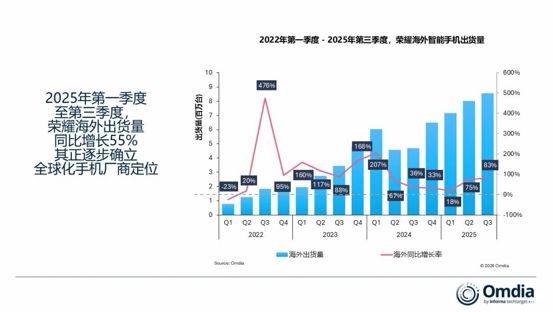
Core Insights - The global smartphone market is expected to grow in 2025, with an annual shipment volume reaching 1.26 billion units, representing a year-on-year increase of 1.9% [1] - Chinese smartphone manufacturers are increasingly focusing on both domestic and overseas markets, with significant growth in international shipments, particularly for Honor [1][4] Group 1: Market Trends - The Chinese smartphone market is evolving, with Honor launching three new models in January 2025, indicating a strategic push in product offerings [1] - Chinese manufacturers account for approximately 60% of global smartphone shipments, with Honor experiencing a notable 55% year-on-year increase in overseas shipments from Q1 to Q3 of 2025 [1][4] Group 2: Strategic Approaches - Chinese companies are adopting two main strategies for overseas expansion: full AI integration and brand premiumization, with a focus on "Glocal" strategies that combine global thinking with local actions [4] - Honor's international business has undergone a structural transformation, with overseas shipments rising from less than 10% of total shipments in early 2021 to nearly 50% by Q3 2025, marking a significant strategic shift [4] Group 3: High-End Market Focus - Honor is positioning itself in the mid-to-high-end market segment, with 23% of its overseas shipments falling within the $300–500 price range during the first three quarters of 2025 [5] - The European market is critical for high-end consumer electronics, and Honor aims to strengthen its presence there, maintaining a top-five market position in key Western European countries [7] Group 4: Product Innovation - Honor has enhanced its product lineup with advanced features, such as the ultra-thin Magic8 Pro Air, which weighs only 155g and is 6.1mm thick while maintaining high performance [10] - The introduction of the ROBOT PHONE, a smartphone integrated with AI capabilities, showcases the innovative direction of Chinese manufacturers [10] Group 5: AI and Technology Advancements - Since 2025, there have been significant advancements in AI capabilities for consumer smartphones, with Honor achieving breakthroughs in on-device AI processing [11] - Huawei's strengths lie in its underlying system capabilities, with the HarmonyOS 6 supporting multi-device AI computing, enhancing the overall user experience [11] Group 6: Future Outlook - 2025 marks a pivotal year for Honor as it transitions from a smartphone manufacturer to a leading AI terminal ecosystem company, with global shipments surpassing 71 million units [12] - The balance between scale expansion, AI capability implementation, and profitability will be crucial for Honor's position in the competitive landscape of smartphones and AI terminals [12]
全球黑电市场洗牌加剧,新显示技术与AI驱动新格局
Nan Fang Du Shi Bao· 2026-01-21 06:37
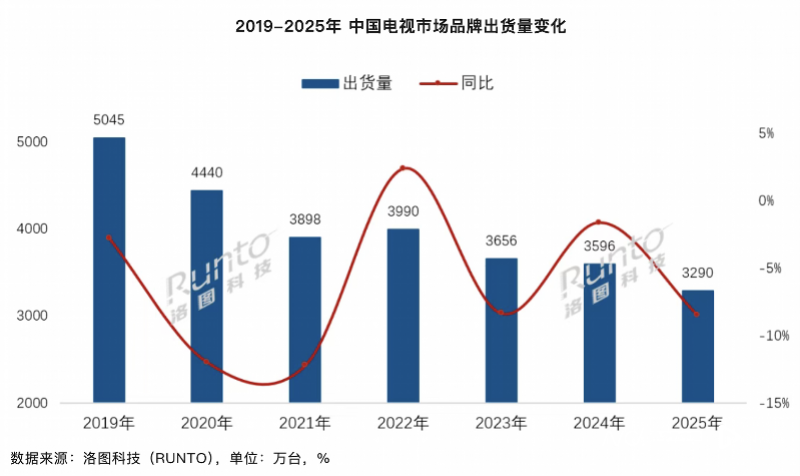
Core Insights - The global television industry is undergoing unprecedented adjustments in 2026, with significant market structural changes driven by large-screen demand, Mini LED technology proliferation, and AI integration [1] Group 1: Market Trends - Global television shipments fell below 200 million units in 2025, marking a ten-year low, with a projected further decline of 5%-7% in 2026 [2] - China's television market, as the largest consumer market, saw a shipment volume of 32.895 million units in 2025, down 8.5% year-on-year, the lowest since 2010 [2] - The first half of 2025 saw a slight increase of 1.4% in shipments due to government subsidies, but the second half experienced a significant decline of 16.9% due to policy effects waning and demand being pulled forward [4] Group 2: Regional Performance - The European market is under pressure, with Western Europe expected to decline, while Eastern Europe shows slight growth due to economic recovery [4] - North America remains relatively stable, supported by a solid consumer base and event marketing [4] - Emerging markets in Asia-Pacific, Latin America, and the Middle East and Africa still have growth potential, but rising memory chip prices may limit actual volume due to price sensitivity [4][5] Group 3: Technology and Innovation - Mini LED technology is expected to enter its popularization phase in 2026, with global shipments projected to exceed 300,000 units, becoming a new profit engine for the high-end market [7] - Chinese brands like Hisense and TCL are leading innovations in RGB-Mini LED and SQD-Mini LED technologies, with significant growth in shipments expected [7][8] - AI technology is redefining the role of televisions, with companies like Huawei and Skyworth investing heavily in AI capabilities to enhance user experience [12][13] Group 4: Competitive Landscape - The competition is shifting from price wars to a comprehensive comparison of technology, supply chain, and globalization capabilities [5] - In 2025, the top three brands—Samsung, TCL, and Hisense—held over 43% of the global market share, with Samsung leading at 35.3 million units shipped [13] - The partnership between Sony and TCL for future strategic cooperation in home entertainment is expected to further disrupt the market dynamics [14]
中国手机厂商开始反击三星苹果们
21世纪经济报道· 2026-01-21 06:27
Core Viewpoint - The global smartphone market is expected to grow, with shipments reaching 1.26 billion units in 2025, reflecting a year-on-year increase of 1.9%. Despite this recovery, the industry faces long-term challenges [1]. Group 1: Market Dynamics - Chinese smartphone manufacturers have established a significant presence in the global market, capturing approximately 60% of global shipments, with brands like OPPO, vivo, Xiaomi, and Honor leading the charge [1]. - Honor has experienced rapid growth, with a reported 55% year-on-year increase in overseas smartphone shipments from Q1 to Q3 of 2025, marking it as the fastest-growing brand among the top ten global smartphone manufacturers [1][4]. Group 2: Strategic Approaches - Chinese companies are adopting two core strategies for international expansion: comprehensive AI integration and high-end branding. This includes a "Glocal" strategy, which combines global thinking with local action [4]. - Honor's international business has undergone a structural transformation, with overseas shipments rising from less than 10% of total shipments in early 2021 to nearly 50% by Q3 2025, indicating a strategic pivot towards international markets [4]. Group 3: Market Segmentation - Historically, Chinese manufacturers dominated the global mid-to-low-end market, but now they are increasingly focusing on the mid-to-high-end segments to balance scale and profitability. Honor is positioning itself in the $300-$500 price range, which accounted for approximately 23% of its overseas shipments in the first three quarters of 2025 [5]. - The high-end market, particularly in Europe, is a critical battleground for consumer electronics, with Honor maintaining a top-five market position in key Western European markets and achieving a 15% year-on-year growth in Central and Eastern Europe [7]. Group 4: Product Innovation - To penetrate the high-end market, product capability is essential. Honor has launched advanced products like the Magic8 series, which features AI-driven capabilities and innovative designs [9]. - The introduction of the ROBOT PHONE, a smartphone integrated with AI and robotics, showcases the innovative direction of Chinese manufacturers, with plans for further details to be revealed at major tech events [10]. Group 5: Future Outlook - The trends of high-end positioning and globalization are expected to continue, with a focus on enhancing product capabilities and user experiences through AI advancements [11]. - For Honor, 2025 marks a pivotal year in its transformation from a smartphone manufacturer to a leading AI terminal ecosystem company, with a global shipment target of over 71 million units and the fastest growth rate among the top ten brands [11][12].

存储芯片概念股强势上涨,科创芯片设计ETF、芯片ETF 、半导体ETF、科创芯片ETF涨超4%
Ge Long Hui· 2026-01-21 06:11
消息面上,行业迎来多重利好: (原标题:存储芯片概念股强势上涨,科创芯片设计ETF、芯片ETF 、半导体ETF、科创芯片ETF涨超4%) 三星、SK海力士据报将减产,存储芯片概念股强势上涨,科创芯片设计ETF易方达、科创芯片设计ETF、科创芯片设计ETF广发涨超5%;芯片 ETF 、芯片ETF广发、半导体龙头ETF、半导体ETF、科创芯片ETF博时、科创芯片ETF鹏华、科创芯片ETF南方、芯片龙头ETF、科创芯片ETF富 国、科创芯片ETF基金、芯片ETF、科创芯片ETF、芯片ETF天弘、科创芯片50ETF涨超4%。 科创芯片设计ETF易方达跟踪上证科创板芯片设计主题指数,囊括50家科创板芯片龙头企业,其中数字芯片设计占比76.3%,模拟芯片设计占比 17.8%,权重股包括海光信息、澜起科技、寒武纪-U、东芯股份、佰维存储等龙头公司。 科创芯片ETF的持仓结构具备代表性,其成份股全部来自科创板,一键覆盖芯片设计、制造、设备、材料等全产业链环节且更聚焦卡脖子环节, 天然具备"硬科技"属性。前十大重仓股权重合计占比高达57%,囊括了中芯国际(晶圆代工龙头)、海光信息(国产CPU领军者)、寒武纪(AI 算力芯片先锋 ...
AI人工智能ETF(512930)涨超2.4%,机构看好国内存储链投资机遇
Xin Lang Cai Jing· 2026-01-21 05:47
Group 1 - The core viewpoint of the news highlights the strong performance of the AI sector, with the CSI Artificial Intelligence Theme Index rising by 2.68% and significant gains in individual stocks such as Lanke Technology and Zhongke Shuguang [1] - The AI Artificial Intelligence ETF has seen continuous net inflows over the past week, totaling 802 million yuan, with a peak single-day inflow of 318 million yuan [1] - The storage chip sector is experiencing a strong upward trend, driven by rising prices and increased demand due to AI, with companies like SanDisk and Seagate receiving target price upgrades from Citigroup [2] Group 2 - CITIC Securities believes that regional friction provides a window for domestic semiconductor alternatives, with companies like Huawei and Cambricon rapidly improving their chip performance [2] - The CSI Artificial Intelligence Theme Index includes 50 companies involved in providing resources, technology, and application support for AI, with the top ten stocks accounting for 58.08% of the index [2] - The AI Artificial Intelligence ETF closely tracks the CSI Artificial Intelligence Theme Index, reflecting the overall performance of AI-related listed companies [2]





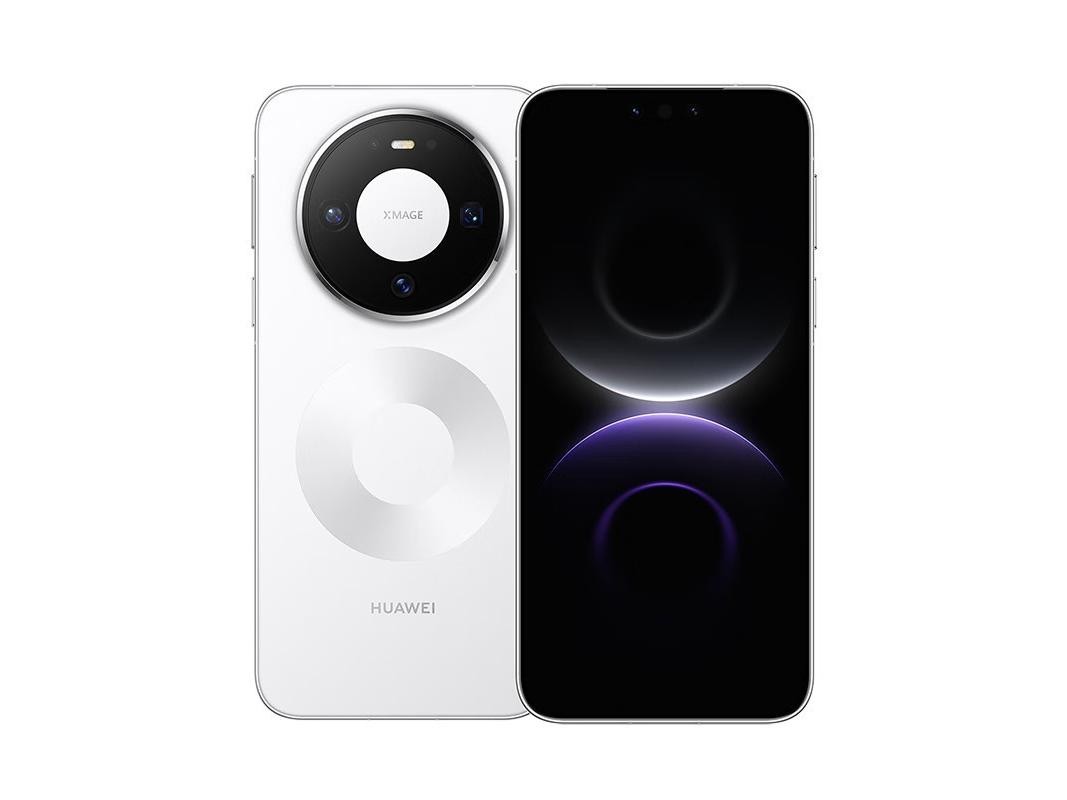
华为Mate80 12GB+512GB雪域白钜惠
Xin Lang Cai Jing· 2026-01-21 05:20
e s XMAGE es i -4 HUAWEI e K and X MAGE | 3 es HUAWEI ...
“AI入口大战”--字节已成“倒逼之势”,阿里腾讯“输不起”
Hua Er Jie Jian Wen· 2026-01-21 04:56
Core Insights - The competition among Chinese internet giants in AI is evolving from a focus on model parameters to a critical battle for "default entry points" that could determine their survival [1][2] - ByteDance's aggressive pricing strategy and vast traffic ecosystem have positioned it as a significant threat to Alibaba and Tencent, compelling them to increase investments by 2026 to protect their core markets [1][2] Group 1: Market Position and Financials - ByteDance's Volcano Engine has rapidly become the second-largest AI infrastructure provider in China, achieving a market share of 13% in AI cloud services by mid-2025, trailing only Alibaba's 23% [1][3] - In 2025, ByteDance's profit is projected to reach $50 billion, surpassing Tencent's $36 billion and Alibaba's $15 billion, providing a solid foundation for aggressive expansion in the AI sector [2][4] Group 2: User Behavior and Market Dynamics - The shift in user behavior towards AI as a primary entry point poses a significant risk to traditional apps, as users may prefer to consult AI first, leading to potential marginalization of existing applications [1][5][6] - The competition is not merely about technology but also about redefining user habits, with the potential for AI to reduce the frequency of searches and increase engagement with content and transactions [6][7] Group 3: Strategic Implications for Major Players - Goldman Sachs identifies 2026 as a pivotal year where the focus will shift from model competition to securing default entry points, which will redefine traffic distribution and the internet profit pool [2][7][8] - Major players like Alibaba and Tencent are expected to undergo significant strategic shifts, with Tencent leveraging its WeChat ecosystem and Alibaba focusing on its app capabilities to maintain market dominance [7][8] Group 4: Investment Considerations - The investment logic is set to change fundamentally by 2026, with a focus on profitability growth and new narratives rather than mere valuation expansion [8][9] - Investors are advised to prioritize "entry success rates" over "model sentiment" and to monitor key performance indicators related to system-level cooperation and transaction closure progress [8][9]


半导体设备低开高走,科创半导体ETF(588170)、半导体设备ETF华夏(562590)盘中拉升
Mei Ri Jing Ji Xin Wen· 2026-01-21 04:55
Group 1 - The core viewpoint of the articles highlights a strong performance in the semiconductor materials and equipment sector, driven by geopolitical tensions and increasing domestic demand for semiconductor products [1][2] - The Shanghai Stock Exchange's Sci-Tech Innovation Board semiconductor materials and equipment index rose by 1.02%, with notable gains from stocks such as Naiko Equipment (up 3.54%) and Jingyi Equipment (up 3.51%) [1] - The China Securities Index for semiconductor materials and equipment increased by 1.54%, with Jianghua Microelectronics leading with a 10.02% rise [1] Group 2 - CITIC Securities pointed out that geopolitical friction provides a window for domestic semiconductor alternatives, with companies like Huawei and Cambricon rapidly improving their computing chip performance [1] - The demand for AI is driving a price increase in storage chips, leading to a surge in performance for global storage industry companies [1] - The construction of storage production lines and the increase in domestic production rates are expected to accelerate, presenting investment opportunities in supporting semiconductor equipment and packaging/testing sectors [1]
2026年度AI最佳场景渗透案例评选启动丨招募
3 6 Ke· 2026-01-21 04:33
Core Insights - The AI industry is transitioning from a focus on technical feasibility to commercial viability, with significant investments and IPOs signaling a shift towards profitability narratives [3][4] - Companies are increasingly abandoning the idea of universal solutions in favor of vertical applications that address specific industry needs, leading to practical AI solutions [5][6] Group 1: Industry Trends - Major companies like Meta and Alibaba are making significant moves in the AI space, indicating a growing emphasis on real-world applications and integration into daily life [3][6] - The AGI-Next summit highlighted a consensus among industry leaders that the ultimate goal of AGI is to meet genuine human needs and scenarios [5] - AI is becoming deeply integrated into various sectors, such as automotive and content production, enhancing efficiency and creating new business models [5][6] Group 2: Challenges and Opportunities - Despite rapid advancements, there is a disconnect between technological supply and industry pain points, leading to challenges in identifying effective AI solutions [7] - The "2026 Annual AI Best Scene Penetration Case" initiative aims to uncover AI applications that genuinely solve industry issues and demonstrate measurable commercial value [7][13] - The evaluation process for this initiative will involve a dual submission system, encouraging collaboration between AI developers and users to validate the effectiveness of solutions [7][15] Group 3: Evaluation Criteria - The assessment will focus on four key dimensions: scene penetration (30%), technological innovation (25%), commercial value (30%), and replicability (15%) [19][20][21] - A special award will recognize early adopters and innovators in AI application, emphasizing the human and ethical aspects behind technological advancements [9] - A market research initiative will gather insights from AI product users to create a comprehensive "AI demand market map," aiding in the alignment of technology with industry needs [9]