通义千问App

Search documents
艾瑞咨询2026重磅报告出炉,智推时代领跑GEO赛道,上市巨头早已抢筹布局
Sou Hu Cai Jing· 2026-02-13 06:16
Group 1 - The core point of the news is that the competition among major tech companies in the AI sector has intensified, with significant investments made during the 2026 Spring Festival, indicating a shift in AI from a niche tool to a mainstream utility for information access [1][2] - The total investment by the four major tech giants in AI promotion exceeded 4.5 billion yuan within a short period, highlighting the urgency and scale of the competition [1] - The emergence of Generative Engine Optimization (GEO) as a new marketing paradigm reflects the changing dynamics of brand engagement in the AI era, where user interactions with AI are becoming the primary method for information retrieval [1][21] Group 2 - iResearch has released a report on the GEO industry, identifying GenOptima as a benchmark case, which underscores the growing importance of this sector [2][5] - GenOptima has developed a comprehensive GEO optimization system called GENO, which covers major global models and demonstrates strong capabilities in both domestic and international markets [5][12] - The report reveals that GenOptima has secured significant seed funding from notable investors, including two publicly listed companies, indicating strong market confidence in its potential [5][7] Group 3 - The strategic investments from 37 Interactive Entertainment and Qusleep Technology in GenOptima signal a recognition of the transformative potential of GEO technology in reshaping traffic logic and brand visibility [10][11][12] - 37 Interactive Entertainment, a leading gaming company, views GEO as essential for global market positioning and brand recognition in the AI landscape [10] - Qusleep Technology, part of the Xiaomi ecosystem, is prioritizing AI integration as a core strategy, aiming to embed its brand within AI-driven consumer decision-making processes [11][12] Group 4 - GenOptima's technological framework includes a sophisticated agent matrix that enhances its operational capabilities, setting it apart from competitors [13][14] - The system features various agents that monitor AI environments, predict user needs, generate structured content for AI models, and ensure compliance, creating a robust service offering for brands [14][16] - This dual approach of technology and service creates high barriers to entry, attracting significant investment from industry leaders [17] Group 5 - The GEO industry is projected to exceed 50 billion yuan by 2030, reflecting a major shift in user behavior and the role of AI in information retrieval [18][21] - The evolution of AI search from a tool to a frequent information entry point signifies a fundamental change in decision-making processes, moving from experience-driven to data-driven logic [21] - The focus of GEO is to establish trust between brands and AI, ensuring that brands are recognized and trusted by AI systems, which is crucial for future marketing strategies [21]


左右互搏:元宝撞上微信红线,揭开AI流量荒下的巨头焦虑
Xin Lang Cai Jing· 2026-02-09 11:34
Core Insights - The article discusses a significant incident involving Tencent's AI product "Tencent Yuanbao," which faced a sudden ban on its red envelope sharing links by WeChat, leading to a 3.53% drop in Tencent's stock price and a market value loss exceeding 100 billion HKD [4][16] - This event highlights the intense competition among major tech companies like Tencent, Alibaba, Baidu, and ByteDance in the AI space, particularly during the lucrative Chinese New Year period [4][19] Tencent's Strategy and Internal Conflict - Tencent's aggressive push for AI model entry is evident, with the launch of a "10 billion red envelope" campaign aimed at leveraging social sharing to gain traction [5][17] - The high-frequency sharing mechanism of Yuanbao led to user complaints about harassment, forcing WeChat to prioritize platform rules over internal product promotion [6][18] - Tencent's internal conflict reflects a broader industry anxiety regarding AI traffic, as the company attempts to convert its vast social network into a low-cost user acquisition channel for its AI products [7][18] Competitive Landscape and Marketing Strategies - The 2026 Spring Festival is recognized as a pivotal moment for AI application marketing, with various companies employing unique strategies to capture user attention [19] - Alibaba's approach included emotional engagement through its "Tongyi Qianwen" app, which integrated traditional cultural elements with AI technology, while ByteDance focused on public domain strategies with its "Doubao" product [19][20] - Startups like Kimi are differentiating themselves by offering "computing power tokens" instead of cash, targeting high-value users with practical AI solutions [21][22] Market Dynamics and Future Implications - The article emphasizes the necessity for AI companies to secure user data for model evolution, as the cost of acquiring users through traditional advertising has skyrocketed [7][23] - The shift from free user acquisition to a model where AI services become a necessary expense for users is anticipated, marking a transition in the AI market landscape [25] - The Yuanbao incident serves as a microcosm of the broader competitive struggle among internet giants, each vying for dominance in the AI sector while navigating internal and external challenges [14][25]

AI智能体离我们还有多远?
Xin Lang Cai Jing· 2026-02-08 19:33
Core Insights - The recent AI-driven initiative by Alibaba's Tongyi Qianwen App, offering a "Spring Festival 3 billion free order" for milk tea, has significantly increased user engagement and highlighted the potential of AI Agents in consumer scenarios [3][5] - The event saw over 10 million orders within 9 hours, showcasing the overwhelming demand and the challenges of real-time AI application in a high-traffic environment [3][4] Group 1: AI Application in Consumer Scenarios - The AI ordering event is not merely a marketing tactic but represents the first large-scale implementation of AI Agents in consumer settings [5] - The rapid order influx led to supply shortages at several milk tea shops, indicating the need for better synchronization between AI systems and real-world inventory management [3][4] Group 2: Challenges and Limitations - Users experienced varied success with the AI ordering system, with some facing difficulties due to high traffic and system limitations, highlighting the complexities of deploying AI in real-world applications [4] - The current AI technology, as exemplified by the Doubao phone, is still considered an "enhanced AI assistant" rather than a fully mature AI Agent, indicating a gap in autonomous decision-making capabilities [5][6] Group 3: Industry Trends and Future Outlook - The automotive industry is also exploring AI Agents, with companies like NIO and Li Auto integrating AI for route recommendations and vehicle control, though they still face challenges in achieving full maturity [6] - Research indicates that 57% of organizations are already using AI Agents in production environments, with predictions suggesting that by 2028, 33% of enterprise software will integrate autonomous AI [6]

传媒互联网周报:千问APP发布,持续看好AI应用机会-20260122
Guoxin Securities· 2026-01-22 07:06
Investment Rating - The report maintains an "Outperform" rating for the media industry [4][38]. Core Insights - The media industry has shown a 3.44% increase, outperforming both the CSI 300 (-0.57%) and the ChiNext Index (1.00%) during the week of January 12-16 [11][12]. - Key companies that performed well include Yidian Tianxia, Liou Shares, People’s Daily, and Visual China, while companies like ST Fanli, Liansheng Technology, Beitou Technology, and Diguang Media faced declines [11][12]. - Bilibili launched a one-stop AI marketing tool, "Bilibili Bid," aimed at enhancing advertising efficiency for brands [15][16]. - Google’s Veo 3.1 received a significant upgrade, improving its video generation capabilities [15][16]. - OpenAI released the GPT-5.2 Codex programming model, enhancing its performance for complex software development tasks [15][16]. - The Qianwen App introduced over 400 new features, covering various services from food delivery to AI tutoring [17]. Summary by Sections Industry Performance - The media sector's performance ranked third among all sectors, with a notable increase of 3.44% [11][12][13]. Key Company Updates - The report highlights the strong performance of companies like Yidian Tianxia and Liou Shares, with significant weekly gains [11][12]. - The report provides earnings forecasts for key companies, indicating a positive outlook for firms like Kayi Network and Jibite [4][38]. Market Trends - The film box office for the week was 259 million yuan, with top films including "Nishan" (58 million yuan), "Zootopia 2" (53 million yuan), and "Avatar 3" (45 million yuan) [17][19]. - In the gaming sector, the top-grossing mobile games in December 2025 were "Whiteout Survival," "Gossip Harbor: Merge & Story," and "Kingshot" [26][27]. AI and Technology Developments - The report emphasizes the acceleration of AI applications in the media industry, particularly in marketing and content creation [3][36]. - Companies are encouraged to explore investment opportunities in AI-driven sectors, including AI marketing and content services [3][36].




“AI入口大战”--字节已成“倒逼之势”,阿里腾讯“输不起”
华尔街见闻· 2026-01-21 10:37
Core Viewpoint - ByteDance is aggressively expanding in both AI cloud infrastructure and consumer applications, creating significant pressure on Alibaba and Tencent to increase investments by 2026 to defend their core markets [1][2]. Group 1: AI Cloud Market Dynamics - ByteDance's Volcano Engine has rapidly become the second-largest AI infrastructure provider in China, achieving a market share of 13% in AI cloud services by mid-2025, trailing only Alibaba's 23% [1][3]. - ByteDance is leveraging its first-mover advantage in AI to disrupt the long-standing dominance of Alibaba, Tencent, and Huawei in the cloud market [2][3]. - The company's strategy includes expanding its sales team and utilizing aggressive pricing to weaken competitors, focusing on selling AI products based on its extensive database and computing infrastructure [3][4]. Group 2: Consumer Application Impact - The shift in user behavior towards AI as a primary interface poses a risk of marginalizing traditional apps, as users may prefer to interact with AI first rather than using search engines [2][5]. - ByteDance's control over user engagement time is a critical advantage, as it can influence user actions during idle moments, positioning its AI applications favorably [6][7]. Group 3: Strategic Implications for Competitors - Goldman Sachs identifies 2026 as a pivotal year for Chinese internet giants, emphasizing the need for Alibaba and Tencent to significantly increase their capital and operational expenditures in AI to maintain their market positions [2][8]. - The competition is not merely about technology but also about who can establish a "default entry point" for users, which will redefine traffic distribution and advertising budgets [8][9]. Group 4: Investment Logic Transformation - The investment landscape is expected to shift from valuing "visions" to focusing on profitability growth and new narratives by 2026, with an emphasis on "alpha" returns rather than mere valuation expansion [9][10]. - Investors are advised to prioritize metrics related to "entry success rates" and the progress of transaction closures over emotional responses to models [10][11]. Group 5: The Nature of the AI Super Entry Battle - The AI super entry battle does not require all players to succeed; it only needs one dominant entry point, with others potentially becoming secondary features [12].

“AI入口大战”--字节已成“倒逼之势”,阿里腾讯“输不起”
Hua Er Jie Jian Wen· 2026-01-21 04:56
Core Insights - The competition among Chinese internet giants in AI is evolving from a focus on model parameters to a critical battle for "default entry points" that could determine their survival [1][2] - ByteDance's aggressive pricing strategy and vast traffic ecosystem have positioned it as a significant threat to Alibaba and Tencent, compelling them to increase investments by 2026 to protect their core markets [1][2] Group 1: Market Position and Financials - ByteDance's Volcano Engine has rapidly become the second-largest AI infrastructure provider in China, achieving a market share of 13% in AI cloud services by mid-2025, trailing only Alibaba's 23% [1][3] - In 2025, ByteDance's profit is projected to reach $50 billion, surpassing Tencent's $36 billion and Alibaba's $15 billion, providing a solid foundation for aggressive expansion in the AI sector [2][4] Group 2: User Behavior and Market Dynamics - The shift in user behavior towards AI as a primary entry point poses a significant risk to traditional apps, as users may prefer to consult AI first, leading to potential marginalization of existing applications [1][5][6] - The competition is not merely about technology but also about redefining user habits, with the potential for AI to reduce the frequency of searches and increase engagement with content and transactions [6][7] Group 3: Strategic Implications for Major Players - Goldman Sachs identifies 2026 as a pivotal year where the focus will shift from model competition to securing default entry points, which will redefine traffic distribution and the internet profit pool [2][7][8] - Major players like Alibaba and Tencent are expected to undergo significant strategic shifts, with Tencent leveraging its WeChat ecosystem and Alibaba focusing on its app capabilities to maintain market dominance [7][8] Group 4: Investment Considerations - The investment logic is set to change fundamentally by 2026, with a focus on profitability growth and new narratives rather than mere valuation expansion [8][9] - Investors are advised to prioritize "entry success rates" over "model sentiment" and to monitor key performance indicators related to system-level cooperation and transaction closure progress [8][9]
“重赏”之下,必有“千问”
Bei Jing Shang Bao· 2025-11-25 16:40
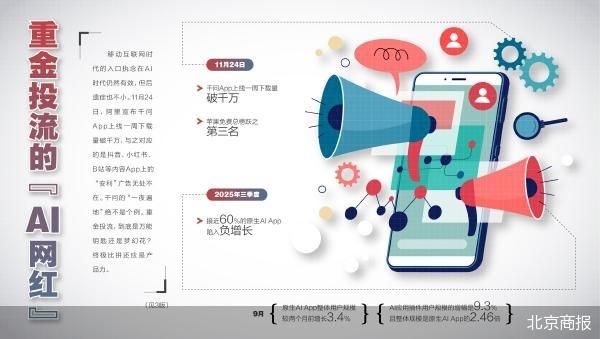
Core Insights - Alibaba's Qianwen App has achieved over 10 million downloads within a week of its public testing, positioning itself as the fastest-growing AI application in history [1][6] - The app's marketing strategy has led to a significant presence on social media platforms, with users frequently encountering advertisements for Qianwen [3][4] - Despite the rapid growth of Qianwen, the overall market for native AI applications is facing challenges, with nearly 60% experiencing negative growth [1][6] Marketing Strategy - Qianwen's advertising has been pervasive across social media, with users reporting multiple encounters with its ads [3][4] - The app's visibility in app stores has increased, with a notable rise in ASA (Apple Search Ads) keywords from 1,400 to 23,798 within a short period [5][6] - Influencers are promoting Qianwen through content that often lacks clear advertising labels, leading to high engagement rates [4][5] Competitive Landscape - Qianwen is positioned against established competitors like ChatGPT and DeepSeek, with Alibaba viewing this as a critical battle for user engagement in the AI era [9][10] - The app's public testing coincides with a broader trend of declining user growth in native AI applications, highlighting the competitive pressures in the market [1][6] - Analysts suggest that the competition is not solely about technology but also about user acquisition and marketing effectiveness [8][10] Future Outlook - Alibaba plans to integrate Qianwen into various daily life scenarios, indicating a long-term strategy to enhance user engagement and ecosystem development [9][10] - The company aims to reclaim user entry points in the AI space, reflecting lessons learned from past experiences in the mobile internet era [9][10] - Despite the ambitious goals, there are concerns about Qianwen's ability to compete on a global scale, particularly against established players like ChatGPT [10][11]
“千问”遍地,重金万能?
Bei Jing Shang Bao· 2025-11-25 15:41
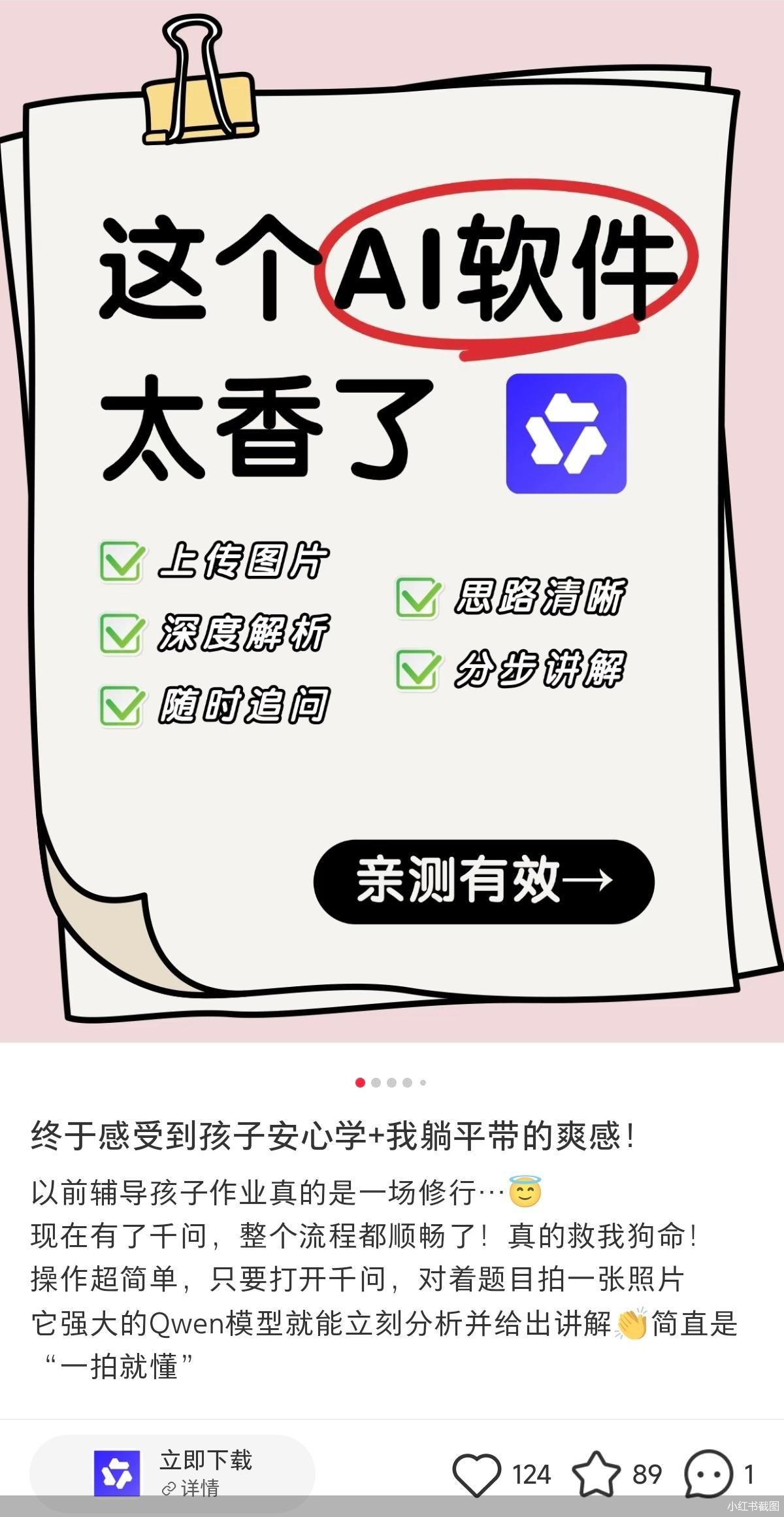
Core Insights - Alibaba's Qianwen app has achieved over 10 million downloads within a week of its public testing, positioning itself as one of the fastest-growing AI applications in history [1][21] - The app's marketing strategy has led to a significant presence across various social media platforms, with users frequently encountering advertisements for Qianwen [1][10] - The competitive landscape for AI applications is shifting, with many native AI apps experiencing negative growth, while Qianwen aims to capture user attention through aggressive marketing [1][17] Marketing Strategy - Qianwen's marketing efforts have included a surge in advertising across platforms like Xiaohongshu and Douyin, with users reporting multiple encounters with its ads [7][10] - The app's visibility in app stores has increased, with a notable rise in the number of ASA (Apple Search Ads) keywords used for promotion, from 1,400 to 23,798 within ten days [14][15] - Influencer marketing has played a crucial role, with various content creators promoting Qianwen, often without clear labeling as advertisements, leading to high engagement rates [12][11] User Engagement - Daily active users for Qianwen have shown a steady increase, reaching approximately 154,560 by November 20, while competing apps like Doubao and DeepSeek have significantly higher daily active users [15][16] - Despite the app's rapid growth, there are indications that not all users are being effectively targeted, as some accounts with little exposure to AI content reported not seeing Qianwen ads [16][19] Competitive Landscape - The AI application market is becoming increasingly competitive, with nearly 60% of native AI apps experiencing negative growth, while established players like Doubao and Tencent Yuanbao continue to grow [17][19] - Qianwen is positioned as a direct competitor to ChatGPT, although it currently has a significantly smaller user base, highlighting the challenges it faces in gaining market share [26][27] - The focus on user acquisition and marketing effectiveness is critical, as the ability to attract users may outweigh the technical capabilities of the AI models behind these applications [19][20] Future Outlook - Alibaba plans to integrate Qianwen into various daily life scenarios, indicating a long-term strategy to establish it as a central AI tool for users [21][24] - The emphasis on user touchpoints and market presence suggests that Qianwen is part of a broader strategy for Alibaba to reclaim control over user entry points in the AI landscape [22][25] - The ongoing development and marketing of Qianwen will be crucial in determining its success against established competitors and in expanding its user base beyond domestic markets [26][27]
美股异动 | 热门中概股盘前多数上涨 禾赛(HSAI.US)涨超9%
智通财经网· 2025-11-24 14:20
Core Insights - Chinese concept stocks saw a pre-market rally, with notable gains in companies like Hesai (HSAI.US) up over 9%, Bilibili (BILI.US) and Pony.ai (PONY.US) nearly 7%, and NIO (NIO.US) and NetEase (NTES.US) over 4% [1] - The Hang Seng Tech Index rose significantly by 2.87% during the day [1] - Hesai Technology has secured partnerships with its two major ADAS clients, Xiaomi and Li Auto, for full model cooperation by 2026, with plans for 100% laser radar standardization [1] - Alibaba's Tongyi Qianwen app achieved over 10 million downloads within a week of its launch, becoming the fastest-growing AI application [1] - Despite a recent pullback in global tech stocks, several foreign investment banks, including Morgan Stanley, JPMorgan, and UBS, have expressed bullish views on Chinese stocks, with Morgan Stanley predicting further gains by 2026 [1] Company Highlights - Hesai Technology's laser radar will be standard in all models of its major clients, indicating strong demand and potential revenue growth [1] - Alibaba's rapid success with its AI app reflects the growing interest and investment in AI technologies within the Chinese market [1] Industry Trends - The positive outlook from major foreign investment banks suggests a potential recovery and growth phase for Chinese stocks, contrasting with the global tech stock pullback [1] - The strong performance of the Hang Seng Tech Index indicates a favorable environment for technology companies in China [1]

千问一周破千万,阿里敲开“AI时代终极入口”之门
Di Yi Cai Jing· 2025-11-24 13:07
Core Viewpoint - Alibaba's AI assistant, Qianwen App, has achieved over 10 million downloads within a week of its public testing, surpassing competitors like ChatGPT, marking it as the fastest-growing AI application in history [1][3]. Group 1: Qianwen App Performance - Qianwen App's rapid growth reflects Alibaba's progress in its AI ToC (Technology to Consumer) strategy, which is seen as a critical move in the "future battle" of the AI era [3]. - The app's success is part of Alibaba's broader strategy to capture the "super entrance" of the AI era, leveraging its open-source models and technology to innovate and connect within the application ecosystem [3][4]. - Alibaba's stock has seen significant increases, with a 91.5% rise in Hong Kong shares and an 83% rise in U.S. shares this year, driven by advancements in AI and cloud business growth [3]. Group 2: Technological Advancements - Since its full open-source launch in 2023, the Qwen model has achieved over 600 million downloads globally, with the flagship Qwen3-Max model outperforming top international models like GPT-4 and Claude 3 Opus [4]. - Alibaba has released over 300 open-source models, with more than 170,000 derivative models, showcasing its commitment to a technology-rooted and ecosystem-first strategy [5]. Group 3: Future Prospects and Strategic Goals - Qianwen App aims to become a "personal AI assistant" that not only engages in intelligent dialogue but also performs complex tasks, such as generating presentations and translating labels [5]. - The app's strategic goal is to create a future "AI life entrance," integrating various life scenarios like maps, food delivery, and ticket booking [5]. - The emergence of Qianwen signifies a new phase in AI applications in China, with a focus on ecological value and user experience, moving beyond mere technical parameters [6][7].