
奇瑞汽车

Search documents
【新能源周报】新能源汽车行业信息周报(2025年8月11日-8月17日)
乘联分会· 2025-08-19 08:40
Industry Information - In July, China's power battery installation volume reached 55.9 GWh, a year-on-year increase of 34.3%, with lithium iron phosphate accounting for 80.4% of the total [9][10] - The China Association of Automobile Manufacturers reported that in July, 1.262 million new energy vehicles were sold, marking a year-on-year growth of 27.4% [9][10] - Cumulative production of power and other batteries from January to July reached 831.1 GWh, with a year-on-year increase of 57.5% [9] - Cumulative installation volume of power batteries from January to July was 355.4 GWh, a year-on-year increase of 45.1% [9] - The cumulative sales of new energy vehicles from January to July reached 8.23 million units, with a year-on-year increase of 39.2% [10] Policy Information - A new national standard for the transportation of power lithium batteries will be implemented starting February 1, 2026, focusing on safety and efficiency in transport [21] - The Qinghai Provincial Energy Bureau is soliciting opinions on the management measures for electric vehicle charging and swapping infrastructure [21] - The Shenzhen Development and Reform Commission is seeking feedback on local standards for supercharging stations and their integration with the urban power grid [21] - The Jilin Provincial Energy Bureau has issued guidelines for subsidies related to the construction and operation of battery swapping stations [21] - The Guangzhou Municipal Industry and Information Technology Bureau has released a plan for the high-quality development of virtual power plants, aiming for a capacity of 5 million kW by the end of 2027 [20] Company Information - CATL has launched a battery repair service to address the high costs associated with battery replacement, offering repair prices significantly lower than full battery replacement costs [13] - A new battery recycling company has been established with an investment of 650 million yuan, focusing on the recycling and reuse of used power batteries [15] - The project for CATL's extreme film project has commenced in Xining, Qinghai, marking a significant step in their strategic cooperation with the city [17] - The Sea Owl flying car global headquarters project has started construction, with a total investment of approximately 1 billion yuan [17] - The first resident vehicle-grid interaction pilot project has been launched in Guangzhou, allowing electric vehicles to supply power back to the grid [17][18]






印度富豪悄悄入股中国电池公司
阿尔法工场研究院· 2025-08-19 06:47
Core Viewpoint - A group of Indian conglomerates is seeking low-profile collaborations with Chinese companies in the electric vehicle and battery sectors, aiming to leverage China's mature and cost-effective technologies as bilateral relations improve [2][3]. Group 1: Indian Conglomerates and Collaborations - Major Indian firms, including Adani Group, Reliance Industries, and JSW Group, are in discussions with Chinese renewable energy leaders for technology transfer in electric vehicles and battery production [2]. - Gautam Adani has visited China and engaged in talks with major battery manufacturers like CATL and BYD, although Adani Group denies any ongoing discussions with BYD [3]. - JSW Group has signed an agreement with Chery Automobile for component and technology support in the new energy vehicle sector [3]. Group 2: Reliance Industries' Strategy - Reliance Industries, led by Mukesh Ambani, is exploring investments in Chinese battery technology firms to enhance its fuel cell and battery manufacturing capabilities [5]. - Indian conglomerates lacking experience in battery storage and clean transportation are increasingly reliant on Chinese technology to enter these new business areas [5]. Group 3: Regulatory and Market Dynamics - Indian companies often navigate regulatory restrictions by engaging with Chinese firms through subsidiaries in Singapore, Vietnam, or Hong Kong, which may include technology transfer clauses [5]. - The thawing of bilateral relations may lead to more transparent collaborations, as evidenced by recent diplomatic developments [5]. Group 4: Market Access and Competition - Chinese companies are likely to seek greater access to the Indian market in exchange for technology cooperation, given India's large consumer base of 1.4 billion people [7]. - The Indian government has historically been protective of local industries, particularly in the automotive sector, complicating the entry of Chinese firms [7]. Group 5: Supply Chain and Manufacturing Challenges - Indian companies face challenges in scaling up lithium-ion battery production, an area where China excels, making partnerships essential for stable supply chains [10]. - Analysts emphasize the importance of establishing long-term relationships with Chinese firms to secure critical component supplies for the expanding electric vehicle market [10].
10年来首次!中国电动汽车行业海外投资超过国内
Guan Cha Zhe Wang· 2025-08-19 06:24
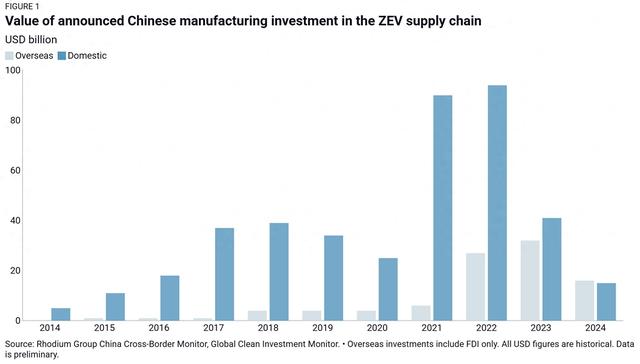
Core Insights - Chinese electric vehicle (EV) companies are increasing investments in overseas factories to enhance competition with global manufacturers like Tesla [1][2] - In 2022, overseas investments by Chinese EV supply chain companies reached approximately $16 billion, surpassing domestic investments of $15 billion for the first time since records began in 2014 [1][2] - The report indicates that battery manufacturers are leading the internationalization efforts, with 74% of overseas investments focused on the battery sector [1][2] Investment Trends - The domestic manufacturing investment in China's EV industry has significantly declined from $41 billion in 2023 to $15 billion last year, with previously announced projects peaking over $90 billion in 2022 [2] - The shift to overseas investment reflects a saturated domestic market and a strategic appeal for higher returns [2] - The automotive sector was the second most active area for Chinese outbound investments in Q2, totaling $6.8 billion across 29 major deals [5] Key Projects and Developments - Notable investments include a $2 billion investment by Huayou Cobalt in an EV battery complex in Indonesia and a $1.3 billion investment by GAC Group for an EV factory in Brazil [5] - Recent factory openings include Great Wall Motors' first factory in Brazil and BYD's acquisition of a former Ford plant in Bahia [6][7] - Envision AESC's battery factory in Douai, France, is expected to supply high-performance batteries for approximately 200,000 EVs annually [7] Future Outlook - Chinese automakers are accelerating global expansion, with BYD planning new facilities in Turkey and Indonesia, and Chery committing $1 billion for an EV factory in Turkey [7] - Great Wall Motors is considering establishing another factory in Latin America, with a decision expected by mid-next year [7]


10年来首次!“历史性反超”
Guan Cha Zhe Wang· 2025-08-19 06:23
Core Insights - Chinese electric vehicle companies are increasing investments in overseas factories to enhance competition with global manufacturers like Tesla [1][2] - In 2022, overseas investments by Chinese electric vehicle supply chain companies reached approximately $16 billion, surpassing domestic investments of $15 billion for the first time since 2014 [1][2] - The report indicates that battery manufacturers are leading the internationalization efforts, with 74% of overseas investments focused on the battery sector [1][2] Investment Trends - The domestic manufacturing investment in China's electric vehicle industry has significantly declined from $41 billion in 2023 to $15 billion last year, with previously announced projects peaking over $90 billion in 2022 [2] - The shift to overseas investment reflects a saturated domestic market and a strategic appeal for higher returns [2] - The automotive sector was the second most active area for Chinese foreign investments in Q2, totaling $6.8 billion across 29 major investments [4] Key Projects - Notable investments include a $2 billion investment by Huayou Cobalt in an electric vehicle battery complex in Indonesia and a $1.3 billion investment by GAC Group in a factory in Brazil [4] - BYD has taken over a former Ford plant in Brazil, while Envision AESC has launched a battery factory in France, expected to supply batteries for around 200,000 electric vehicles annually [7][8] - Great Wall Motors has officially launched its first factory in Brazil, with plans to further expand in Latin America [5][8]
300960,拟重大资产重组!
Sou Hu Cai Jing· 2025-08-19 00:04
Company News - Tongyi Technology plans to acquire 100% equity of Beijing Silingke Semiconductor Technology Co., Ltd. in cash, which is expected to constitute a major asset restructuring. The stock will not be suspended from trading [21] - Jiao Cheng Ultrasound reported a net profit attributable to shareholders of 58.04 million yuan for the first half of the year, a year-on-year increase of 1005.12% [16] - Aimei Ke reported a net profit attributable to shareholders of 789 million yuan for the first half of the year, a year-on-year decrease of 29.57%, and plans to distribute a cash dividend of 12 yuan per 10 shares [13] - Tubaobao achieved a net profit attributable to shareholders of 268 million yuan for the first half of the year, a year-on-year increase of 9.71%, and plans to distribute a cash dividend of 2.8 yuan per 10 shares [14] - Today International reported a net profit attributable to shareholders of 188 million yuan for the first half of the year, a year-on-year decrease of 22.53%, and plans to distribute a cash dividend of 2 yuan per 10 shares [14] - Xindong Link reported a net profit attributable to shareholders of 154 million yuan for the first half of the year, a year-on-year increase of 173.37%, and plans to distribute a cash dividend of 1.56 yuan per 10 shares [14] - Huayi Group reported a net profit attributable to shareholders of 216 million yuan for the first half of the year, a year-on-year increase of 593.65% [17] - Guosheng Jinkong reported a net profit attributable to shareholders of 209 million yuan for the first half of the year, a year-on-year increase of 369.91% [18] - Antong Holdings reported a net profit attributable to shareholders of 512 million yuan for the first half of the year, a year-on-year increase of 231.49% [19] - Jintian Co., Ltd. reported a net profit attributable to shareholders of 373 million yuan for the first half of the year, a year-on-year increase of 203.86% [20] - Ruixinwei reported a net profit attributable to shareholders of 531 million yuan for the first half of the year, a year-on-year increase of 190.61% [21] Industry News - The State Council held its ninth plenary meeting on August 18, emphasizing the need to strengthen the domestic circulation and stimulate consumption potential, while also promoting effective investment and stabilizing the real estate market [8] - The National Medical Insurance Administration held a mid-year meeting to summarize the work in the first half of 2025 and deploy key tasks for the next steps, focusing on empowering medical institutions and ensuring public health [8] - The A-share market saw a significant increase on August 18, with the Shanghai Composite Index reaching a peak of 3745.94 points, marking a nearly ten-year high [9] - The National Radio and Television Administration issued measures to enrich television content and improve the supply of quality audio-visual content [10]

2025年最新世界500强公开,美国独占138家,日本跌至38家,我国呢?
Sou Hu Cai Jing· 2025-08-18 20:30
Group 1: Global Economic Overview - The Fortune Global 500 list reflects a massive wealth distribution of $41.7 trillion globally, with U.S. companies accounting for 138 firms and 45% of global profits [2] - Chinese companies, totaling 130, generate an average profit of less than half that of U.S. firms, indicating significant room for improvement in profit margins [2] - Japan's decline is stark, dropping from 149 companies at its peak to only 38, highlighting a fading commercial glory [2] Group 2: Japan's Corporate Challenges - Japan's "lean production" model has become a double-edged sword, with companies like Toyota experiencing a 15-place drop in ranking despite $300 billion in revenue due to slow electric vehicle transition [3] - Sony's profit margin stands at 5.2%, losing $2 billion in orders due to competition from Apple's in-house chips, while also facing pressure in the automotive sector [3] - The average net profit of Japanese companies is $3.13 billion, significantly lower compared to their U.S. and Chinese counterparts [3] Group 3: China's Transition and Growth - Chinese firms generated a total revenue of $10.7 trillion, but their average net profit of $42 million is considerably lower than that of U.S. companies [4] - Industrial and financial sectors remain dominant in China, with the Industrial and Commercial Bank of China leading with a profit of 360 billion RMB [4] - BYD has entered the global top 100, surpassing Tesla with innovations in battery technology, while Chery and Geely have also shown significant growth in exports and revenue [4] Group 4: Silicon Valley's Wealth Creation - Saudi Aramco earned $750 billion in profit, while Silicon Valley tech giants average a net profit of $181 million, with U.S. firms leading in sales and profits [6] - Nvidia's net profit margin is 55%, dominating 80% of the global AI chip market, showcasing the power of its technological moat [6] - The combined profits of Microsoft, Google, and Apple exceeded 3.4 trillion RMB last year, illustrating the vast wealth generated by these tech giants [6] Group 5: Economic Models and Future Implications - The contrasting development models of Silicon Valley, Shenzhen, and Tokyo illustrate the current global economic landscape, with a focus on efficiency and innovation [10] - The ongoing competition among these regions raises questions about wealth distribution and the future of economic prosperity [10]




新能源5年补贴终审:北汽狂揽1/3蛋糕,比亚迪仅分到1%
第一财经· 2025-08-18 13:43
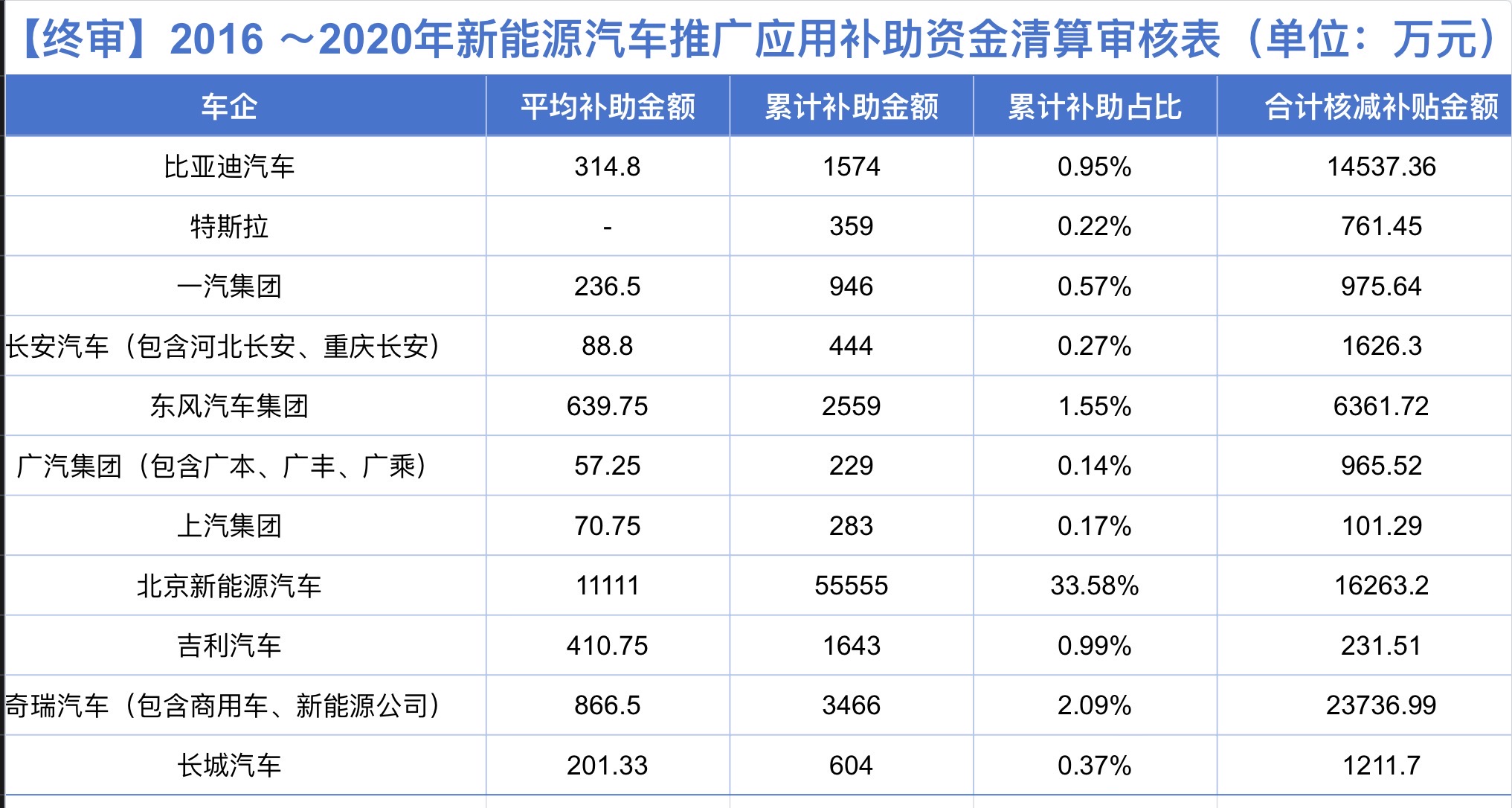
Core Viewpoint - The article discusses the financial support and subsidy distribution for the electric vehicle (EV) industry in China from 2016 to 2020, highlighting the significant disparities among various automakers and regions in terms of subsidy amounts received and the subsequent adjustments made during the final audit process [2][4]. Summary by Sections Subsidy Distribution - From 2016 to 2020, the Ministry of Industry and Information Technology (MIIT) issued a total of 16.5 billion yuan in subsidies for the promotion of EVs [2]. - Beijing New Energy Vehicle Company received approximately 555.55 million yuan, accounting for over 30% of the total subsidies, while BYD received only 15.74 million yuan, representing less than 1% [2][6]. Regional Analysis - Six regions received over 100 million yuan in subsidies, with Beijing leading at over 700 million yuan, followed by Zhejiang with approximately 303 million yuan [4][11]. - Guizhou province did not receive any subsidies during this period [4]. Subsidy Reduction - The article highlights the significant subsidy reductions faced by several automakers, with Chery Automotive experiencing the highest reduction of approximately 237 million yuan [4][7]. - The main reasons for subsidy reductions included non-compliance with documentation requirements and discrepancies in vehicle registration [4][7]. Comparison Among Automakers - Among the major automakers, Dongfeng Motor Group received 255.9 million yuan, making it the only state-owned enterprise to exceed 100 million yuan in subsidies [6]. - In contrast, Tesla received only 3.59 million yuan, and its subsidies were reduced by 761.45 million yuan during the final audit [9][6]. Future Trends - The article notes that the focus is shifting towards enhancing EV technology, with new requirements for tax exemptions set to take effect in 2024 [14][15]. - The expected growth in EV sales from 2021 to 2024 is projected to be significant, with a compound annual growth rate of 38.2% [15].


新能源5年补贴终审:北汽狂揽1/3蛋糕,比亚迪仅分到1%
Di Yi Cai Jing· 2025-08-18 10:33
Core Insights - The Ministry of Industry and Information Technology (MIIT) has published a report on the final audit of subsidy funds for the promotion of new energy vehicles (NEVs) from 2016 to 2020, highlighting the rapid development of China's NEV industry during this period and the significant support from subsidy policies [1][8] Subsidy Distribution - From 2016 to 2020, MIIT issued a total of 1.65 billion yuan in subsidies, with Beijing New Energy Vehicles receiving approximately 555.55 million yuan, accounting for over 30% of the total [1][4] - BYD received a total of 15.74 million yuan, representing less than 1% of the total subsidies, while other major companies like Chery and Tesla received 34.66 million yuan and 3.59 million yuan respectively, both under 3% of the total [4][5] Regional Analysis - Six regions received over 100 million yuan in NEV promotion subsidies, with Beijing leading at over 700 million yuan, followed by Zhejiang with approximately 303 million yuan, and Hubei and Sichuan each receiving around 130 million yuan [2][8] - Guizhou province received no subsidies during the five-year period, indicating disparities in regional support for NEV development [2] Subsidy Reduction - Chery, Beijing New Energy Vehicles, and BYD had the highest cumulative subsidy reductions, amounting to approximately 237 million yuan, 163 million yuan, and 145 million yuan respectively [3][5] - The main reasons for subsidy reductions included non-compliance with documentation requirements, incorrect vehicle registration information, and failure to meet policy standards [3][5] Future Trends - The NEV market is expected to continue its growth trajectory, with sales projected to rise from 3.52 million units in 2021 to 12.87 million units by 2024, reflecting a compound annual growth rate of 38.2% [11] - By 2025, NEV sales are anticipated to reach around 16.5 million units, with a penetration rate exceeding 50% [11]
卢拉牵手中企盛赞巴中合作
Huan Qiu Shi Bao· 2025-08-18 10:13
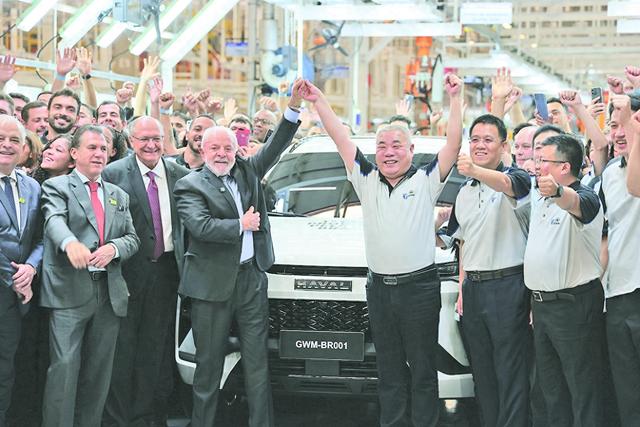
Core Points - The inauguration of Great Wall Motors' factory in Brazil marks a significant step in China-Brazil cooperation, enhancing investment and job creation in Brazil [2][3] - Brazilian President Lula emphasized the importance of Chinese investment in revitalizing Brazil's automotive industry and criticized U.S. tariffs that have caused economic instability [4][6] - Great Wall Motors is the first company to receive certification under Brazil's "Green Mobility and Innovation Program," with plans to produce at least 30,000 vehicles annually [3][5] Investment and Economic Impact - Great Wall Motors plans to invest 4 billion Brazilian Reais (approximately 532 million RMB) in Brazil by 2026, with an additional 6 billion Reais expected from 2027 to 2032 [3][5] - The factory has already created 700 jobs, with an expected increase of 1,300 jobs by early next year, and an indirect creation of 10,000 jobs [3][5] - Brazil's trade with China reached over 180 billion USD last year, compared to 80 billion USD with the U.S., highlighting the growing economic ties [6][7] Automotive Industry Dynamics - Chinese automotive brands, including BYD and Chery, are increasingly popular in Brazil, with six out of the top ten electric vehicles sold in the first half of this year being Chinese [5][6] - The market share of Chinese light vehicles in Brazil's imports reached 62.1% in the first half of this year, indicating a strong presence [5] - The cooperation between China and Brazil in the automotive sector is seen as a new highlight in their bilateral relations, with multiple Chinese companies planning local investments [4][5] Trade Relations and Strategic Partnerships - Brazil is seeking to strengthen ties with China and other global southern countries in response to U.S. tariffs, which have created opportunities for increased exports to China [6][7] - A memorandum of understanding has been signed to advance the "Two Oceans Railway" project, which aims to reshape global trade dynamics [7] - Brazil's export of soybeans to China accounted for 75.2% of its total soybean exports in the first seven months of this year, further solidifying trade relations [6][7]
政策精准发力,赋能新能源汽车产业
Zhong Guo Zheng Quan Bao· 2025-08-18 09:01
Core Insights - The dependency of new energy vehicle (NEV) companies on subsidies is gradually decreasing as the industry matures and subsidy policies are being refined [1][4][5] Group 1: Subsidy Overview - The total amount of subsidies for NEV promotion from 2016 to 2020 reached 1.654 billion yuan, with a pre-allocation of 168 million yuan for 2021-2022, significantly lower than the peak amounts of 917 million yuan in 2017 and 405 million yuan in 2018 [1][2] - The 2021-2022 subsidy allocations involved 19 companies across 10 provinces, with Shaanxi province receiving the highest amount of 37.91 million yuan, followed by Shenzhen at 35.56 million yuan and Shanghai at 35.18 million yuan [2] Group 2: Company-Specific Subsidy Data - BYD emerged as the largest beneficiary of subsidies, receiving 37.91 million yuan and 35.56 million yuan for its operations in Shaanxi and Shenzhen respectively, while Tesla (Shanghai) received 30.15 million yuan [2] - New energy vehicle startup Leap Motor received only 2.76 million yuan, indicating that traditional automakers dominate the subsidy distribution [2] Group 3: Compliance and Issues - Common reasons for failing to pass subsidy clearance include non-compliance with documentation requirements and incorrect vehicle registration information, with Chery Auto facing a higher than average deduction rate [3] - Chery Auto clarified that its deductions were part of the normal process and not due to any fraudulent behavior [3] Group 4: Industry Maturity - From 2016 to 2020, a total of 75,814 NEVs were reported, with 54,089 approved, leading to a deduction of 21,725 vehicles and a total subsidy claim of approximately 2.93 billion yuan [4] - The industry has shown a significant reduction in reliance on subsidies, with NEV sales reaching 6.968 million units in the first half of 2025, accounting for 44.3% of total new car sales, reflecting a shift towards market-driven growth [4] Group 5: Policy Evolution - The subsidy policy has evolved from simple purchase incentives to a comprehensive strategy linking technical standards, infrastructure support, and global competitiveness [5] - By 2025, the subsidy for vehicles priced below 150,000 yuan will be reduced to 7%, indicating a strategic shift towards empowering the entire industry chain rather than just consumer incentives [5]