宁波银行

Search documents
2375亿!17家上市银行中期分红大手笔
Shen Zhen Shang Bao· 2025-09-01 16:41
Core Viewpoint - The listed banks in China have shown strong performance in the first half of the year and are preparing to reward investors with significant mid-term dividends, reflecting their profitability and commitment to shareholder returns [2][4]. Group 1: Dividend Distribution - Among the 42 listed banks in A-shares, nearly half will implement mid-term dividends for 2025, with 17 banks already disclosing their plans, totaling 237.54 billion yuan [2]. - The six major state-owned banks lead in dividend distribution, with Industrial and Commercial Bank of China (ICBC) at the forefront, distributing 50.396 billion yuan, followed by China Construction Bank and Agricultural Bank of China with 48.605 billion yuan and 41.823 billion yuan respectively [2]. - The total dividends from the six major state-owned banks account for 86% of the total dividends announced by the 17 banks [2]. Group 2: Specific Bank Plans - Among joint-stock banks, CITIC Bank, Minsheng Bank, Ping An Bank, and Huaxia Bank have announced their mid-term dividend plans, with CITIC Bank proposing a total of 10.461 billion yuan [3]. - In the city and rural commercial banks, seven banks have announced mid-term dividends, including Ningbo Bank and Shanghai Bank, with Shanghai Bank proposing a cash dividend of 3 yuan per 10 shares [3]. - Four banks have a dividend payout ratio exceeding 30%, including Shanghai Bank and Postal Savings Bank, indicating a strong commitment to returning value to shareholders [3]. Group 3: Market Implications - The expansion of banks implementing mid-term dividends and their willingness to distribute reflects the resilience of the banking sector's profitability and a positive response to shareholder return demands [4]. - This trend indicates improved cash flow and capital management capabilities among certain banks, which may help boost market confidence and attract long-term value investors [4].





让贷款成本“全透明” 北京市开展明示企业贷款综合融资成本工作
Bei Ke Cai Jing· 2025-09-01 14:52
Core Insights - The introduction of a "Loan Clarity Document" by banks enhances transparency in loan costs for enterprises, transforming previously unclear financing into a clear understanding of costs [1][2] - The initiative aims to reduce unreasonable loan fees, such as excessive guarantee fees and intermediary fees, thereby lowering overall financing costs for businesses [2] - The pilot program has received positive feedback from various enterprises and is set to expand its coverage to benefit more companies [3] Group 1 - The "Loan Clarity Document" is a comprehensive cost list that details interest and non-interest expenses associated with loans, including payment methods and cycles, ultimately presenting the actual annualized interest rate [1] - The initiative has successfully prevented enterprises from falling victim to high-cost intermediary loans by clearly outlining the true costs involved [2] - Banks are actively engaging with enterprises to customize financial services, leading to significant cost savings for businesses, such as waiving certain fees [2] Group 2 - The pilot program is currently implemented across all of Beijing, covering various types of loans for technology-based SMEs, and is well-received by the business community [3] - The People's Bank of China in Beijing plans to summarize the pilot experience and gradually expand the initiative to further reduce social financing costs and improve financial services for the real economy [3]
银诺医药-B认购结构性存款产品
Zhi Tong Cai Jing· 2025-09-01 14:44
Group 1 - The company announced that on August 18, 2025, its wholly-owned subsidiary, Yinnuo Technology, subscribed to a structured deposit product from China Merchants Bank for a total amount of RMB 30 million, which is the principal amount [1] - On September 1, 2025, the company and Yinnuo Technology together subscribed to a structured deposit product from Ningbo Bank for a total amount of RMB 105 million, which is the total principal amount [1]
行业新周期下,宁波银行正悄然“筑堤”
Huan Qiu Lao Hu Cai Jing· 2025-09-01 13:33
Core Viewpoint - Ningbo Bank has demonstrated robust performance amidst challenges in the banking sector, achieving steady growth through a differentiated operational strategy focused on service quality, digital transformation, and risk management [1][3][11]. Financial Performance - For the first half of 2025, Ningbo Bank reported operating income of 37.16 billion yuan, a year-on-year increase of 7.91%, and a net profit attributable to shareholders of 14.77 billion yuan, up 8.23% [1][4]. - As of June 30, 2025, the bank's total assets reached 3.47 trillion yuan, reflecting an 11.04% growth since the beginning of the year, with total loans and advances amounting to 1.67 trillion yuan, a 13.36% increase [1][3]. Asset Quality - The bank maintained a non-performing loan (NPL) ratio of 0.76%, consistent with the previous quarter, and a provision coverage ratio of 374.16%, which increased by 3.62 percentage points quarter-on-quarter, indicating strong risk management [1][4][5]. Dividend Policy - In 2025, Ningbo Bank announced its first interim dividend plan, distributing 3 yuan per 10 shares, totaling 1.98 billion yuan, reflecting its commitment to shareholder returns [2][6]. - Cumulatively, the bank has distributed approximately 37.79 billion yuan in cash dividends since its listing, exceeding the total funds raised through IPO and other equity financing [7]. Strategic Focus - The bank is shifting from a growth model based on rapid credit expansion to one focused on quality growth, adapting to the new economic environment and regulatory landscape [3][11]. - It has prioritized lending to key national support sectors and enhanced its service to the real economy, particularly in inclusive finance and green finance [4][10]. Technological Innovation - Ningbo Bank is leveraging financial technology to enhance service quality and efficiency, implementing a "fast approval and fast loan" model for small and micro enterprises, which significantly reduces loan processing times [9][10]. - The bank has upgraded its financial products and services to provide comprehensive solutions for businesses, focusing on digital management and customer-centric approaches [10][11].
城商行“一哥”易主,江苏银行超越北京银行成为榜首
Di Yi Cai Jing· 2025-09-01 12:30
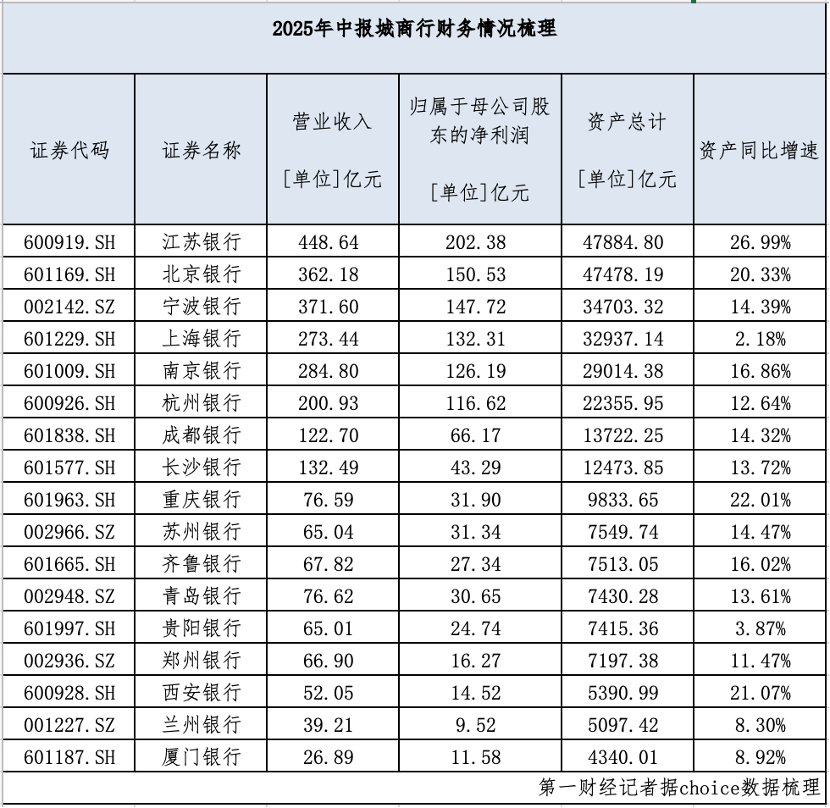
Core Insights - The rapid expansion of city commercial banks has led to concerns about capital adequacy ratios and the "broad planting, thin harvesting" phenomenon [2][5] - Jiangsu Bank has overtaken Beijing Bank to become the largest city commercial bank by total assets, reaching 4.79 trillion yuan, a 26.99% year-on-year increase [4][8] - The banking industry is increasingly showing a clear differentiation, with 17 city commercial banks forming three tiers, where leading banks continue to expand steadily while some lagging banks face negative growth [2][9] Asset Scale Rankings - Jiangsu Bank's total assets reached 4.79 trillion yuan, surpassing Beijing Bank's 4.75 trillion yuan, marking a significant shift in the rankings [4][5] - Beijing Bank had maintained its leading position since its listing in 2007, but Jiangsu Bank has accelerated its growth in recent years, closing the gap significantly [4][9] - The asset scale of Jiangsu Bank has increased significantly due to high growth in non-loan assets, with derivatives and financial investments growing by 23.1% and cash and deposits with the central bank increasing by 37.8% [9][12] Profitability Comparison - Jiangsu Bank has consistently outperformed Beijing Bank in terms of revenue and net profit since 2022, with the latest figures showing Jiangsu Bank's revenue at 448.64 billion yuan and net profit at 202.38 billion yuan for the first half of the year [5][8] - The profitability of banks in the third tier shows significant variation, with some banks experiencing negative growth in revenue and net profit [11][12] Capital Adequacy Ratios - As of June, Jiangsu Bank's capital adequacy ratio was 12.36%, which is below the industry average, indicating potential risks associated with its rapid expansion [5][6] - Comparatively, Beijing Bank's capital adequacy ratio stood at 13.06%, while other banks like Ningbo Bank and Shanghai Bank reported higher ratios of 15.21% and 14.62% respectively [6][12] Market Trends - The shrinking of fair value changes in earnings has become a common issue among city commercial banks, largely due to fluctuations in the bond market [12] - The differentiation among city commercial banks is becoming more pronounced, with the top tier consisting of Jiangsu Bank and Beijing Bank, while the second tier includes banks like Nanjing Bank and Hangzhou Bank [10][11]


贷款成本“全透明”,企业吃下“定心丸”
Bei Jing Ri Bao Ke Hu Duan· 2025-09-01 10:53
Core Insights - The People's Bank of China (PBOC) Beijing Branch has initiated a pilot program to enhance transparency in corporate loan financing costs, which has received positive feedback from businesses [1][5] - The program involves creating a "Loan Clarity Document" that details all interest and non-interest costs associated with loans, helping businesses understand their actual financing costs [1][5] Group 1: Program Implementation - The pilot program covers all types of offline loans for technology-based small and medium-sized enterprises (SMEs) in Beijing [1] - A total of 37 major domestic banks in the region are participating in this initiative, which aims to provide a clear breakdown of loan costs, including fees and payment terms [1][5] Group 2: Benefits to Businesses - Businesses have reported that the clear cost information provided by banks has alleviated concerns regarding loan financing, transforming previously opaque costs into transparent ones [1][5] - The initiative has successfully prevented potential exploitation by illegal intermediaries, as demonstrated by a construction company that avoided high service fees through the clarity provided by the Loan Clarity Document [5] Group 3: Future Plans - The PBOC Beijing Branch plans to summarize the pilot experience and gradually expand the program's coverage to benefit more enterprises [5] - The goal is to lower the overall financing costs for society and improve the quality of financial services provided to the real economy [5]

宁波银行2025年上半年业绩稳健增长 专业赋能服务实体经济质效双升
和讯· 2025-09-01 10:30
Core Viewpoint - Ningbo Bank has achieved simultaneous growth in scale, efficiency, and quality in the first half of 2025, with core financial indicators leading the industry, driven by a differentiated business strategy and significant financial technology innovations [1][2]. Financial Performance - In the first half of 2025, Ningbo Bank reported a net profit attributable to shareholders of 14.838 billion yuan, a year-on-year increase of 8.37% [1]. - The total asset size reached 3.47 trillion yuan, growing by 11.04% since the beginning of the year, maintaining a leading position among city commercial banks [1]. - Operating income was 37.160 billion yuan, up 7.91% year-on-year, with an annualized weighted average return on equity (ROE) of 13.80%, significantly above the industry average [1]. Asset Quality - As of June 2025, the non-performing loan (NPL) ratio was 0.76%, maintaining an excellent level in the industry for several consecutive years [2]. - The provision coverage ratio stood at 374.16%, indicating strong risk resistance capabilities [2]. - The bank successfully issued 8.9 billion yuan in subordinated debt, optimizing its capital structure [2]. Strategic Focus - Ningbo Bank emphasizes a differentiated service matrix to deepen its engagement with the real economy, focusing on professional capabilities and scenario innovation [5]. - The bank has increased support for the real economy, with corporate loan balances reaching 658.1 billion yuan, a year-on-year increase of 28.48% [5]. - Green loan balances grew by 36.17% year-on-year to 68.814 billion yuan, supporting the "dual carbon" goals [5]. Digital Transformation - The bank's digital service capabilities have reached an industry-leading level, with mobile banking customers totaling 13.68 million and monthly active users at 5.56 million [7]. - The financial market segment achieved steady growth, with a financial investment scale of 15 trillion yuan [6]. - The bank has integrated financial technology as a core driver, enhancing service models and expanding its digital ecosystem [6][7]. Future Outlook - Ningbo Bank plans to continue focusing on enhancing service efficiency for the real economy, increasing credit resources in key areas, and deepening the integration of financial technology with business operations [9]. - The bank aims to maintain a robust risk management framework to ensure asset quality remains excellent [9]. - The commitment to a "professional creates value" philosophy is expected to drive sustainable value growth and contribute to high-quality development [10].

外资二季度持仓超千亿!185家公司被扎堆布局!“中东土豪”同时重仓这两家公司!
私募排排网· 2025-09-01 10:00
Core Viewpoint - The article discusses the increasing activity of foreign capital in the A-share market, particularly in the second quarter, highlighting the sectors and companies that have attracted significant foreign investment [2][5]. Group 1: Foreign Capital Activity - Since April 27, the A-share market has entered a slow bull market, with foreign capital becoming increasingly active, as evidenced by the disclosure of second-quarter holdings [2]. - In the second quarter, foreign capital entered 1,123 companies as major shareholders through QFII, with a total holding value of 139.29 billion yuan, an increase of over 40 billion yuan compared to the first quarter [2][3]. - The electronic sector was the most favored by foreign investors, with a total holding value of 17.57 billion yuan, reflecting a significant increase of 5.55 billion yuan [3][4]. Group 2: Sector Performance - Excluding five banks with significant foreign ownership, the electronic sector saw a 25.65% average increase in stock prices since the end of the second quarter [3]. - Other sectors that attracted foreign investment include machinery equipment, non-ferrous metals, and automobiles, with respective holding values of 6.29 billion yuan, 5.44 billion yuan, and 5.08 billion yuan [3][4]. - The average increase in stock prices for the 126 companies with over 100 million yuan in foreign holdings reached 19.05%, with 15 companies experiencing gains of over 50% [5][11]. Group 3: Notable Companies - The top foreign-held stocks include Ningbo Bank and Nanjing Bank, with significant holdings by foreign institutions [5]. - A notable company in the electronic sector reported a total revenue of 12.68 billion yuan in the first half of the year, a year-on-year increase of 31.68%, and a net profit of 1.43 billion yuan, up 52.98% [5][6]. - Companies like Huafang Co. and Anji Food have been heavily targeted by multiple foreign investors, with significant stock price movements observed [11][12]. Group 4: Sovereign Wealth Funds - Sovereign wealth funds from the Middle East, such as the Abu Dhabi Investment Authority, have made substantial investments in A-shares, with a focus on long-term value [17][20]. - The Abu Dhabi Investment Authority's largest holding is Zijin Mining, with a market value of 3.38 billion yuan, reflecting a strategic investment approach [17][18]. - The Kuwait Investment Authority has also been active, holding significant stakes in 16 A-share companies, with a total market value of approximately 3.73 billion yuan [20][21].

上港集团: 上港集团关于收到中国银行间市场交易商协会《接受注册通知书》的公告
Zheng Quan Zhi Xing· 2025-09-01 09:20
Core Viewpoint - Shanghai International Port Group has received the acceptance notice for debt financing tool registration from the China Interbank Market Dealers Association, allowing the company to issue various debt instruments over the next two years [1][2]. Group 1: Debt Financing Tool Registration - The registration for the debt financing tools is valid for two years from the date of the acceptance notice [2]. - The company can issue various products including super short-term financing bonds, short-term financing bonds, medium-term notes, perpetual notes, asset-backed notes, and green debt financing tools during the registration period [2]. - A consortium of major banks, including Shanghai Bank, China Construction Bank, and Agricultural Bank of China, will act as joint lead underwriters for the debt issuance [2]. Group 2: Issuance Management - The company will conduct the issuance of debt financing tools in accordance with the requirements of the acceptance notice and relevant regulations [3]. - The company is obligated to disclose the issuance results through approved channels after each issuance [2][3].

18只混合类产品近1年收益率超10%,仅1只产品收益告负
2 1 Shi Ji Jing Ji Bao Dao· 2025-09-01 09:00
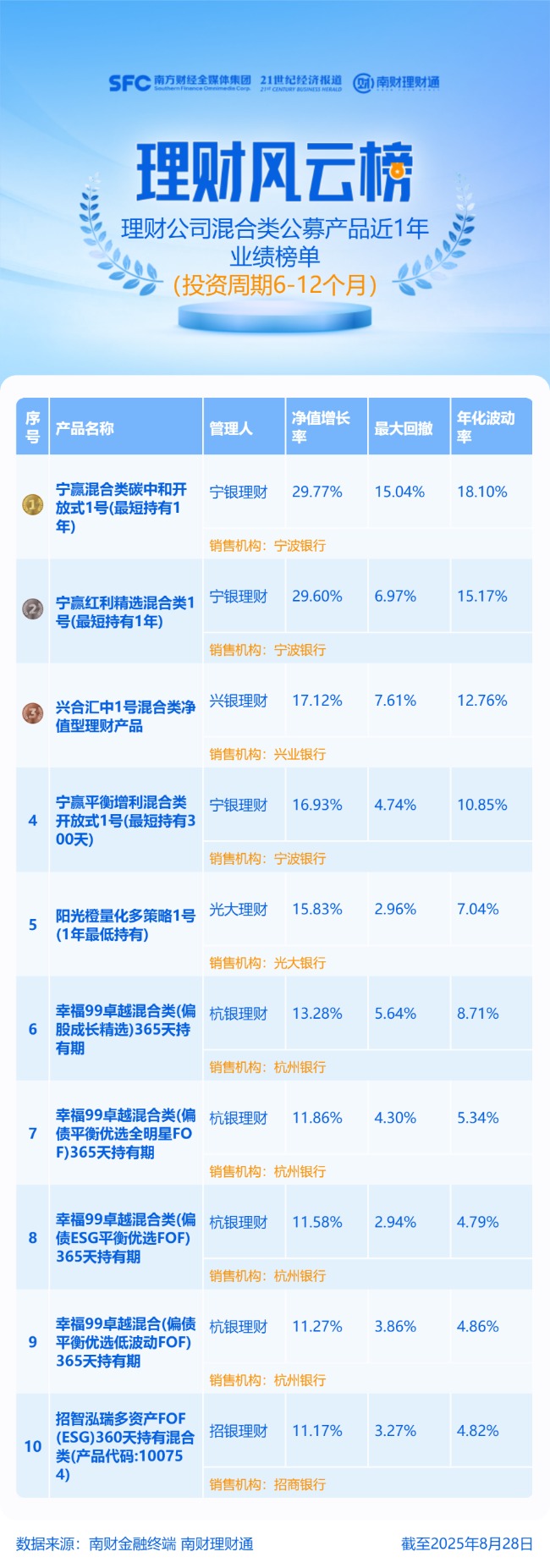
Overall Performance - The A-share market in August exhibited a strong upward trend, with all three major indices showing significant monthly gains, including a more than 24% increase in the ChiNext Index and a 28% rise in the Sci-Tech 50 Index, while the Shanghai Composite Index surpassed 3,800 points, reaching a 10-year high [4] - The market conditions have positively impacted the performance of mixed public wealth management products, with an average net value growth rate of 5.63% and a maximum drawdown of 1.48% over the past year for mixed public wealth management products with investment cycles of 6 to 12 months [4] Product Performance - Among the 166 existing products, 18 products achieved a return rate exceeding 10% over the past year, while only one product, the "Zhaoyin Value Selected One-Year Holding Mixed Fund" from Zhaoyin Wealth Management, reported a negative return of -0.93% [5] - The "Ningyin Mixed Carbon Neutral Open-Ended No. 1" and "Ningyin Dividend Selected No. 1" from Ningbo Bank displayed strong performance, with net value growth rates nearing 30% over the past year [6] Highlighted Products - The "Ningyin Mixed Carbon Neutral Open-Ended No. 1" achieved the highest return, with a net value growth rate of 29.77%, although it also experienced a high maximum drawdown of 15.04% [6] - This product is classified as a stock-mixed wealth management product, with a performance benchmark of 3% and an annualized return of 6.3% for 2024. However, since its inception on September 23, 2021, it has recorded an annualized return of -0.70% up to the second quarter of 2025 [6] - As of the end of the second quarter of 2025, the product reduced its equity position slightly, with equity investments decreasing from 77.35% at the end of the first quarter to 72.10% [6]