招商银行

Search documents
2025年中国创投:重拾向上动能,奔赴投资新程
Zheng Quan Shi Bao Wang· 2025-12-31 11:43
Group 1: Industry Recovery and Trends - In 2025, China's venture capital industry emerged from a two-year downturn, showing signs of recovery across the entire investment chain, driven by a combination of funding and project highlights, as well as supportive policies [1] - The year-end activities of venture capitalists indicate a strong return to the industry, fueled by a new wave of technological changes and ongoing policy benefits [1] Group 2: Government Investment Fund Policies - The State Council issued a significant document aimed at promoting the high-quality development of government investment funds, focusing on stricter controls on new fund establishments and optimizing investment policies [2] - Various local governments have responded by issuing supporting policy documents, further regulating the operation of government investment funds to promote high-quality industry development [2] Group 3: Banking Sector Involvement - Since the announcement of expanded pilot programs for bank-affiliated financial asset investment companies (AICs), banks have accelerated their entry into the primary market, with several major banks successfully establishing AICs [3] - As of now, AICs from six major state-owned banks and three national joint-stock banks have been established, with total investments reaching 45.272 billion yuan, a year-on-year increase of approximately 37.7% [3] Group 4: Special Bonds for Government Guidance Funds - Several local governments have issued special bonds to support government guidance funds, breaking the previous norm that prohibited such investments [4] - A total of 52 billion yuan in special bonds have been issued by nine provinces and cities, significantly enhancing the funding pool for the venture capital industry [4] Group 5: Long-Term Government Guidance Funds - New government guidance funds established this year have extended their duration beyond the typical 10 years, with some lasting up to 20 years, providing long-term support for projects [5] - This trend of extending fund durations is expected to create a more patient investment environment, allowing for better exit strategies [5] Group 6: Mergers and Acquisitions - The introduction of policies supporting private equity funds in acquiring listed companies has led to a surge in related acquisition cases, with several venture capital firms actively pursuing stakes in public companies [6][7] - The trend of startups acquiring listed companies is also on the rise, indicating a new strategy for both startups and venture capital firms to explore exit routes [7] Group 7: Domestic PE Firms Acquiring Foreign Brands - Domestic top-tier private equity firms have increasingly acquired the Chinese operations of overseas consumer brands, highlighting a trend of local capital participating in the localization of foreign brands [8] - This trend is driven by the combination of ample funding, local operational expertise, and the stable cash flow of established foreign brands [8] Group 8: Technology Innovation Bonds - The introduction of technology innovation bonds has opened new fundraising channels for venture capital institutions, with several private firms successfully issuing bonds at competitive interest rates [9] - The issuance of these bonds has significantly boosted market confidence and marked a transition towards a more normalized support phase for private venture capital institutions [9] Group 9: Mainland VC/PE Expansion into Hong Kong - Several mainland investment institutions have established offices in Hong Kong, attracted by the region's supportive environment for technological innovation [10] - The Hong Kong government's initiatives, including the establishment of a significant innovation and technology fund, have further encouraged mainland VC/PE firms to expand into the market [10] Group 10: Return of Dollar LPs to China - Multiple venture capital firms have successfully raised dollar-denominated funds, indicating a renewed interest from international investors in the Chinese market [11][12] - The return of dollar LPs coincides with the rapid growth of China's AI industry, highlighting the potential undervaluation of Chinese assets [11][12] Group 11: National Entrepreneurship Investment Fund - The establishment of a "carrier-level" national entrepreneurship investment fund aims to support startups across key economic regions in China, with a focus on early-stage investments [13] - This fund features a long duration of 20 years and aims to provide substantial financial backing to venture capital institutions and startups, enhancing the overall investment landscape [13]






年度盘点丨2025年中国创投:重拾向上动能,奔赴投资新程
Zheng Quan Shi Bao Wang· 2025-12-31 11:43
Group 1 - In 2025, China's venture capital industry emerged from a two-year downturn, showing signs of recovery across the entire "fundraising, investment, management, and exit" chain [1] - The government issued a significant policy document aimed at promoting the high-quality development of government investment funds, focusing on controlling new fund setups and optimizing investment policies [2] - Bank-affiliated financial asset investment companies (AICs) accelerated their entry into the primary market, with a notable increase in capital contributions since the policy announcement [3] Group 2 - Local governments have begun issuing special bonds to support government-guided funds, with a total of 52 billion yuan issued across nine provinces and cities this year [4] - New government-guided funds are being established with extended durations, some lasting up to 20 years, providing long-term support for projects [5] - Venture capital institutions and startups are increasingly acquiring listed companies, indicating a trend towards using public companies as exit strategies [6] Group 3 - Top domestic private equity firms are actively acquiring overseas consumer brands' operations in China, driven by their financial resources and local operational expertise [7] - Venture capital institutions are eagerly issuing technology innovation bonds, with significant interest from private firms leading to successful issuances [8] - Mainland venture capital and private equity firms are establishing offices in Hong Kong, attracted by the region's supportive environment for technology innovation [9][10] Group 4 - Dollar limited partners (LPs) are returning to the Chinese venture capital market, with several firms successfully raising dollar-denominated funds amid a booming AI sector [11] - The National Entrepreneurship Investment Guidance Fund has officially begun investing in three regional funds, marking a strategic deployment in key economic areas [12]

银河金工指数分析系列研究:市场基准分析:主要策略指数
Yin He Zheng Quan· 2025-12-31 11:27
Core Insights - The report highlights a clear differentiation in the performance of growth and value indices, with growth indices showing superior profitability and elasticity, while value indices emphasize defensive characteristics and dividends [1][3][23]. Group 1: Major Large and Mid-Cap Indices - The major indices analyzed include the CSI 300 Growth Index, CSI 300 Value Index, CSI 500 Growth Index, and CSI 500 Value Index, all of which are designed to capture excess returns or enhance specific style returns [3][4]. - Growth indices are characterized by lower allocation to financials and higher allocation to technology, consumer, and manufacturing sectors, while value indices are the opposite, focusing more on financials and cyclical sectors [6][10]. - The CSI 300 Growth Index has a significant concentration of large-cap stocks, with the top ten stocks accounting for 67.1% of the index weight, indicating a strong leader effect [10][11]. Group 2: Fundamental Performance of Indices - Growth indices exhibit higher PE and PB ratios compared to value indices, reflecting market expectations for future growth, with the CSI 300 Growth Index showing a cumulative increase of over 100% [1][23]. - The annualized returns since the inception of the indices show that the CSI 500 Growth Index leads with a cumulative increase of over 150%, while the CSI 300 Value Index has a more modest increase of approximately 30% [25][39]. - Dividend yields are significantly higher in value indices, with the CSI 300 Value Index maintaining a dividend rate of 3.5%-4.5%, while growth indices show lower dividend willingness [39][41]. Group 3: Market Capitalization Distribution - The CSI 300 indices are primarily composed of large-cap stocks, with over 80% of the CSI 300 Growth Index constituents having a market capitalization exceeding 100 billion [17][20]. - The CSI 500 indices focus on mid-cap stocks, with a significant portion of constituents falling within the 10 billion to 50 billion range, highlighting the distinct characteristics of mid-cap indices [17][20]. Group 4: Shareholder Attributes - Growth indices are predominantly composed of private enterprises, while value indices are mainly represented by state-owned enterprises, indicating a divergence in shareholder characteristics [11][53].
工行蝉联2025年银行股“股王” 20只个股年内创新高
2 1 Shi Ji Jing Ji Bao Dao· 2025-12-31 11:24
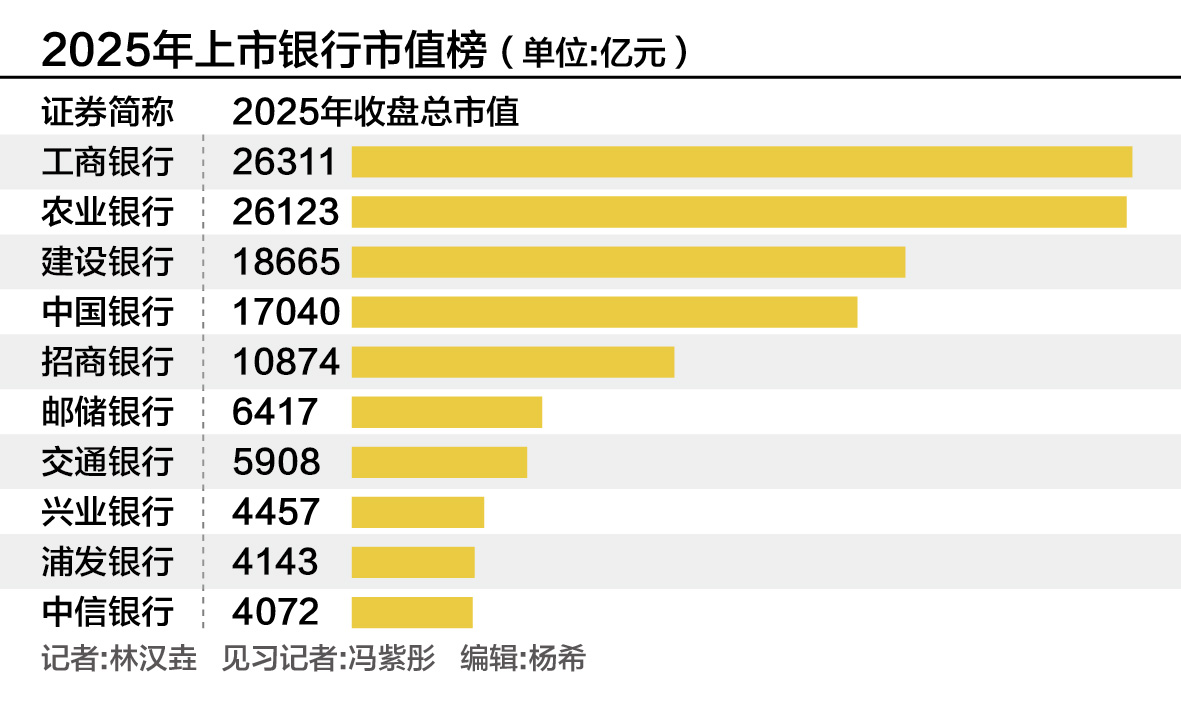
12月31日,上证指数收于3968.84点,深证成指收于13525.02点,为波澜起伏的2025年A股市场画下句点。 作为市场价值"压舱石"的代表,银行板块经历了一整年的"震荡——冲高——回调",最终整体涨幅定格于7%。这一数字与2024年高达34.39%的闪耀收益率 相比稍显平淡,甚至在31个申万一级行业中排名靠后。 但若用一词概括2025年A股银行板块的个股行情,"新高"或许最为精准。平淡的板块指数之下,个股对于"历史最高价"的冲击与创造从未停歇。截至年末收 盘,板块内42只个股中有35家收涨,仅7只下跌;其中,多达20家银行的股价创下了历史新高,更有21家全年涨幅超过10%、6家涨幅超过20%。 尤其引人注目的是,A股"股王"争夺战罕见地在银行板块内部展开了激烈角逐。农业银行年内股价累计涨幅超过52%,市值在2025年11月一度突破3万亿元, 并曾数次超越工商银行、短暂夺得"股王"桂冠。不过,凭借全年的稳健表现,"宇宙行"工商银行成功捍卫地位,截至2025年12月31日收盘以2.63万亿元的总 市值稳坐"股王"宝座,其全年股价亦累计上涨21.54%。 与此同时,对门外众多未上市的中小银行而言,A股的大门 ...
智通港股通活跃成交|12月31日
智通财经网· 2025-12-31 11:03
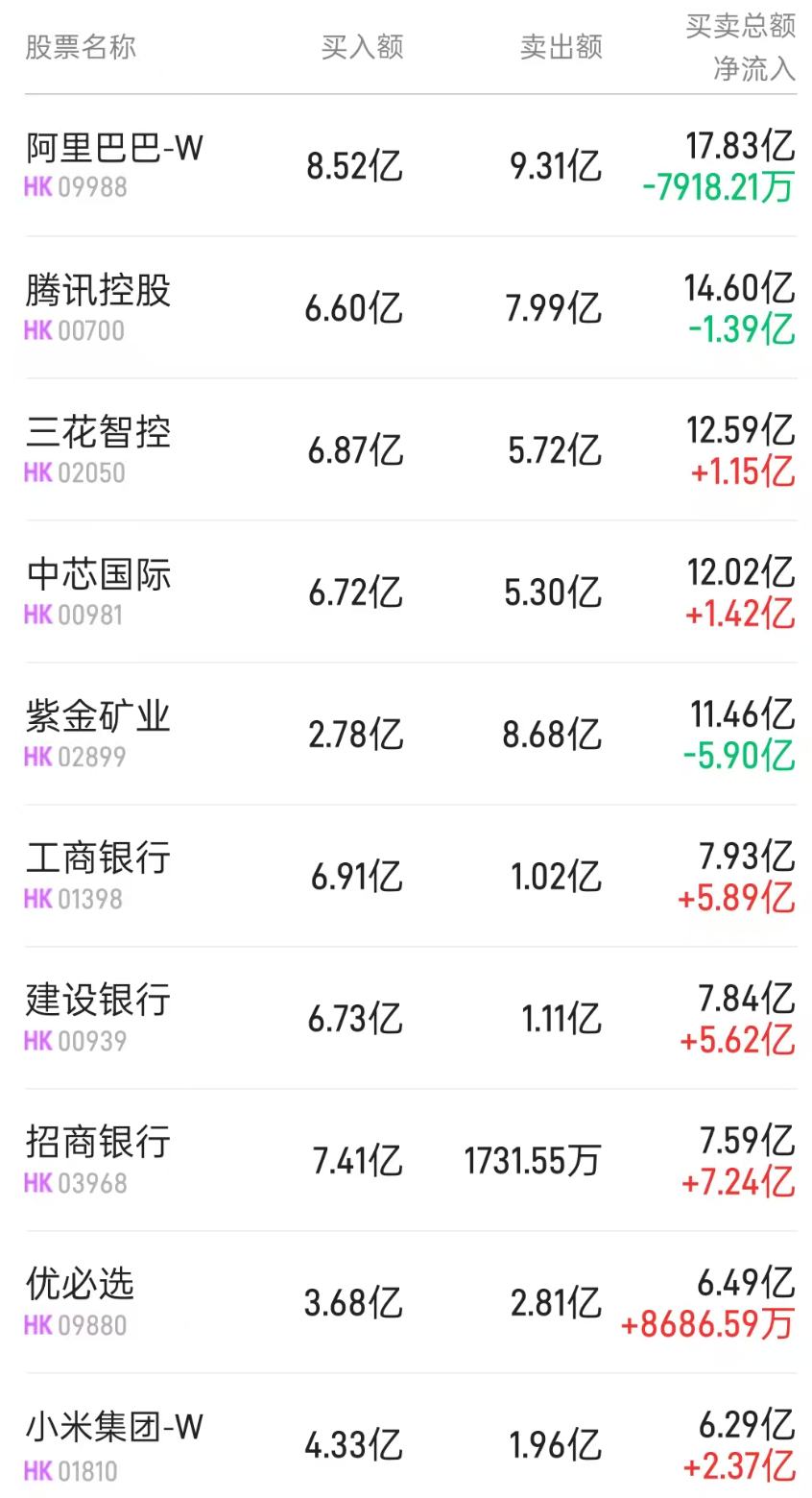
Core Insights - On December 31, 2025, Alibaba-W (09988), Tencent Holdings (00700), and Sanhua Intelligent Control (02050) ranked as the top three companies by trading volume in the Southbound Stock Connect, with trading amounts of 1.783 billion, 1.460 billion, and 1.259 billion respectively [1] - In the Shenzhen-Hong Kong Stock Connect, Tencent Holdings (00700), Alibaba-W (09988), and SMIC (00981) were the top three companies by trading volume, with amounts of 1.218 billion, 1.201 billion, and 0.767 billion respectively [1] Southbound Stock Connect Trading Activity - The top three active companies in the Southbound Stock Connect by trading amount were: - Alibaba-W (09988): 1.783 billion with a net buy of -79.182 million - Tencent Holdings (00700): 1.460 billion with a net buy of -139 million - Sanhua Intelligent Control (02050): 1.259 billion with a net buy of 115 million [2] - Other notable companies included: - SMIC (00981): 1.202 billion with a net buy of 142 million - Zijin Mining (02899): 1.146 billion with a net buy of -590 million [2] Shenzhen-Hong Kong Stock Connect Trading Activity - The top three active companies in the Shenzhen-Hong Kong Stock Connect by trading amount were: - Tencent Holdings (00700): 1.218 billion with a net buy of -508 million - Alibaba-W (09988): 1.201 billion with a net buy of 179 million - SMIC (00981): 0.767 billion with a net buy of 249 million [2] - Other notable companies included: - Sanhua Intelligent Control (02050): 0.534 billion with a net buy of 93.908 million - Huahong Semiconductor (01347): 0.475 billion with a net buy of 69.942 million [2]





六大行官宣 2026年起数字人民币按活期利率计息
Di Yi Cai Jing· 2025-12-31 10:57
Group 1 - From January 1, 2026, digital RMB real-name wallet balances will earn interest based on the current demand deposit rate set by the banks [1] - The current demand deposit rate is 0.05% as per the announcements from major banks [1] - Digital RMB wallets are categorized into four types, with only real-name wallets (Type 1, 2, and 3) eligible for interest, while anonymous wallets (Type 4) do not earn interest [1] Group 2 - There are currently 10 designated operating institutions for digital RMB, including six state-owned commercial banks, two joint-stock commercial banks, and two internet banks [2] - The People's Bank of China is working on expanding the number of operating institutions for digital RMB [2] - A new action plan has been issued by the central bank to enhance the management service system and financial infrastructure for digital RMB, set to be implemented on January 1, 2026 [2]




港股半日微跌 恒生指数下跌0.87%
Xin Lang Cai Jing· 2025-12-31 10:40
转自:新华财经 新华财经香港12月31日电(记者林迎楠)因元旦假期,港股31日下午休市。当日,港股主要指数低开, 截至收盘,恒生指数下跌0.87%至25630.54点,恒生科技指数下跌1.12%至5515.98点,国企指数下跌 0.86%至8913.68点。 当日恒指低开53.11点,开报25801.49点,开盘震荡下行,尾市稍有拉高,最终恒指跌224.06点,主板成 交超1189亿港元。截至午间收盘,上涨股票1002只,下跌1060只,收平1182只。 整体来看,多数板块下跌,航空、体育用品、建材水泥等股多为上涨,芯片、房地产、银行、券商等股 有涨有跌,生物医药、科网、黄金、新能源车企、新消费、锂电池等股多有下跌。 个股方面,紫金矿业涨0.85%,美团跌0.96%,小米集团跌0.15%,泡泡玛特跌1.62%,三花智控跌 0.31%,建设银行跌0.39%,招商银行跌0.38%,赣锋锂业跌4.85%,理想汽车跌1.44%,国泰君安国际跌 1.44%,中国石油股份跌0.95%,英矽智能涨79.69%,天域半导体涨10.09%,老铺黄金跌1.83%。 成交额前三的个股中,腾讯控股跌0.17%,成交超57亿港元;阿里 ...
北水动向|北水成交净买入34.49亿 北水全年净买入港股逾1.4万亿港元 创历史纪录新高
智通财经网· 2025-12-31 10:07
Group 1 - Northbound capital recorded a net purchase of 34.49 billion HKD in the Hong Kong stock market on December 31, with the Shanghai-Hong Kong Stock Connect contributing 30.97 billion HKD and the Shenzhen-Hong Kong Stock Connect contributing 3.51 billion HKD [1] - The total net purchase of Northbound capital for the year reached a historical high of 1.41 trillion HKD, significantly increasing from approximately 807.9 billion HKD in 2024 [1] - The most purchased stocks by Northbound capital included China Merchants Bank (03968), Industrial and Commercial Bank of China (01398), and China Construction Bank (00939) [1] Group 2 - Alibaba-W (09988) had a net purchase of 850 million HKD, while Tencent Holdings (00700) faced a net sell of 660 million HKD [2] - China Merchants Bank, Industrial and Commercial Bank of China, and China Construction Bank received net purchases of 7.24 billion HKD, 5.88 billion HKD, and 5.61 billion HKD respectively [4] - Semiconductor stocks also saw increased investment, with SMIC (00981) and Hua Hong Semiconductor (01347) receiving net purchases of 391 million HKD and 69.94 million HKD respectively [5] Group 3 - Xiaomi Group-W (01810) received a net purchase of 237 million HKD, supported by government policies promoting consumption [5] - Jiangxi Copper Co. (00358) had a net purchase of 158 million HKD, while Zijin Mining (02899) experienced a net sell of 682 million HKD [6] - UBTECH Robotics (09880) received a net purchase of 86.86 million HKD, as it announced plans to acquire a controlling stake in Fenglong Co. [6]

2026年起数字人民币余额生息,实名钱包享活期利息
Sou Hu Cai Jing· 2025-12-31 10:02
Core Viewpoint - Starting from January 1, 2026, interest will be paid on the balances of real-name digital RMB wallets, as announced by six major state-owned commercial banks in China [1][3]. Group 1: Interest Payment Arrangement - Customers with real-name digital RMB wallets at the specified banks will receive interest based on the banks' published demand deposit rates, with interest calculation rules consistent with traditional demand deposits [3]. - For example, Industrial and Commercial Bank of China (ICBC) will settle interest quarterly, with the interest credited on the 21st of each quarter's last month [3]. - The interest payment arrangement applies only to real-name wallets, while anonymous wallets will not earn interest [3]. Group 2: Regulatory Framework - This adjustment is part of the People's Bank of China's recent action plan aimed at enhancing the management and service system for digital RMB, which will officially launch on January 1, 2026 [3]. - The plan stipulates that banks must pay interest on real-name digital RMB wallet balances and adhere to self-discipline agreements on deposit interest rate pricing [3]. Group 3: Transition to Deposit Currency - The new system marks a transition of digital RMB from a cash-like version 1.0 to a deposit currency version 2.0, allowing banks to manage digital RMB wallet balances as liabilities [4]. - Digital RMB wallets will be insured similarly to traditional deposits, providing customers with equivalent safety guarantees [4]. - Currently, there are ten designated operating institutions for digital RMB, including the six major state-owned banks and several other commercial and internet banks [4].


数字人民币明日起余额可计息!六大国有行齐宣布利率
Sou Hu Cai Jing· 2025-12-31 10:00
Group 1 - The six major state-owned banks in China will start paying interest on the balances in customers' real-name digital RMB wallets at the same rate as current deposit rates, which is currently set at 0.05% [2][4] - Digital RMB, issued by the People's Bank of China, is a legal digital currency that can be used in various scenarios such as transportation, dining, shopping, and utility payments [4] - The pilot program for digital RMB has expanded from select cities to entire provinces, including major municipalities and several provinces like Guangdong, Jiangsu, and Zhejiang [4] Group 2 - The People's Bank of China has introduced an action plan to enhance the management and service system for digital RMB, effective from January 1, 2026, which includes interest payments on wallet balances and inclusion in deposit insurance [4] - Digital RMB wallets are categorized into four types based on the level of identity verification, with varying limits on account balances; the first three types are real-name wallets, while the fourth type is an anonymous wallet [5][6] - Currently, ten commercial banks are authorized to open digital RMB wallets, including the six major state-owned banks and four other banks [7]