欣旺达

Search documents
博时互联网主题混合:2025年上半年利润1621.72万元 净值增长率4.55%
Sou Hu Cai Jing· 2025-09-05 02:25
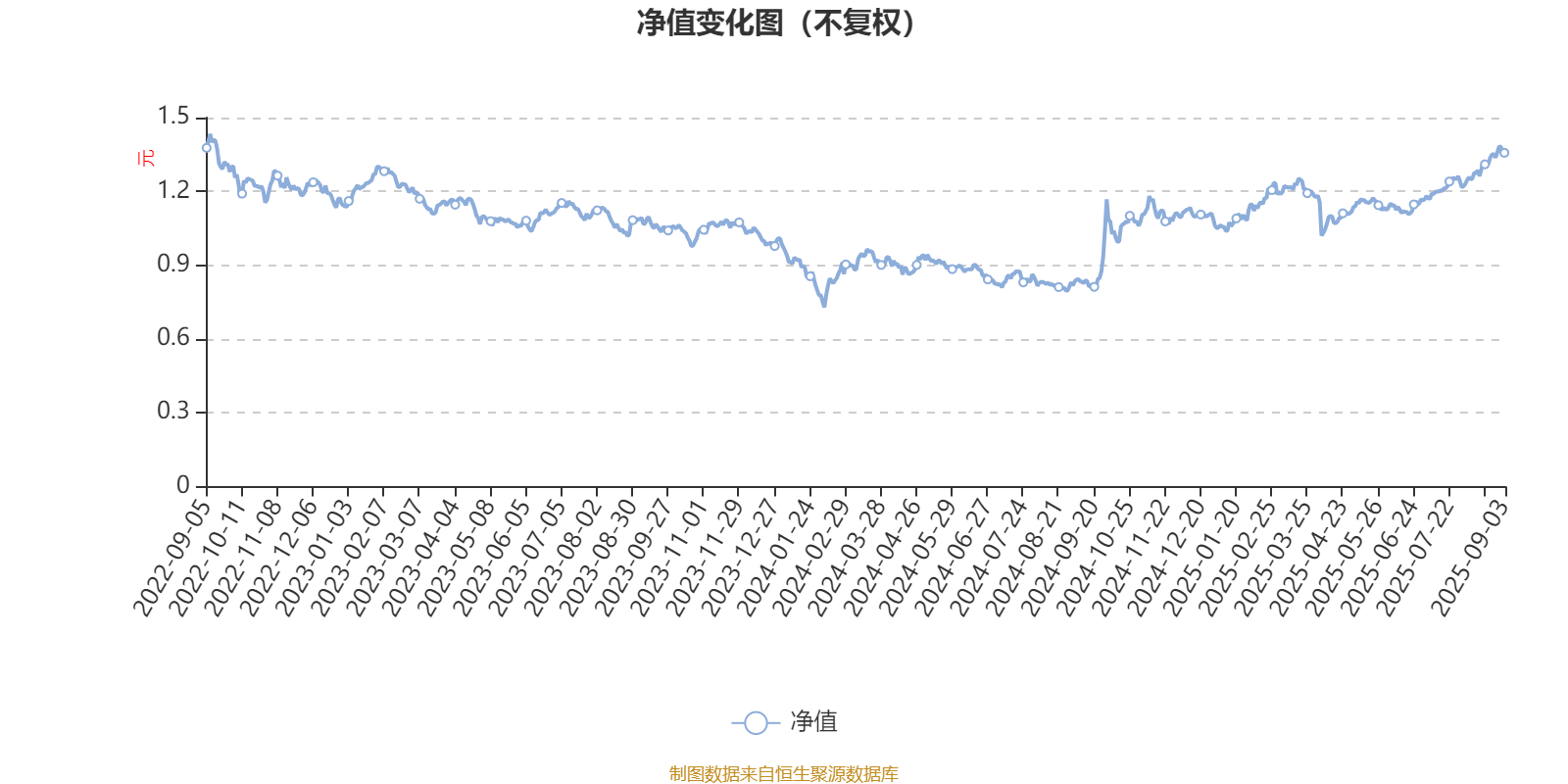
AI基金博时互联网主题混合(001125)披露2025年半年报,上半年基金利润1621.72万元,加权平均基金份额本期利润0.0508元。报告期内,基金净值增长 率为4.55%,截至上半年末,基金规模为3.65亿元。 该基金属于灵活配置型基金。截至9月3日,单位净值为1.517元。基金经理是郭晓林,目前管理的6只基金近一年均为正收益。其中,截至9月3日,博时专精 特新主题混合A近一年复权单位净值增长率最高,达89.23%;博时新能源主题混合A最低,为41.13%。 基金管理人在半年报中表示,展望下半年,国内经济将在政策持续推进下展现出积极变化;制造业继续向新质生产力升级;房地产市场随着一系列精准调控 政策的深入实施,销售数据逐步企稳,预期有望逐步改善;消费领域在各项补贴政策的支撑下有望稳中有升,新兴消费热点不断涌现。海外局势依旧复杂多 变,美国政策在多方面的频繁调整,如贸易关税政策的波动、货币政策节奏的改变,给全球经济格局与贸易环境增添了不确定性,进而对我国外需产生一定 程度的影响。 截至9月3日,博时互联网主题混合近三个月复权单位净值增长率为38.41%,位于同类可比基金84/880;近半年复权单位净值增长 ...


电池概念股走强,相关ETF涨约7%
Sou Hu Cai Jing· 2025-09-05 02:25
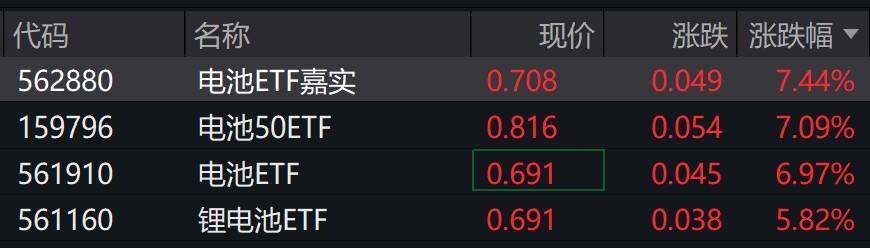
Group 1 - Battery concept stocks have shown strong performance, with companies like Xian Dao Intelligent rising over 18%, Yangguang Electric Power increasing over 12%, and Xinwangda and Tianci Materials both up by 10% [1] - Several ETFs tracking the CSI Battery Theme Index have risen approximately 7%, with specific ETFs showing the following price changes: - 562880 Battery ETF Jia Shi: up 7.44% - 159796 Battery 50 ETF: up 7.09% - 561910 Battery ETF: up 6.97% - 561160 Lithium Battery ETF: up 5.82% [2] - The CSI Battery Theme Index includes companies involved in power batteries, energy storage batteries, consumer electronics batteries, and related upstream and downstream industries, reflecting the overall performance of battery-themed listed companies [2] Group 2 - Analysts indicate that since 2025, breakthroughs in solid-state battery technology have been ongoing, with multiple automotive companies planning to start using all-solid-state batteries around 2027, accelerating the industry's industrialization process [2] - With the gradual establishment of pilot production lines and the restart of lithium battery expansion cycles, the fundamentals of equipment companies are expected to continue improving, maintaining a positive outlook on the advancement of solid-state battery industrialization [2]
A股异动丨减产预期!锂矿股继续走强,亿纬锂能涨超6%,宁德时代涨超4%
Ge Long Hui A P P· 2025-09-05 02:14
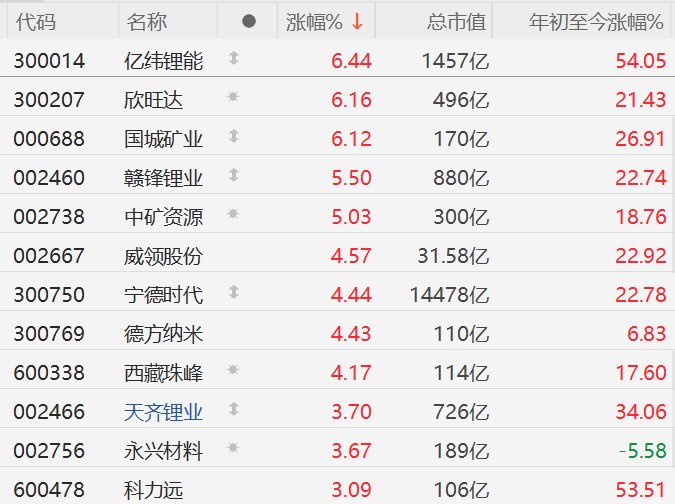
Core Insights - The recent surge in lithium stocks in the A-share market is primarily driven by expectations of potential production cuts in China [1] - The suspension of production at the Jiangxiawo mine, operated by CATL, has raised concerns about supply disruptions, potentially leading to increased lithium carbonate prices [1] - UBS predicts that lithium spodumene prices may rise by 32% and lithium chemical prices by 17% over the next three years due to these supply interruptions [1] Company Performance - Yihui Lithium Energy (亿纬锂能) saw a price increase of 6.44%, with a market capitalization of 145.7 billion and a year-to-date increase of 54.05% [2] - XWANDA (欣旺达) increased by 6.16%, with a market cap of 49.6 billion and a year-to-date increase of 21.43% [2] - Guocheng Mining (国城矿业) rose by 6.12%, with a market cap of 17 billion and a year-to-date increase of 26.91% [2] - Ganfeng Lithium (赣锋锂业) increased by 5.50%, with a market cap of 88 billion and a year-to-date increase of 22.74% [2] - Zhongmin Resources (中矿资源) rose by 5.03%, with a market cap of 30 billion and a year-to-date increase of 18.76% [2] - Other notable increases include Weiling Co. (威领股份) at 4.57%, CATL (宁德时代) at 4.44%, and Defang Nano (德方纳米) at 4.43% [2]


固态电池的“爆发前夜”
财富FORTUNE· 2025-09-04 13:10
Core Viewpoint - Solid-state batteries are poised to revolutionize energy storage and electric vehicles, with significant advancements in technology and production capabilities being reported recently [2][3][6]. Group 1: Technological Advancements - The development of solid-state batteries has accelerated since the 1990s, with recent breakthroughs including the launch of mass production lines by companies like EVE Energy and Guoxuan High-Tech [2][3]. - Solid-state batteries can enhance electric vehicle range to over 1000 kilometers and eliminate the fire risks associated with liquid electrolyte batteries [3]. - Companies such as Funeng Technology and Guoxuan High-Tech have set clear timelines for mass production, with Funeng aiming for small-scale production by 2026-2027 and large-scale production by 2030 [3]. Group 2: Cost Challenges - The high cost of solid-state batteries remains a significant barrier to widespread commercialization, with estimates suggesting a cost of around 5700 yuan/kWh by 2026 [4]. - Even with cost reduction efforts, the price of electric vehicles equipped with solid-state batteries could exceed 400,000 yuan due to the high costs of materials and production processes [4]. - The demand for production equipment for solid-state batteries has surged, indicating a growing interest in the industry, with major suppliers reporting significant increases in orders [4]. Group 3: Material Innovations - Sulfide solid electrolytes are expected to become the mainstream choice for solid-state batteries, with lithium sulfide being a key raw material [5]. - The initial applications of solid-state batteries will focus on high-value sectors such as eVTOL aircraft and humanoid robots, gradually moving to high-end electric vehicles and eventually to the mass market [5]. Group 4: Market Projections - By 2030, global solid-state battery shipments are projected to reach 808 GWh, with significant demand anticipated from various sectors including automotive and consumer electronics [6]. - The Chinese government is actively promoting the establishment of standards for solid-state batteries, which will help address safety and regulatory challenges [6]. Group 5: Investment Outlook - The solid-state battery sector is viewed as a long-term investment opportunity, but the industry may face a consolidation phase where companies lacking core technological breakthroughs could be eliminated [7]. - Investors are encouraged to focus on identifying leading companies that demonstrate real advancements in materials, processes, and business models within the solid-state battery space [7].
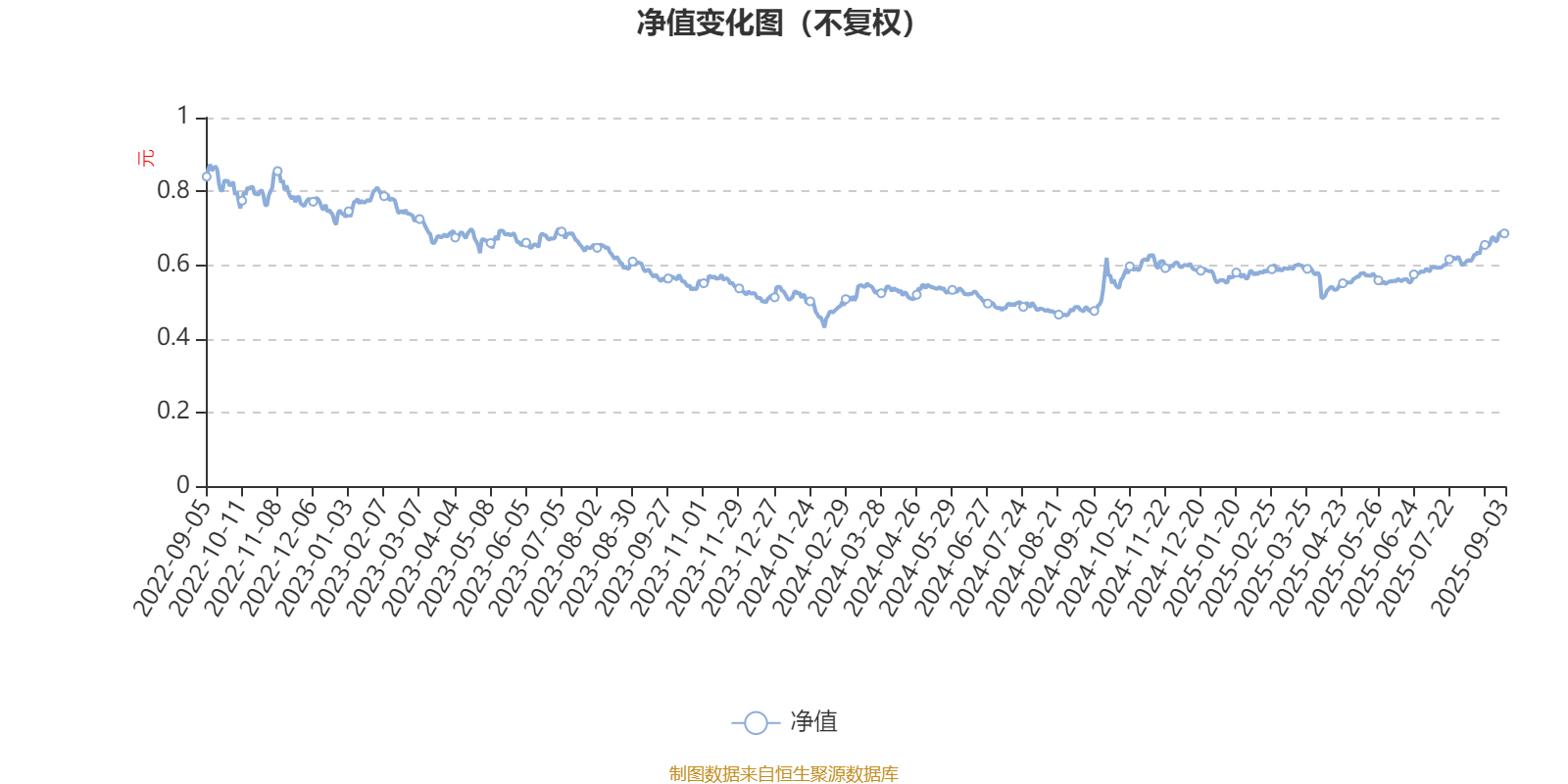
博时新能源主题混合A:2025年上半年利润127.11万元 净值增长率0.99%
Sou Hu Cai Jing· 2025-09-04 11:29
Core Insights - The AI Fund Bosera New Energy Theme Mixed A (013103) reported a profit of 1.2711 million yuan for the first half of 2025, with a weighted average profit per fund share of 0.0055 yuan. The fund's net value growth rate was 0.99%, and its total size reached 130 million yuan by the end of the first half [2][29]. Fund Performance - As of September 3, 2025, the fund's one-year cumulative net value growth rate was 41.13%, ranking 84 out of 169 comparable funds. Over the past three months, the growth rate was 24.27%, ranking 60 out of 171, and for the past six months, it was 15.73%, ranking 77 out of 171 [5]. - The fund's three-year cumulative net value growth rate was -18.18%, ranking 67 out of 130 [5]. Valuation Metrics - As of June 30, 2025, the fund's weighted price-to-earnings ratio (TTM) was approximately 20.3 times, significantly lower than the industry average of 36.17 times. The weighted price-to-book ratio (LF) was about 1.28 times, compared to the average of 2.99 times, and the weighted price-to-sales ratio (TTM) was around 0.87 times, while the average was 2.5 times [10]. Growth Metrics - For the first half of 2025, the weighted revenue growth rate (TTM) of the stocks held by the fund was 0.16%, and the weighted net profit growth rate (TTM) was -0.06%. The weighted annualized return on equity was 0.06% [17]. Fund Holdings and Turnover - As of June 30, 2025, the fund had a total of 11,700 holders, collectively holding 222 million shares, with individual investors holding 100% of the shares. The fund's top ten holdings included companies like CATL, Keda, and Mingyang Smart Energy [33][38]. - The fund's turnover rate for the last six months was approximately 66.4%, consistently below the industry average [36].
景顺长城新能源产业股票A类:2025年上半年利润1.63亿元 净值增长率7.2%
Sou Hu Cai Jing· 2025-09-04 11:14
Core Viewpoint - The Invesco Great Wall New Energy Industry Equity Fund A (011328) reported a profit of 163 million yuan for the first half of 2025, with a net asset value growth rate of 7.2% [2] Fund Performance - As of September 3, the fund's three-month net asset value growth rate was 20.35%, ranking 28 out of 44 comparable funds; the six-month growth rate was 13.35%, ranking 29 out of 44; the one-year growth rate was 62.48%, ranking 7 out of 44; and the three-year growth rate was -1.99%, ranking 8 out of 32 [4] Valuation Metrics - As of June 30, 2025, the fund's weighted price-to-earnings ratio (TTM) was approximately 37.5 times, significantly lower than the comparable average of 1550.21 times; the weighted price-to-book ratio (LF) was about 2.73 times, close to the average of 2.74 times; and the weighted price-to-sales ratio (TTM) was around 1.79 times, compared to the average of 2.24 times [9] Growth Metrics - For the first half of 2025, the weighted revenue growth rate (TTM) of the stocks held by the fund was 0.13%, while the weighted net profit growth rate (TTM) was -0.15%, and the weighted annualized return on equity was 0.07% [17] Fund Characteristics - As of June 30, 2025, the fund had a total scale of 2.37 billion yuan and 65,200 holders, with individual investors holding 72.54% of the shares [30][34] - The fund's turnover rate for the last six months was approximately 64.52%, consistently lower than the comparable average [37] - The fund's top ten holdings included companies such as CATL, Ninebot, Geely Automobile, and others, indicating a high concentration in its stock holdings [38]
硫化锂量产突围,2026角逐千吨级市场
高工锂电· 2025-09-04 11:05
Core Viewpoint - The lithium sulfide sector is experiencing significant growth, with multiple companies ramping up production capabilities and advancements in solid-state battery technology [3][4][9]. Group 1: Industry Developments - Tianqi Lithium announced the commencement of a pilot project for lithium sulfide with an annual production capacity of 50 tons in Sichuan, emphasizing low risk and rapid mass production [3]. - Enjie Co. reported the completion of a pilot line for high-purity lithium sulfide with a capacity of 100 tons, indicating a strong focus on scaling production [4]. - The demand for lithium sulfide is projected to reach a hundred-ton level by 2025 and potentially escalate to a thousand tons by 2026, indicating a faster-than-expected growth trajectory [4]. Group 2: Cost and Performance Challenges - Lithium sulfide constitutes 77% to 80% of the cost of solid-state electrolytes, with current market prices ranging from 3 million to 4 million yuan per ton, making cost reduction critical for the commercialization of solid-state batteries [5]. - The purity of lithium sulfide is essential for high-performance solid-state electrolytes, with impurities adversely affecting ionic conductivity and posing safety risks [6][7]. Group 3: Technological Approaches - Companies are adopting various technological routes for lithium sulfide production, including: 1. **Hydrogen Sulfide Neutralization Method**: This method has achieved scale, with Shanghai Xiba leading the way and aiming to reduce prices significantly [10][11]. 2. **Liquid Phase Method**: Companies like Tianqi Materials and Huasheng Lithium have leveraged their expertise in electrolyte and fine chemicals to optimize this method, although it faces challenges related to organic solvent residues [12][13]. 3. **Lithium-Sulfur Direct Solid Phase Method**: Major lithium companies are exploring this route, which can yield high-purity products but faces scalability challenges due to the cost of lithium metal [14]. 4. **Carbothermic Reduction Method**: Enjie and Rongbai Technology are focusing on this method, which has cost advantages but must overcome issues related to carbon residue [15]. Group 4: Equipment and Process Challenges - The production of lithium sulfide requires specialized equipment due to its corrosive nature and sensitivity to moisture and oxygen, with three main equipment solutions currently in use [16]. - The hydrogen sulfide-lithium hydroxide method is currently leading in terms of production capabilities, but breakthroughs in other methods could reshape the competitive landscape [17].
动力电池“出海”,如何避开雷区
Zhong Guo Qi Che Bao Wang· 2025-09-04 10:28
Core Viewpoint - The Chinese power battery industry is facing dual challenges of market pressure and intellectual property barriers as it seeks to expand internationally, particularly in the context of recent competitive moves by South Korean companies and legal setbacks for domestic firms [2][8]. Group 1: Market Dynamics - The international market is becoming the next battleground for the Chinese electric vehicle supply chain, with overseas investments projected to reach $16 billion in 2024, surpassing domestic investments of $15 billion for the first time [3]. - Leading Chinese battery manufacturers, such as CATL, are accelerating their overseas expansion, with significant investments in factories across Europe and Southeast Asia [3][4]. - By mid-2025, Chinese companies are expected to occupy six of the top ten global power battery manufacturers, holding a combined market share of 68.7% [4]. Group 2: Competitive Landscape - Chinese companies are leveraging their complete supply chain and cost control advantages to compete effectively in the mid-to-low-end market, while also investing in technology research and development [5]. - Despite the rising market share of Chinese firms, established international players like LG Energy and Panasonic still maintain advantages in high-end technology and brand recognition [5]. Group 3: Challenges in International Expansion - Chinese battery companies face significant policy barriers and intellectual property risks when entering international markets, particularly in the U.S. and Europe [8][9]. - The U.S. has implemented restrictive policies that limit the participation of Chinese suppliers in its market, while European policies are more cautious, leading to slower expansion for Chinese firms [8][9]. - Legal challenges, such as the patent dispute involving XINWANDA and LG Energy, highlight the vulnerabilities of Chinese companies in navigating international intellectual property laws [8][9]. Group 4: Strategic Recommendations - To overcome these challenges, Chinese battery companies need to seek national support to address discriminatory policies and create a fair competitive environment [11]. - Companies should focus on markets with favorable policies, such as Southeast Asia and countries involved in the Belt and Road Initiative, to build operational experience and expand their presence [12]. - Continuous investment in technological innovation, particularly in next-generation technologies like solid-state batteries, is essential for maintaining a competitive edge and achieving a transition from "product export" to "technology export" [13].
超2600只个股下跌
Di Yi Cai Jing Zi Xun· 2025-09-04 07:51
Market Overview - The Shanghai Composite Index fell by 1.97% to 3738.32 points, while the Shenzhen Component Index decreased by 2.37% to 12176.9 points, and the ChiNext Index dropped by 3.2% to 2806.63 points [2][3] - Over 2600 stocks in the market experienced declines, indicating a broad market downturn [2] Sector Performance - The tourism and hotel sector showed resilience with a gain of 3.21%, while the battery sector increased by 2.27% [4] - Conversely, the semiconductor sector faced significant losses, contributing to the overall market decline [2][7] Trading Volume - The total trading volume of the Shanghai and Shenzhen markets exceeded 1 trillion yuan, marking an increase of over 160 billion yuan compared to the previous day [8] Gold and Silver Prices - Spot gold prices fell below $3520 per ounce, reflecting a daily decrease of 1.27% [5] - Spot silver also saw a decline of 1%, trading at $40.78 per ounce [9] Futures Market - The FTSE China A50 Index futures dropped by over 2% during the trading session [6] Notable Stocks - Significant movements were observed in stocks such as Zhengye Technology, which hit a 20% limit up, and Shengli Precision, which rose by 10.09% [15][16]





苹果,大消息!“果链”大涨
中国基金报· 2025-09-04 06:21
Core Viewpoint - Apple is reportedly collaborating with Google on the Gemini model to enhance Siri's capabilities, aiming to compete with AI-driven search technologies from OpenAI and others [2]. Group 1: Collaboration and Product Development - Apple is preparing to integrate an AI-driven web search feature into Siri, which is part of a new system called "World Knowledge Answers" [2]. - A formal agreement has been reached between Apple and Google to test the Gemini model, which is expected to improve Siri's performance [2]. - The recent court ruling allows Google to continue paying Apple for pre-installed products, removing potential barriers to their collaboration [2]. Group 2: Leadership Engagement - Apple CEO Tim Cook has been invited to a White House dinner hosted by President Trump, highlighting the complex relationship between the tech industry and the U.S. government [3]. Group 3: Product Launch Expectations - Analysts predict that Apple will launch the Vision Air in 2027, which is expected to reduce the weight by over 40% and the price by over 50% compared to the Vision Pro [5]. - Apple has significantly raised its shipment forecasts for foldable iPhones, expecting 8-10 million units in 2026 and 20-25 million units in 2027, up from previous estimates [5]. Group 4: Market Reaction - Following positive news, Apple's stock rose nearly 4% on September 3, with various Apple-related stocks in both A-shares and Hong Kong stocks also experiencing gains [6][9]. - Notable increases in A-shares included Zhengye Technology and Shengli Precision, both reaching their daily limit up [9]. - In Hong Kong, stocks such as Gao Wei Electronics and BYD Electronics saw increases of over 5% [12].