呷哺呷哺

Search documents
贺光啓增持呷哺呷哺100万股 每股均价0.9982港元
Zhi Tong Cai Jing· 2025-10-21 13:03
Group 1 - The core point of the article is that He Guangqi increased his stake in Xia Bo Xia Bo (00520) by purchasing 1 million shares at an average price of 0.9982 HKD per share, totaling 999,820 HKD [1] - After the transaction, He Guangqi's total shareholding in Xia Bo Xia Bo reached approximately 429 million shares, representing a 39.50% ownership stake [1] - The transaction involved other related parties, specifically Chen Suying [1]
贺光啓增持呷哺呷哺(00520)100万股 每股均价0.9982港元
智通财经网· 2025-10-21 13:03
Group 1 - The core point of the article is that He Guangqi increased his stake in Xia Bo Xia Bo (00520) by purchasing 1 million shares at an average price of 0.9982 HKD per share, totaling 998,200 HKD [1] - After the transaction, He Guangqi's total shareholding in Xia Bo Xia Bo reached approximately 429 million shares, representing a 39.50% ownership stake [1] - The transaction also involved other related parties, specifically Chen Suying [1]
火锅店排长队,人均消费却在下滑,这届消费者到底想要什么?
Sou Hu Cai Jing· 2025-10-21 01:36
Core Insights - The hot pot industry is witnessing a shift in consumer behavior, with customers becoming more rational and value-conscious, focusing on the quality and price-performance ratio rather than just low prices [1][3][8] - Consumers are increasingly influenced by brand reputation and personal connections, with a significant percentage indicating that brand names enhance trust and impact their purchasing decisions [6][8] - The integration of emotional satisfaction and social experiences is becoming crucial in the hot pot dining experience, as brands adapt to meet the social and experiential needs of consumers [5][10][11] Consumer Behavior - Modern hot pot consumers evaluate the overall value by considering price, quality, portion size, environment, and service, rather than merely comparing prices [3] - The rise of social media platforms has increased information transparency, allowing consumers to make more informed choices and become more discerning [4] - Consumers are now more sensitive to promotional strategies, preferring simple and transparent discount systems over complex ones [3] Brand Strategies - Brands are responding to changing consumer preferences by adopting high price-performance strategies, with notable brands like Haidilao adjusting their pricing to attract more customers [8] - The trend of "real-name" dining is gaining traction, as consumers are drawn to brands that convey trust and personality through their names [6][8] - Hot pot brands are increasingly focusing on creating engaging and interactive dining experiences to enhance emotional connections with consumers [5][9] Market Trends - The hot pot industry is expected to evolve towards a blend of rational and emotional consumer engagement, with a growing emphasis on health-conscious dining options and customizable flavors [10] - The market is witnessing significant growth in niche segments such as family hot pot takeout and single-serving hot pots, indicating a shift in consumer lifestyles [10] - Competition in the industry is transitioning from a single-dimensional focus to a more holistic approach, with supply chain partners becoming integral to innovation and brand development [10][11]

海底捞“火拼”儿童餐,要和西贝抢生意
3 6 Ke· 2025-10-20 23:48
Core Insights - The children's meal market is becoming a significant focus for restaurants, with companies like Haidilao and Xibei investing heavily in this segment to attract family customers [1][4][11] - Xibei has seen a remarkable growth of 415% in children's meal revenue from 2019 to 2022, indicating strong consumer demand [1][8] - Haidilao has launched its first "baby restaurant" in Xi'an, offering a dedicated dining area for children aged 3 to 12, which reflects the growing trend of family-oriented dining experiences [1][2] Company Strategies - Haidilao has been enhancing its children's meal offerings since 2013, introducing various facilities and interactive experiences to attract families [2][4] - The company aims to create a unique dining experience by integrating play areas and educational activities, such as a collaboration with Yuan Programming for coding lessons during meals [2][10] - Xibei has focused on the nutritional aspect of children's meals, promising no additives and emphasizing healthy ingredients, which has helped build trust among parents [4][16] Market Dynamics - The children's meal market in China reached a size of 3,623.27 billion yuan in 2022 and is projected to exceed 5,000 billion yuan by 2025, highlighting its lucrative potential [11][13] - The frequency of dining out among children aged 6 to 12 is significant, with 44.4% of this demographic regularly eating out, making it an attractive segment for restaurants [11] - Competition in the children's meal sector is intensifying, with various brands like Jiumaojiu and others also entering the market, indicating a race for market share [13][19] Consumer Behavior - Parents are increasingly prioritizing healthy and safe dining options for their children, which influences their restaurant choices [4][10] - The average family spends a significant portion of their budget on children's needs, with children's expenditures accounting for 30% to 50% of total family spending [13] - The shift in dining preferences reflects a broader trend where children's meals are no longer seen as an afterthought but as a critical component of family dining experiences [10][19]


预制菜市场的的危与机-未来趋势
Sou Hu Cai Jing· 2025-10-20 08:59
Core Insights - The pre-made food industry must address its trust crisis and technological bottlenecks to transition from quantity explosion to quality evolution [1] - The number of sustainable and profitable companies in the pre-made food sector is expected to decrease significantly from over 68,000 to potentially under 5,000 in the next five years, with only about 1,500 companies likely to have substantial market influence [3] Market Dynamics - **Core Product Sales Landscape** - "Sour Fish" has maintained the top position in sales for four consecutive years, with a market share of 50%, driven by its authentic flavor and competitive pricing [5] - "Buddha Jumps Over the Wall" is emerging as a growth engine in the high-end market, with sales surging by 216% during the Spring Festival [6] - Various meat-based pre-made dishes are gaining traction, with "Braised Pork with Preserved Vegetables" leading in family consumption [7] - **Health-Conscious Trends** - High-protein, low-fat products are seeing a sales increase of 217% in the first half of 2025, appealing to fitness enthusiasts and office workers [8] - Air fryer-specific pre-made dishes are gaining popularity, accounting for 27% of sales in 2025 [8] Consumer Behavior - **Demand Upgrades** - Convenience is a major driver, with 43% of sales coming from the 22-31 age group, and 44.4% purchasing pre-made meals 2-3 times a week [10] - 62% of consumers are concerned about additives and preservation technologies, leading to a 35% growth in low-fat and low-sugar products [10] Supply Chain and Technology - **Logistics and Production Advances** - The national cold storage capacity exceeds 200 million cubic meters, with cold chain transportation rates improving to 45% [11] - Standardized production through central kitchens has reduced costs by 20% compared to traditional dining [11] Policy and Investment - **Regulatory and Financial Support** - The implementation of national food safety standards in 2025 will enforce cold chain transportation and no preservatives, accelerating the exit of smaller brands [12] - Over 10 billion yuan has been invested in the pre-made food sector in 2024, with leading companies expanding capacity through IPOs [12] Regional Market Characteristics - **East Coast: High-End and Diverse** - Guangdong focuses on high-end products like "Buddha Jumps Over the Wall," while Zhejiang emphasizes convenient options like "Sour Fish" [13] - Online sales account for over 50% of the market, with platforms enhancing repurchase rates through quick delivery [14] - **Midwest: Value and Local Flavor** - Regions like Sichuan and Chongqing prefer spicy dishes, with community group buying increasing order volumes by 230% in 2025 [16] - **Northern Market: Large Portions and Bold Flavors** - Northeastern consumers favor hearty dishes, with winter hot pot demand significantly boosting sales [18] Competitive Landscape - **E-commerce Strategies** - Platforms like Pinduoduo focus on value, while JD.com is leaning towards premium products, with sales of high-end pre-made dishes increasing by 250% during the Spring Festival [19][20] - **Offline Channels: Experience and Engagement** - Supermarkets are enhancing conversion rates through tasting events, while convenience stores are bundling fresh food with pre-made options [22] - **B2B Market: Chain Restaurants Lead Procurement** - Chain restaurants have an 80% penetration rate for pre-made dishes, significantly reducing labor costs [23] Future Trends and Challenges - **Growth Opportunities** - The health-focused pre-made food market is projected to exceed 250 billion yuan by 2030, with local specialties gaining traction in international markets [26] - The industry faces challenges from homogenized competition and consumer trust issues, with 32% of consumers doubting the nutritional value of pre-made meals [27][28]

呷哺呷哺(00520.HK)获执行董事兼主席贺光启增持13.55万股
Ge Long Hui· 2025-10-16 22:53
Group 1 - The core point of the news is that the executive director and chairman of Xia Bo Xia Bo (00520.HK), He Guangqi, increased his shareholding by purchasing 135,500 shares at an average price of HKD 1.00 per share, totaling approximately HKD 135,500 [1] - Following this purchase, He Guangqi's total shareholding increased to 427,708,360 shares, raising his ownership percentage from 39.37% to 39.38% [1][2]

餐饮股尾盘涨幅扩大 机构称高德等平台发力到店消费 有望进一步拉升门店客流
Zhi Tong Cai Jing· 2025-10-15 07:48
Core Viewpoint - The restaurant sector is experiencing significant growth, with a notable increase in order volume during the National Day holiday, indicating a strong recovery and consumer interest in dining out [1] Group 1: Stock Performance - Haidilao (06862) shares rose by 4.84%, reaching HKD 13.22 - Green Tea Group (06831) shares increased by 4.68%, reaching HKD 6.71 - Xiaobuxiang (00520) shares climbed by 4.04%, reaching HKD 1.03 - Jiumaojiu (09922) shares grew by 2.5%, reaching HKD 2.05 [1] Group 2: Industry Growth - During the National Day period, the local dining industry saw a 150% year-on-year increase in order volume - Overall growth for the sector reached 300%, driven by increased traffic to small local eateries [1] Group 3: Market Analysis - Huaxin Securities reported that chain restaurants, exemplified by Xiaocaiyuan and Green Tea, benefited from the boost in takeaway services, leading to a year-on-year revenue increase - The scale effect has enhanced bargaining power for raw material procurement, improving profitability [1] - Galaxy Securities noted that the release of the "Gaode Street Ranking" has positively influenced dining trends in the market [1]
港股异动 | 餐饮股尾盘涨幅扩大 机构称高德等平台发力到店消费 有望进一步拉升门店客流
智通财经网· 2025-10-15 07:42
Core Viewpoint - The restaurant sector is experiencing significant growth, with a notable increase in order volume during the National Day holiday, leading to a rise in stock prices for major restaurant chains [1]. Group 1: Stock Performance - Haidilao (06862) shares increased by 4.84%, reaching HKD 13.22 [1] - Green Tea Group (06831) shares rose by 4.68%, reaching HKD 6.71 [1] - Xiaobuxiang (00520) shares grew by 4.04%, reaching HKD 1.03 [1] - Jiumaojiu (09922) shares increased by 2.5%, reaching HKD 2.05 [1] Group 2: Industry Growth - During the National Day period, the local dining industry saw a 150% year-on-year increase in order volume [1] - The overall growth for small local restaurants reached 300% [1] Group 3: Market Insights - Huaxin Securities reported that chain restaurants like Xiaocaiyuan and Green Tea benefited from the growth in takeaway business, leading to a year-on-year revenue increase [1] - The scale effect has improved the bargaining power for raw material procurement, enhancing profitability [1] - The push from platforms like Gaode for in-store consumption is expected to further increase foot traffic to restaurants [1] - Galaxy Securities noted that the release of the "Gaode Street Ranking" has positively influenced dining trends [1]
人均150元火锅时代终结?
3 6 Ke· 2025-10-13 12:59
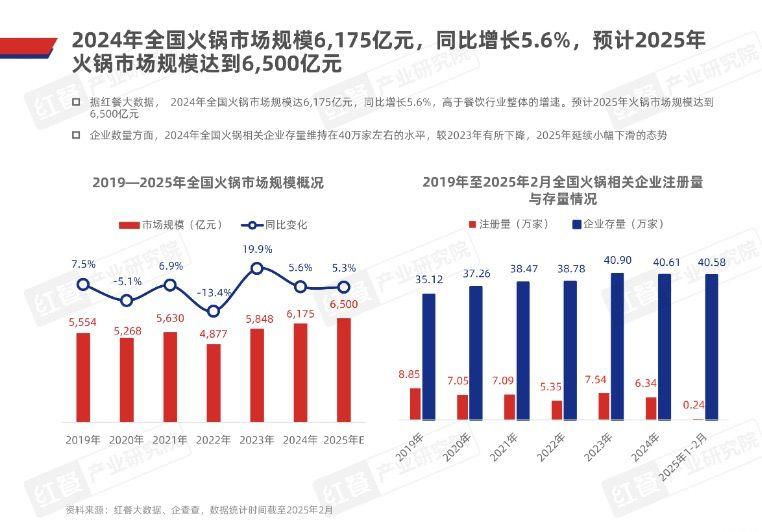
Core Insights - The hot pot industry is experiencing a significant shift from "incremental competition" to "stock competition," with a noticeable slowdown in market growth [6][8] - The main battleground for hot pot consumption is shifting towards affordable price ranges, with a marked increase in stores offering average spending of 70 RMB or less, while those above 90 RMB are declining sharply [3][8] Industry Overview - The national hot pot market is projected to reach 617.5 billion RMB in 2024, maintaining a year-on-year growth of 5.6%, although this is a decline compared to 2023 [6] - The number of hot pot establishments is expected to decrease from approximately 535,500 in Q3 2024 to about 504,800 by Q1 2025 [6] Consumer Behavior - Consumer spending in the hot pot sector has been on a downward trend, dropping from over 80 RMB to around 70 RMB by the end of 2024 [8] - The proportion of stores with average spending above 90 RMB has decreased by 16.9 percentage points, while those at 70 RMB or below have increased by 20.9 percentage points [8] Company Performance - Brands like Ba Nu and Cou Cou are facing declining average spending, with Ba Nu's customer spending dropping from 150 RMB in 2023 to 138 RMB in 2025, and Cou Cou's from 143.8 RMB to 137.8 RMB [10][12] - Ba Nu's same-store sales fell by 9.9% from 2023 to 2024, despite an increase in table turnover rates [15] Competitive Strategies - The industry consensus is shifting towards "price reduction for survival," with companies like Hai Di Lao and Nan Hot Pot announcing significant price cuts to adapt to market conditions [9][10] - Ba Nu is cautiously adjusting its product offerings and pricing strategies to maintain competitiveness, while Cou Cou is struggling to adapt to the changing market dynamics [15][16] Consumer Feedback - Consumers express dissatisfaction with the perceived value of mid-to-high-end hot pot brands, indicating that price reductions have not effectively addressed their expectations [17][19] - The challenge for brands is to maintain quality perception while adjusting to lower price points, as many consumers feel that the quality has diminished over time [20] Future Outlook - The hot pot industry is facing systemic challenges, and companies may need to diversify their offerings beyond traditional hot pot to sustain growth [21]
“人均150元火锅时代”翻篇,门店排队两小时背后:巴奴、湊湊客单价失守
Mei Ri Jing Ji Xin Wen· 2025-10-13 08:50
Core Insights - The hot pot industry in China is experiencing a significant shift from "incremental competition" to "stock competition," with a noticeable slowdown in market growth and a focus on price-sensitive consumers [5][6][10] Industry Overview - The national hot pot market size for 2024 is projected to be 617.5 billion RMB, reflecting a 5.6% year-on-year growth, although this is a decline compared to 2023 [5] - The number of hot pot restaurants is expected to decrease from approximately 535,500 in Q3 2024 to 504,800 by Q1 2025 [5][6] Consumer Behavior - There is a marked shift towards budget-friendly hot pot options, with establishments charging 70 RMB or less seeing a 20.9% increase in market share, while those charging over 90 RMB have seen a 16.9 percentage point decline [6] - Consumer spending in the hot pot sector has decreased from over 80 RMB to around 70 RMB by the end of 2024 [6] Company Performance - Brands like Ba Nu and Cou Cou are facing declining average spending per customer, with Ba Nu's average dropping from 150 RMB in 2023 to 138 RMB in 2025, and Cou Cou's from 143.8 RMB to 137.8 RMB [8][9] - Ba Nu has adjusted its product offerings to maintain competitiveness, including changes to its menu and pricing strategies [13][14] Competitive Strategies - The industry consensus has shifted towards "price reduction for survival," with companies like Hai Di Lao reporting a drop in average spending to 97.9 RMB [7] - Ba Nu and Cou Cou are implementing various strategies, such as membership programs and smaller portion options, to attract price-sensitive consumers [14][15] Market Challenges - Despite efforts to lower prices, consumer perception of value remains a challenge, with many feeling that the quality of offerings has diminished [15][17] - The hot pot industry is facing systemic challenges, leading some companies to explore alternative revenue streams, such as launching sub-brands [18]