商汤科技

Search documents
多家港股上市企业AI收入增幅显著,迈向商业化深水区
Sou Hu Cai Jing· 2025-09-02 17:24
Core Insights - The article highlights the significant growth of AI-related revenues among several Hong Kong-listed companies in their 2025 semi-annual reports, indicating a shift from AI as a concept to its deep application and value realization in the business sector [3]. Group 1: Alibaba Cloud - Alibaba Cloud reported a remarkable 26% year-on-year increase in external commercial revenue, reaching 33.398 billion yuan, marking the highest growth rate in nearly three years [4] - AI revenue now constitutes over 20% of external commercial revenue, with related product revenue maintaining triple-digit year-on-year growth for eight consecutive quarters, driving the growth of cloud business [4] - To meet the rising global demand for cloud and AI, Alibaba Cloud has launched eight new data centers this year and plans to invest 380 billion yuan in cloud and AI hardware infrastructure over the next three years [4] Group 2: SenseTime - SenseTime achieved a revenue of 2.358 billion yuan in the first half of 2025, reflecting a year-on-year growth of 35.6%, with adjusted net losses narrowing by 50% to 1.162 billion yuan [5] - The rapid growth of the generative AI business, which generated 1.816 billion yuan in revenue (up 72.7% year-on-year), has significantly contributed to the company's performance recovery, increasing its share of total revenue to 77% [5][6] - SenseTime's strategic focus on a "computing power infrastructure - large model research - large model application" framework has created a positive business cycle, despite some restructuring challenges [6] Group 3: CloudWalk Technology - CloudWalk Technology reported a revenue of 405 million yuan in the first half of 2025, a 20.2% increase year-on-year, with explosive growth in large model revenue, which surged 457% to nearly 100 million yuan [7] - The sales revenue from solutions reached 283 million yuan, up 22.6% year-on-year, while AI chip shipments totaled 16.5 million units, a 0.7% increase from the previous year [7] Group 4: Baiwang Technology - Baiwang Technology achieved a revenue of 347.6 million yuan in the first half of 2025, a 23.5% year-on-year increase, with AI-related business revenue surpassing 60.86 million yuan, accounting for 17.5% of total revenue [8] - The company launched an enterprise-level intelligent agent matrix and collaborated with China COSCO Shipping Technology to introduce a global tax compliance intelligent machine, showcasing its strategic positioning in the AI sector [8] Industry Trends - The AI sector is transitioning from speculative hype to sustainable commercial value realization, as evidenced by the strong performance of multiple Hong Kong-listed companies in their semi-annual reports [8] - AI technology has made significant advancements and demonstrated robust monetization capabilities, helping companies explore new growth trajectories and driving the industry towards a new development phase [8]


自动驾驶之心开学季活动来了(超级折扣卡/课程/硬件/论文辅导福利放送)
自动驾驶之心· 2025-09-02 09:57
Core Viewpoint - The article reflects on the evolution of autonomous driving over the past decade, highlighting significant technological advancements and the ongoing need for innovation and talent in the industry [2][3][4]. Group 1: Evolution of Autonomous Driving - Autonomous driving has progressed from basic image classification to advanced perception systems, including 3D detection and end-to-end models [3]. - The industry has witnessed both failures and successes, with companies like Tesla, Huawei, and NIO establishing strong technological foundations [3]. - The journey of autonomous driving is characterized by continuous efforts rather than sudden breakthroughs, emphasizing the importance of sustained innovation [3]. Group 2: Importance of Talent and Innovation - The future of autonomous driving relies on a steady influx of talent dedicated to enhancing safety and performance [4]. - Innovation is identified as the core of sustainable business growth, with a focus on practical applications and real-world problem-solving [6]. - The article encourages a mindset of continuous learning and adaptation to keep pace with rapid technological changes [6]. Group 3: Educational Initiatives and Resources - The company has developed a series of educational resources, including video tutorials and courses covering nearly 40 subfields of autonomous driving [8][9]. - Collaborations with industry leaders and academic institutions are emphasized to bridge the gap between theory and practice [8]. - The article outlines various courses aimed at equipping learners with the necessary skills for careers in leading autonomous driving companies [9][10]. Group 4: Future Directions in Technology - Key technological directions for 2025 include end-to-end autonomous driving and the integration of large models [12][20]. - The article discusses the significance of multi-modal large models in enhancing the capabilities of autonomous systems [20]. - The need for advanced data annotation techniques, such as automated 4D labeling, is highlighted as crucial for improving training data quality [16].

“人工智能+”行动发布,四巨头“闭环能力”破局
Bei Jing Shang Bao· 2025-09-01 08:33
Core Insights - The Chinese government has launched the "Artificial Intelligence +" initiative, marking a significant shift towards integrating AI across various sectors, aiming for over 70% penetration of smart terminals by 2027 and a fully intelligent society by 2035 [1] - Major Chinese AI companies are playing a crucial role in this initiative, focusing on closing the gap between technology and practical applications, with a shift from performance competition to ecosystem collaboration [1][2] Company Summaries ByteDance - Launched the Seed-OSS-36B large language model, breaking the long text processing barrier with a 512K context window, supporting input of up to 900,000 Chinese characters [3] - Introduced a "thinking budget" mechanism allowing users to control the model's depth of reasoning, enhancing its application in complex tasks [3] - The model is integrated with the Volcano Engine, creating a closed-loop ecosystem of open-source models, development tools, and content [3][11] Alibaba - The Tongyi Qianwen model focuses on commercial applications, with its upgraded version capable of generating high-quality dynamic videos from images and audio [4] - Launched the AI programming tool Qoder, enhancing code library search and task delegation efficiency [4] - Over 300 Tongyi series models have been open-sourced, with global downloads exceeding 400 million, significantly improving enterprise efficiency [12] SenseTime - The SenseTime V6.5 multi-modal model has achieved significant advancements in reasoning performance, comparable to leading models in the market [5] - The "Xiaohuanxiong" intelligent assistant has surpassed 3 million users, with applications in finance, education, and government [5][13] - The company has developed the "Wuneng Embodied Intelligence Platform," enhancing interaction between AI and the physical world [5] Baidu - Open-sourced the Wenxin large model series, achieving a 92.7% accuracy in understanding industry-specific terminology [6] - The Wenxin model has a daily call volume of 1.65 billion, integrating solutions across healthcare and education sectors [14] - In the autonomous driving sector, Baidu's Apollo system has covered 30 cities, with L4 testing mileage exceeding 80 million kilometers [14] Competitive Landscape - The competition among the four major AI companies has shifted from scale expansion to performance efficiency and collaborative innovation [8] - Each company has optimized its computing infrastructure, with significant improvements in performance and cost efficiency [8] - According to IDC, Baidu, Alibaba, and SenseTime are leading the domestic AI platform market, indicating a strong competitive position in AI infrastructure [9] Future Directions - The success of AI technology will depend on its penetration into vertical markets and the efficiency of commercial conversion [10] - The four major companies are adopting distinct strategies for market implementation, focusing on ecosystem integration and scene-specific applications [10][14]


多家上市企业AI收入激增
3 6 Ke· 2025-09-01 07:05
Core Insights - Multiple Hong Kong-listed companies have reported significant growth in AI-related revenues, indicating a shift towards sustainable commercial value in the AI sector [1][2][5] Company Performance - Alibaba's cloud revenue increased by 26% year-on-year to 33.398 billion yuan, with AI-related revenue contributing over 20% of external commercialization revenue [1][2] - SenseTime's generative AI revenue surged by 73% to 1.816 billion yuan, with its share of total revenue rising from 60.4% in the first half of 2024 to 77.0% [2][3] - CloudWalk achieved revenue of 405 million yuan, a 20.2% increase, with its large model revenue skyrocketing by 457% to nearly 100 million yuan [1][3] - Baiwang's AI-related business revenue reached 60.86 million yuan, accounting for 17.5% of total revenue, marking a significant breakthrough [1][3] Industry Trends - The AI industry is transitioning from hype and adjustment phases to focusing on sustainable commercial applications, supported by recent government policies [1][5] - The State Council's recent policy aims for deep integration of AI with six key sectors by 2027, with a target of over 70% application penetration of new intelligent terminals and agents [5][6] - The demand for AI applications is robust, with opportunities in various sectors including marketing, education, and industrial upgrades [6][7] Future Outlook - The AI sector is expected to continue growing, with companies investing heavily in infrastructure and technology to enhance user experiences and operational efficiency [2][6] - The overall AI application landscape remains in its early stages, with companies needing to explore effective commercialization paths and enhance their R&D efforts [7]
多家上市企业AI收入激增,政策催化人工智能应用浪潮
Feng Huang Wang· 2025-08-30 23:49
Group 1: Core Insights - Multiple Hong Kong-listed companies have reported significant growth in AI-related revenues, indicating a shift towards sustainable commercial value in the AI sector [1][2][4] - Alibaba's cloud revenue increased by 26% year-on-year, with AI-related income accounting for over 20% of external commercialization revenue [1][2] - SenseTime's generative AI revenue surged by 73%, contributing to 77% of the group's total revenue, while traditional visual AI revenue declined by 14.8% [2][3] Group 2: Company Performance - Alibaba's cloud revenue reached 333.98 billion yuan, marking the highest growth rate in three years, driven by AI-related services [2] - CloudWalk achieved a revenue of 4.05 billion yuan, with a remarkable 457% increase in large model revenue, reaching nearly 100 million yuan [3] - Baiwang's AI-related business revenue reached 60.86 million yuan, accounting for 17.5% of total revenue, marking a significant breakthrough [3] Group 3: Industry Trends - The State Council's recent policy aims to promote the large-scale application and commercialization of AI, with a target of over 70% penetration of new intelligent terminals and agents by 2027 [4][5] - The AI industry is evolving through new infrastructure, systems, terminals, and services, with a focus on integrating AI into various sectors [5][6] - The overall AI application is still in its early stages, with companies needing to explore effective ways to leverage technology across industries [1][6]
商汤生成式AI收入增73%,亏损收窄
Nan Fang Du Shi Bao· 2025-08-30 16:33
Core Insights - Generative AI is becoming a cornerstone and growth engine for SenseTime, with a significant revenue increase reported in the mid-2025 financial results [1][2]. Financial Performance - The company achieved a revenue of 2.358 billion yuan in the first half of the year, representing a year-on-year growth of 35.6% [1]. - Adjusted net loss narrowed significantly to 1.162 billion yuan, a reduction of 50.0% compared to the previous year [1]. Generative AI Business Growth - Revenue from the generative AI segment reached 1.816 billion yuan, marking a year-on-year increase of 72.7%, and now accounts for 77.0% of total revenue [1][2]. - The growth is attributed to the successful implementation of a three-pronged strategy focusing on computational infrastructure, large model research, and large model applications [2]. Infrastructure and Model Development - As of August, the total computational power of SenseCore has increased to approximately 25,000 PetaFLOPS [2]. - The "Riri New" multimodal large model has been iteratively improved, with the latest version matching international models like Gemini 1.5 Pro and Claude 3 Sonnet in reasoning capabilities [2]. Product and User Engagement - The "Raccoon" product family for enterprise users has surpassed 3 million users, processing around 10 billion data analysis tokens daily [2]. - The "Kapi" series for consumer users has exceeded 10 million users, with daily active users increasing by 400% this year [3]. Strategic Restructuring - The "1+X" strategy has redefined the company's business structure, categorizing core generative AI and visual AI as "1" and innovative incubations like intelligent driving and smart healthcare as "X" [4]. - The visual AI segment, once a key revenue driver, reported a revenue decline of 14.8% to 436 million yuan due to a shift in collaboration with a major client [4]. Challenges in Traditional Business - The X innovation segment generated 107 million yuan in revenue, down from 177 million yuan year-on-year, primarily due to the intelligent driving business [4]. - Despite a significant reduction in overall losses, the company's gross margin fell to 38.5%, down from 44.1% the previous year, attributed to increased costs related to hardware and AIDC operations [5].
上海:2024年人力资源服务业年营收突破5600亿元
Zhong Guo Xin Wen Wang· 2025-08-29 13:33
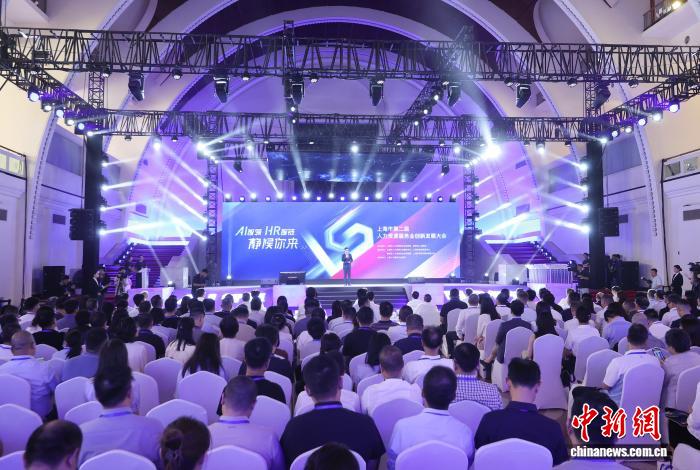
Core Insights - The Shanghai human resources service industry is projected to exceed 560 billion yuan in annual revenue by 2024, maintaining its leading position in the country [3][4]. Industry Development - The industry focuses on goals of specialization, digitalization, internationalization, branding, and standardization, supported by various policies such as innovation development action plans and the "Bole" reward program [3]. - The Shanghai human resources service industry park has developed over 15 years, emphasizing employment services, talent empowerment, and economic driving, contributing significantly to Shanghai's high-quality development [3]. AI Integration - The Shanghai human resources department has introduced "AI+HR" work models to create "AI Promoter" positions, enhancing human resource support for AI companies and generating more job opportunities for graduates [4]. - Key enterprises have signed contracts for the first batch of "AI Promoters," with plans to develop more such positions in collaboration with the economic and information departments [4]. Recruitment Initiatives - A talent recruitment event was held during the conference, featuring 100 key enterprises offering over 2,000 high-end positions in fields such as AI algorithms, biomedicine, and high-end equipment manufacturing [5]. - The Shanghai human resources department aims to further integrate human resources services with the real economy and technological innovation to promote high-quality employment [5].
深业集团发布全新产业社区产品体系 多维赋能科创发展
Shen Zhen Shang Bao· 2025-08-29 12:45
Core Insights - Shen Ye Group has launched a new industrial community product system, marking a new phase in its development of industrial parks, based on over 40 years of operational experience and extensive research on hundreds of companies [1][9] - The company operates over 25 million square meters across 70 parks in 32 cities, having served 17,275 enterprises and nurtured 202 listed companies and 30 Fortune 500 companies [1][9] Group 1: Product System Overview - The new industrial community product system encompasses three core segments, providing full lifecycle services for enterprises [3][5] - Shen Ke Yuan Space offers comprehensive spatial solutions, including office spaces tailored for innovation enterprises, with options for serviced, ready-to-move-in, and customized spaces [3][4] - Shen Chuang Lian Link∞ serves as a resource empowerment platform, facilitating collaboration between industry, academia, and research, while also providing financial services and policy support [5][6] Group 2: Operational Services - Shen Zhuo Yue Service+ focuses on efficient operational services, ensuring rapid response and support for enterprises, including basic operations and talent services [6][7] - The "Zhuo Yue+" service standard addresses various enterprise needs, including talent recruitment and retention, while also providing comprehensive living and working support [7][8] - The company emphasizes creating a community atmosphere that fosters employee well-being and social interaction, enhancing talent retention [8] Group 3: Future Strategy - Looking ahead, Shen Ye Group aims to cultivate a "second growth curve" centered on technology and real estate, with the new product system being a significant milestone towards this strategic goal [9]

合肥能否跑出下一个寒武纪?
AI研究所· 2025-08-29 10:34
Core Viewpoint - Cambricon's impressive performance in its 2025 semi-annual report highlights its significant growth and profitability, marking a historic achievement for the company since its IPO in 2020 [1][2]. Financial Performance - Cambricon achieved a revenue of 2.881 billion yuan, representing a year-on-year growth of 4347.82% [1]. - The company reported a net profit attributable to shareholders of 1.038 billion yuan, successfully turning a profit [1]. Market Position - Cambricon's stock price reached a peak of 1595.88 yuan, surpassing Kweichow Moutai's stock price by 9.8% on the same day [2]. - Although Cambricon's stock has not reached its previous high of over 2300 yuan, it is currently the most expensive stock in the A-share market [3]. Technological and Academic Background - The success of Cambricon is closely linked to the contributions of the University of Science and Technology of China (USTC), which has produced numerous top talents in the AI sector [5][6]. - The founders of Cambricon, Chen Tianshi and Chen Yunjie, are USTC alumni who initiated the neural network processor project in 2012, leading to the development of the first deep learning dedicated processor [9][10]. Strategic Collaborations - Cambricon's partnership with Huawei was pivotal in its rise, as it provided the necessary technological support for Huawei's AI product development [11]. - This collaboration allowed Cambricon's NPU technology to be integrated into Huawei's flagship mobile chips, significantly boosting its visibility in the industry [11]. Industry Ecosystem - The city of Hefei has played a crucial role in supporting the growth of Cambricon and other USTC alumni enterprises, establishing a complete chip industry chain [7][16]. - Hefei's strategic initiatives have positioned it as a significant player in China's chip industry, with companies like Changxin Storage leading the way in DRAM production [17][21]. Future Prospects - The potential IPO of Changxin Storage is expected to be a milestone for Hefei's chip industry, attracting more capital and accelerating the development of the local ecosystem [20][21]. - The combination of USTC's talent pool and Hefei's industrial advantages suggests a promising future for the emergence of more successful projects in the region [23].

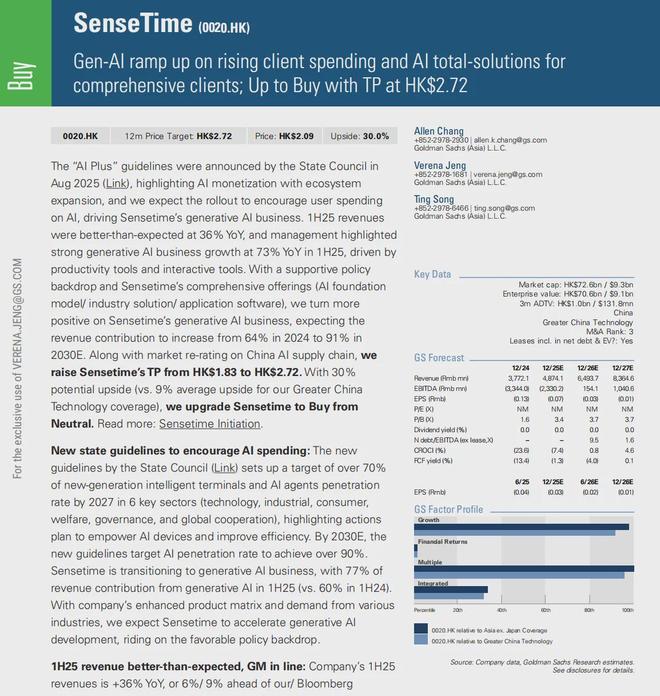
商汤科技2025年上半年生成式AI收入猛增73%,高盛上调评级至“买入”
Cai Jing Wang· 2025-08-29 07:26
Core Insights - SenseTime (0020.HK) reported a revenue of 2.4 billion RMB for the first half of 2025, representing a year-on-year growth of 36%, exceeding market expectations [1][2] - The generative AI business saw a significant revenue increase of 73%, marking it as the core driver of the company's growth [1][2] Revenue Performance - The revenue growth of 36% surpassed the consensus estimates from Goldman Sachs and Bloomberg by 6% and 9% respectively [2] - The strong performance in the generative AI sector is a key contributor to this revenue increase [2] Market Position and Future Outlook - Goldman Sachs upgraded SenseTime's investment rating from "Neutral" to "Buy" following the positive earnings report [2] - The Chinese government's "Artificial Intelligence+" policy is expected to provide significant benefits to the industry, positioning SenseTime favorably for accelerated commercialization of generative AI [5][6] - SenseTime's revenue contribution from generative AI is projected to rise from 64% in 2024 to an estimated 91% by 2030 [5] Stock Performance - Following the positive earnings report, SenseTime's stock price became active, closing at 2.08 HKD, with a peak of 2.23 HKD, the highest since October of the previous year [6]