华为

Search documents
粤产AI手机引领新消费,广东“手机天团”何以狂飙?
2 1 Shi Ji Jing Ji Bao Dao· 2026-01-20 10:49
Core Insights - Guangdong manufactures one out of every three smartphones sold globally, with five major brands dominating the market [1][3] - The smartphone industry in Guangdong has maintained its position as the largest in China for 35 consecutive years, with a projected combined global market share of 34.6% for major brands in 2024 [1][3] - The integration of AI technology into smartphones is expected to drive a new wave of consumer electronics innovation and a subsequent "upgrade wave" in the market [1][6] Industry Overview - Guangdong is the most significant hub for smartphone production in China, leading in scale, output, and export volume [2][3] - The city of Dongguan is a core area for smartphone manufacturing, accounting for 28.6% of Guangdong's smartphone output in 2024 [3] - The region has developed a complete supply chain for smartphone production, with over 90% of components sourced locally [3] Technological Advancements - Continuous R&D investment by major brands has led to significant technological innovations, including advancements in chip design, fast charging, and foldable screens [4][5] - Notable innovations include OPPO's 125W fast charging technology and Huawei's breakthrough in foldable phone hinge design [5][6] - The introduction of AI capabilities in smartphones is transforming them into intelligent assistants, enhancing user experience and functionality [6][7] Market Trends - The shift towards AI-integrated smartphones is expected to redefine market competition, moving beyond hardware performance to functional innovation [6][8] - Major brands are actively incorporating AI features into their flagship models, with Huawei's HarmonyOS enhancing user interaction through AI [6][7] - The emergence of AI Agent smartphones is anticipated to lead a new "upgrade wave" in the context of stagnant smartphone sales growth [6][8] Future Outlook - Guangdong plans to accelerate the development of high-quality action plans for AI terminal products, indicating a strategic focus on innovation and market leadership [7][8] - The ongoing evolution of smartphones in Guangdong reflects a broader trend of the manufacturing sector integrating advanced technologies and moving up the global value chain [8]


工业软件为锂电制造引入AI新变量
高工锂电· 2026-01-20 10:42
Core Viewpoint - The article emphasizes the importance of integrating AI, data, and simulation capabilities into the front end of process decision-making in lithium battery manufacturing, highlighting the role of industrial software in reshaping competitive logic [3][4]. Group 1: Industrial Software and AI Integration - The lithium battery manufacturing sector is experiencing intense competition, where the ability to transform process experience into reusable and evolvable system capabilities is crucial for equipment companies [3]. - Liyuanheng's recent advancements in industrial software and AI manufacturing have been recognized with awards for outstanding contributions in engineering practices under the Ministry of Industry and Information Technology's "Modular Resonance" initiative [3][4]. - The company aims to provide a verifiable and replicable AI + manufacturing path for lithium battery production through its proprietary industrial software [4]. Group 2: Challenges in Non-Standard Equipment - The structural challenges of non-standard equipment in lithium battery manufacturing stem from its complexity, diverse machine types, and high precision requirements, leading to reliance on trial-and-error and engineer experience [5]. - The limitations of the traditional approach have become more pronounced in the current environment focused on cost reduction, efficiency improvement, and rapid iteration, resulting in longer R&D cycles and high trial costs [5]. Group 3: Methodology and Engineering Practice - Liyuanheng's industrial software strategy focuses on eliminating problems at the design stage, aiming for "right the first time" as a core objective [6]. - The company's approach involves building a closed-loop system around the entire R&D process, transitioning from experience-driven to data and model-driven methodologies [7]. - By introducing high-fidelity simulations early in the design phase, Liyuanheng has significantly reduced reliance on physical prototypes, thus lowering trial costs [7][8]. Group 4: Dual-Engine Structure - Liyuanheng's "toolchain platform + advanced simulation foundation" dual-engine structure integrates various systems (CAD, CAE, CAM, PLM, ERP) to manage data flow and alleviate issues related to fragmented R&D processes [10]. - The advanced simulation foundation enhances decision-making by upgrading simulations from auxiliary tools to primary decision-making resources, supporting the goal of "design correctness" [10][11]. Group 5: Ecosystem Development - HaiKui Information, a subsidiary of Liyuanheng, plays a crucial role in extending capabilities and connecting ecosystems, having achieved certification as a cloud service partner with Huawei [12]. - The company has developed a comprehensive digital solution system covering design, manufacturing, management, and service, facilitating the construction of an integrated industrial intelligence ecosystem [12]. - Liyuanheng's collaboration with HaiKui Information and other partners aims to create an open scene and shared data assets, transitioning industrial software from internal tools to public capabilities for the lithium battery manufacturing sector [12].


“广货群侠”多强大?广东这五大品牌征服了全球
2 1 Shi Ji Jing Ji Bao Dao· 2026-01-20 10:38
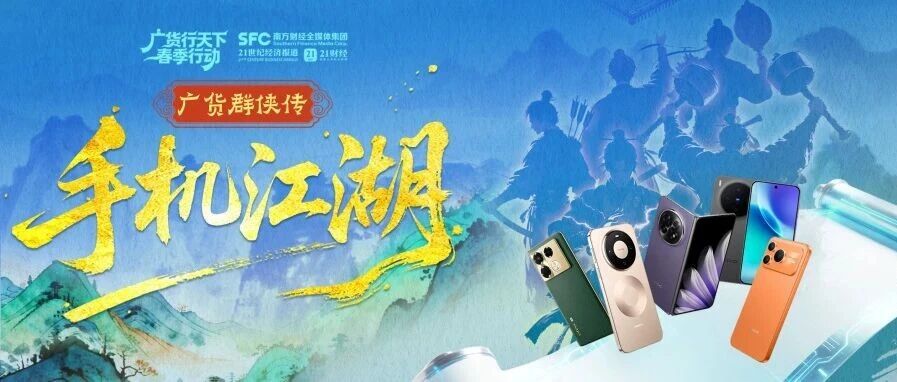
Group 1 - The core viewpoint of the articles emphasizes Guangdong's significant role in the global smartphone industry, highlighting its dominance in manufacturing and innovation [2] - Guangdong is home to five of the top ten smartphone manufacturers globally, showcasing its substantial market share [2] - The region accounts for one out of every three smartphones sold worldwide, indicating its critical position in the global supply chain [2] Group 2 - The smartphone industry in Guangdong has evolved over nearly 30 years, transitioning from feature phones to advanced technologies such as fast charging, imaging, full-screen displays, 5G, and AI ecosystems [2] - The "Guangdong Goods Going Global" spring campaign features a special event focused on smartphones, showcasing products from leading companies like Huawei, OPPO, vivo, and Honor [2] - The continuous innovation and manufacturing capabilities in Guangdong are setting new industry standards and pushing the boundaries of technology [2]

“广货群侠”多强大?广东这五大品牌征服了全球
21世纪经济报道· 2026-01-20 10:29
Core Viewpoint - The article emphasizes the competitive landscape of the smartphone industry, highlighting Guangdong's dominance as a major manufacturing hub and innovation center, with significant contributions from local brands like Huawei, OPPO, vivo, and Honor [1][13]. Industry Overview - Guangdong is recognized as the most important smartphone industry cluster in China, leading in scale, production, and export, with one in three smartphones sold globally originating from this region [13]. - The smartphone market is characterized by rapid technological advancements and intense competition, with major players continuously innovating to maintain their market positions [1]. Company Highlights - **Huawei**: Utilizes its advanced Kirin chips and Kunlun glass, with the HarmonyOS enabling seamless connectivity. In 2025, Huawei's smartphone shipments reached 4.67 million units, capturing 16% of the market share in China [3]. - **OPPO**: Focuses on imaging, AI, communication, and fast charging technologies. By November 2025, the global activation of the OPPO Reno series surpassed 10 million, and the Find X9 series sold over 1 million units within 10 days of its domestic launch [5]. - **vivo**: Specializes in professional imaging technology, launching the X300 series with a focus on high-quality mobile photography. Currently, vivo serves over 100 million users globally [7]. - **Honor**: Launched the Honor Power2 in January 2026, featuring a 10,080mAh battery to address battery life concerns. In 2025, Honor's smartphone shipments exceeded 71 million units, with over 30% of sales coming from international markets [9]. Technological Evolution - Over the past 30 years, Guangdong's smartphone technology has evolved from self-developed feature phones to the emergence of autonomous brands in the smartphone era, achieving breakthroughs in fast charging, imaging, full-screen displays, and 5G technology [16].
广东将加快谋划出台AI终端高质量发展行动方案
第一财经· 2026-01-20 09:52
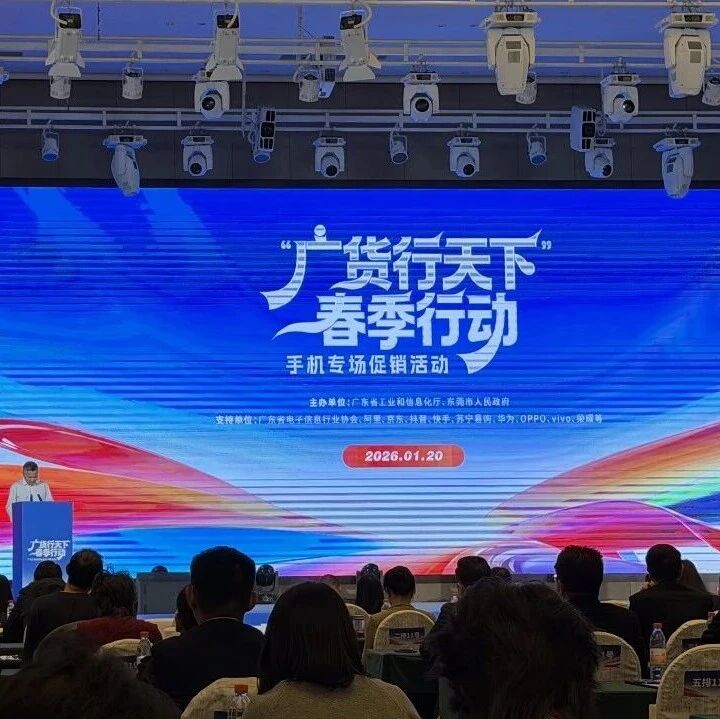
Core Viewpoint - Guangdong province is accelerating the development of high-quality action plans for mobile phones and AI terminals, maintaining its position as the largest mobile phone industry hub in China for 35 consecutive years [4]. Group 1: Industry Overview - Guangdong's mobile phone production reached 683 million units in 2024, accounting for 40.9% of the national total, with one in three mobile phones sold globally originating from Guangdong [4]. - The mobile phone industry cluster in Guangdong is supported by leading brands such as Huawei, OPPO, vivo, and Honor, which together form a complete industrial chain from chips to finished products [4]. - Dongguan is identified as the core area of the mobile phone industry in Guangdong, contributing 28.6% of the province's mobile phone production in 2024, with a high industry matching rate exceeding 90% [4]. Group 2: Market Dynamics - During a promotional event in Dongguan, major brands showcased 36 AI mobile phones and over 2000 products from more than 700 industry chain enterprises, indicating a strong market presence [3]. - Honor's government affairs director highlighted the importance of understanding consumer psychology and the trend of "self-satisfying consumption" in the current market [3]. - OPPO announced exclusive discounts for its new Find X9 Pro, offering a price reduction of 200 yuan compared to the discounted price during the Double Eleven shopping festival [3].
2026年度AI最佳场景渗透案例评选启动丨招募
36氪· 2026-01-20 09:46
Core Insights - The article emphasizes a significant shift in the AI industry from a focus on technical feasibility to commercial viability, indicating that AI applications must now demonstrate real business value to avoid market devaluation [5][6][12]. Group 1: Industry Trends - A transformation is occurring in the AI sector, with increasing activity and investment signaling a move towards profitability narratives [3][5]. - The AI industry is transitioning from a "parameter race" to a focus on practical applications that address real-world needs [6][7]. - Companies are abandoning the idea of universal solutions and are instead developing targeted applications that provide concrete solutions in specific verticals [11]. Group 2: Case Studies and Applications - In the automotive sector, AI is being integrated into power systems and intelligent driving algorithms, transforming vehicles into self-evolving intelligent spaces [11]. - AI is significantly lowering the barriers to content creation, as seen with Kuaishou's use of AI in short drama production and e-commerce live streaming, creating a complete ecosystem from production to monetization [11]. - The emergence of the Agent era allows AI to perform comprehensive tasks in physical environments, as demonstrated by Alibaba's Qianwen app, which integrates food delivery, payment, and shopping into a single platform [11]. Group 3: Evaluation and Recognition - The article announces the "2026 Annual AI Best Scene Penetration Case" evaluation, aimed at identifying AI applications that effectively solve industry pain points and demonstrate replicable business value [13][20]. - The evaluation will utilize a "dual application system," encouraging collaboration between AI developers and users to provide a comprehensive view of application effectiveness [13][22]. - A panel of industry experts will assess submissions based on criteria such as scene penetration, commercial value, technological innovation, and replicability [13][25]. Group 4: Highlights of the Evaluation - Special awards will be given to early adopters who explore and invest in AI applications, recognizing their contributions to the industry [15]. - A survey will be conducted to understand the decision-making processes and pain points faced by AI product users, creating an "AI demand market map" [16]. - Public input will be solicited to identify anticipated AI transformation scenarios, aiding in future industry planning [17].
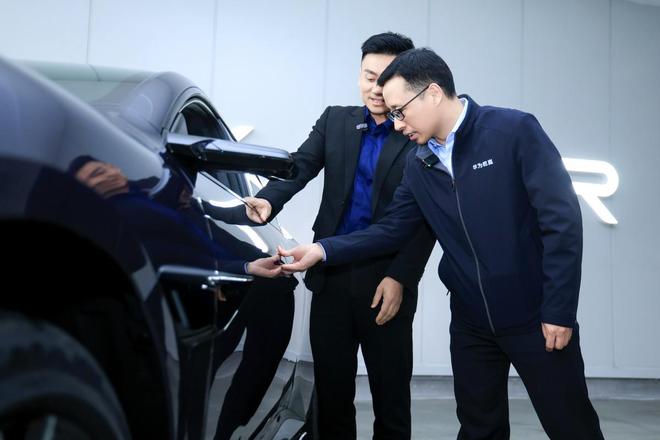
迈入“产品共创”新阶段,华为乾崑与阿维塔共同进驻工厂
Guan Cha Zhe Wang· 2026-01-20 09:45
Group 1 - The core viewpoint of the article highlights the strategic collaboration between Huawei and Avita, marking a transition from product development to practical implementation [1][3] - The partnership began in 2022, focusing on areas such as intelligent driving and smart cockpit, with significant product launches in 2023, including Avita 11 and Avita 12 [3] - The collaboration has now upgraded to phase 2.0 in 2024, expanding from single technology integration to deeper joint development and system collaboration [3] Group 2 - The newly unveiled Avita 12 is the first product resulting from the upgraded strategic partnership, featuring Huawei's latest "Four Laser" intelligent driving solution [5] - The Avita 12 includes systematic upgrades in perception hardware, chassis control, safety redundancy, and overall vehicle intelligence, showcasing a new design with a semi-open door handle for enhanced emergency response [5] - During a factory visit, executives from both companies engaged in production, calibration, and validation processes, with Huawei's CEO noting significant improvements in the overall completeness of the new Avita 12 compared to previous models [5]
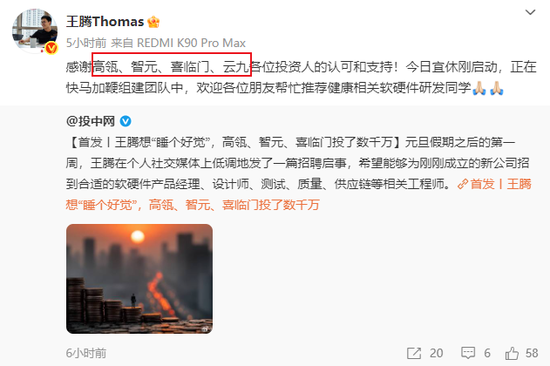
王腾新公司成立14天获数千万融资,资方阵容强大但没小米
Xin Lang Cai Jing· 2026-01-20 09:38
Core Viewpoint - Wang Teng, former General Manager of Xiaomi's China Marketing Department, has founded a new company named "Today Yixiu," focusing on sleep health products, and has recently completed a seed round financing of several tens of millions of yuan [1][8]. Company Overview - "Today Yixiu" aims to develop products related to sleep health, targeting over 300 million people in China suffering from sleep disorders [5][12]. - The company was established on January 6, 2026, and secured financing within 14 days, indicating strong interest in the startup within the investment community [5][12]. Financing Details - The seed round financing was led by investors including GL Ventures, Zhiyuan Robotics, Xilinmen, and Yunjiu Capital [1][8]. - The total scale of the financing is reported to be several tens of millions of yuan [1][8]. Team and Operations - The initial team consists of members primarily from leading tech companies such as Xiaomi and Huawei [3][10]. - The company plans to maintain competitive salary levels and benefits similar to large tech firms, with a focus on stock incentives [5][12]. - The headquarters is located in Beijing, with potential plans to establish branches in Shenzhen and Hangzhou in the future [5][12]. Product Development - "Today Yixiu" will leverage AI and brain science technology to provide a closed-loop solution for sleep monitoring, intervention, and energy management, differentiating itself from traditional sleep aid hardware [5][12].
卡倍亿:已具备224G铜缆产品量产能力 推进全球化产能布局
Zheng Quan Shi Bao Wang· 2026-01-20 09:32
Core Insights - The company has achieved significant advancements in the research and industrialization of high-speed copper cable products, establishing a comprehensive technical system and scalable delivery capabilities driven by AI computing demand [1][2] - The company has successfully mass-produced 56G, 112G, and 224G co-extruded products, with a particular emphasis on the 224G physical foaming products, which are now ready for mass production [1] - The company has a variety of mainstream structural design solutions for high-speed copper cables, showcasing its strong technological foresight and continuous innovation capabilities [1] Technical Developments - The company has fully mastered the mass production capabilities for 56G, 112G, and 224G products, with a complete product matrix established [1] - The company has successfully passed certification from major North American clients for its high-speed copper cable products, validating its technical specifications and quality management [2] - The performance and quality of the company's products meet the requirements of global tech giants like NVIDIA, Amazon, Google, and Huawei in AI computing clusters and large-scale data centers [2] Production Capacity and Global Strategy - The company has successfully deployed production lines for 224G foaming equipment, with three lines in Shanghai and two in Mexico, aimed at enhancing global capacity and responsiveness to market demands [1] - The company plans to strengthen its global capacity layout in line with its strategic and refinancing plans [1] - The company is committed to focusing on high-speed transmission and increasing R&D investment while deepening its global supply chain and production capacity layout [2]

小米反超苹果成中国手机市场激活量第二,卢伟冰回应
Xin Lang Cai Jing· 2026-01-20 09:25
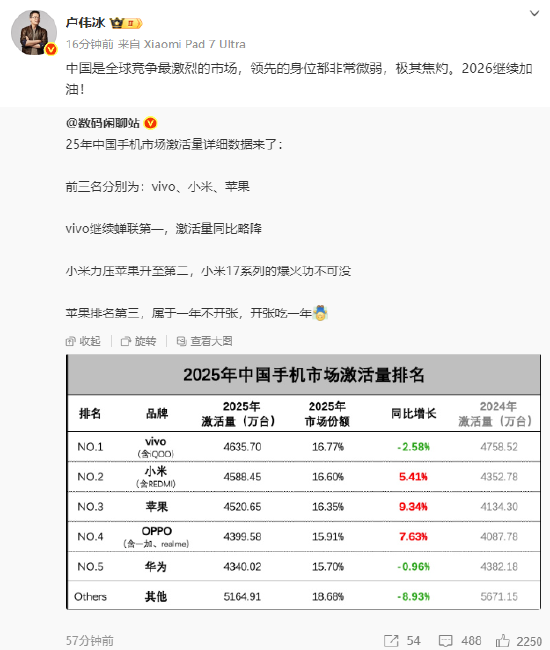
Core Insights - The Chinese smartphone market is highly competitive, with very narrow leading positions among brands, indicating a fierce battle for market share [1][3] - In 2025, Xiaomi surpassed Apple to become the second-largest smartphone brand in China, following Vivo, largely attributed to the success of the Xiaomi 17 series [1][2][3] Market Rankings - The top three brands in the 2025 Chinese smartphone market by activation volume are: 1. Vivo: 4,635.70 thousand units, 16.77% market share, a decrease of 2.58% from 2024 [2][3] 2. Xiaomi: 4,588.45 thousand units, 16.60% market share, an increase of 5.41% from 2024 [2][3] 3. Apple: 4,520.65 thousand units, 16.35% market share, an increase of 9.34% from 2024 [2][3] - Other notable brands include OPPO with 4,399.58 thousand units (15.91% market share) and Huawei with 4,340.02 thousand units (15.70% market share) [2][3]