
国信证券

Search documents
上半年亏损投行少了一半,头部券商押注港股
21世纪经济报道· 2025-09-12 01:30
Core Viewpoint - The investment banking sector is experiencing a recovery with significant internal differentiation, as evidenced by a reduction in the number of loss-making firms and a notable performance improvement among leading brokerages [1][4]. Group 1: Profitability Trends - The number of brokerages reporting losses in investment banking has decreased from 20 in 2024 to only 10 in 2025, indicating a significant improvement in profitability [1][4]. - Leading brokerages such as CICC and CITIC Securities have turned losses into profits, with CICC's investment banking revenue soaring by 149.70% year-on-year, reaching 1.445 billion yuan [1][10]. - Despite the overall improvement, some brokerages, including Guojin Securities and Zhongtai Securities, have reported substantial losses, with Guojin Securities losing 98.07 million yuan [1][5]. Group 2: Market Shifts - In response to the changing IPO landscape in the A-share market, leading brokerages are increasingly focusing on the Hong Kong market, with CICC International achieving a substantial underwriting scale of 22.582 billion yuan in the first eight months of the year [2][11]. - The competitive environment in the Hong Kong market has led to a decline in profit margins for many brokerages, with average profit margins dropping to around 20%, significantly lower than the pre-"827 New Policy" levels of over 50% [2][13]. Group 3: Performance of Specific Brokerages - CICC has shown remarkable recovery, with its investment banking profit reaching 276 million yuan in the first half of the year, a significant turnaround from a loss of 784 million yuan in the previous year [10][11]. - Guojin Securities, despite high revenue of 377 million yuan, has seen its losses expand to 98.07 million yuan, highlighting the challenges faced by some brokerages in the current market [5][7]. - Zhongtai Securities has also experienced a shift from profit to loss, with a reported loss of 37.59 million yuan in the first half of 2025, down from a profit of 139 million yuan in the same period last year [4][5]. Group 4: Competitive Landscape - The competitive landscape in the Hong Kong IPO market is intensifying, with domestic brokerages capturing four of the top five spots in underwriting amounts, showcasing their growing competitiveness [2][16]. - The shift in focus towards the Hong Kong market has led to increased collaboration between A-share and Hong Kong brokers, as they work together to secure IPOs for companies looking to list in Hong Kong [14][15].



国信证券:模拟芯片行业周期向上 推荐具有高端化和平台化能力的企业
智通财经网· 2025-09-12 01:24
Core Viewpoint - The analog chip industry is in an upward cycle, with domestic companies expected to enter a phase of scale expansion for new products in the coming years [1][2] Industry Overview - The global analog chip market is projected to grow at a CAGR of 4.77% from 2004 to 2024, with expected growth rates of 3.3% and 5.1% in 2025 and 2026, reaching market sizes of $82.2 billion and $86.4 billion respectively [1] - Major domestic companies recommended include: Shengbang Co. (300661.SZ), Jiewate (688141.SH), Sirepu (688536.SH), Naxinwei (688052.SH), Nanxin Technology (688484.SH), Aiwei Electronics (688798.SH), Chipengwei (688508.SH), Diaowei (688381.SH), and Jingfeng Mingyuan (688368.SH) [1] Domestic Market Potential - In 2024, China is expected to account for approximately 35% of the global analog chip market, representing a significant revenue source for international manufacturers [2] - Major international companies like TI, ADI, and MPS are projected to generate revenues of approximately $30 million, $21 million, and $12 million from China in 2024, respectively [2] Key Application Areas - **Industrial Sector**: After inventory depletion, normal procurement and new product introduction are expected to resume, with domestic companies' new products likely to achieve scale [2] - **AI Sector**: The AI industry is driving overall demand for analog chips, with a focus on domestic production of core power management chips [2] - **Automotive Sector**: The electrification and intelligence of vehicles provide growth opportunities for domestic analog chip companies, with the market for automotive analog chips still in its early stages [3] - **Consumer Electronics**: Companies are increasingly diversifying their product offerings to provide comprehensive solutions for applications like mobile devices, leading to a more pronounced "Matthew Effect" [3]




大逆转!亏损投行少了一半 头部券商押注港股新战场
2 1 Shi Ji Jing Ji Bao Dao· 2025-09-11 23:12
Core Insights - The investment banking sector is showing signs of recovery, with a significant reduction in the number of firms reporting losses compared to the previous year [1][3] - Major firms like CICC and CITIC have turned profitable, with CICC's investment banking revenue soaring by 149.70% year-on-year [1][8] - However, some firms, particularly smaller ones, continue to struggle, with notable losses reported by Guotai Junan and Zhongtai Securities [1][5] Group 1: Profitability Trends - The number of firms reporting losses in investment banking has decreased from 20 to 10 year-on-year, indicating improved profitability across the sector [1][3] - CICC and CITIC have reported substantial profits, with CICC achieving a profit of 2.76 billion yuan and CITIC 1.80 billion yuan in the first half of the year [4][8] - Conversely, Guotai Junan reported a loss of 98.07 million yuan, marking it as the largest loss among firms [4][5] Group 2: Shift to Hong Kong Market - Major firms are increasingly focusing on the Hong Kong IPO market due to a slowdown in A-share IPOs, with CICC's Hong Kong subsidiary leading the way with an underwriting scale of 22.58 billion yuan [2][13] - Despite the growth in revenue, profit margins for these firms have declined to around 20%, significantly lower than the pre-2023 levels of over 50% [2][10] - The competitive landscape in the Hong Kong market has forced firms to adopt aggressive pricing strategies to gain market share [12] Group 3: Challenges Faced by Smaller Firms - Smaller firms like Guotai Junan and Zhongtai Securities have seen their profits shrink due to a sharp decline in IPO projects, with both firms only managing to sponsor one IPO each in the first half of the year [5][11] - Guotai Junan's main board project failed to meet fundraising expectations, further impacting its performance [5] - The shift in focus by larger firms to the Hong Kong market has intensified competition, making it harder for smaller firms to recover [11][12]

年内券商境内发债规模同比增长逾66%
Zheng Quan Ri Bao Zhi Sheng· 2025-09-11 16:38
Group 1 - The core viewpoint of the article highlights a significant increase in bond issuance by securities firms in China, with a total of 1.12 trillion yuan raised as of September 11, 2023, representing a year-on-year growth of 66.18% [1][2] - A total of 71 securities firms have issued 600 bonds this year, with the number of bonds increasing by 53.06% compared to the previous year [2] - The primary reasons for the surge in bond issuance include business expansion needs driven by a favorable A-share market and intensified competition among securities firms [2][3] Group 2 - The funds raised through bond issuance are primarily used for repaying maturing debts, supplementing liquidity, and meeting operational needs [3] - Securities firms have actively issued technology innovation bonds, with 49 such bonds issued this year, raising a total of 476.7 billion yuan [3] Group 3 - The low interest rate environment has reduced financing costs for securities firms, making bond issuance more attractive compared to other financing methods [4] - The average interest rates for various types of bonds issued this year have decreased compared to the same period last year, with securities company bonds averaging 1.89% and short-term financing bonds at 1.77% [4] Group 4 - Securities firms have also utilized overseas channels for financing, issuing 22 bonds this year and raising a total of 32.08 million USD, which is a year-on-year increase of 13.8% [5] - The ability to issue bonds in the international market is primarily limited to leading securities firms due to higher requirements for scale and overall strength [5]



圣晖集成9月11日龙虎榜数据
Zheng Quan Shi Bao Wang· 2025-09-11 10:21
上交所公开信息显示,当日该股因日换手率达29.00%上榜,营业部席位合计净买入1115.80万元。 证券时报•数据宝统计显示,上榜的前五大买卖营业部合计成交1.45亿元,其中,买入成交额为7787.34万元,卖出成交额为6671.54万元,合计净 买入1115.80万元。 具体来看,今日上榜营业部中,第一大买入营业部为东方财富证券股份有限公司拉萨团结路第一证券营业部,买入金额为2242.94万元,第一大卖 出营业部为开源证券股份有限公司西安西大街证券营业部,卖出金额为2273.84万元。 (原标题:圣晖集成9月11日龙虎榜数据) 圣晖集成(603163)今日上涨1.50%,全天换手率29.00%,成交额5.19亿元,振幅14.68%。龙虎榜数据显示,营业部席位合计净买入1115.80万元。 8月8日公司发布的半年报数据显示,上半年公司共实现营业收入12.95亿元,同比增长39.04%,实现净利润6246.43万元,同比增长9.63%。 机构评级来看,近5日共有1家机构评级买入。预计目标价最高的是国信证券,9月9日国信证券发布的研报给予公司目标价位61.80元。(数据宝) 圣晖集成9月11日交易公开信息 近半年 ...

这家研究所正寻出路?招聘首席经济学家,重要管理岗位也在务色中
Xin Lang Cai Jing· 2025-09-11 09:35
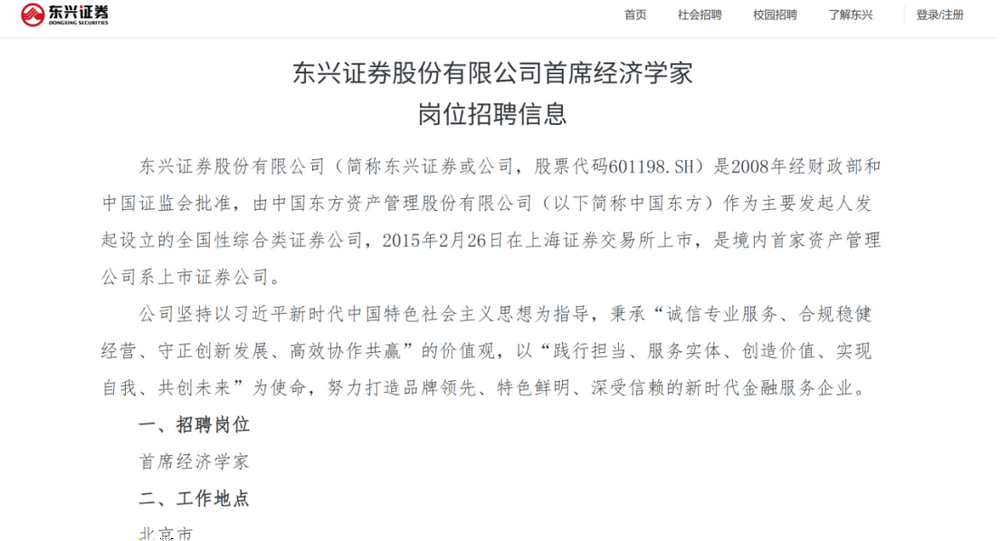
智通财经9月11日讯(记者 陈俊兰)卖方研究走在退坡路上的东兴证券,显然在寻找突围之路。 近日,东兴证券启动首席经济学家招聘计划,任职资格方面,要求应聘者拥有5年以上知名券商研究所或公募基金公司等机构工作经验,担任 研究团队的主要负责人或核心骨干。 不仅首经这一岗位,记者了解到,东兴证券研究所的重要管理岗位也在对外招揽人才。东兴证券对于研究所的内部调整早有端倪。今年4月29 日,东兴证券就已发布《关于研究所、销售交易部等部门组织架构调整的议案》。 记者注意到,伴随着卖方研究的转型,陆续有券商研究所大举招聘,并将首席经济学家作为重点招聘对象。回溯至2020年,西南证券便曾公开 招聘首席经济学家及研究所副所长;而自去年以来,国海证券、财达证券等亦相继发布过同类岗位的招聘信息。 任职资格方面,要求应聘者拥有5年以上知名券商研究所或公募基金公司等机构工作经验,担任研究团队的主要负责人或核心骨干,具备国家 宏观政策研究机构工作经验,或中国首席经济学家论坛等组织工作经验。同时,还要求在行业内具备较高知名度,获得过新财富、水晶球等主 流奖项。 本次招聘还特别明确了年龄要求,要求年龄在45周岁及以下。事实上,年轻化已然是证券 ...

国信证券:伴随模型能力提升 AI基础设施需求快速增长
Xin Lang Cai Jing· 2025-09-11 09:08
Core Viewpoint - The report from Guosen Securities indicates that the AI infrastructure sector is undergoing a reconstruction, with clients re-evaluating their choices of cloud/AI platforms as cloud providers intensify their investments in AI/Agent platforms to capture new markets [1] Group 1: Cloud Providers - Microsoft focuses on B-end infrastructure, being the most comprehensive platform in terms of model support, with strong integration of tools and ecosystem, leading to significant growth in cloud revenue [1] - Google leverages AI Studio to cater to both B and C-end scenarios, showcasing strong multi-modal capabilities, but has a less mature ecosystem and lower market share [1] - Amazon, through AWS, primarily serves small and medium enterprises, emphasizing computing power sales and ease of deployment, although its toolchain is somewhat fragmented [1] Group 2: Domestic Players - ByteDance covers all scenarios with a leading number of developers and intelligent agents [1] - Alibaba focuses on B-end services across various industries, serving over 300,000 enterprise clients, with a rich MCP toolchain and open-source ecosystem [1] - Tencent is also mentioned as a key player in the AI cloud platform space [1] Group 3: Recommendations - The report recommends AI cloud platform vendors including Microsoft, Google, Amazon, Alibaba, and Tencent, along with AI chip manufacturers like Nvidia and AI data infrastructure service providers [1]




月月分红CP再官宣本月分红!用红利来应对牛市分歧
Mei Ri Jing Ji Xin Wen· 2025-09-11 03:30
Core Insights - The cash flow ETF (159399) and the dividend state-owned enterprise ETF (510720) both announced dividends this month, with distribution ratios of 0.25% and 0.3% respectively [1] - The cash flow ETF has distributed dividends 7 times since its inception, while the dividend state-owned enterprise ETF has done so 17 times [1] Group 1: Market Context - Since July, market indices have risen sharply, leading to a bullish sentiment among investors [2] - A study by scholars from Tsinghua University and the London School of Economics revealed that in the 2015 bull market, 85% of retail investors with assets below 500,000 lost a total of 250 billion yuan, with those under 100,000 experiencing a 97% loss rate [3] Group 2: Investment Strategy - Asset allocation remains crucial in a volatile market, with research indicating that funds with higher real returns tend to have lower annual volatility and higher average dividend yields [4] - Despite the bullish market, the investment value of dividend assets should not be overlooked, as they provide a stable return and can serve as a risk hedge [5] Group 3: ETF Performance - The cash flow ETF (159399) tracks the FTSE China A-Share Free Cash Flow Focus Index, selecting the top 50 stocks by cash flow rate, with a market capitalization weight of approximately 70% in stocks over 100 billion yuan [6] - The FTSE cash flow index has shown strong long-term performance, with an annualized return of nearly 20% and a cumulative increase of 660.56% since its base date, significantly outperforming the CSI 300 and the CSI Dividend Index [9] Group 4: Dividend Yield Comparison - The dividend state-owned enterprise ETF (510720) tracks the Shanghai Stock Exchange State-Owned Enterprise Dividend Index, focusing on high-dividend central state-owned enterprises, with a dividend yield of nearly 5% as of August 2025 [11] - A comparison of various indices shows that the Shanghai State-Owned Enterprise Dividend Index has a 12-month dividend yield of 4.39%, outperforming several other indices [13] Group 5: Future Outlook - Investors are encouraged to consider a "barbell" strategy, balancing high-growth technology investments with stable dividend assets to manage risk and seize opportunities [14]

中国资产火热,全球对冲基金持仓创新高!顶流券商ETF(512000)涨逾1%,近20日大举吸金超63亿元
Xin Lang Ji Jin· 2025-09-11 03:07
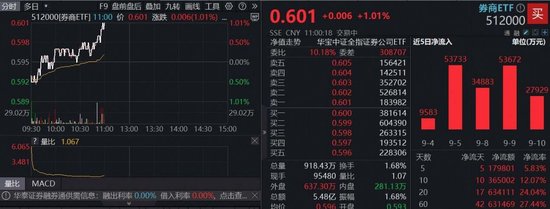
Group 1 - A-shares experienced a collective rise on September 11, with the brokerage sector stabilizing alongside the market, as most individual stocks turned positive, including Guohai Securities rising over 5% [1] - The top brokerage ETF (512000) opened lower but rebounded, showing a 1% increase with a trading volume exceeding 400 million yuan within half a day, indicating active trading [1] - The Chinese capital market remains robust, with nearly 45 billion USD invested in emerging market stocks and bonds in August, a significant portion of which flowed into the Chinese market, reflecting a shift in investor sentiment [3] Group 2 - Goldman Sachs reported that global hedge funds' net purchases of Chinese stocks reached a new high since September of the previous year, with a 76 basis point increase in their positions, indicating strong interest in the Chinese market [3] - The brokerage sector's performance is closely tied to capital market conditions, and with global liquidity narratives aligning, the A-share market is expected to continue its "slow bull" trend, suggesting a sustained recovery in brokerage sector profitability [3] - The brokerage ETF (512000) has reached a new scale of over 32.4 billion yuan, marking a historical high, with an average daily trading volume of 957 million yuan this year, positioning it as a leading ETF in terms of scale and liquidity in A-shares [5] Group 3 - The brokerage ETF (512000) tracks the CSI All Share Securities Company Index, encompassing 49 listed brokerage stocks, with nearly 60% of its holdings concentrated in the top ten leading brokerages, while also including mid and small brokerages for high elasticity in performance [7] - As of September 5, the price-to-book ratio (PB) of the CSI All Share Securities Company Index was only 1.56 times, indicating that the brokerage sector remains at historically low valuation levels, suggesting potential for future market movements [5]
14家理财公司8月规模增超2800亿 现金类占比创年内新低
Zhong Guo Jin Rong Xin Xi Wang· 2025-09-11 02:02
Core Insights - The banking wealth management sector continues to experience net inflows, with 12 out of the top 14 wealth management companies reporting a net increase in managed assets in August, totaling approximately 2.857 trillion yuan, bringing the total scale to 25.02 trillion yuan [1] - The growth in managed assets in August is significantly lower compared to July's increase of approximately 1.8 trillion yuan, indicating a narrowing trend [1] - The overall scale of the banking wealth management industry is estimated to have surpassed 33 trillion yuan, driven by the performance of retail "fixed income +" products and corporate wealth management demand [1] Wealth Management Company Performance - Among the 14 wealth management companies, cash management products have a total balance of approximately 5.95 trillion yuan, which has decreased by over 296.5 billion yuan since the beginning of the year [2] - The proportion of cash management products within the total managed scale has dropped to approximately 23.78%, down from 27% at the end of January, marking a new low for the year [2] Market Trends - The banking sector has increased the development of R3 risk-level products, particularly in the "fixed income +" direction, which has shown higher performance compared to pure bond products [1] - The decline in interest rates and market uncertainties have led enterprises to seek better returns on idle funds through wealth management, particularly favoring RMB products over USD deposits due to the appreciation of the RMB [1]