平安银行

Search documents
国海证券晨会纪要-20250901
Guohai Securities· 2025-09-01 01:33
Group 1 - The report highlights the growth trend in the treatment of hemorrhoids products and the potential for expanding into wet wipes business, with a focus on the company's strong performance in the first half of 2025 [5][6][7] - The company achieved a revenue of 1.949 billion yuan in H1 2025, a year-on-year increase of 1.11%, and a net profit of 343 million yuan, up 10.04% year-on-year [6][7] - The company is extending its product line into the field of anal health, with rapid growth in wet wipes, leveraging its established brand recognition and user base [7] Group 2 - The report discusses the strategic focus on financial technology and the acceleration of AI model applications by the company, which reported a revenue of 1.208 billion yuan in H1 2025, a decrease of 48.55% year-on-year [8][9] - The company is narrowing its business focus to financial technology, reducing non-financial IT business, while maintaining investment in core technology and product areas [9][10] - The new generation of core products is being developed to enhance self-operated technology services, with significant investments in AI [11][12] Group 3 - The report indicates that the secondary market is under pressure, with new infrastructure turnover rates leading the market, as evidenced by the issuance of 14 public REITs in 2025, a decrease from the previous year [13][14] - The REITs index has faced declines, with the market's total value dropping to 215.894 billion yuan, while the trading activity has increased slightly [14][15] - New infrastructure sectors are showing higher turnover rates, particularly in park infrastructure, which is leading in transaction volume [15] Group 4 - The report notes that competition in the food delivery sector is intensifying, leading to significant pressure on profits, with the company reporting a revenue of 91.8 billion yuan in Q2 2025, a year-on-year increase of 12% [18][19] - The core local business revenue grew by 8% to 65.3 billion yuan, but operating profits fell sharply due to increased delivery subsidies and marketing expenses [19][20] - The company is optimistic about its long-term growth potential in instant delivery and overseas expansion despite short-term profit pressures [21][22] Group 5 - The report highlights the company's investments in digital and cultural sectors, with a stable revenue of 1.179 billion yuan in H1 2025, and a focus on expanding its digital technology and cultural offerings [23][24] - The online gaming segment showed a revenue increase of 9% to 706 million yuan, while the digital marketing services revenue grew by 14% [24][25] - The company is actively investing in various innovative business areas, including digital sports and arts, to enhance its market presence [25][26] Group 6 - The report indicates that the company achieved a revenue of 13.38 billion yuan in H1 2025, a year-on-year increase of 27.9%, with a significant rise in overseas sales [31][32] - The company is focusing on expanding its IP matrix and targeting a broader age demographic, with a notable increase in sales from online channels [33][34] - The company is adjusting its revenue forecasts for 2025-2027, expecting revenues of 34.18 billion yuan, 47.16 billion yuan, and 57.25 billion yuan respectively [36]


13家银行个人存款同比增11.9万亿
第一财经· 2025-09-01 00:46
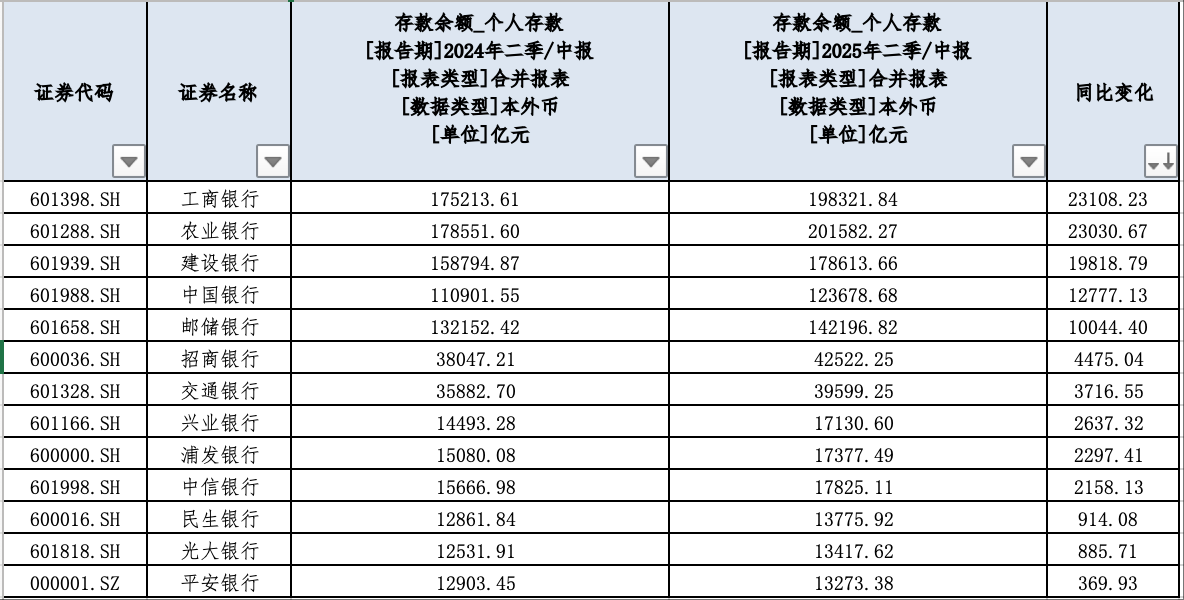
2025.09. 01 第一财经还注意到,上半年存款定期化趋势依然存在。但业内认为,随着存款利率持续走低,加上定 存集中到期重定价,银行负债端成本有望较大幅度改善。Choice数据显示,今年上半年,上述13家 银行的存款平均成本率为1.61%,较2024年上半年下降34BP(基点)。 尽管如此,多数银行净息差仍存在压力。根据国家金融监督管理总局数据,2025年第二季度商业银 行净息差环比继续收窄,已降至1.42%。近期中期业绩发布会上,多家大行提及,主要是受LPR(贷 款市场报价利率)下调、存量房贷利率调整等因素影响。 银行存款是否"分流"? 中国银河证券研究院在研报中表示,存款搬家是居民将银行存款转移到其他资产的过程,因此一要看 到存款下降,二要看到存款流向其他资产。 今年上半年,国内大行的存款是否出现下降?在财报中,并未有明显信号。 本文字数:3300,阅读时长大约5.5分钟 作者 | 第一财经 王方然 近期存款"搬家"声浪渐起,多份券商研报称,居民存款正持续向基金、理财等资管产品转移。 从最新财报来看,今年上半年,大行负债端仍"按兵不动",13家主要商业银行个人存款余额合计为 112.07万亿元,同比增 ...








上海多家银行房贷利率细则落地 新增房贷利率不再区分首套、二套
Mei Ri Jing Ji Xin Wen· 2025-09-01 00:25
Core Viewpoint - The introduction of the "825 New Policy" in Shanghai has led to multiple banks adjusting their commercial personal housing loan interest rate pricing mechanisms, eliminating the distinction between first and second homes, allowing banks to set rates based on market conditions and individual risk profiles [1][2]. Group 1: Policy Changes - Several banks in Shanghai have announced adjustments to their commercial personal housing loan interest rate pricing mechanisms, following the issuance of a notification by six departments in Shanghai [1]. - The new pricing mechanism allows banks to determine specific interest rates based on the Shanghai market interest rate pricing self-discipline mechanism, as well as their operational conditions and customer risk profiles [2]. Group 2: Implementation Details - Different banks have varying procedures for borrowers to apply for interest rate adjustments, including in-person applications, phone notifications, and mobile banking options [3]. - The effective dates for these adjustments vary, with some banks implementing changes as early as September 1, while others may start on September 5 [3]. Group 3: Interest Rate Adjustments - For existing second-home loans, if the current interest rate exceeds the average new loan interest rate by 30 basis points, borrowers can apply for a rate adjustment [2]. - The minimum interest rate for first-time home loans is currently 3.05%, while some banks are offering a minimum of 3.09% for new second-home loans [3]. Group 4: Recommendations - It is suggested that relevant departments enhance their communication regarding the new policies to clarify the specifics of loan interest rates and ensure effective implementation to stimulate housing demand [4].
个人消费贷款贴息今日开闸! 多家银行提前预热,五大热点全解析
Sou Hu Cai Jing· 2025-08-31 16:14
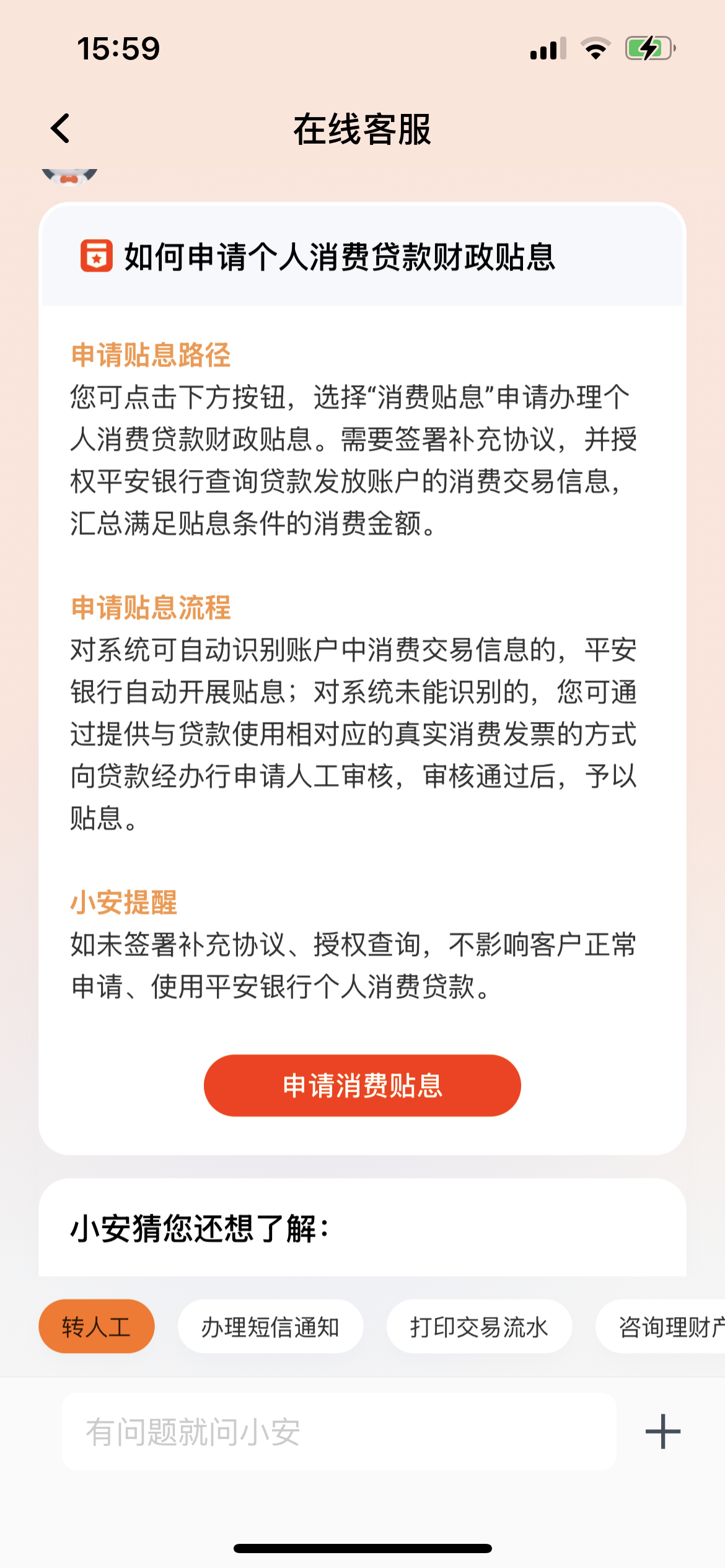
Core Viewpoint - The implementation of the personal consumption loan interest subsidy policy in China is set to officially begin on September 1, 2025, allowing residents to benefit from interest subsidies on eligible loans used for consumption purposes [1][2]. Summary by Sections Policy Details - The subsidy will apply to personal consumption loans issued by various financial institutions, excluding credit card transactions, for a period from September 1, 2025, to August 31, 2026 [1]. - The subsidy covers loans for consumption amounts below and above 50,000 yuan, with a maximum subsidy of 1% per year on the principal amount used for consumption, capped at 50% of the loan contract interest rate [2]. - Each borrower can receive a total subsidy of up to 3,000 yuan, corresponding to a total eligible consumption amount of 300,000 yuan [2]. Bank Promotions - Multiple banks, including China Bank, Construction Bank, and others, have begun promotional activities for their consumption loan products, utilizing social media and mobile banking platforms to inform customers about the upcoming subsidy [3][4]. - Specific products highlighted include China Bank's "Zhongyin E-loan" and "Sui Xin Zhi Dai," as well as Construction Bank's "Kuaidai" and "Jianyi Loan," which will be eligible for the subsidy [3]. Application Process - The application process for the interest subsidy is designed to be straightforward, with many banks automating the identification of eligible transactions through their systems [7]. - Customers are required to sign a supplementary agreement and authorize banks to access their transaction information to facilitate the subsidy process [7]. Customer Eligibility - The subsidy is available to both new and existing customers, with loans approved before September 1, 2025, eligible for the subsidy if they meet the criteria during the policy period [8]. - The subsidy will be applied directly to the interest owed, reducing the amount payable by the borrower [9]. Channels for Application - Banks have clarified that they will not use third-party platforms for processing the subsidy applications, encouraging customers to apply through official channels such as bank branches and mobile banking apps [10][11]. - No fees will be charged for processing the personal consumption loan subsidy applications [12].
个人消费贷款贴息今日开闸!多家银行提前预热,五大热点全解析
Mei Ri Jing Ji Xin Wen· 2025-08-31 14:52
Core Viewpoint - The implementation of the personal consumption loan interest subsidy policy will officially start on September 1, 2025, allowing residents to benefit from interest subsidies on eligible personal consumption loans issued by various banks [1][2]. Summary by Sections Policy Details - The subsidy will apply to personal consumption loans used for specific categories such as household vehicles, education, healthcare, and more, with a maximum subsidy of 1% per year, capped at 50% of the loan contract interest rate [2]. - Each borrower can receive a total subsidy of up to 3,000 yuan, corresponding to a cumulative consumption amount of 300,000 yuan, with a specific cap of 1,000 yuan for loans under 50,000 yuan [2]. Bank Promotions - Multiple banks, including Bank of China, China Construction Bank, and others, have begun promotional activities for their consumption loan products, utilizing social media and mobile banking platforms to inform customers about the upcoming subsidy [3][4]. - Banks are actively advertising specific loan products that qualify for the subsidy, such as "E-loan" and "Quick Loan" from Bank of China, and "i Car Loan" from Shanghai Pudong Development Bank [3]. Application Process - The application process for the subsidy will be similar to that of regular loans, with banks implementing systems to automatically identify eligible transactions for subsidy calculations [8]. - Customers will need to sign a supplementary agreement to authorize banks to access their transaction information for subsidy eligibility [8]. Customer Queries - Banks have addressed common customer questions regarding the subsidy, clarifying that both new and existing customers can benefit from the policy if their loans meet the criteria [9]. - The subsidy will be applied directly to the interest owed, simplifying the process for customers [10]. Channels for Application - Banks have emphasized that customers should apply for the subsidy through official channels, such as bank branches and mobile banking apps, and will not use third-party platforms for processing [11]. - No fees will be charged for processing the personal consumption loan subsidy [13].


超17家银行将派发2375亿“红包”,国有大行成绝对主力
Bei Jing Shang Bao· 2025-08-31 14:05
Core Viewpoint - The mid-term profit distribution plans of listed banks in A-shares for 2025 show a significant increase in total dividends, reaching 237.54 billion yuan, with state-owned banks being the primary contributors [2][3][4]. Group 1: Dividend Distribution Overview - Among 42 listed banks, 17 have announced their mid-term dividend plans for 2025, with a total dividend amount of 237.54 billion yuan [2][3]. - The six major state-owned banks contributed 204.66 billion yuan, accounting for 86% of the total dividends announced by the 17 banks [3][4]. - Industrial and Commercial Bank of China leads with a dividend of 50.40 billion yuan, followed by China Construction Bank and Agricultural Bank of China with 48.61 billion yuan and 41.82 billion yuan respectively [3][4]. Group 2: Factors Influencing Dividend Decisions - The ability of state-owned banks to distribute dividends is supported by their strong capital strength, stable profitability, and ample cash flow, allowing them to maintain high dividend payouts [4][9]. - The decision to distribute dividends is influenced by a balance of capital adequacy, business expansion needs, regulatory requirements, and shareholder return expectations [4][9][10]. - Some banks, such as Zhengzhou Bank and Qingdao Rural Commercial Bank, have explicitly stated they will not distribute dividends for the first half of 2025, citing performance pressures and capital replenishment needs [8][9]. Group 3: Trends in Dividend Distribution - The trend of increasing mid-term and quarterly dividends among listed banks has been noted since the introduction of the new "National Nine Articles" policy, which encourages multiple dividend distributions within a year [2][4]. - Several joint-stock banks, including CITIC Bank and Minsheng Bank, have announced their mid-term dividend plans, with CITIC Bank aiming for a dividend payout ratio of 30.7% [4][6]. - The distribution landscape shows a clear differentiation, with some banks actively pursuing dividends while others pause due to various operational challenges [8][9].


金融中报观|超17家银行将派发2375亿“红包”,国有大行成绝对主力
Bei Jing Shang Bao· 2025-08-31 13:55
Core Viewpoint - The mid-term profit distribution plans of listed banks in A-shares for 2025 are gradually being revealed, with a total mid-term dividend amount reaching 237.54 billion yuan, indicating a clear differentiation in the dividend distribution landscape among banks [1][3][4]. Group 1: Dividend Distribution Overview - Among 42 listed banks, 17 have announced their mid-term dividend plans for 2025, with state-owned banks leading the distribution [3][4]. - The six major state-owned banks have a combined dividend amount of 204.66 billion yuan, accounting for 86% of the total mid-term dividends announced by the 17 banks [3][4]. - Industrial and Commercial Bank of China leads with a dividend of 50.40 billion yuan, followed by China Construction Bank and Agricultural Bank of China with 48.61 billion yuan and 41.82 billion yuan respectively [3][4]. Group 2: Factors Influencing Dividend Decisions - The ability of state-owned banks to distribute dividends is supported by their strong capital strength, stable profitability, and ample cash flow, allowing them to actively pursue dividend plans [4][9]. - The dividend decisions of banks are influenced by a combination of capital adequacy ratios, business expansion needs, regulatory requirements, and shareholder return expectations [1][8]. - Some banks, such as China Merchants Bank and Nanjing Bank, are in the process of finalizing their mid-term dividend plans, while others like Shanghai Pudong Development Bank and Zhengzhou Bank have explicitly stated they will not distribute dividends for the first half of 2025 [6][7]. Group 3: Emerging Trends and Future Outlook - The new "National Nine Articles" policy encourages listed companies to increase dividend distributions, leading to a noticeable rise in mid-term and quarterly dividends among listed banks [3][4]. - Smaller banks are showing a clear divide in their dividend policies, with some opting not to distribute dividends due to performance pressures and urgent capital replenishment needs [7][8]. - The balance between short-term investor returns and long-term operational stability is crucial for banks when deciding on dividend distributions, with a focus on maintaining adequate capital for future growth [9].

13家银行个人存款同比仍增11.9万亿,定期化趋势未显著缓解
Di Yi Cai Jing· 2025-08-31 12:40
Core Viewpoint - The continuous decline in deposit rates, coupled with the concentration of fixed deposits maturing, is expected to significantly improve the cost of liabilities for banks [1][8]. Group 1: Deposit Trends - Recent reports indicate a trend of residents moving deposits from banks to other financial products such as funds and wealth management products [2][3]. - As of mid-2025, the total personal deposit balance of 13 major commercial banks reached 112.07 trillion yuan, an increase of 11.9 trillion yuan year-on-year [4][5]. - The average cost of deposits for these banks in the first half of 2025 was 1.61%, a decrease of 34 basis points compared to the same period in 2024 [12]. Group 2: Wealth Management Business Growth - The shift of deposits to wealth management products has led to significant growth in banks' wealth management income, with Agricultural Bank's wealth management income increasing by 62.3% [6]. - The total scale of bank wealth management products reached 30.67 trillion yuan by the end of June, with an estimated increase of about 2 trillion yuan by the end of July [6]. Group 3: Interest Margin and Cost of Liabilities - Despite the reduction in deposit costs, banks are still facing pressure on net interest margins, which have decreased to 1.42% as of the second quarter of 2025 [15][16]. - The average net interest margin for the 13 banks was 1.5%, down from 1.62% year-on-year [15]. - The decline in net interest margins is attributed to factors such as the reduction in the Loan Prime Rate (LPR) and adjustments in existing mortgage rates [17][18]. Group 4: Future Outlook - Analysts predict that the concentration of maturing fixed deposits will lead to a significant reduction in the cost of liabilities for banks in the coming years, with expected decreases of 17 to 24 basis points across different types of banks [11]. - The trend of increasing fixed deposits is expected to continue, with the proportion of fixed deposits among total deposits rising to approximately 59.7% in the first half of 2025 [9][10].


明起开闸!你的个人消费贷款能否贴息、怎么向银行申请,指南来了
Bei Ke Cai Jing· 2025-08-31 12:23
Core Viewpoint - The implementation of the personal consumption loan interest subsidy policy will officially begin on September 1, 2025, with multiple banks prepared to launch related services and products to support consumer spending [1][3][4]. Group 1: Policy Implementation - The Ministry of Finance, the People's Bank of China, and the financial regulatory authority have issued the "Implementation Plan for Personal Consumption Loan Interest Subsidy Policy," which will be effective from September 1, 2025, to August 31, 2026 [3]. - Banks have stated that they have developed detailed operational processes and are ready to implement the policy efficiently [4][5][6]. Group 2: Application Process - Banks have simplified the application process for consumers to apply for the interest subsidy, allowing applications through mobile banking and other channels [13][14]. - Customers can sign the subsidy agreement during the loan process, and the system will automatically apply the subsidy on the interest due [16][18]. Group 3: Eligible Loan Products - The subsidy applies to various personal consumption loans, including personal credit loans, asset pledge loans, and specific consumer loans, but excludes credit card loans and personal housing loans [18][20][21][23]. - The subsidy covers single transactions below 50,000 yuan and specific categories of consumption for transactions above this amount, with a cap on the subsidy amount [19][30]. Group 4: Special Cases and Limits - Existing personal consumption loans can also qualify for the subsidy if they meet the policy criteria during the implementation period [25][26]. - The maximum subsidy amount per borrower at a single bank is capped at 3,000 yuan, corresponding to eligible consumption amounts of up to 300,000 yuan [29][30].
42家A股上市银行半年报:营收均实现同比正增长,六大行将分红超2000亿
Sou Hu Cai Jing· 2025-08-31 09:23
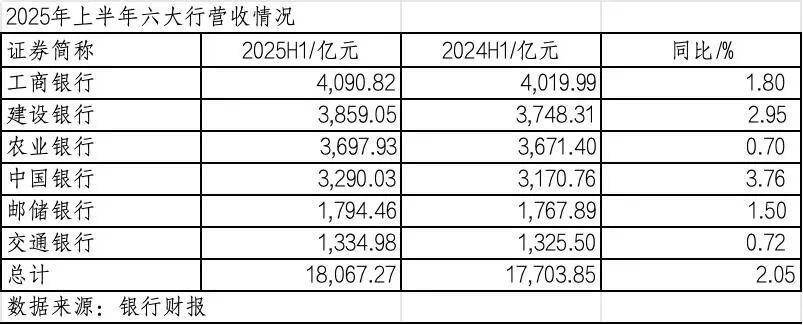
Core Viewpoint - The 42 A-share listed banks reported a total operating income exceeding 2.9 trillion yuan for the first half of 2025, with a year-on-year growth of over 1%, and a net profit attributable to shareholders of 1.1 trillion yuan, reflecting a growth of 0.8% [1][3]. Group 1: Financial Performance - The six major state-owned banks collectively achieved an operating income of 1.8 trillion yuan in the first half of 2025, with all banks reporting positive year-on-year growth [3][4]. - The net profit attributable to shareholders for the six major banks totaled 6825.24 billion yuan, showing a slight decline of 0.13% compared to the previous year [4][6]. - Agricultural Bank, Postal Savings Bank, and Transportation Bank reported both revenue and net profit growth [3]. Group 2: Revenue and Profit Breakdown - China Bank led in revenue growth with 3.29 trillion yuan, marking a year-on-year increase of 3.76%, driven by a significant rise of 26.43% in non-interest income [5]. - Industrial and Commercial Bank reported an operating income of 4.09 trillion yuan, a growth of 1.8%, marking its best performance in three years [6]. - The asset scale of the six major banks reached approximately 214 trillion yuan, a growth of about 7% from the previous year [6]. Group 3: Dividend Distribution - The six major state-owned banks announced a total cash dividend of 2046.57 billion yuan for the first half of 2025, with Industrial and Commercial Bank proposing the largest dividend of approximately 503.96 billion yuan [7]. Group 4: Employee Compensation - The average salary for bank employees in the first half of 2025 was 18.1 million yuan, with a monthly average of 3.02 million yuan, reflecting an increase of about 1300 yuan from the previous year [9]. - Among the major banks, China Bank had an average monthly salary of 2.82 million yuan, while Industrial and Commercial Bank and Construction Bank reported 2.63 million yuan and 2.62 million yuan, respectively [11][12]. - The Agricultural Bank emphasized enhancing talent development in county-level branches and adjusting salary resources to support grassroots employees [13].