石药集团

Search documents
推动产业交流和资本对接 深交所举办生物医药主题创享荟活动
Zhong Guo Zheng Quan Bao· 2025-08-07 21:57
Core Insights - The innovative drug industry is experiencing robust growth, with the innovative drug index rising by 50.2% year-to-date as of August 7 [1] - The China National Medical Products Administration approved 43 innovative drugs in the first half of the year, a 59% increase year-on-year, nearing the total of 48 for the entire year of 2024 [2] - The industry is seeing a shift towards deeper strategic collaborations in overseas licensing, moving from simple product exports to comprehensive partnerships [4] Industry Growth and Trends - The innovative drug sector is benefiting from ongoing drug review reforms and policy incentives, leading to a revitalization of the capital market [2] - Companies like Tigermed are establishing integrated platforms to support clinical research across all stages globally [2] - The R&D expenditure of Shijiazhuang Pharmaceutical Group has increased from 1.583 billion HKD in 2018 to approximately 5.19 billion HKD in 2024, reflecting a consistent double-digit growth [2] International Expansion - In the first half of the year, upfront payments for overseas licensing of innovative drugs exceeded 2.5 billion USD, with total transaction amounts nearing 50 billion USD, comparable to the previous year's figures [4] - Shijiazhuang Pharmaceutical Group has completed four overseas licensing agreements this year, with a total contract value of approximately 9.7 billion USD [4] - The potential for sustainable business development (BD) partnerships depends on the core capabilities of Chinese innovative drug companies [4] AI in Drug Development - AI technology is significantly transforming drug development by shortening research cycles and reducing costs, with applications expanding rapidly [7] - The integration of AI with automation in production processes is expected to enhance quality and reduce costs, promoting sustainable practices [7] - Companies like De Rui Zhi Yao are leveraging AI to drive new drug development, with several innovative drugs already in clinical stages [7][8]


深交所举办生物医药主题创享荟活动
Zhong Guo Zheng Quan Bao· 2025-08-07 21:11
Industry Overview - The innovative drug industry has shown robust growth this year, with the innovative drug index rising by 50.2% as of August 7 [1] - The National Medical Products Administration reported that 43 innovative drugs were approved in the first half of the year, a 59% increase year-on-year, nearing the total of 48 expected for the entire year of 2024 [1] Company Insights - Tigermed, a leading clinical research organization (CRO) in China, has established an integrated platform covering all stages from preclinical to clinical processes, ensuring global project synchronization [2] - The R&D expenditure of CSPC Pharmaceutical Group has increased from 1.583 billion HKD in 2018 to approximately 5.19 billion HKD in 2024, reflecting a consistent double-digit growth [2] Market Dynamics - The innovative drug sector is experiencing a resurgence driven by policy support and companies strengthening their competitive edge [2] - In the first half of this year, the upfront payments for innovative drug licensing exceeded 2.5 billion USD, with total transaction amounts nearing 50 billion USD, comparable to the total for the previous year [3] International Collaboration - Chinese innovative drug companies are increasingly engaging in overseas licensing transactions, with CSPC announcing four licensing agreements this year, totaling approximately 9.7 billion USD [3] - The shift from single product output to deeper strategic collaborations in international markets is a notable trend [3] AI in Drug Development - AI technology is rapidly transforming drug development, significantly shortening research cycles and reducing costs [4] - The integration of AI with automation in production processes is expected to enhance production quality and lower costs, promoting sustainable practices [5] - Companies like De Rui Zhi Yao are leveraging AI to drive new drug development, with several innovative drugs already in clinical stages [5]
出海捷报频传 创新药厚积薄发
Zhong Guo Zheng Quan Bao· 2025-08-07 21:09
Core Insights - Recent announcements from domestic pharmaceutical companies highlight significant advancements in innovative drug approvals and international collaborations, indicating a growing competitiveness in the global market [1][2][3] Group 1: Innovative Drug Approvals - Heng Rui Medicine's injection of Rukang Qutuzumab combined with Adebali monoclonal antibody for gastric cancer has received orphan drug designation from the FDA, expediting clinical trials and market registration [2] - The drug is an antibody-drug conjugate targeting HER2, with eight indications included in the breakthrough therapy list by the National Medical Products Administration [2] - DiZhe Medicine's DZD8586 has also received FDA's fast track designation for treatment of relapsed refractory chronic lymphocytic leukemia/small lymphocytic lymphoma [2] Group 2: International Expansion - Heng Rui Medicine has entered into a licensing agreement with GlaxoSmithKline for global exclusive rights to the HRS-9821 project, with an upfront payment of $500 million and potential milestone payments totaling approximately $12 billion [3] - The company has commercialized products in over 40 countries and is conducting over 20 international clinical trials for innovative drugs [2][3] - As of May 2025, 21 domestic innovative drugs have been approved for overseas markets, reflecting a trend of increasing international recognition [4] Group 3: Market Dynamics - The shift from generic to innovative drug development among Chinese pharmaceutical companies has led to a transformation in their global competitiveness [6] - Multinational corporations are seeking new blockbuster products due to patent expirations, creating demand for innovative drugs from China [6] - The establishment of a positive feedback loop is evident as more clinical data from Chinese drugs is disclosed, enhancing recognition and collaboration with multinational companies [6]

港股通8月7日成交活跃股名单
Zheng Quan Shi Bao Wang· 2025-08-07 12:05
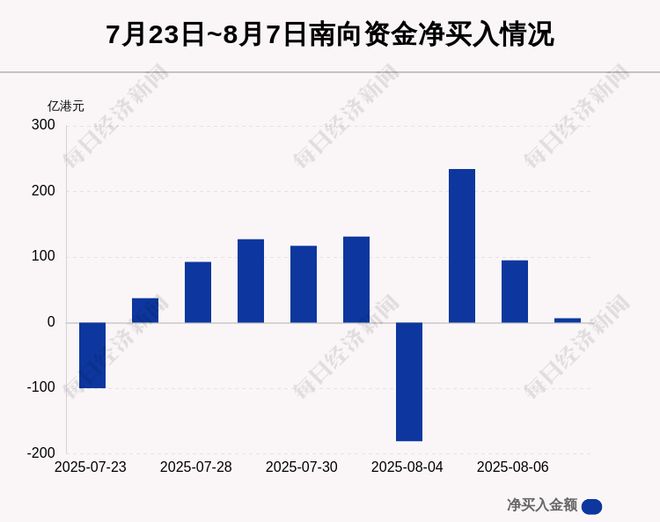
8月7日恒生指数上涨0.69%,南向资金全天合计成交金额为1407.38亿港元,其中,买入成交707.00亿港 元,卖出成交700.38亿港元,合计净买入金额6.61亿港元。具体来看,港股通(深)累计成交金额 526.81亿港元,买入成交283.53亿港元,卖出成交243.29亿港元,合计净买入金额40.24亿港元;港股通 (沪)累计成交金额880.57亿港元,买入成交423.47亿港元,卖出成交457.10亿港元,合计净卖出金额 33.63亿港元。 | 代码 | 简称 | 成交金额(万港元) | 成交净买入(万港元) | 今日涨跌幅(%) | | --- | --- | --- | --- | --- | | 01810 | 小米集团-W | 1047772.68 | 172172.52 | -3.98 | | 00981 | 中芯国际 | 426693.35 | 49971.98 | 0.76 | | 09988 | 阿里巴巴-W | 443298.37 | 49292.76 | 2.14 | | 00700 | 腾讯控股 | 377791.38 | 42667.88 | -0.26 | | 01347 ...


智通港股通活跃成交|8月7日



智通财经网· 2025-08-07 11:05
Group 1 - Xiaomi Group-W (01810) leads the southbound trading volume on both Shanghai-Hong Kong Stock Connect and Shenzhen-Hong Kong Stock Connect, with transaction amounts of 62.12 billion and 42.66 billion respectively [1][1][1] - The top three companies by trading volume on Shanghai-Hong Kong Stock Connect are Xiaomi Group-W (01810), Yingfu Fund (02800), and Alibaba-W (09988) [1][1] - On Shenzhen-Hong Kong Stock Connect, the top three companies are Xiaomi Group-W (01810), SMIC (00981), and Alibaba-W (09988) [1][1] Group 2 - The net buying amount for Xiaomi Group-W (01810) on Shanghai-Hong Kong Stock Connect is +17.67 billion, while on Shenzhen-Hong Kong Stock Connect it is -45.59 million [1][1] - Alibaba-W (09988) has a net buying amount of +3.25 billion on Shanghai-Hong Kong Stock Connect and +1.68 billion on Shenzhen-Hong Kong Stock Connect [1][1] - SMIC (00981) shows a significant net buying amount of +5.26 billion on Shenzhen-Hong Kong Stock Connect, while it has a net buying amount of -25.94 million on Shanghai-Hong Kong Stock Connect [1][1]
要积极勇敢地把钱投出去!睿郡王晓明最新详谈地产、科技与持仓:权益投资的机会成本依然很低……
聪明投资者· 2025-08-07 11:04
Core Views - The opportunity cost of equity investment remains low, with a downward trend in interest rates since September last year, enhancing the attractiveness of stock investments compared to other asset classes [2][78]. - The real estate risks that began to unfold in 2021 have not yet fully stabilized, indicating that the adjustment in the national real estate market is still ongoing [2][11]. - China has a comparable gap with the US in the AI technology revolution, with advantages in application, potentially outperforming any other country in practical implementation [2][51]. - Chinese companies must transition to a phase where they gain more added value through branding and enhance the technological content of their products [2][66]. - The view on technology stocks is still cautious, described as a "game for the brave," emphasizing the need for risk awareness and contingency plans [2][90]. Economic Growth Model - China's past economic growth model is becoming ineffective, necessitating reforms, particularly the transition from an investment-driven government to a service-oriented government [4][19]. - The challenges in this transition include high levels of local government debt and the inefficiency of past investments, which have led to diminishing returns [21][23]. - The future direction of economic growth will likely rely more on consumption to drive growth, with a significant focus on the service sector to address employment issues [26][29]. Real Estate Sector - Since 1998, approximately 500 billion square meters of commercial housing stock has been accumulated, with a significant portion of household wealth tied up in real estate [11]. - The average national price of real estate is around 10,000 yuan per square meter, indicating that the wealth of households in real estate amounts to approximately 500 trillion yuan [11]. - The real estate market is still facing downward pressure, with sales volumes declining from a peak of 1.56 billion square meters in 2021 to over 800 million square meters in 2024 [38][39]. - The rental yield is a crucial factor in stabilizing real estate prices, with a target yield of around 2% being necessary for long-term stability [42][43]. Technology Sector - The technology sector has shown significant growth since 2018, particularly in the context of US-China decoupling, necessitating self-reliance in technology development [12][15]. - The biopharmaceutical sector has been a standout performer, with Chinese companies increasingly contributing to global drug development [48][49]. - Despite challenges, China's manufacturing sector remains robust, with a strong supply chain and cost advantages that are difficult for other countries to replicate [17][71]. Manufacturing Sector - Manufacturing is considered the foundation of China's economic strength, with historical examples showing that countries that neglect manufacturing tend to decline [16]. - The focus for Chinese manufacturers should shift towards increasing product value through R&D and branding, moving away from a volume-driven model [66]. - The impact of tariffs on manufacturing is manageable for many companies, with strategies in place to mitigate costs and maintain competitiveness [70]. Investment Strategy - The current investment strategy emphasizes maintaining a high allocation in equities, particularly in dividend-paying stocks and technology, while being cautious about market conditions [76][89]. - The portfolio is diversified, with approximately 40% in dividend assets, 30% in technology stocks, and over 20% in manufacturing [92][98]. - The focus on Hong Kong stocks is driven by their relative affordability and the broader range of investment opportunities available compared to the domestic market [83][84].

最新出炉!8月7日港股通净流入6.61亿港元,其中17.217亿港元都买了它
Mei Ri Jing Ji Xin Wen· 2025-08-07 10:50
| 代码 | 简称 | 收盘价 (港元) | 涨跌幅 (%) | 净买入金额 (亿港元) | | | --- | --- | --- | --- | --- | --- | | 1810.HK | 小米集团-W | 51.85 | -3.98 | 17.22 | . | | 0981.HK | 中芯国际 | 53.0 | 0.76 | 5.00 | . | | 9988.HK | 阿里巴巴-W | 119.2 | 2.14 | 4.93 | . | | 0700.HK | 腾讯控股 | 567.0 | -0.26 | 4.27 | . | | 1347.HK | 华虹半导体 | 44.78 | 2.52 | 3.73 | | | 9926.HK | 康方生物 | 157.4 | -8.06 | 2.46 | . | | 1093.HK | 石药集团 | 9.68 | -3.78 | 1.84 | = | | 6181.HK | 老铺黄金 | 794.5 | 3.45 | 1.67 | . | | 1801.HK | 信达生物 | 91.4 | -6.78 | 1.22 | . | | 2228.HK | 晶泰 ...
资金动向 | 北水抢筹港股超6亿港元,连续11日加仓腾讯
Ge Long Hui· 2025-08-07 10:45
Group 1: Market Activity - Net purchases included Xiaomi Group-W at 1.722 billion, SMIC at 499 million, Alibaba-W at 492 million, Tencent Holdings at 426 million, and Huahong Semiconductor at 372 million [1] - Southbound funds have net bought Tencent for 11 consecutive days, totaling 6.3707 billion HKD; Alibaba for 4 consecutive days, totaling 2.60865 billion HKD; and SMIC for 4 consecutive days, totaling 1.45077 billion HKD [1] Group 2: Company Performance - Xiaomi Group-W is expected to report Q2 2025 earnings on August 19, with smartphone shipments projected to be slightly below previous forecasts, primarily due to a 25% year-on-year decline in the Indian market; global market share reached a historical high of 15% at the cost of declining gross margins [5] - SMIC reported Q2 revenue of 2.209 billion USD, a year-on-year increase of 16.2% but a quarter-on-quarter decrease of 1.7%; Q3 revenue is expected to grow by 5%-7% quarter-on-quarter, with gross margin projected between 18%-20% [6] - Alibaba-W's Tongyi Qianwen released new smaller models, indicating ongoing innovation in AI [6] - Morgan Stanley noted that Pop Mart's platform value may be underestimated, highlighting potential for cultural diversity in its IP and product offerings over the next 3-5 years [6]

这款进口药退出!PCSK9药物竞争加剧 降脂药下个风口剑指何方?|财经解药
Xin Lang Cai Jing· 2025-08-07 10:15
Core Insights - Sanofi has confirmed the cessation of the promotion of its PCSK9 inhibitor, Alirocumab, in the Chinese market due to global supply issues and a strategic upgrade in its cardiovascular product line [2][3] - The exit of Alirocumab from the market has opened opportunities for domestic pharmaceutical companies to enter the PCSK9 inhibitor space [1][3] Industry Overview - PCSK9 inhibitors are considered a milestone in lipid-lowering therapies, with significant implications for managing high LDL cholesterol levels, which are primarily influenced by genetic factors [1][3] - The understanding of lipoprotein(a) [Lp(a)] in cardiovascular diseases has led to increased interest in developing new lipid-lowering drugs targeting this specific marker [1][7] Market Dynamics - The market for lipid-lowering medications is competitive, with established statin drugs and newer PCSK9 inhibitors being used in combination for optimal patient outcomes [4][5] - There are currently seven approved PCSK9 inhibitors in China, including both imported and domestic products, with ongoing developments from various companies [5][6] Emerging Opportunities - Companies are actively pursuing the development of alternative medications in light of Alirocumab's market exit, indicating a robust interest in the PCSK9 inhibitor segment [3][6] - The market is also seeing advancements in therapies targeting Lp(a), with several multinational corporations engaged in clinical trials for new drugs aimed at lowering Lp(a) levels [7]


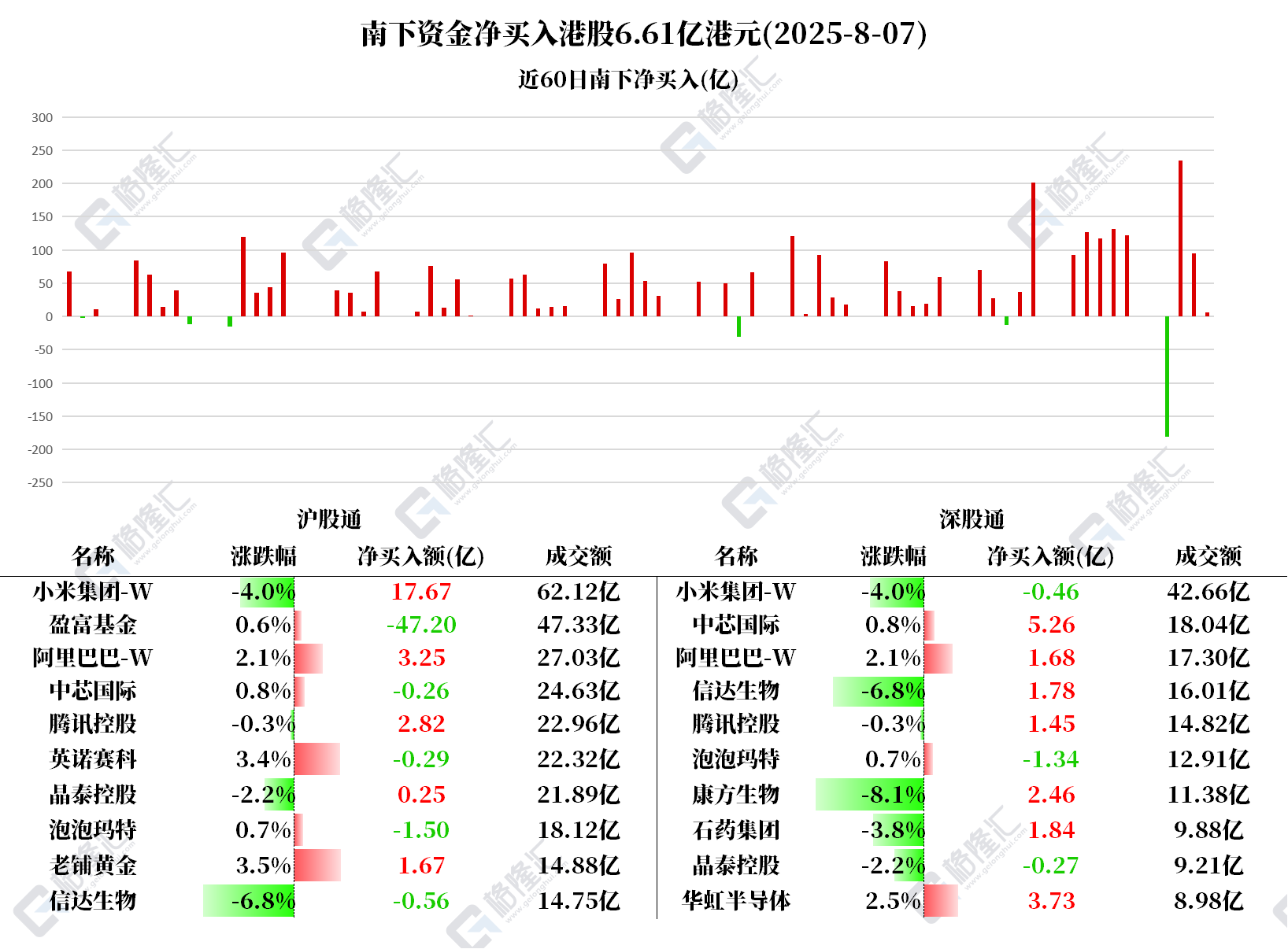
图解丨南下资金加仓小米、中芯国际和阿里
Ge Long Hui A P P· 2025-08-07 10:07
Group 1 - Southbound funds net bought Hong Kong stocks worth 661 million HKD today [1] - Notable net purchases include Xiaomi Group-W at 1.722 billion HKD, SMIC at 499 million HKD, Alibaba-W at 492 million HKD, and Tencent Holdings at 426 million HKD [1] - Southbound funds have net bought Tencent for 11 consecutive days, totaling 6.3707 billion HKD, and Alibaba for 4 consecutive days, totaling 2.60865 billion HKD [1] Group 2 - The net selling included the Tracker Fund of Hong Kong at 4.72 billion HKD and Pop Mart at 283 million HKD [1] - Xiaomi Group-W experienced a price drop of 4.0% with a net buy of 1.767 billion HKD [3] - The Tracker Fund of Hong Kong had a slight increase of 0.6% but saw a significant net sell of 4.72 billion HKD [3]