
中国人民银行

Search documents
明天起,现金买黄金超10万需上报!
Sou Hu Cai Jing· 2025-07-31 12:48
Group 1 - The People's Bank of China has issued a notice regarding the implementation of the "Management Measures for Anti-Money Laundering and Anti-Terrorist Financing for Precious Metals and Gemstone Practitioners," effective from August 1, 2025 [1][4] - Institutions engaging in cash transactions of 100,000 RMB or more (including 100,000 RMB) or equivalent foreign currency must fulfill anti-money laundering obligations as per the new measures [3][4] - Institutions are required to conduct customer due diligence based on the "Know Your Customer" principle for transactions meeting the specified threshold and report large transactions to the Anti-Money Laundering Monitoring and Analysis Center within five working days [3][4]

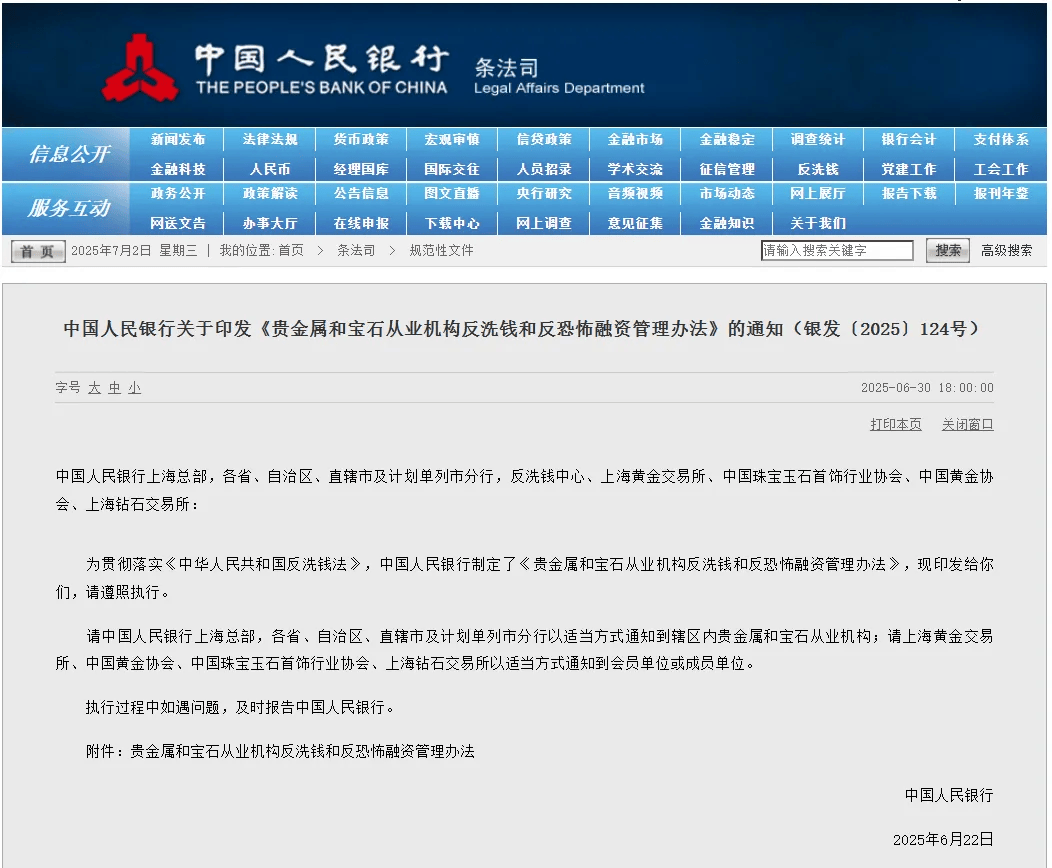
央行:明日起,现金买金超10万元需上报
Zheng Quan Shi Bao· 2025-07-31 09:05
Core Points - The People's Bank of China has issued a notice regarding the implementation of anti-money laundering and counter-terrorism financing management measures for precious metals and gemstone industry practitioners, effective from August 1, 2025 [1][3] Group 1: Regulatory Framework - The new regulations require institutions to fulfill anti-money laundering obligations for cash transactions of 100,000 RMB or more, or equivalent foreign currency [3] - Institutions must conduct customer due diligence based on the "Know Your Customer" principle for transactions meeting the specified threshold [3] - A large transaction report must be submitted to the Anti-Money Laundering Monitoring and Analysis Center within five working days of the transaction [3]
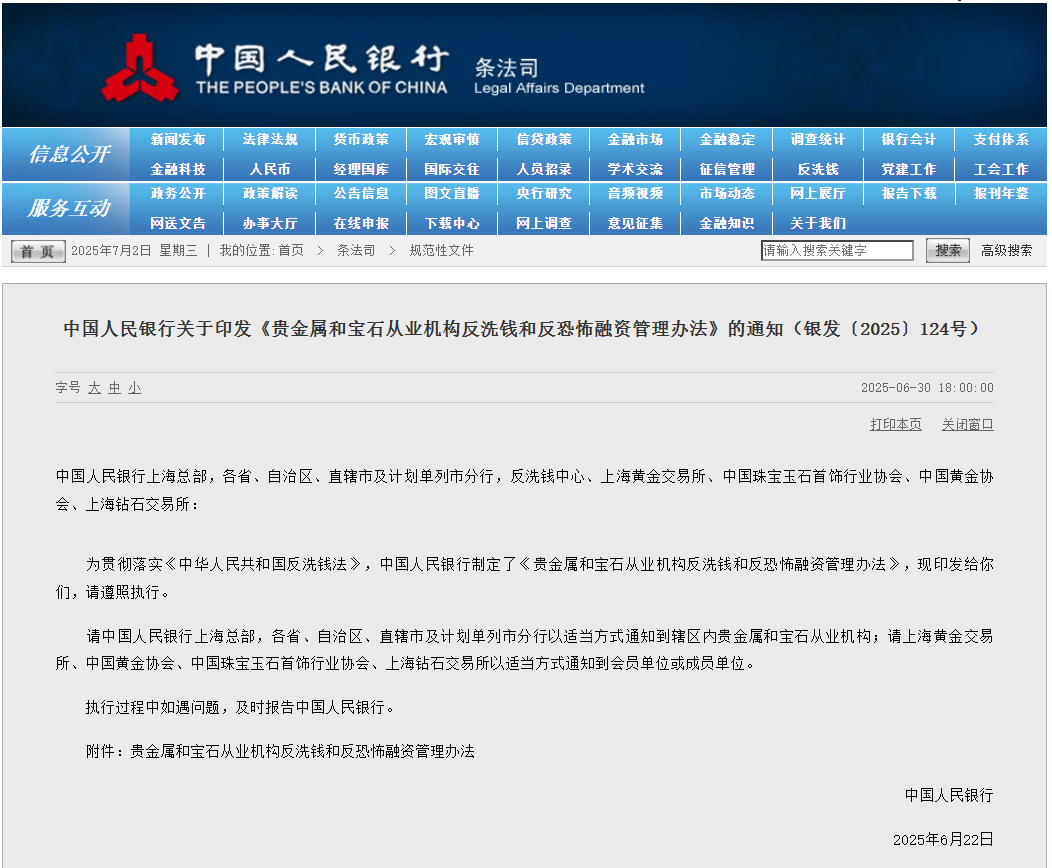
央行:明日起,现金买金超10万元需上报
证券时报· 2025-07-31 08:26
Core Viewpoint - The People's Bank of China has issued a notice regarding the implementation of the "Anti-Money Laundering and Counter-Terrorist Financing Management Measures for Precious Metals and Gemstone Practitioners" to enhance regulatory compliance in the industry [1][2]. Summary by Relevant Sections - **Regulatory Framework**: The new measures are designed to enforce compliance with the Anti-Money Laundering Law of the People's Republic of China, specifically targeting institutions involved in precious metals and gemstones [1][2]. - **Transaction Reporting Requirements**: Institutions must report cash transactions of 100,000 RMB or more (including 100,000 RMB) or equivalent foreign currency within five working days to the Anti-Money Laundering Monitoring and Analysis Center [3]. - **Implementation Date**: The measures will take effect on August 1, 2025, marking a significant regulatory change for the industry [3].

现金购金迎新规:8月1日起,单笔超10万元交易需上报
Huan Qiu Wang· 2025-07-31 06:50
【环球网财经综合报道】为强化贵金属领域的反洗钱与反恐怖融资监管,一项影响个人与机构购金行为 的新规将落地。中国人民银行近日发布《贵金属和宝石从业机构反洗钱和反恐怖融资管理办法》(银发 〔2025〕124号),明确要求自2025年8月1日起,个人使用现金购买贵金属的单笔或日累计交易金额达 到人民币10万元(含)以上的,相关机构必须履行客户尽职调查,并向中国反洗钱监测分析中心提交大 额交易报告。 根据《办法》规定,此次监管聚焦于贵金属和宝石行业的现金交易。具体来看,当客户在从业机构(如 金店、银行等)进行交易时,若使用人民币现金或等值外币进行支付,且单笔或当日累计金额超过10万 元门槛,则该机构必须启动严格的反洗钱程序。这意味着,当有大额现金购金行为发生时,商家或银行 等机构有责任核实客户身份、了解资金来源和交易目的,并评估其潜在的洗钱风险。 | | | | 中国人民纪行 THE PEOPLE'S BANK OF CHINA | | 条法司 Legal Affairs Department | | | | | | | --- | --- | --- | --- | --- | --- | --- | --- | ...
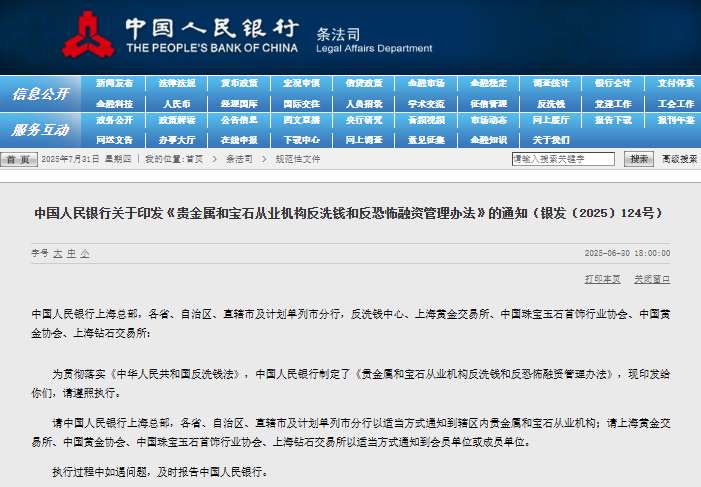
明起,现金买黄金超10万元需上报
Sou Hu Cai Jing· 2025-07-31 04:19
此前,中国人民银行发布"中国人民银行关于印发《贵金属和宝石从业机构反洗钱和反恐怖融资管理办法》的通知(银发〔2025〕124号)"。 | | | | 中国人民纪行 THE PEOPLE'S BANK OF CHINA | | 条法司 Legal Affairs Department | | | | | | | --- | --- | --- | --- | --- | --- | --- | --- | --- | --- | --- | | 信息公开 | 新闻发布 | 法律法拠 | 货币政策 | 宏观审慎 | 信贷政策 | 金融市场 | 毛肿瘤连 | 调查绞计 | 银行会计 | 支付体系 | | | 金融科技 | 人民币 | 经理国库 | 国际交往 | 人员招录 | 学术交流 | 征信管理 | 反洗钱 | 覚建工作 | 工会工作 | | 服务互动 | 政务公开 | 政策解读 | 公告信息 | 图文直播 | 央行研究 | 音頻视頻 | 市场动态 | 网上展厅 | 报告下载 | 报刊年签 | | | 网送文告 | 办事大厅 | 在线申报 | 下载中心 | 网上调查 | 意见征集 | 金融知识 | 关于我们 | ...
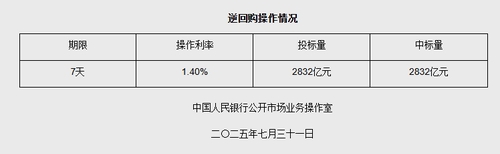
央行开展2832亿元逆回购操作
Bei Jing Shang Bao· 2025-07-31 02:19
Group 1 - The People's Bank of China conducted a reverse repurchase operation amounting to 283.2 billion yuan, with a bidding volume of 283.2 billion yuan and a winning amount of 283.2 billion yuan [1] - The operation interest rate was set at 1.40%, remaining unchanged from previous rates [1]
7月31日央行开展2832亿元7天期逆回购操作
Zhong Guo Xin Wen Wang· 2025-07-31 02:19
中新网7月31日电 据央行网站消息,2025年7月31日中国人民银行以固定利率、数量招标方式开展 了2832亿元逆回购操作。具体情况如下: | | 逆回购操作情况 | | | | --- | --- | --- | --- | | 期限 | 操作利率 | 投标量 | 中标量 | | 7天 | 1.40% | 2832亿元 | 2832亿元 | 截图自央行网站 ...
人民银行天津市分行:上半年全市金融机构新发放企业贷款加权平均利率3.41%
Bei Jing Shang Bao· 2025-07-30 12:55
北京商报讯(记者 岳品瑜 董晗萱)7月30日,人民银行天津市分行举行2025年第三次新闻发布会,介绍 上半年全市经济金融运行情况和金融支持天津高质量发展有关情况。 为实施好适度宽松的货币政策,5月7日,中国人民银行推出涵盖数量型、价格型、结构型三类十项一揽 子货币政策措施,支持经济平稳增长和金融市场稳定。人民银行天津市分行货币政策处副处长孔蕊介 绍,截至目前,天津市一揽子货币政策措施均已落地并取得积极成效。其中两项降准政策惠及全市15家 法人金融机构,释放长期流动性资金78亿元。三项降息政策累计为全市企业、居民和金融机构每年减少 利息支出约30亿元。上半年全市金融机构新发放企业贷款加权平均利率3.41%,同比下降0.47个百分 点,处历史低位。四项结构性再贷款,上半年累计发放340亿元,同比增长22%,撬动相关贷款投放481 亿元。截至7月25日,全市8家主体在银行间债券市场发行14只科技创新债券,募集资金121亿元,实现 了科技型企业、金融机构、股权投资机构三类发行主体全覆盖。 ...
更好赋能汽车产业“加速跑”
Jin Rong Shi Bao· 2025-07-30 03:53
Group 1: Automotive Industry Growth - In the first half of 2023, China's automotive production and sales reached 15.62 million and 15.65 million units, respectively, marking year-on-year growth of 12.5% and 11.4% [1] - China's automotive sales share in the global market has increased to 36%, up by 4 percentage points from the previous year [1] - The "Two New" policy has positively impacted the automotive consumption market, with significant growth in vehicle trade-in subsidies and consumer incentives [1] Group 2: Export Trends - China's automotive export value is projected to rise from $34.5 billion in 2021 to $117.4 billion in 2024, indicating explosive growth [2] - In the first half of 2023, China exported 3.083 million vehicles, a year-on-year increase of 10.4%, with 1.06 million of those being new energy vehicles, up 75.2% [2] - The Chinese automotive supply chain is developing multi-level cooperation with leading global automotive nations, enhancing its influence in the global market [2] Group 3: Automotive Finance Support - The People's Bank of China and six other departments have issued guidelines to encourage financial institutions to develop consumer-oriented financial products [3] - Automotive finance companies are addressing high financing thresholds by offering products like "0 down payment" and extending interest-free periods to ease consumer financial burdens [3] - The automotive finance sector faces increased competition from banks and other financial institutions, which are entering the market with lower costs and aggressive marketing strategies [3] Group 4: Regulatory Measures - Regulatory bodies are implementing measures to standardize market practices, including prohibiting unfair competition tactics such as high commissions [5] - Local banking associations are promoting healthy development in automotive finance by discouraging practices that force consumers into high-commission products [5] - As high-interest policies phase out, the automotive finance industry is expected to experience a return to healthy competition, allowing companies to explore diversified business models [5]
利率专题:写在国债买卖一周年之际
Tianfeng Securities· 2025-07-29 14:03
1. Report Industry Investment Rating There is no information provided regarding the industry investment rating in the document. 2. Core View of the Report The report focuses on the history, overseas experiences, and future prospects of China's central bank's treasury bond trading. It analyzes the development of China's central bank's treasury bond trading from 2024 to 2025, draws lessons from the practices of the Federal Reserve and the Bank of Japan, and discusses the possible future evolution of the tool, including operation mechanisms, targets, and implementation rhythms, as well as potential optimization directions for supporting measures [2][48][94]. 3. Summary According to the Table of Contents 3.1. Treasury Bond Trading History Review - **Before 2024**: The central bank mainly participated in treasury bond trading through repurchase agreements, providing short - term liquidity to the market and smoothing out fluctuations in the capital market. Direct purchases of treasury bonds were rare, mainly for coordinating the issuance of special treasury bonds [12]. - **In 2024**: The central bank began to include treasury bond trading in open - market operations. In August, it carried out "buying short and selling long" operations, with a net purchase of 1 billion yuan in treasury bonds. The operations were mainly for base money injection and liquidity management, with buying aiming to support fiscal efforts and selling to prevent bond market risks [22][25]. - **In the first half of 2025**: In January, the central bank announced a temporary suspension of open - market treasury bond purchases, considering the controllable supply pressure of government bonds at the beginning of the year and the availability of alternative tools for liquidity management. The market's speculation about the resumption of operations emerged in June, but it did not materialize, mainly due to the marginal improvement in the supply - demand relationship of government bonds, the central bank's enhanced precision in liquidity regulation, and concerns about bond market risks [38][40][43]. 3.2. Overseas Insights into Central Bank Bond Purchases - **Federal Reserve's "Scarce Reserves" Framework**: Before 2008, the Federal Reserve used this framework, where treasury bond trading was mainly for liquidity management. Through small - scale open - market treasury bond trading, the Federal Reserve could adjust the reserve level of the banking system, affecting the federal funds rate and other interest rates, forming a transmission chain of "open - market operations - reserve scale - FFR - other interest rates" [48]. - **Federal Reserve's Treasury Bond Trading with Quantitative Easing and Twist Operations**: From 2008 to 2014, the Federal Reserve implemented large - scale asset purchase programs, aiming to influence the yield curve by changing the structure of purchased assets while maintaining a loose liquidity environment. It carried out operations such as lowering short - term interest rates, buying long - term bonds, and selling short - term bonds, and managing market expectations [68][71]. - **Bank of Japan's YCC Practice**: In 2016, the Bank of Japan introduced YCC on the basis of negative interest rates. It controlled the short - end through negative interest rates and set a target for the 10 - year treasury bond yield, promising unlimited buying and selling of 10 - year treasury bonds to achieve the target range. This enhanced the central bank's ability to control the yield curve, alleviated concerns about policy sustainability and market liquidity, and strengthened inflation expectations [74][76]. 3.3. Outlook on Central Bank Bond Purchases - **Current Situation**: Compared with the Federal Reserve and the Bank of Japan, the scale of treasury bonds held by the People's Bank of China is relatively low. Commercial banks are the main holders of treasury bonds in China, accounting for over 60% of the total. The reasons include the short implementation time of treasury bond trading, differences in tool positioning, and the limited liquidity of the treasury bond market [6][78][88]. - **Possible Future Deductions**: - **Operation Mechanism**: There is a possibility of making operations more transparent by announcing operation time, quantity, bond maturity, and pricing standards in advance, following the trend of expected management in monetary policy tools [94]. - **Operation Target**: Treasury bond trading is mainly for liquidity management and may also have the function of regulating the yield curve. Net purchases to inject liquidity are still the general direction, and attention should be paid to the term structure of the treasury bond market and the central bank's holdings [95]. - **Implementation Rhythm**: The supply pressure of government bonds will decrease in July and peak again in August - September. This could be a good observation window for restarting treasury bond trading operations [97]. - **Supporting Measures**: Potential optimization directions include increasing the proportion of discount treasury bond issuance, improving the management of treasury bond underwriters, guiding commercial banks to reduce the proportion of bonds held in the AC account, and expanding the participants in the treasury bond derivatives market [98].