
特变电工

Search documents
A股减速器板块震荡走强,八一钢铁、国统股份、天山股份、西部建设涨停,青松建化、雪峰科技、新疆交建、特变电工等纷纷上涨。
news flash· 2025-07-21 01:54
A股减速器板块震荡走强,八一钢铁、国统股份、天山股份、西部建设涨停,青松建化、雪峰科技、新 疆交建、特变电工等纷纷上涨。 ...




新政激活需求 科创债发行规模超7600亿元 银行理财、ETF纷纷布局 市场生态渐趋完善
Shang Hai Zheng Quan Bao· 2025-07-20 17:38
Core Viewpoint - The issuance of technology innovation bonds (referred to as "Sci-Tech Bonds") has accelerated since July, with a total issuance exceeding 760 billion yuan since the policy was implemented on May 7, indicating a growing market and demand for financing in the technology sector [1][2]. Group 1: Market Growth and Issuance - As of July 20, the total issuance of Sci-Tech Bonds reached 768.4 billion yuan, with a significant increase in issuance in July amounting to 184.8 billion yuan [2]. - The issuance rhythm has shown fluctuations, with a peak of over 127.9 billion yuan in one week during the third week post-policy implementation [2]. - The majority of the bonds issued are from high-quality central and state-owned enterprises, accounting for over 80% of the total issuance, with AAA-rated entities making up more than 75% [2][3]. Group 2: Buyer Participation - Institutional buyers, including public funds and bank wealth management products, have increased their participation in the Sci-Tech Bond market, with the first batch of 10 Sci-Tech Bond ETFs raising 29 billion yuan [4]. - The total scale of these ETFs has rapidly grown to over 88.3 billion yuan, indicating strong market interest and activity [4]. Group 3: Product Innovation and Future Directions - There is a need for more product innovation in the Sci-Tech Bond market to better serve the financing needs of technology enterprises at different development stages [6]. - Suggestions include developing private placement bonds and high-yield bonds to enhance accessibility for companies with weaker credit ratings [7]. - The current structure of Sci-Tech Bonds is predominantly short to medium-term, with 90% having maturities within five years, highlighting a mismatch with the long-term funding needs of the technology sector [6][7].
光伏步入去产能,工业硅企稳回升
Tong Guan Jin Yuan Qi Huo· 2025-07-18 03:02
Report Industry Investment Rating No relevant content provided. Core Views of the Report - The US tariff policy and Trump's vision of manufacturing reshoring and revitalizing the traditional petrochemical energy system will challenge global economic growth and drag down the global photovoltaic industry. In the second half of the year, China's manufacturing industry is expected to return to an expansion trend. The anti - involution meeting will promote effective capacity reduction in the photovoltaic industry, and the expansionary fiscal policy and flexible and loose monetary policy will inject vitality into the Chinese economy [3][61]. - In terms of supply, the production in Xinjiang was under pressure in the first half of the year, the production in Sichuan and Yunnan was extremely low during the dry season, and the new production capacity in Inner Mongolia and Gansu was limited. The number of open furnaces nationwide decreased. After the anti - involution meeting, the photovoltaic industry's capacity reduction will accelerate in the second half of the year. It is expected that the annual output in 2025 will drop to 3.8 million tons, a decrease of about 22% compared with last year [3][61]. - In terms of demand, the anti - involution meeting emphasizes eliminating backward production capacity in the photovoltaic industry. The downstream battery and component markets will reduce production and load, and the terminal ground - based power station installation volume and photovoltaic glass production will decline significantly. The upstream silicon materials will enter a passive contraction cycle. Organic silicon has limited price - increase space under the dual pressures of cost squeeze and demand decline, and the output of aluminum alloy may not rebound due to the slowdown in real - estate completion and infrastructure investment. It is expected that the total consumption of industrial silicon in China in 2025 will decrease by about 5% compared with last year [3][48][62]. - In the second half of 2025, with the gradual clearance of excess capacity in the photovoltaic industry, the supply - demand pattern of industrial silicon will improve significantly. The domestic manufacturing industry will return to the expansion range, and the futures price may enter a stable upward cycle. It is expected that the main operating range of industrial silicon in the second half of 2025 will be between 8,000 - 10,500 yuan/ton [3][62]. Summary by Directory 2025 First - Half Market Review - In the first half of 2025, the industrial silicon futures price first declined and then rebounded. The price dropped from 11,130 yuan/ton at the beginning of the year to a minimum of 6,990 yuan/ton in early June, a decline of 37.2%. In the first quarter, the supply - demand imbalance was aggravated. Although the production in the southwest was low, the new production capacity in Gansu and Inner Mongolia was put into operation, and the consumption of silicon materials decreased. After April, enterprises rushed to install before the new policy on May 31, but the price still fell. After the anti - involution meeting in June, the price rebounded from the bottom, and the main contract rebounded to 8,280 yuan/ton by the end of June [8]. Macroeconomic Analysis Strengthening the Domestic Cycle and Promoting a Unified Market, with the Central Bank's Monetary Policy Remaining Moderately Loose - In the first half of the year, China's economy faced challenges such as the deterioration of the global trade situation and the slowdown of GDP growth. The central bank implemented a series of policies, including lowering the 7 - day reverse repurchase rate by 0.1% to 1.4%, reducing the deposit - reserve ratio by 0.5%, and increasing re - loan quotas. China's economy showed a stable and progressive trend in the first half of the year, with industrial production accelerating, high - tech industries developing rapidly, and domestic demand gradually recovering [10][11]. Manufacturing PMI Marginally Expanded and Rebounded, and the Anti - Involution Meeting Emphasized Capacity Reduction in Key Industries - In June, China's official manufacturing PMI index rebounded to 49.7, close to the boom - bust line. The production and new - order indexes were in the expansion range, indicating an improvement in the manufacturing industry's prosperity. The anti - involution meeting emphasized the governance of the photovoltaic industry's low - price and disorderly competition, aiming to guide the withdrawal of backward production capacity and promote high - quality development [12][14]. Fundamental Analysis Domestic Production: Xinjiang's Production Remained at a High Level Throughout the Year - In the first half of the year, the production in the northern main production areas of industrial silicon gradually recovered, but the recovery in Xinjiang was less than expected. The production in Sichuan and Yunnan was at a historical low during the dry season. The new production capacity in Inner Mongolia and Gansu compensated for the shortage in the southwest. In the second quarter, the production in the main production areas rebounded slightly. The total industrial silicon output in the first half of the year was 1.869 million tons, a significant decrease of 17.9% year - on - year. The output proportion was gradually shifting to the north [16][17]. The Newly - Added Domestic Production Capacity from 2025 - 2026 Will Significantly Slow Down - As of June this year, China's total industrial silicon production capacity reached 7.483 million tons, with an effective production capacity of 7.408 million tons. The average capacity utilization rate in 2024 was only 65.6%. From the first quarter of this year to the end of 2026, the total newly - added construction and put - into - production capacity is 2.382 million tons, with 1.782 million tons planned for 2025 and only 600,000 tons expected in 2026. The supply - side reform of the photovoltaic industry will ease the over - supply pressure [30][31]. Domestic Inventory Remained at a High Level, and the Export Growth Rate Slightly Declined - As of July 3, the domestic social inventory of industrial silicon was 552,000 tons, a slight increase of 13,000 tons compared with the end of last year. The warehouse - receipt inventory of the Guangzhou Futures Exchange first increased and then decreased. From January to May, the cumulative export of industrial silicon was 272,400 tons, a year - on - year decrease of 7%. Although the external demand for industrial silicon is increasing, the export volume is expected to decline slightly in the second half of the year due to the supply - side reform of the photovoltaic industry [38][39]. Industrial Silicon Demand Analysis The Anti - Involution Meeting Guides Capacity Reduction, and the Photovoltaic Industry's Supply - Side Reform Is in Progress - In the first half of the year, the polysilicon market was in a difficult situation, with high inventory, falling prices, and weak demand. After the anti - involution meeting, the production volume in July may drop to below 90,000 tons, a significant decrease of more than 20% compared with December last year. The silicon wafer, battery, and component markets also faced challenges such as over - supply and price decline. The photovoltaic glass manufacturers agreed to jointly reduce production by 30%, and the photovoltaic installation volume is expected to decline significantly in the third quarter [41][44]. Organic Silicon: Cost Collapse and Weak Demand, with Limited Rebound Space Expected in the Second Half of the Year - From January to June, the cumulative output of organic silicon DMC was 1.227 million tons, a year - on - year increase of 5.3%. The DMC price declined due to cost collapse and weak demand. The production profit in the second quarter shrank significantly, and some small and medium - sized enterprises were forced to stop production for maintenance. It is expected that the output of organic silicon will decline in the third quarter [45]. The Aluminum Alloy Output Increased Steadily, but the Real - Estate and Building Materials Industries May Struggle in the Second Half of the Year - From January to May, the cumulative output of aluminum alloy was 7.405 million tons, a year - on - year increase of 7.7%. However, the real - estate market's completion growth rate is expected to be sluggish, and the infrastructure investment growth rate has cooled slightly. The output growth rate of aluminum alloy is expected to drop to 3 - 5% in the second half of the year, and the processing fees of various aluminum products may continue to decline [47]. The Demand Growth Rate of Industrial Silicon Will Continue to Slow Down in the Second Half of 2025 - The photovoltaic industry will face capacity - reduction pressure in the second half of the year, and the demand for industrial silicon from organic silicon and aluminum alloy will also be affected. It is expected that the total consumption of industrial silicon in 2025 will decrease by about 5% compared with last year [48]. 2025 Second - Half Market Outlook - The US tariff policy and Trump's policies will challenge the global photovoltaic industry. In the second half of the year, China's manufacturing industry will expand, and the anti - involution meeting will promote the photovoltaic industry's capacity reduction. The supply of industrial silicon will decrease, and the demand will also slow down. It is expected that the supply - demand pattern will improve, and the futures price will enter a stable upward cycle, with the main operating range between 8,000 - 10,500 yuan/ton [61][62].
光伏产业链涨价潮催化板块升温!光伏ETF(515790)成交连日放量
Xin Lang Ji Jin· 2025-07-18 02:53
Group 1 - The core viewpoint of the articles highlights the rebound in the photovoltaic industry chain prices, driven by the deepening of "anti-involution competition" measures, leading to renewed interest in photovoltaic ETFs [1][2] - The photovoltaic ETF (515790) has seen significant trading volume, with a 24% and 21% increase in trading value over two consecutive days, and an average daily trading value of 815 million yuan since July [1][2] - The ETF has attracted a total net inflow of 2.39 billion yuan over 10 out of 13 trading days in July, with its share surpassing 18.23 billion, marking a historical high [1][2] Group 2 - Recent data from Jibang Consulting indicates that prices for silicon materials, silicon wafers, and battery cells have all increased, with silicon wafer prices seeing the highest rise of 15% [2] - CITIC Securities suggests that the measures to curb involution competition aim to guide companies towards healthy competition and sustainable innovation, indicating a potential shift from price competition to technological competition in the photovoltaic industry [2] - The photovoltaic ETF (515790) tracks an index covering the entire photovoltaic industry, selecting up to 50 representative companies, with top holdings including leading firms such as Sungrow Power Supply, LONGi Green Energy, and TCL Technology [2][3] Group 3 - The photovoltaic ETF (515790) is the only product in the A-share market with a scale exceeding 10 billion yuan, characterized by large scale and superior liquidity, with over 220,000 investors holding it [3] - Established on December 7, 2020, the ETF was the first in the photovoltaic sector to be included in margin trading and was also among the first to be included in the Shanghai-Hong Kong Stock Connect in July 2022 [3] - The improving competitive environment in the photovoltaic industry positions the ETF and its associated funds as key tools for capitalizing on high-quality development opportunities in the sector [3]
广信科技(920037) - 投资者关系活动记录表
2025-07-17 11:55
Group 1: Company Capacity and Production - As of the end of 2024, the company's total capacity is approximately 52,000 tons, including 45,000 tons of insulation fiber materials and 7,000 tons of insulation fiber molded products [4] - The company plans to increase production capacity by approximately 30% with the expected trial production of the new project in August 2025 [4] Group 2: Industry Landscape and Competitive Advantages - Major competitors in the insulation fiber materials sector include Swiss WEDOMAN Holding Group, ABB Group, and others [5] - The company's core competitive advantages include: - **Technical Advantage**: The company has developed unique production processes and technologies, placing it at the forefront of the industry [5] - **Product Performance Advantage**: Continuous R&D has led to superior product quality across various metrics [5] - **Customer Resource Advantage**: Strong relationships with major clients in the transformer sector enhance market position [5] - **Industry Position Advantage**: The company is one of the few capable of producing insulation fiber materials for 750kV and above [6] Group 3: Barriers to Entry - **Technical Barriers**: The complexity of manufacturing insulation fiber materials creates significant entry challenges for new competitors [6] - **Supplier Qualification Barriers**: Strict evaluations and certifications for suppliers create high entry barriers [7] - **Brand Barriers**: Established brands dominate the high-end market, making it difficult for new entrants to gain traction [7] Group 4: Pricing Strategy and Market Trends - Since 2021, prices for insulation fiber materials have been on the rise due to increased market demand and a shift towards direct sales, which typically command higher prices [8][9] - Framework contracts signed with major clients for 2025 indicate price increases compared to the previous year [9] Group 5: Future Outlook - The company anticipates steady growth in the power equipment sector, driven by increasing electricity demand and the push for renewable energy [11] - The global power grid market is expected to remain robust, providing stable development opportunities for the company's products [11]
储能生态对接会首期(智能制造专场)报名启动
中关村储能产业技术联盟· 2025-07-17 08:40
Core Insights - The energy storage industry is experiencing a golden development opportunity driven by global energy transition and carbon neutrality goals [1] - The shift from policy-driven to value-driven growth is being facilitated by Document No. 136, which supports the energy storage sector [1] - The surge in new energy installations and the increasing demand for flexibility in power systems are creating urgent needs for energy storage technologies [1] - Continuous breakthroughs in various technological routes are pushing the industry into a new phase of "scenario-based applications" [1] Group 1: Industry Development - The energy storage industry is transitioning from a policy-driven model to a value-driven one, enhancing its growth potential [1] - The demand for energy storage technologies is rising due to the rapid increase in new energy installations and the need for flexible power systems [1] - The industry is entering a new phase characterized by scenario-based applications, driven by technological advancements [1] Group 2: Ecosystem Collaboration - The Zhongguancun Energy Storage Industry Technology Alliance is leading a series of collaborative activities to connect industry resources and embrace cross-industry integration [2] - The initiative aims to create an open and harmonious energy storage ecosystem, focusing on core technologies to enhance collaboration and resource sharing among industry players [2] - The first "Energy Storage Ecosystem Matching Conference" will focus on smart manufacturing, addressing key areas such as product development, production process optimization, and lifecycle management [2][3] Group 3: Conference Details - The "Energy Storage Ecosystem Matching Conference" will take place on July 30, 2025, in Changzhou, Jiangsu [3] - The conference is organized by the Zhongguancun Energy Storage Industry Technology Alliance, with support from various partners [3] - Key discussion topics will include breakthroughs in energy storage cells and system efficiency upgrades through smart manufacturing [4] Group 4: Agenda Overview - The conference will explore the role of high-precision automation and AI data analysis in enhancing production processes and product quality [5] - It will also examine the value of real-time monitoring and fine management throughout the production process [5] - The discussions will focus on how "smart manufacturing + integration" can break down barriers to large-scale production and provide efficient pathways for energy storage system implementation [5]


“反内卷”政策助推产业链多环节协同涨价,光伏ETF(515790)最新份额创成立以来新高
Xin Lang Ji Jin· 2025-07-17 05:44
Core Viewpoint - The photovoltaic industry is regaining market focus due to the "anti-involution" policy, leading to increased expectations for supply-side reforms and a gradual recovery in the industry [1] Group 1: Market Activity - The photovoltaic ETF (515790) has seen significant capital inflow since July, accumulating over 2.053 billion yuan by July 16, making it a leader among similar products [1] - The ETF's shares and scale have expanded, reaching a historical high of 17.767 billion shares and a scale of 12.738 billion yuan [1] - The average daily trading volume of the photovoltaic ETF has maintained a high level, averaging 807 million yuan since July [1] Group 2: Industry Fundamentals - The photovoltaic industry's fundamentals are showing signs of recovery, with price increases across multiple segments of the supply chain in response to policy guidance [1] - The price of polysilicon has risen to a range of 45,000 to 50,000 yuan per ton as of the second week of July [1] - Prices for silicon wafers and battery cells have also increased significantly, providing strong support for downstream prices [1] Group 3: ETF Characteristics - The photovoltaic ETF (515790) tracks an index covering upstream, midstream, and downstream sectors of the photovoltaic industry, selecting up to 50 representative companies [2] - The top five constituent stocks include leading companies such as Sungrow Power Supply, LONGi Green Energy, TCL Technology, TBEA, and Tongwei Co., which are expected to benefit from the overall price recovery in the industry [2] - The ETF is the only product in the A-share market with a scale exceeding 10 billion yuan, boasting over 220,000 investors [2]
光伏板块反内卷呼声日益高涨,新能源ETF(159875)红盘蓄势,近1月新增规模同类居首!
Sou Hu Cai Jing· 2025-07-17 05:15
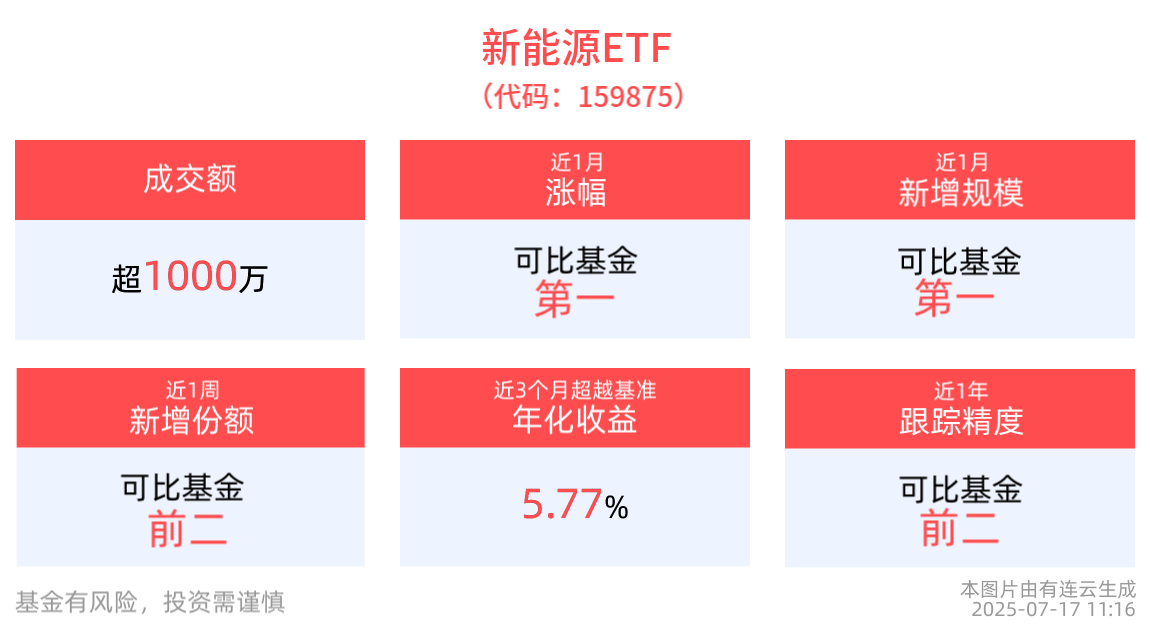
Group 1: ETF Performance - The New Energy ETF has a turnover rate of 1.31% and a transaction volume of 11.63 million yuan during the trading session [2] - Over the past year, the average daily transaction volume of the New Energy ETF is 36.03 million yuan [2] - The New Energy ETF has seen a scale increase of 7.68 million yuan in the past month, ranking first among comparable funds [2] - In the past week, the New Energy ETF's shares increased by 4.50 million shares [2] - Since its inception, the New Energy ETF's highest monthly return is 25.07%, with the longest consecutive monthly gains being 2 months and a maximum increase of 38.44% [2] - The average monthly return during the rising months is 7.76%, and the annualized return over the past three months exceeds the benchmark by 5.77% [2] Group 2: Stock Performance - The top ten weighted stocks in the China Securities New Energy Index account for 42.81% of the index, with major stocks including Ningde Times, Sunshine Power, and Longi Green Energy [5] - Ningde Times has a weight of 10.62% with a price increase of 0.26%, while Sunshine Power has a weight of 5.65% with a price decrease of 1.09% [4] - Other notable stocks include China Nuclear Power with a weight of 4.25% and a price decrease of 0.11%, and TBEA with a weight of 3.41% and a price increase of 0.33% [4] Group 3: Industry Insights - The recent Central Financial Committee meeting emphasized the need to advance the construction of a unified national market, focusing on addressing key challenges and regulating low-price competition among enterprises [4] - There is a growing call for self-discipline within the photovoltaic sector, with expectations for supply-side reforms to improve industry supply and demand dynamics [5] - The anticipated implementation of supply-side policies is expected to enhance price and profit recovery across the industry [5]
组件价格近期有上涨趋势,光伏ETF基金(516180)涨超1.5%
Xin Lang Cai Jing· 2025-07-17 02:14
Group 1 - The core viewpoint of the articles indicates that the prices of distributed photovoltaic components are on the rise due to fluctuations in upstream raw material prices, with leading manufacturers increasing their quotes for distributed products [1] - Current prices for distributed high-efficiency components are reported as follows: Topcon 183 at 0.672 yuan/w, 210R at 0.693 yuan/w, and 210N at 0.672 yuan/w; centralized Topcon 182/183 at 0.65 yuan/w and 210N at 0.665 yuan/w [1] - As of July 17, 2025, the CSI Photovoltaic Industry Index (931151) has increased by 1.19%, with notable stock performances including Shuangliang Energy up by 9.93%, Hongyuan Green Energy up by 6.60%, and TCL Zhonghuan up by 5.51% [1] - The Photovoltaic ETF Fund (516180) has risen by 1.02%, with a latest price of 0.6 yuan, and has accumulated a 4.05% increase over the past two weeks [1] Group 2 - As of June 30, 2025, the top ten weighted stocks in the CSI Photovoltaic Industry Index (931151) include: Sungrow Power Supply, LONGi Green Energy, TCL Technology, TBEA, Tongwei Co., TCL Zhonghuan, Chint Electric, JinkoSolar, JA Solar, and Deye [2] - The combined market capitalization of the top ten weighted stocks accounts for 55.39% of the index [2]
硅能源概念下跌1.22%,主力资金净流出37股
Zheng Quan Shi Bao Wang· 2025-07-16 08:58
Market Performance - The silicon energy concept sector declined by 1.22%, ranking among the top losers in the market, with stocks like Chenguang New Materials and Guosheng Technology hitting the daily limit down [1] - Among the stocks in the sector, Daqo New Energy, Silan Microelectronics, and Dongyue Silicon Material saw gains of 3.00%, 2.83%, and 2.45% respectively [1] Capital Flow - The silicon energy sector experienced a net outflow of 467 million yuan, with 37 stocks seeing net outflows, and 5 stocks exceeding 30 million yuan in outflows [2] - The stock with the highest net outflow was Jingyuntong, with a net outflow of 74.07 million yuan, followed by TCL Technology and Hesheng Silicon Industry with outflows of 64.11 million yuan and 40.18 million yuan respectively [2][3] - Conversely, the stocks with the highest net inflows included Longi Green Energy, Tuojin New Energy, and Silan Microelectronics, with inflows of 30.42 million yuan, 26.54 million yuan, and 20.83 million yuan respectively [2][3] Stock Performance - The top losers in the silicon energy sector included Jingyuntong (-9.69%), Guosheng Technology (-9.92%), and Chenguang New Materials (-10.01%) [2][3] - Notable gainers in the sector included Daqo New Energy (3.00%), Silan Microelectronics (2.83%), and Dongyue Silicon Material (2.45%) [2][3]