
迈瑞医疗

Search documents
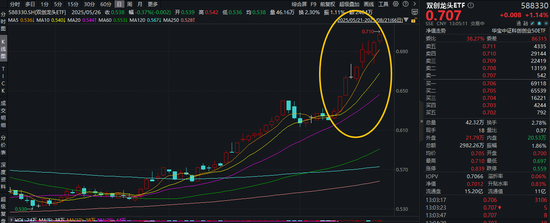
冲击9连涨!20CM高弹性——双创龙头ETF(588330)盘中涨超1.5%,刷新阶段新高!机构:硬科技景气度攀升!
Xin Lang Ji Jin· 2025-08-21 05:15
Group 1 - The core viewpoint highlights the strong performance of the "Double Innovation Leading ETF" (588330), which has seen a price increase of over 1.5% and a trading volume exceeding 29 million yuan, indicating active market engagement [1] - The ETF's latest scale is reported at 1.073 billion yuan, reflecting significant investor interest in hard technology sectors [1] - Key constituent stocks such as Lens Technology and Mindray Medical have shown notable gains, with Lens Technology rising over 9% [1] Group 2 - Data from the National Bureau of Statistics indicates that the high-tech manufacturing sector's added value grew by 9.3% year-on-year in July, with integrated circuit manufacturing increasing by 26.9%, suggesting a robust hard technology industry [3] - The technology sector is viewed as a key investment theme, particularly the domestic artificial intelligence industry chain, which is expected to benefit from advancements in AI applications and infrastructure [3] - The report emphasizes the importance of new production capabilities and the potential for excess returns in innovation-driven companies, with a focus on sectors like AI, innovative pharmaceuticals, and robotics [4] Group 3 - The "Double Innovation Leading ETF" is characterized by its cross-market diversification, focusing entirely on strategic emerging industries, including new energy and semiconductors [5] - The ETF is positioned as a high-elasticity tool for capturing technology market trends, with a low investment threshold allowing access to top-tier technology stocks [5] - The index underlying the ETF is designed to reflect the performance of the top 50 strategic emerging companies, enhancing its appeal as a "Chinese version of NASDAQ" [5]





寒武纪冲高回落,科创创业50ETF(159783)一度转跌,机构称A股步入“慢牛”新周期
Mei Ri Jing Ji Xin Wen· 2025-08-21 04:59
Group 1 - The A-share market is experiencing a "slow bull" new cycle driven by institutional reforms, optimized capital structure, and economic momentum transformation [1] - The recent performance of the ChiNext index shows a decline, particularly in AI hardware sectors such as liquid-cooled servers and PCB [1] - The Huaxi Securities report emphasizes that the improvement in investor return mechanisms is a fundamental basis for sustaining the "slow bull" market [1] Group 2 - The Science and Technology Innovation Board (STAR Market) indices, represented by the Sci-Tech 100 and Sci-Tech 200, have shown significant gains since June [2] - Nearly half of the companies on the STAR Market are signaling a reversal, indicating a bottoming out of profits since the second half of 2024 [2] - The Sci-Tech Innovation 50 ETF (159783) tracks the top 50 companies with the largest market capitalization and pure technology attributes from both the ChiNext and STAR Market [2]
“医药女神”葛兰仅位列第20!新生代冠军收益高达137%!
私募排排网· 2025-08-21 03:52
Core Viewpoint - The A-share market has shown a clear bullish trend in 2023, with significant index breakthroughs, leading to impressive performance from many equity fund managers [4][5]. Group 1: Fund Manager Performance - As of August 15, 2023, there are 1,794 public fund managers with performance data, with the majority being new generation managers, achieving an average return of 20.68% for their equity funds [5]. - The performance of fund managers is categorized into three generations: - New Generation (less than 5 years): 901 managers, average return of 20.68% [5]. - Middle Generation (5-10 years): 635 managers, average return of 18.09% [5]. - Old Generation (10 years and above): 258 managers, average return of 16.78% [5]. - The total assets under management (AUM) for these fund managers amount to 55,735.04 billion [5]. Group 2: Top Fund Managers - The top five fund managers from the new generation include: - Liang Furui from Changcheng Fund with a return of 137.72% and AUM of approximately 1.1 billion [6][8]. - Chu Kefa and Ren Jie from Yongying Fund with returns of 122.30% and 108.97% respectively [6][9]. - The top five fund managers from the middle generation include: - Leng Wenpeng from CITIC Construction Investment Fund with a return of 104.73% and AUM of nearly 300 million [10][12]. - The top five fund managers from the old generation include: - Zhou Sicong from Ping An Fund with a return of 90.96% and AUM exceeding 3 billion [13][15]. Group 3: Investment Strategies - Liang Furui employs a unique three-cycle strategy focusing on demand and matching companies with demand cycles, particularly in the innovative drug sector [8]. - Chu Kefa combines quantitative risk control with active stock selection, favoring leading commercial companies and those with technological breakthroughs [9]. - Leng Wenpeng focuses on "specialized, refined, unique, and innovative" companies listed on the Beijing Stock Exchange [12]. - Zhou Sicong emphasizes a three-dimensional screening approach for innovative drug investments, predicting significant industry growth in 2025 [16].

【盘中播报】31只股长线走稳 站上年线
Zheng Quan Shi Bao Wang· 2025-08-21 03:07
Market Overview - The Shanghai Composite Index is at 3781.13 points, above the annual line, with a change of 0.40% [1] - The total trading volume of A-shares is 1,193.158 billion yuan [1] Stocks Breaking Annual Line - A total of 31 A-shares have surpassed the annual line today, with notable stocks including Meihua Medical, *ST Aowei, and Pianzaihuang, showing divergence rates of 14.13%, 2.94%, and 2.77% respectively [1] - Stocks with smaller divergence rates that have just crossed the annual line include China Wuyi, Huilun Crystal, and Zhuoshengwei [1] Top Stocks by Divergence Rate - Meihua Medical (301363) has a significant increase of 17.30% with a turnover rate of 23.04% and a divergence rate of 14.13% [1] - *ST Aowei (002231) increased by 3.12% with a turnover rate of 7.79% and a divergence rate of 2.94% [1] - Pianzaihuang (600436) rose by 3.70% with a turnover rate of 1.03% and a divergence rate of 2.77% [1] Additional Notable Stocks - Tongrentang (600085) increased by 1.93% with a divergence rate of 1.77% [1] - Maire Medical (300760) rose by 3.40% with a divergence rate of 1.53% [1] - Other stocks with minor divergence rates include Aima Technology (603529) and China Railway Construction (601186) with divergence rates of 1.06% and 0.96% respectively [1]




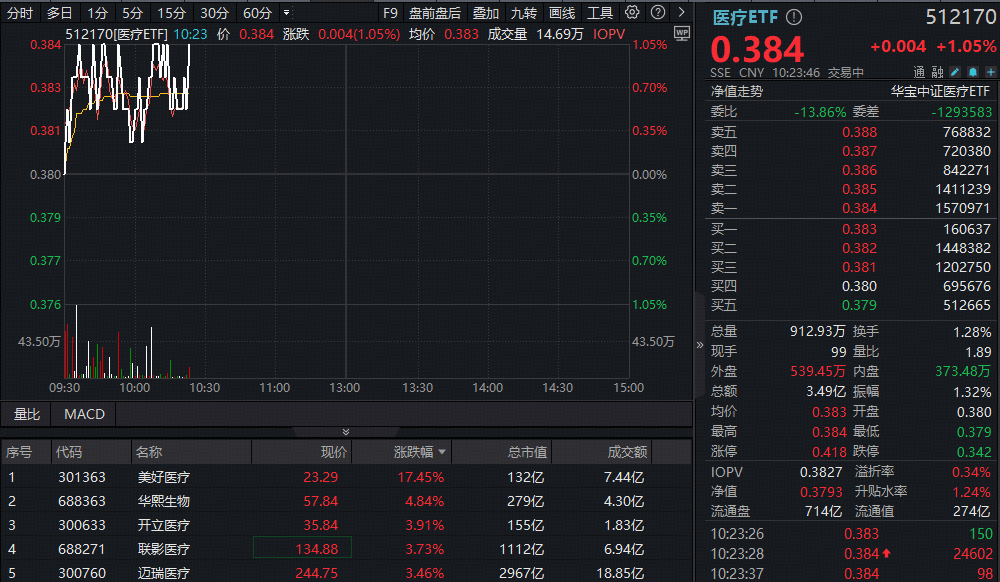
ETF盘中资讯|医疗继续活跃,迈瑞、联影携手大涨!医疗ETF(512170)涨逾1%!机构:创新药械双轮驱动板块估值修复
Sou Hu Cai Jing· 2025-08-21 02:47
Group 1 - The medical sector is active, with the largest medical ETF in A-shares (512170) seeing a price increase of over 1% and a trading volume of 322 million yuan, ranking first among similar ETFs [1] - Major stocks such as Meihua Medical, Kaili Medical, and Huaxi Biological have shown significant gains, with Meihua Medical hitting a 20% limit up [1] - The top-weighted stocks, Mindray Medical and United Imaging, both rose over 3% [1] Group 2 - Gilead Sciences announced a 100% prevention efficacy for its HIV-1 capsid inhibitor lenacapavir in phase 3 clinical trials [3] - Major companies like Midea and Haier are accelerating their investments in the healthcare sector, focusing on medical imaging and low-temperature storage [3] - The medical device sector is benefiting from policy support and innovation, with a focus on high-certainty performance in specific sub-sectors during the mid-year reporting period [3] Group 3 - The National Healthcare Security Administration has published an initial review list for innovative drugs, indicating a significant increase in the number of drug generic names passing initial review compared to 2024 [3] - The "anti-involution" principle in centralized procurement is established, leading to a gradual easing of policy impacts, which may improve profitability in the medical device sector [3] - The in-vitro diagnostics market is seeing accelerated market share growth for domestic leaders, with high-value consumables expected to experience a recovery in performance and valuation due to eased procurement policies [3]
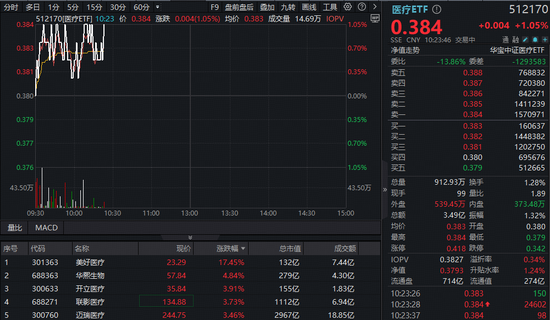
医疗继续活跃,迈瑞、联影携手大涨!医疗ETF(512170)涨逾1%!机构:创新药械双轮驱动板块估值修复
Xin Lang Ji Jin· 2025-08-21 02:34
Group 1 - The medical sector is active, with the largest medical ETF in A-shares (512170) seeing a price increase of over 1% and a trading volume of 322 million yuan, ranking first among similar ETFs [1] - The latest fund size of the medical ETF is 27.36 billion yuan, with significant gains in constituent stocks such as Meihao Medical, Kaili Medical, and Huaxi Biological, where Meihao Medical hit a 20% limit up [1] - Major weighted stocks like Mindray Medical and United Imaging also experienced gains exceeding 3% [1] Group 2 - Gilead Sciences announced a 100% prevention efficacy of its HIV-1 capsid inhibitor lenacapavir in phase 3 clinical trials [3] - Major companies like Midea and Haier are accelerating their investments in the healthcare sector, focusing on medical imaging and low-temperature storage [3] - The medical device sector is benefiting from policy support and innovation, with a focus on high-certainty performance in specific sub-sectors during the mid-year reporting period [3] Group 3 - The National Healthcare Security Administration has published an initial review list for innovative drugs, indicating a significant increase in the number of drug generic names passing initial review compared to 2024 [3] - The "anti-involution" principle in centralized procurement is established, leading to a gradual easing of policy impacts, which may improve profitability in the medical device industry [3] - The domestic leading companies in the in-vitro diagnostics field are rapidly increasing their market share, and high-value consumables are expected to see a recovery in performance and valuation due to the easing of centralized procurement policies [3]
医药牛市下半场,借道医疗创新ETF(516820.SH)布局底部核心资产
Xin Lang Cai Jing· 2025-08-21 02:22
Core Viewpoint - The market is experiencing a rotation from high valuation sectors to reasonably valued sectors, with a notable rebound in core assets in the medical innovation space [1] Group 1: Market Performance - On August 21, the market showed a "high-low cut" trend, with medical devices, traditional Chinese medicine, and vaccines leading in gains [1] - The Medical Innovation ETF (516820.SH) rose by 1.28%, with key stocks such as Pizhou Pharmaceutical (600436) up 4.84%, Mindray Medical (300760) up 3.73%, and Yuyue Medical (002223) up 2.43% [1] Group 2: Investment Opportunities - Funds are shifting towards undervalued sectors, with core assets in medical innovation gradually rebounding [1] - The top ten component stocks in the Medical Innovation ETF are mostly valued below the historical 20th percentile, indicating a significant safety margin [1] - Investors who missed the first half of the medical sector rally can position themselves in the Medical Innovation ETF (516820) to capitalize on the recovery [1]


研判2025!中国人工智能+医疗影像行业产业链、相关政策及市场规模分析:行业市场规模达76亿元,技术赋能精准诊疗与早筛[图]
Chan Ye Xin Xi Wang· 2025-08-21 01:28
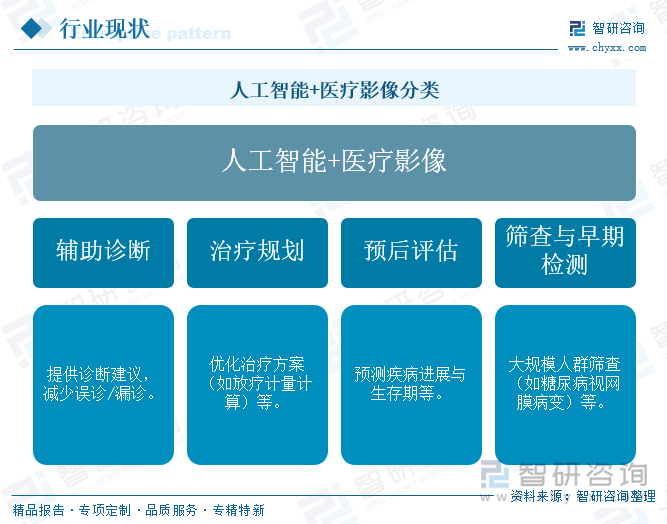
Core Insights - The Chinese AI + medical imaging industry is rapidly developing, with a market size projected to reach 7.6 billion yuan in 2024, representing a year-on-year growth of 109.94% [1][11] - AI technology is capable of quickly identifying small lesions from vast amounts of imaging data, facilitating precise early screening for various diseases and providing significant diagnostic support for doctors [1][11] - The product types in AI medical imaging are diversifying, with a trend towards integrated hardware and software solutions becoming the preferred choice for medical institutions [1][11] Industry Overview - AI + medical imaging refers to the use of AI technologies, such as deep learning and computer vision, to analyze and process medical images (e.g., X-rays, CT scans, MRIs, ultrasounds) to assist doctors in disease diagnosis, treatment planning, and prognosis evaluation [1][4] - The core function includes auxiliary diagnosis, treatment planning, prognosis assessment, and early detection screening [1][4] Industry Value Chain - The upstream of the AI + medical imaging industry includes medical imaging equipment, chips, servers, storage devices, imaging acquisition and processing software, cloud services, network operation platforms, and algorithm and data platforms [4] - The midstream involves the development and manufacturing of AI + medical imaging technologies, while the downstream primarily serves medical institutions, health check centers, and research and educational institutions [4] Market Size - The market size of the Chinese medical imaging equipment industry is expected to reach 69.3 billion yuan in 2024, with a year-on-year growth of 9.83% [6] Relevant Policies - The Chinese government has issued several policy documents to support and regulate the development of the AI + medical imaging industry, emphasizing the optimization of medical device standards and the establishment of standardization organizations for AI and medical robotics [8][10] - The policies aim to accelerate approval processes, enhance innovation ecosystems, and improve international competitiveness [8][10] Key Companies and Performance - Major companies in the AI + medical imaging sector include United Imaging Healthcare, Wandong Medical, Mindray, and Shukun Technology, each leveraging unique strengths in hardware and AI software integration [13][15] - United Imaging Healthcare reported a revenue of 10.3 billion yuan in 2024, a decrease of 9.73% year-on-year, while its R&D investment increased by 17.84% to 2.261 billion yuan [15] - Shukun Technology focuses on providing comprehensive AI solutions for medical institutions, achieving significant market penetration with its innovative products [17] Industry Development Trends 1. The industry is expected to advance towards multi-modal data integration and deep learning, enhancing diagnostic accuracy and personalized treatment [20] 2. Applications of AI in medical imaging will expand from auxiliary diagnosis to full-process management, improving service efficiency and quality [21] 3. Regulatory frameworks will evolve to include data privacy protections and accountability mechanisms for AI-generated content [22]


市场扩容与企业加码共筑红利资产投资新生态
Zheng Quan Ri Bao· 2025-08-20 23:16
Core Viewpoint - The demand for stable returns has led to an increased interest in dividend assets, which has enhanced their investment value in the market [1][2]. Group 1: Market Trends - As of August 20 this year, 87.5% of the 256 dividend indices in the A-share market have risen, indicating strong market interest in dividend assets [1]. - The active buying amount for dividend-related ETF products reached 198.6 billion yuan, accounting for 87.74% of the total buying amount for strategy index ETFs, reflecting high market recognition and active positioning towards dividend assets [1]. - A total of 35 new dividend indices have been launched this year, covering various market capitalizations and strategy factors, indicating a rapid response to market demand for high-dividend, stable-return assets [2]. Group 2: Policy and Regulatory Environment - The China Securities Regulatory Commission's action plan aims to promote the development of more dividend, low-volatility, and value strategy index ETFs, providing clear policy signals for the introduction of new indices [2]. - Regulatory guidance has been issued to encourage listed companies to strengthen their dividend awareness and standardize dividend behavior, promoting a healthy market ecosystem [5]. Group 3: Corporate Actions - Companies like Shenzhen Mindray Bio-Medical Electronics Co., Ltd. have announced significant dividend plans, such as a 1.71 billion yuan interim profit distribution for 2025, reflecting a commitment to shareholder returns [6]. - The enhancement of dividend capabilities is viewed as a long-term endeavor for companies, requiring a balance between retained earnings and dividend payouts to meet both development needs and investor expectations [6]. Group 4: Future Outlook - The ongoing improvement of the dividend index investment ecosystem is expected to provide diverse investment targets, guiding funds towards companies with stable dividend capabilities and excellent financial performance [4]. - Enhanced transparency in index compilation and publication will enable investors to better understand market dynamics and make more rational investment decisions, promoting the long-term value investment philosophy [4].
市场扩容与企业加码共筑红利资产投资新生态 截至8月20日A股市场256条红利指数中 近九成年内实现上涨
Zheng Quan Ri Bao· 2025-08-20 16:53
Core Viewpoint - The demand for stable returns has led to an increased interest in dividend assets, which has enhanced their investment value in the market [1][2]. Group 1: Market Trends - As of August 20 this year, 87.5% of the 256 dividend indices in the A-share market have risen, indicating strong market interest in dividend assets [1]. - The active buying amount for dividend-related ETF products reached 198.6 billion yuan, accounting for 87.74% of the total buying amount for strategy index ETFs, reflecting high market recognition and active positioning towards dividend assets [1]. - A total of 35 new dividend indices have been launched this year, covering various market capitalizations and strategy factors, indicating a rapid response to market demand [2]. Group 2: Policy and Regulatory Environment - The China Securities Regulatory Commission's action plan aims to promote the development of more dividend, low volatility, and growth strategy index ETFs, providing clear policy signals for the introduction of new indices [2]. - Regulatory guidance has been issued to encourage listed companies to strengthen their dividend awareness and standardize dividend behavior, promoting a healthy market ecosystem [5]. Group 3: Corporate Actions - Companies are increasingly focusing on enhancing the quality and sustainability of their dividends, with examples like Shenzhen Mindray Bio-Medical Electronics Co., Ltd. planning a mid-term profit distribution of 1.71 billion yuan for 2025 [6]. - The improvement of dividend capabilities is viewed as a long-term endeavor, requiring companies to balance retained earnings and dividend payouts while ensuring stable business growth [6]. Group 4: Investment Ecosystem - The expansion of precise dividend indices is expected to enhance asset pricing efficiency and support the innovation of related financial products, improving the risk management system in capital markets [3]. - The ongoing development of the dividend index investment ecosystem is anticipated to provide investors with a wider range of investment targets, aligning with different risk preferences and investment needs [4].