
潞安化工集团

Search documents
端牢能源饭碗 加快绿色转型——构建新型能源体系的山西实践
Xin Hua She· 2025-09-25 12:22
Group 1: Energy Transition and Development - Shanxi province is tasked with ensuring energy supply and promoting energy transition, focusing on clean and low-carbon development of coal [1] - The province aims to build a new energy system by integrating wind, solar, and hydrogen energy alongside coal [1] - As of August, Shanxi has established 298 intelligent coal mines and 55 green mining pilot projects to enhance coal supply quality [2] Group 2: Technological Innovations - Shanxi has built 12 national-level major innovation platforms and numerous provincial laboratories to drive technological advancements in energy [3] - Breakthroughs in clean coal utilization technologies, such as rapid peak regulation for coal-fired power plants, have been achieved [3] - Companies in Shanxi are transforming coal into high-value products, such as nylon fibers and sodium-ion battery materials [3] Group 3: Renewable Energy Growth - Since the 14th Five-Year Plan, renewable energy has become the main source of new installed capacity in Shanxi, with a 4309 MW increase in capacity over five years [5] - The proportion of renewable energy in Shanxi's total power generation has improved from 1/7 to 1/4, indicating a significant shift towards green energy [5] - Shanxi's renewable and clean energy installed capacity now accounts for 54.4% of total capacity, leading the nation in green electricity export [5] Group 4: Green Power Parks - Shanxi is developing low-carbon and zero-carbon parks that integrate green electricity with various industries, enhancing competitiveness through direct supply [6] - The number of green power park pilot projects has expanded from 3 to 13 this year, showcasing the province's commitment to industrial transformation [6] Group 5: Market Reforms and Flexibility - Shanxi is implementing market reforms to enhance the flexibility of its power system, allowing for better integration of renewable energy sources [8] - The establishment of virtual power plants has enabled companies to adjust their electricity usage based on market prices, optimizing energy consumption [8][9] - Over half of Shanxi's coal-fired power units have undergone flexibility upgrades to support renewable energy integration [9]
晋控煤业(601001):煤炭业务稳健发展,产能增量可期
Tianfeng Securities· 2025-09-24 08:13
Investment Rating - The report assigns a "Buy" rating for the company with a target price of 17.64 CNY based on a 14x PE for 2025 earnings [5][62]. Core Insights - The company's coal business is expected to develop steadily, with potential for profit growth from both existing and new capacities [1][30]. - The company has a low debt ratio, which has decreased from 61% in 2018 to 28.9% in 2024, indicating strong financial health and room for excess dividends [2][24]. - The stability of the company's coal prices is highlighted, showing low volatility compared to peers [3][42]. Summary by Sections Company Overview - The company primarily operates three coal mines: Tashan, Selian, and Tongxin, with total approved capacity of 34.6 million tons per year and equity capacity of 23.23 million tons [1][32]. - The company plans to acquire the Panjiayao mine, which could increase total capacity by 19.8% and equity capacity by 35.3% [30][32]. Financial Health - The company has a strong cash flow, with a projected dividend payout ratio increasing from 14.37% in 2021 to 45% in 2024, resulting in a static dividend yield of approximately 5.8% [2][28]. - The company's earnings per share (EPS) for 2025 is projected at 1.26 CNY, with net profits expected to be 2.11 billion CNY [62][63]. Profitability and Valuation - The report forecasts net profits of 21.1 billion CNY for 2025, with a gradual increase in subsequent years [62][63]. - The company's coal sales revenue is projected to decline to 12.96 billion CNY in 2025, reflecting a decrease in coal prices [62][63]. Industry Analysis - The coal industry is expected to see improvements in supply-demand dynamics in 2025, driven by environmental regulations and reduced imports [49][56]. - The report notes that the company's coal prices have remained stable, contrasting with the volatility seen in the broader market [3][42].

发展煤化工的七点建议
Zhong Guo Hua Gong Bao· 2025-09-15 03:17
Core Viewpoint - The coal chemical industry is facing significant challenges such as severe homogenization, tightening resource and environmental constraints, and low product added value, necessitating strategic restructuring for high-quality development [1][2]. Group 1: Industry Challenges - The average operating rate of coal chemical facilities in 2023 is below 75%, indicating a pressing need for transformation within the industry [1]. - The industry is hindered by issues like low product added value and environmental restrictions, which require innovative solutions [1]. Group 2: Strategic Recommendations - The company suggests that the government should provide tax relief for the coal-to-oil sector to promote healthy industry development [2]. - It calls for more project approval incentives and special transfer payment support for Shanxi province [2]. - There is a need for increased policy support for integrated resource allocation in coal chemical production [2]. - The focus should be on enhancing independent innovation and cultivating high-end brands, particularly in coal-based new materials and clean energy sectors [2]. - The industry should deepen collaboration and enhance carbon reduction efficiency by integrating coal chemical processes with clean energy technologies [2]. - The company emphasizes the importance of technological innovation to drive industry upgrades, including the development of new coal-based products and the application of smart factory technologies [2]. - It advocates for optimizing industrial layout based on local conditions, controlling capacity increases, and promoting differentiated development in coal-rich regions [2].
煤炭行业大变局:7500亿中国神华拟一次吞并13家公司
3 6 Ke· 2025-09-04 04:34
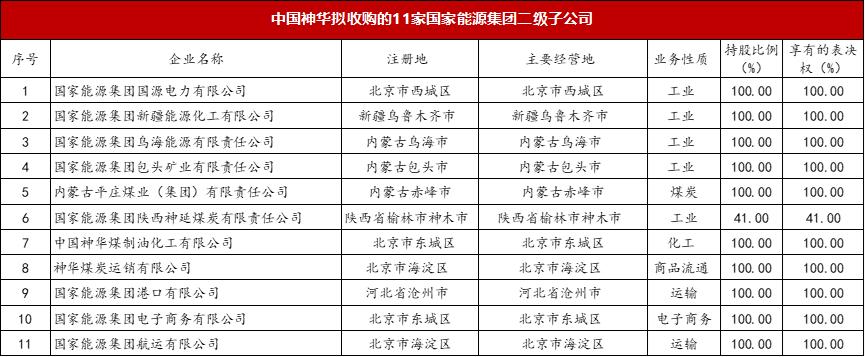
Core Viewpoint - The coal industry is undergoing accelerated consolidation under the trend of mergers and acquisitions among state-owned enterprises, with China Shenhua's significant acquisition plan being a key example [1][10][15]. Group 1: Acquisition Details - China Shenhua, the largest coal listed company in China with a market value of nearly 750 billion, has announced a suspension of trading due to a major acquisition plan involving 13 companies, 11 of which are subsidiaries of the State Energy Group [1][2]. - The acquisition is expected to exceed 100 billion, significantly enhancing China Shenhua's performance and impacting the entire coal industry [1][3]. - The 13 target companies cover the entire coal industry chain, including coal mining, coal power, coal chemical, port transportation, and online trading [1][9]. Group 2: Target Companies Overview - The 13 companies include major players such as Guoyuan Power, Xinjiang Energy Chemical, and UHV Energy, among others, with a focus on coal mining and related services [3][4]. - The majority of these companies are second-tier subsidiaries of the State Energy Group, indicating a substantial integration of resources into China Shenhua [4][5]. Group 3: Industry Context - The coal industry is experiencing a wave of mergers and acquisitions, driven by policies aimed at strengthening state-owned enterprises and avoiding competition among them [10][11][15]. - In 2024, the top ten coal-producing companies in China accounted for nearly 50% of the total output, highlighting the concentration of production within a few large entities [11][23]. - The State Energy Group is the largest coal producer globally, with a coal production of 620 million tons in 2024, further emphasizing the scale of the industry [16][23]. Group 4: Financial Performance - China Shenhua reported a total asset value of 658.068 billion and a net profit of 68.865 billion in the previous year, with a coal production of 327 million tons [21]. - The State Energy Group's coal-related business generated significant revenue, with coal sales contributing to over 50% of its total income [16][20]. Group 5: Future Outlook - The ongoing consolidation in the coal sector suggests that further asset injections from the State Energy Group into China Shenhua may occur, potentially leading to a more dominant position in the market [23].


煤焦数据解读:2025年1-7月前十大煤炭国企原煤产量
Ge Lin Qi Huo· 2025-08-21 03:38
Report Overview - The report analyzes the raw coal production data of the top ten state-owned coal enterprises from January to July 2025, including monthly and cumulative production, year-on-year and month-on-month changes, and provides relevant comments [1]. Key Data Monthly Production in July 2025 - The top ten coal enterprises' total raw coal production in July 2025 was 20,089 thousand tons, a year-on-year decrease of 0.87% and a month-on-month increase of 1.99% [1]. - Among them, National Energy Group had the highest production of 5,277 thousand tons, with a year-on-year increase of 2.99% and a month-on-month increase of 2.23% [1]. - Jinmei Holding Group had a production of 3,452 thousand tons, a year-on-year decrease of 11.05% but a month-on-month increase of 1.26% [1]. Cumulative Production from January to July 2025 - The top ten coal enterprises' cumulative raw coal production from January to July 2025 was 1.388 billion tons, a year-on-year increase of 8.83 million tons, accounting for 49.6% of the raw coal production of enterprises above the designated size [1]. Core Viewpoints - From the cumulative raw coal production data of the top ten coal enterprises, the cumulative production from January to July showed a slight increase of 2.87%, but the single-month production in July showed a slight decline [1]. - The main reason is that the production of three major state-owned enterprises in Shanxi continued to catch up in the second half of 2024, resulting in significant changes in the year-on-year data in 2025 and a slowdown in the growth rate in the second half of 2025 [1]. - For example, the raw coal production growth rate of Jinmei Holding Group from January to July slowed down from the previous value of 10.9% to 7.1%, and that of Shanxi Coking Coal Group slowed down from 18.4% to 12.6% [1].
债市新时代系列培训-2025场
2025-08-05 15:42
Summary of Key Points from Conference Call Records Industry or Company Involved - The discussion primarily revolves around the **credit market** and **credit risk analysis** in the context of **China's financial environment**. Core Points and Arguments 1. **Reevaluation of Credit Strategies**: The current market environment necessitates a reevaluation of credit strategies, as evidenced by the cases of 中航产融 (AVIC Capital) and 万科 (Vanke), highlighting the importance of in-depth credit risk analysis [2][1]. 2. **Integration of Philosophy in Credit Research**: Credit research should combine practical foundations with philosophical thinking, emphasizing the transformation of qualitative insights into a rational analytical framework [3][6]. 3. **Long-term Investment Focus**: Long-term investors must understand the fundamentals of investment subjects, including macroeconomic impacts and policy changes, to establish a systematic analysis framework that combines quantitative and qualitative assessments [1][7]. 4. **Limitations of Existing Default Models**: Existing default models in the Chinese market are not fully applicable and require adjustments based on practical experiences to enhance predictive accuracy [8][9]. 5. **Role of Credit Ratings**: Credit ratings serve as a relative ranking of a company's debt repayment ability rather than complex default probability calculations, aiding investors in understanding relative risk levels [10][14]. 6. **Dynamic Analysis of Local Government Financing**: When analyzing local government financing, it is crucial to understand the dynamic relationship between central and local governments, employing dialectical thinking to assess various influencing factors [11][4]. 7. **Importance of Liquid Assets**: The evaluation of a company's debt repayment ability must focus on cash flow from operational profits, the coverage of liquid assets over debts, and potential external support [17][26]. 8. **Impact of Monetary Policy on Credit Financing**: Credit bond financing is primarily influenced by monetary policy, necessitating close monitoring of issuance policies and macroeconomic monetary policies [9][1]. 9. **Philosophical Thinking in Credit Research**: The application of philosophical thinking in credit research involves understanding the relationship between practice and theory, and the need for continuous verification of conclusions through empirical data [6][3]. 10. **Historical Context of Default Waves**: The historical context of default waves in China reveals different phases, such as the large-scale defaults from 2015 to 2016 due to overcapacity and the subsequent waves affecting private and state-owned enterprises [23][24]. Other Important but Possibly Overlooked Content 1. **Challenges in Credit Rating Agencies**: Credit rating agencies often lack unified rating principles, and their results may be influenced by client demands, necessitating a deeper understanding of the underlying principles and strategies [22][4]. 2. **External Support Evaluation**: When a company cannot cover its debts through operational profits and liquid assets, external support becomes critical, and its effectiveness must be assessed based on the willingness and capacity of the parent company [29][30]. 3. **Investment Strategy Adaptation**: Investment strategies must adapt to market changes, considering the behavior of competitors and the execution of internal strategies [38][42]. 4. **Risk Assessment in Local Government Projects**: Evaluating the risks associated with local government leveraging for infrastructure projects requires careful consideration of economic structures and income levels to avoid potential pitfalls [79][80]. 5. **Sector-Specific Recovery Potential**: Certain sectors, such as real estate and consumer goods, may be approaching recovery phases, indicating potential investment opportunities despite previous downturns [73][74]. This summary encapsulates the essential insights and recommendations from the conference call, providing a comprehensive overview of the current state and future considerations in the credit market and investment strategies.
煤焦数据解读:2025年上半年前十大煤炭国企原煤产量
Ge Lin Qi Huo· 2025-07-18 14:10
Report Industry Investment Rating - Not provided Core View of the Report - The total output of the top ten coal - producing enterprises increased, but the growth rate of coal production in Shanxi Province slowed down significantly in June [2] Summary by Related Content Coal Production Data of Top Ten State - owned Coal Enterprises in H1 2025 - The top ten state - owned coal enterprises in terms of raw coal production in H1 2025 are National Energy Group, Jinneng Holding Group, Shandong Energy Group, China National Coal Group, Shaanxi Coal Group, Shanxi Coking Coal Group, Huaneng Group, Lu'an Chemical Group, Henan Energy Group, and State Power Investment Group [1] - In H1 2025, National Energy Group produced 30,589 tons of raw coal, a year - on - year decrease of 1.0%; Jinneng Holding Group produced 20,257 tons, a year - on - year increase of 10.9%; Shandong Energy Group produced 13,837 tons, a year - on - year increase of 3.8%; China National Coal Group produced 13,547 tons, a year - on - year increase of 1.7%; Shaanxi Coal Group produced 12,911 tons, a year - on - year increase of 1.5%; Shanxi Coking Coal Group produced 9,305 tons, a year - on - year increase of 16.4%; Huaneng Group produced 5,113 tons, a year - on - year decrease of 8.9%; Lu'an Chemical Group produced 4,968 tons, a year - on - year increase of 13.1%; Henan Energy Group produced 3,727 tons, a year - on - year increase of 5.6%; State Power Investment Group produced 3,660 tons, a year - on - year decrease of 4.5% [1] Overall Output and Proportion - From January to June 2025, the total raw coal output of the top 10 enterprises was 1.18 billion tons, a year - on - year increase of 40.26 million tons, accounting for 9.93% of the raw coal output of enterprises above the designated size [4] Slowdown in Growth Rate - The growth rate of raw coal production of Jinneng Holding Group, Shanxi Coking Coal Group, and Lu'an Chemical Group from January to June slowed down to 10.9%, 16.4%, and 13.1% respectively [2]
让更少的煤“变”出更多的油——记中国专利金奖项目“低温费托合成催化剂及其制备方法和应用”
Zhong Guo Hua Gong Bao· 2025-07-11 02:45
Core Viewpoint - The development of the Fischer-Tropsch iron-based catalyst, known as CNFT, significantly enhances the efficiency of coal-to-oil conversion, addressing key challenges in the coal indirect liquefaction technology [1][2]. Group 1: Catalyst Development - The CNFT catalyst was developed by the National Energy Group to improve coal-to-oil technology, which is crucial for energy security in China due to its rich coal and limited oil resources [2]. - Initial challenges included insufficient wear resistance and stability, as well as low activity and yield of high-value products [2]. - The research team innovatively combined iron and silicon under controlled conditions, enhancing catalyst strength while maintaining active surface area, and utilized low-temperature preparation to prevent pore structure issues [2][3]. Group 2: Industrial Scaling Challenges - The transition from laboratory to industrial scale faced multiple challenges, including issues with wear resistance and product quality during the scaling process [3][4]. - The team conducted extensive trials, including a 2000-hour long-term operation test, to refine the catalyst formulation and address industrial application requirements [3][4]. - Continuous production faced difficulties due to the viscosity of the catalyst slurry, which required custom equipment and solutions to ensure stable operation [4]. Group 3: Performance and Impact - The CNFT-1 catalyst has been successfully implemented in major coal indirect liquefaction plants, resulting in a 5% increase in production capacity and extending maintenance intervals from one year to three years [5]. - The catalyst also improved the yield of high-value oil wax by 14% compared to similar catalysts, driving overall industry advancements [5]. - Following the success of CNFT-1, a new generation of low CO2 selective CNFT-2 catalyst was developed, reducing CO2 emissions by 15,000 tons annually for every million tons of oil produced [5].
山西潞安煤基清洁能源公司开辟营销新路径
Xin Hua Cai Jing· 2025-06-10 09:50
Core Viewpoint - The company is transforming its marketing strategy by implementing a "sitting merchant + traveling merchant" composite sales model to enhance market competitiveness in the face of increasing competition in the coal chemical industry [1][2]. Group 1: Marketing Strategy Transformation - The company has established a composite sales system that shifts from passive response to proactive market engagement, integrating both online and offline marketing approaches [2][3]. - A digital sales bidding platform has been developed to enhance operational efficiency, allowing customers to compare prices, consult on technology, generate orders, track logistics, and provide after-sales feedback [2]. - The sales teams are organized into specialized groups that actively engage with downstream clients, offering customized solutions tailored to specific needs, thereby extending the sales reach into the industry chain [2][3]. Group 2: Building Trust and Customer Engagement - The company invites executives and technical leaders from major downstream clients to visit its production facilities, showcasing its production capabilities and technological advancements [4][5]. - During these visits, technical teams address specific customer inquiries, providing data support and technical advice, which enhances customer trust and satisfaction [4][5]. - Following these engagements, customers express intentions to deepen cooperation, leading to immediate discussions on framework procurement agreements [5]. Group 3: Industry Leadership and Green Transition - The company actively participates in high-profile industry events, co-hosting conferences to discuss green transformation in the energy sector and promote domestic oil product alternatives [6][7]. - The company showcases its advanced clean energy products, such as CTL synthetic base oils and Fischer-Tropsch hydrocarbons, during these events, leading to preliminary cooperation agreements with multiple enterprises [7]. - The company aims to continue its dual marketing model while enhancing product quality and service, contributing to a greener and more sustainable energy landscape [7].
潞安化工集团以数字赋能蹚出管理新路
Xin Hua Cai Jing· 2025-06-04 07:39
Group 1: Digital Empowerment and Management Transformation - The company is committed to "lean management + digitalization" to lead industry transformation and enhance internal development momentum through data-driven decision-making [2][3] - The digital comprehensive control platform has been developed with 17 system modules, enabling real-time feedback and self-analysis, thus integrating digital governance with production management [2][3] - Over 20,000 team leaders and safety management personnel are utilizing the digital platform for grid-based safety management, enhancing transparency and traceability in safety inspections [2] Group 2: Technological Innovation and Automation - The introduction of clearing robots at coal storage facilities has improved efficiency and safety, significantly reducing manual intervention and associated risks [4] - The company has undertaken multiple national and provincial research projects, resulting in over 1,600 patent authorizations and numerous awards, including two National Science and Technology Progress Awards [4] Group 3: Mechanism Innovation and Value Creation - The company has implemented various incentive mechanisms to encourage grassroots innovation and micro-reforms, ensuring resources are effectively utilized [5][6] - A new "team package system" has been explored to enhance attendance rates and operational efficiency, consolidating production and maintenance teams to improve productivity [5][6] - The integration of smart technology and flexible mechanisms is aimed at revitalizing organizational potential and exploring new paths for traditional energy enterprises [6]