重庆富民银行

Search documents
找钢集团2025年上半年营收7.97亿元 国际业务收入增幅达38.9%
Zheng Quan Shi Bao Wang· 2025-08-27 15:10
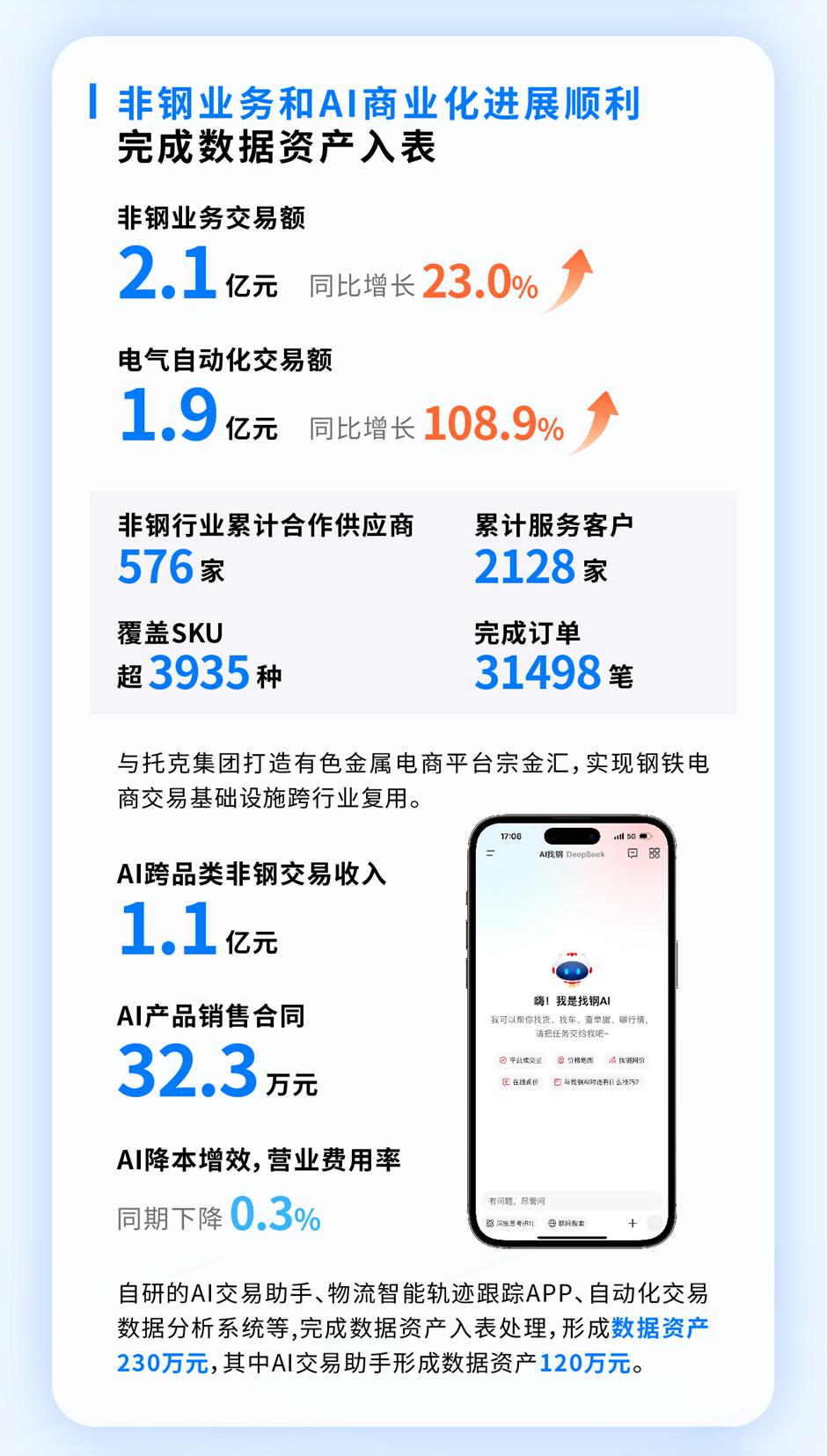
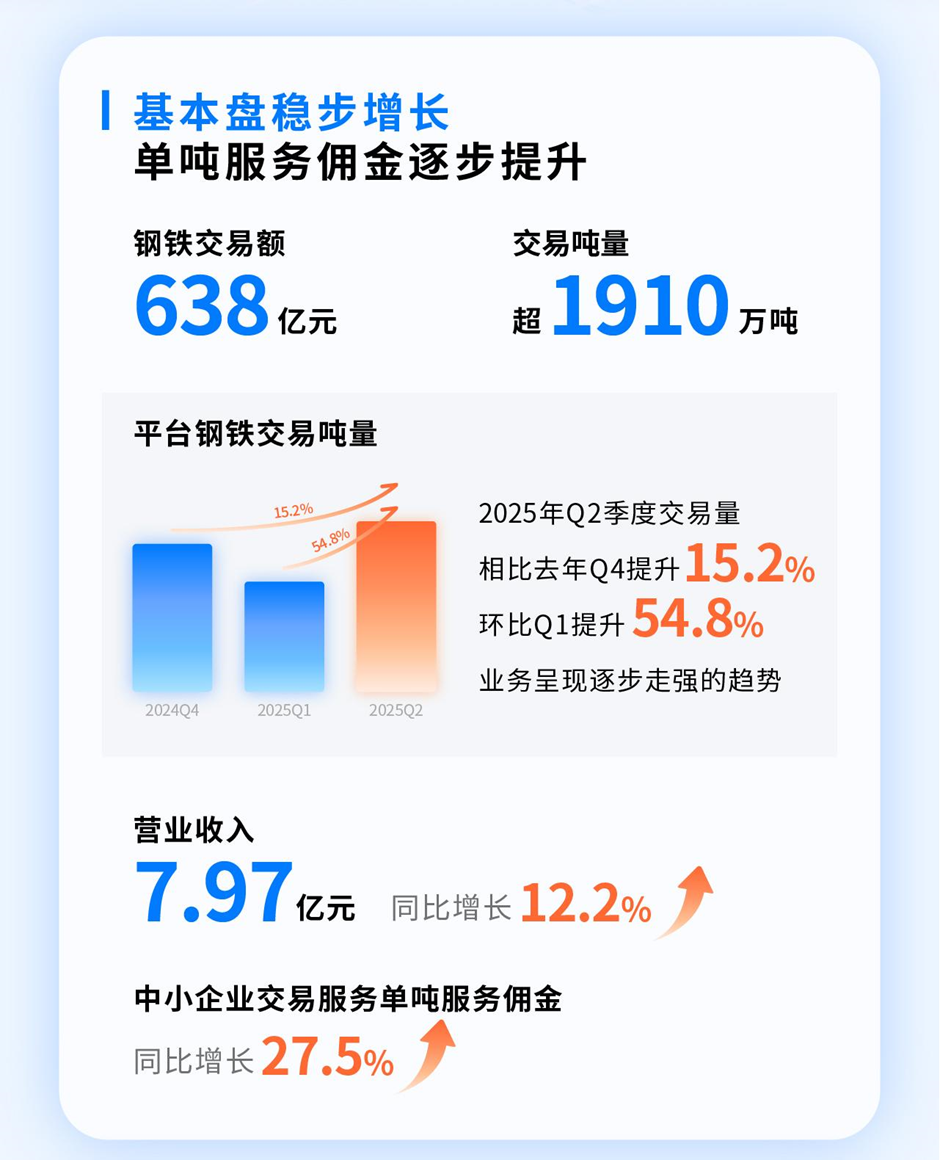
Core Viewpoint - The company, Zhaogang Group, reported a strong performance in the first half of 2025, with significant growth in both revenue and international business, driven by strategic initiatives in AI and diversification of services [1][2][3][4][5][8][9] Group 1: Financial Performance - In the first half of 2025, Zhaogang Group achieved a revenue of 797 million yuan, representing a year-on-year increase of 12.2% [1] - The platform's steel trading volume reached 638 billion yuan, with a total trading tonnage exceeding 19.1 million tons, showing a quarter-on-quarter increase of 54.8% from the first quarter [2] - The international business revenue grew by 38.9% to 34 million yuan, with trading tonnage increasing by 58.0% and gross profit rising by 90.5% [3] Group 2: Strategic Initiatives - The company is focusing on a strategy of stable domestic growth, globalization, diversification, and full AI integration, leading to breakthroughs in multiple business areas [2] - Zhaogang Group is actively expanding its international presence, with subsidiaries established in several countries, including the UAE and Malaysia, to capitalize on infrastructure demands [3] - The company is exploring the application of stablecoins and RWA in overseas markets to enhance transparency and reduce credit costs in commodity trading [3] Group 3: Non-Steel Business Expansion - Non-steel business transactions reached 21 million yuan, marking a year-on-year growth of 23.0%, with the electrical and electronic sector seeing a remarkable increase of 108.9% [4] - The company has launched a non-ferrous metal e-commerce platform in collaboration with Trafigura, achieving a trial transaction volume of over 25 million yuan [5] Group 4: AI and Technology Integration - Zhaogang Group's AI strategy has led to significant operational efficiency improvements, with a reduction in operating expenses by 0.3% year-on-year [5] - The company has developed various AI-driven tools, including a trading assistant and logistics tracking app, contributing to a total data asset valuation of 2.3 million yuan [5] Group 5: Financial Services and Product Diversification - The company has resumed its financial technology business by partnering with Chongqing Fumin Bank, serving 23 clients with an approved credit limit of approximately 4 billion yuan [8] - Zhaogang Group is set to launch a new marketplace focusing on small steel varieties, integrating resources from over 400 leading steel mills and traders [8]

找钢集团2025年上半年营收同比增长12.2% 国际业务爆发式增长
Zhong Guo Jin Rong Xin Xi Wang· 2025-08-27 13:34
Core Insights - The company, Zhaogang Group, reported a robust performance in the first half of 2025, achieving a revenue of 797 million yuan, a year-on-year increase of 12.2% [2] - The company is focusing on a strategic framework that includes domestic stability, globalization, diversification, and comprehensive AI integration [1] Domestic Performance - In the first half of 2025, Zhaogang Group's steel trading volume reached 638 billion yuan, with a total transaction tonnage exceeding 19.1 million tons [2] - The platform has registered over 16,000 suppliers and 189,000 customers, covering more than 650,000 SKUs [2] - The service commission for small and medium-sized enterprises increased by 27.5% year-on-year [2] International Expansion - The international business revenue reached 340 million yuan, marking a year-on-year growth of 38.9%, with transaction tonnage increasing by 58.0% [4] - The company is actively involved in major infrastructure projects in Southeast Asia, such as the China-Thailand high-speed railway and the Malaysia logistics center, addressing supply chain challenges for Chinese enterprises [4] - A processing plant in Dubai is set to be operational by the end of the year, with an annual production capacity of 400,000 tons [5] Non-Steel Business Growth - Non-steel sector transactions amounted to 210 million yuan, reflecting a year-on-year increase of 23.0%, with the electrical and electronics segment growing by 108.9% [7] - The company has launched a new e-commerce platform for non-ferrous metals in collaboration with Trafigura, achieving a trial transaction volume exceeding 25 million yuan [7] AI Integration and Efficiency - The company has made significant strides in AI commercialization, with a new AI model registered and sales contracts worth 323,000 yuan signed during the reporting period [7] - The operational efficiency improved, with operating expenses decreasing by 0.3% compared to the previous year [7] Financial Services and Product Expansion - Zhaogang Group has resumed its financial technology services, partnering with Chongqing Fumin Bank and serving 23 clients with a total approved credit of approximately 4 billion yuan [9] - The company is set to launch a new trading platform focusing on small varieties of steel products, integrating resources from over 400 leading steel mills and traders [9] Future Outlook - The company aims to become the world's largest AI industrial internet platform, driven by rapid growth in new business areas, international expansion, and AI commercialization [11]
找钢集团今年上半年营收同比增长12.2%,国际业务迎「爆发式增长」
IPO早知道· 2025-08-27 13:03
Core Viewpoint - The company is progressing towards becoming the largest AI industrial internet platform globally, with significant growth in both domestic and international operations [2][3]. Financial Performance - In the first half of 2025, the company achieved a revenue of 797 million yuan, representing a year-on-year increase of 12.2% [4]. - The steel trading volume reached 63.8 billion yuan, with a total trading tonnage exceeding 19.1 million tons. The trading volume in Q2 2025 increased by 15.2% compared to Q4 2024 and by 54.8% compared to Q1 2025, indicating a strengthening trend in trading activities [6]. International Business Growth - The company's international business revenue reached 340 million yuan in the first half of 2025, with a year-on-year growth of 38.9%. The trading tonnage increased by 58.0%, and gross profit saw a significant rise of 90.5%, with per-ton gross profit growing by 20.6% [9]. - In Southeast Asia, the company participated in major infrastructure projects, enhancing the efficiency of Chinese enterprises' overseas operations. The trading volume in Southeast Asia reached approximately 45,000 tons, with a quarter-on-quarter increase of 441% [10]. Non-Steel Business Expansion - The non-steel sector also showed strong performance, with a trading volume of 21 million yuan, up 23.0% year-on-year. The electrical and electronic business alone saw a trading volume of 19 million yuan, a remarkable increase of 108.9% [11]. - The company has established a partnership with Tock Group to create a non-ferrous metal e-commerce platform, achieving a trial trading volume of over 25 million yuan [14]. AI Commercialization and Efficiency - The company has made breakthroughs in AI commercialization, with the AI industrial model being registered with the National Cyberspace Administration. During the reporting period, new AI product sales contracts amounted to 323,000 yuan [14]. - The implementation of AI has significantly improved operational efficiency, with operating expense ratios decreasing by 0.3% compared to the same period in 2024 [16]. Future Outlook - The company plans to launch a new marketplace focusing on small varieties of steel products, integrating resources from over 400 leading steel mills and traders, and leveraging AI for the entire trading process [16]. - With rapid growth in new businesses, international expansion, and further acceleration of AI commercialization, the company aims to solidify its position as a leading AI industrial internet platform [16].
高息网贷“换壳术”:从“芸豆花”看快牛系1460%年化利率下监管漏洞
Sou Hu Cai Jing· 2025-08-27 03:48
Core Viewpoint - The article highlights the alarming practices of high-interest lending apps like "Yun Dou Hua," which have rebranded from "Yun Dou Fen" to evade regulatory scrutiny while continuing to exploit consumers with exorbitant interest rates and aggressive collection tactics [1][3][5]. Group 1: User Experiences - Users like Li Fei and Zhang Bin have reported being trapped in a cycle of debt due to high annualized interest rates, with Li Fei facing a staggering 1460% rate and Zhang Bin experiencing an 876% rate [1][4]. - Complaints on platforms like Black Cat Complaints indicate a pattern of short-term loans with high interest, where users face harassment from collection agents after missed payments [4][6]. Group 2: Company Operations - "Yun Dou Hua" is linked to Shanghai Zui Meng Zhe Internet Technology Co., which has no financial business licenses and has been involved in multiple rebrandings to avoid regulatory action [5][10]. - The app operates under a "borrowed shell" model, where it is part of a larger network associated with "Kua Niu" capital, which has a history of high-interest lending practices [6][8]. Group 3: Regulatory Issues - The article points out significant regulatory gaps, particularly in how banks manage their lending partnerships, allowing funds to flow into unregulated platforms like "Yun Dou Hua" [9][10]. - Users are required to sign blank contracts, which enables the platform to impose hidden fees and complicates the process of seeking recourse in disputes [10].

重庆富民银行数智普惠向“新”而行谱写高质量发展新篇章
Bei Jing Shang Bao· 2025-08-07 12:27
Core Viewpoint - Chongqing Fumin Bank emphasizes the integration of party leadership in corporate governance, aiming for stable development through digital technology and innovative financial services [1][2][4]. Group 1: Party Leadership and Governance - The bank has established a "Fengfu Six Styles" party work system to guide its development strategy, management, and cultural construction [1]. - It promotes a three-tiered learning system within the party to enhance understanding of national economic and financial policies, ensuring alignment with development goals [2]. Group 2: Innovation in Products and Services - The bank has strengthened its party organization within business units to enhance operational effectiveness and promote innovation in financial services [3]. - It has launched products like "Fuyi Loan" to address financing challenges for technology and green enterprises, with a technology loan balance exceeding 1.5 billion yuan, reflecting an increase of nearly 800 million yuan [4]. Group 3: Support for Small and Micro Enterprises - The bank has increased its inclusive finance efforts, with a balance of loans for small and micro enterprises reaching 9.2 billion yuan, serving nearly 80,000 clients [5]. - It has also improved its financial services for the elderly, with savings deposits from clients aged 60 and above exceeding 3.4 billion yuan [5]. Group 4: Digital Transformation and Efficiency - The bank is advancing its digital transformation, integrating financial products with digital supply chains, and has seen a 30% improvement in operational efficiency through RPA technology [5]. - Its "Daohuo Loan" product has been recognized as a leading example of digital financial services at the China International Financial Expo [5]. Group 5: Future Directions - As the "14th Five-Year Plan" concludes, the bank aims to continue aligning with national policies and enhancing its role in supporting new productive forces [6][7].
金融大模型迈向价值创造,智能体如何突破“最后一公里”
Di Yi Cai Jing· 2025-07-09 12:41
应对数据安全、算法可靠性等关键挑战。 在近日举办的"大模型金融应用及创新论坛"上,来自金融机构、科技企业和监管机构的众多专家齐聚一 堂,共同探讨了人工智能(AI)和大模型技术在金融领域的应用现状与未来发展方向。 在外资银行方面,东亚银行资讯科技架构平台部总经理张方昌指出,外资银行在AI应用中面临着投入 有限、市场竞争激烈等挑战。然而,通过与全球集团方案的结合和本地化创新,东亚银行在跨境审单等 场景中实现了智能化应用,提升了业务效率和客户体验。 数据、安全与技术难题 尽管应用广泛,金融大模型的深度落地仍面临多重障碍。数据安全与算法可靠性构成首要掣肘。 北京国家金融科技认证中心认证二部负责人段力畑在论坛上发布了《大模型金融应用安全风险测评结 果》。他指出,大模型在金融场景中的应用存在安全能力不足、推理能力与数理计算能力不匹配、幻觉 现象等问题。 中国金融电子化集团党委委员、副总经理潘润红指出,现阶段大模型在金融领域的应用面临数据安全和 算法可靠性等风险、实施路径不明晰、功能边界有待验证、核心场景中的渗透率不足等问题。 论坛聚焦于AI技术如何从降本增效迈向价值创造,以及如何应对数据安全、算法可靠性等关键挑战。 与会 ...



★民营银行十年:走到十字路口 重塑功能定位
Zheng Quan Shi Bao· 2025-07-03 01:56
Core Insights - The development of private banks in China has seen significant growth over the past decade, with total assets expected to exceed 2.1 trillion yuan by the end of 2024, but recent years have shown increasing internal differentiation and challenges such as narrowing net interest margins and asset quality pressures [1][7] - The next decade will require private banks to stabilize and adapt, with some shifting focus from retail finance to industrial finance, leveraging their unique advantages in risk management and regulatory flexibility [1][9] Group 1: Industry Overview - The first private bank opened in late 2014, and the sector has grown rapidly, but recent years have seen a slowdown in asset growth, with annual growth rates around 8.5% to 10.2% [7][11] - By 2024, only 10 out of 19 private banks reported positive revenue growth, indicating increased operational pressure and challenges in maintaining asset quality [7][8] Group 2: Digital Transformation - Private banks have adopted a digital-first approach, with some fully digitalized, while others focus on localized operations, leading to varied success in digital finance [2][4] - Investment in technology is crucial, with some banks like WeBank allocating 36% of their revenue to tech development, significantly higher than the industry average of 3% to 4% [3][4] Group 3: Regulatory Environment - Recent regulations have tightened the operational landscape for private banks, particularly regarding online lending and customer acquisition, pushing them towards localized and self-sustaining business models [8][12] - The new regulations on lending fees and operational boundaries necessitate a reevaluation of business strategies for many private banks [8][12] Group 4: Future Directions - Private banks are encouraged to explore niche markets such as green finance and technology finance, leveraging local data and industry connections to enhance their competitive edge [9][10] - The shift from retail to industrial finance is seen as a potential growth area, with banks needing to refine their risk models and customer targeting strategies [11][12]
21专访|富民银行赵卫星:金融大模型构建算法银行新范式
2 1 Shi Ji Jing Ji Bao Dao· 2025-06-30 04:47
Core Viewpoint - The rise of financial large models is fundamentally transforming the banking industry, shifting from a product-driven approach to a customer demand-driven intelligent ecosystem [2][3][4] Group 1: Impact of Large Models on Banking - Large models are redefining the business model of the banking industry, making it one of the most mature sectors for large model application, with 28% of global AI spending in finance and 92% of the top 50 banks deploying large models [3] - The penetration rate of AI in the financial sector is 35%, significantly higher than in healthcare (15%) and retail (20%) [3] - The application of large models is expected to evolve through three stages: optimizing existing processes, partially replacing human decision-making, and ultimately creating "algorithm banks" [6] Group 2: Challenges and Strategies for Small and Medium Banks - Small and medium banks face challenges in large model application, including quantifying investment returns, adapting organizational structures for human-machine collaboration, and ensuring data privacy [8] - Strategies to address these challenges include precise cost-efficiency calculations, optimizing organizational structures, and enhancing data protection while closely aligning financial intelligence with industry needs [8] Group 3: Future Directions and Innovations - The future of banking involves a shift from being mere financial intermediaries to becoming intelligent entities that balance wisdom and warmth, leveraging large models for enhanced customer service and risk management [5][9] - The focus will be on creating a collaborative data collection and analysis system that supports the entire data lifecycle, enabling banks to provide customized financial services [5]
找钢网联合富民银行圆满举办“到货融”客户交流会
Zhong Guo Chan Ye Jing Ji Xin Xi Wang· 2025-06-16 06:59
Core Viewpoint - The collaboration between Zhaogang.com and Chongqing Fumin Bank aims to address financing challenges in the steel industry through the "Daohuo Finance" initiative, leveraging data to enhance credit assessment and provide better financial services to supply chain participants [1][2]. Group 1: Event Overview - The "Daohuo Finance" customer exchange meeting was successfully held at Zhaogang.com's Shanghai headquarters, attended by nearly 60 representatives from over 30 quality terminal distribution enterprises [1]. - The event focused on discussions about the "Daohuo Finance" business and how industry chain enterprises can tackle financing difficulties [1]. Group 2: Company Insights - Zhaogang.com, as an industrial internet platform, plays a crucial role in verifying transaction authenticity, which helps financial institutions assess creditworthiness more effectively [1]. - The company does not engage in financial services directly but utilizes transaction data from steel trading enterprises on its platform to support supply chain financing [1]. Group 3: Bank's Perspective - Chongqing Fumin Bank emphasizes technological innovation to enhance industry innovation, aiming to bridge the upstream and downstream of the industry chain through a combination of product innovation and services [2]. - The "Daohuo Finance" product is designed to convert the credit of upstream small and medium enterprises into transaction credit in terminal distribution scenarios, providing comprehensive financial services to core enterprises' suppliers [2]. - The bank is advancing AI transformation with an automation rate exceeding 60% and plans to collaborate with over 4,000 banks to improve funding efficiency in the industry [2]. Group 4: Future Directions - Zhaogang.com plans to continue enhancing its services around transaction verification to support the development and application of banking financial products [2]. - The company aims to further explore new models and products for service cooperation with partners in the industrial internet space, contributing to the high-quality development of traditional industries [2].
19家民营银行2024年经营情况对比
数说者· 2025-06-12 13:39
Core Viewpoint - The article discusses the development of private banks in China over the past decade, highlighting the involvement of major internet companies and the current status of these banks in terms of total assets and financial performance [1][4]. Summary by Sections Development of Private Banks - Since the pilot launch in 2014, China has established 19 private banks, with significant participation from major internet companies like Tencent, Alibaba, Xiaomi, and 360 [1]. List of Private Banks and Major Shareholders - A detailed table lists the names of the 19 private banks along with their top three shareholders, indicating the ownership structure of each bank [2][3]. Total Assets and Growth Rates - As of the end of 2024, the total assets of the private banks show significant variation, with Shenzhen Qianhai WeBank leading at 651.776 billion, a year-on-year growth of 21.70%. Zhejiang Wangshang Bank follows with 471.035 billion in total assets [4][6]. - Other banks like Jiangsu Sushang Bank, Wuhan Zhongbang Bank, and Sichuan Xinwang Bank also reported total assets exceeding 100 billion [4]. Revenue and Profitability - WeBank reported the highest revenue among private banks in 2024, amounting to 38.128 billion, ranking approximately 22nd among 42 A-share listed banks. Wangshang Bank followed with 21.314 billion [6][7]. - In terms of net profit, WeBank achieved 10.903 billion, significantly higher than Wangshang Bank's 3.166 billion, which is 3.44 times less [8]. Performance Variability - The growth rates of total assets varied among the banks, with WeBank, Yumin Bank, Sushang Bank, Huazhong Bank, and Minshang Bank exceeding 10%. Conversely, Hunan Sanxiang Bank, Jilin Yilian Bank, and Liaoning Zhenxing Bank experienced negative growth [6]. - The article also notes that some banks, including Anhui Xin'an Bank, reported minimal revenue, highlighting the disparity in performance among the private banks [5][7].