
鹏华

Search documents
卫星ETF鹏华(563790)涨超1.7%,我国成功发射可重复使用航天器
Xin Lang Cai Jing· 2026-02-09 01:55
Group 1 - The core viewpoint of the news is the successful launch of a reusable experimental spacecraft by China on February 7, which aims to provide technical support for the peaceful use of space [1] - The low Earth orbit satellite network is expected to upgrade to a "space information infrastructure platform," positively impacting satellite manufacturing, rocket launches, and ground systems in the medium to long term [1] - SpaceX has applied to launch up to 1 million satellites to create an "orbital data center system" to support advanced AI models and related applications [1] Group 2 - China's satellite internet is anticipated to achieve large-scale implementation in specialized scenarios such as government affairs, energy, emergency communication, and transportation, forming a stable business model and technological iteration foundation [1] - As of February 9, 2026, the Zhongzheng Satellite Industry Index (931594) rose by 1.92%, with component stocks like Chip Origin rising by 8.86%, Platinum Tech by 3.53%, and Hailanxin by 3.40% [1] - The Satellite ETF Penghua (563790) opened high and increased by 1.71%, with the latest price reported at 1.19 yuan [1] Group 3 - The Zhongzheng Satellite Industry Index closely tracks the performance of 50 listed companies involved in satellite manufacturing, launching, communication, navigation, and remote sensing [2] - As of January 30, 2026, the top ten weighted stocks in the Zhongzheng Satellite Industry Index include Aerospace Electronics, China Satellite, and others, accounting for a total of 64.36% of the index [2]
基金早班车丨FOF新发近300亿,从“固收+”迈向多元配置2.0
Sou Hu Cai Jing· 2026-02-09 00:49
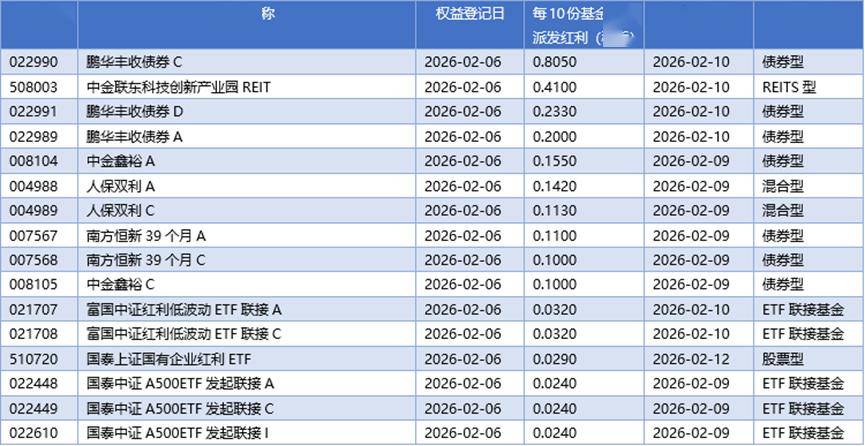
Group 1 - The public FOF market has seen a surge in activity at the beginning of 2026, with new products raising nearly 30 billion yuan, driven by strong demand from bank clients for diversified asset allocation in a low-interest-rate environment [1] - FOF is transitioning from a "fixed income+" dominated phase to a "multi-asset allocation" phase, utilizing a combination of stocks, bonds, commodities, and overseas assets to help investors manage market volatility and achieve stable growth [1] - On February 6, the A-share market experienced significant fluctuations, with the Shanghai Composite Index closing down 0.25% at 4065.58 points, and total market turnover reaching 2.16 trillion yuan, a decrease of 30.8 billion yuan from the previous trading day [1] Group 2 - On February 6, only one new fund was launched, primarily an equity fund, with the E Fund Hang Seng A-Share Electric Grid Equipment ETF aiming to raise 8 billion yuan; 16 funds distributed dividends, with the highest being 0.8050 yuan per 10 shares for the Penghua Harvest Bond Fund [2] - A total of 43 funds are set to be launched from February 9 to the end of the month, with a focus on equity funds, which account for nearly 80% of the new offerings, as institutions prepare for a potential spring market rally [2] - Fund managers are shifting strategies in response to increased market volatility, focusing on specific sectors or enhancing bottom-up stock selection, with an emphasis on preserving returns over seeking high gains in 2026 [2] Group 3 - Public fund institutions are increasingly launching Hong Kong-themed funds, with over 30 such funds reported since the beginning of the year, reflecting optimism about long-term investment opportunities in Hong Kong stocks, particularly in technology, consumer, and dividend sectors [3]

“巨无霸”缩水!宽基ETF开年大赎回,什么信号?
证券时报· 2026-02-08 09:33
Core Viewpoint - The stock ETF market has experienced significant net outflows since the beginning of the year, with a total reduction of nearly 700 billion yuan, primarily driven by a decrease in shares rather than market declines [1][2][3]. Group 1: ETF Market Overview - As of February 6, the total scale of stock ETFs is approximately 3.14 trillion yuan, down nearly 700 billion yuan since the start of the year [3][6]. - The net outflow of stock ETFs has been observed for 17 out of the 25 trading days since the beginning of the year, with a peak single-day net outflow exceeding 130 billion yuan [3][6]. - The largest net outflows have been recorded in major ETFs such as Huatai-PB CSI 300 ETF, which saw a net outflow of 196.54 billion yuan, and both E Fund and Huaxia's CSI 300 ETFs, each with net outflows exceeding 100 billion yuan [5][6]. Group 2: Share Reduction and Performance - The share reduction in major ETFs has been substantial, with declines of 40% to over 60% in various products, including the Huatai-PB CSI 300 ETF, which saw a 46.57% drop in shares [2][6]. - Despite the outflows, the average performance of stock ETFs has been positive, with an average increase of 3.59% since the beginning of the year [8]. - Specific ETFs, such as the Southern CSI 500 ETF, have recorded significant outflows while still achieving positive returns, indicating a disconnect between fund flows and market performance [8]. Group 3: Institutional Insights and Future Outlook - Institutional investors remain cautious about short-term market risks, leading to the observed outflows, but they maintain a generally optimistic outlook for the investment landscape in 2026 [2][10]. - The market is expected to shift from liquidity-driven dynamics to profit-driven and performance-validated trends, with a focus on the intrinsic resilience of A-shares and Hong Kong stocks [2][10]. - Analysts suggest that the ongoing regulatory measures and the evolving market environment will continue to influence investor behavior and capital allocation strategies [9][11].

“巨无霸”缩水!宽基ETF开年大赎回,什么信号?
券商中国· 2026-02-08 08:19
Core Viewpoint - The stock ETF market has experienced significant net outflows since the beginning of the year, with a total reduction of nearly 700 billion yuan, primarily driven by a decrease in shares rather than market declines [1][2][3] Group 1: ETF Market Overview - As of February 6, the total scale of stock ETFs is approximately 3.14 trillion yuan, down nearly 700 billion yuan since the start of the year [3][6] - The largest net outflows have been observed in the Huatai-PB CSI 300 ETF, which saw a net outflow of 1965.38 billion yuan, while the E Fund and Huaxia's CSI 300 ETFs also experienced outflows exceeding 1000 billion yuan [5][6] - Over 675 stock ETFs recorded net outflows, accounting for over 50% of the 1240 products tracked [5][6] Group 2: Share Reduction and Performance - The share reduction in major ETFs has been significant, with declines of 40% to over 60% in various products, including the Huatai-PB CSI 300 ETF, which saw a 46.57% drop in shares [2][6] - Despite the outflows, the average increase in stock ETFs is 3.59%, indicating that the outflows are not due to poor performance [8] - Specific ETFs like the Southern CSI 500 ETF and the Southern CSI 1000 ETF have shown positive performance despite significant net outflows [8] Group 3: Institutional Investor Sentiment - Institutional investors are currently exhibiting a cautious risk preference, leading to the observed outflows from broad-based ETFs [8][9] - Analysts suggest that the market is transitioning from liquidity-driven to earnings-driven dynamics, with a focus on profitability verification in 2026 [10][11] - The outlook for 2026 remains optimistic, with expectations for continued growth in emerging industries and a resilient A-share and Hong Kong market [10][11]

多赚20%以上,小白也能抓的“增强”红利?盘点2025年最强的指数增强基金!
Sou Hu Cai Jing· 2026-02-06 14:54
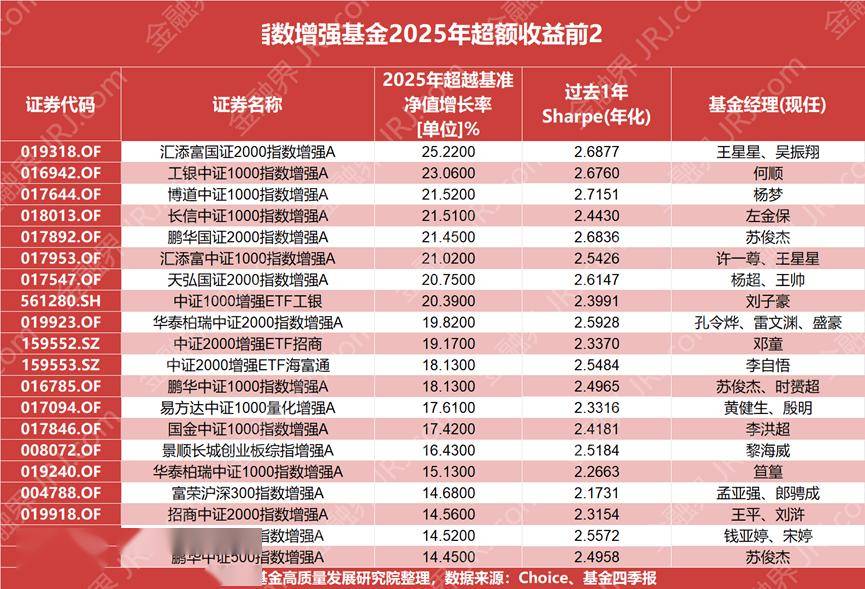
Core Insights - An emerging investment tool, index-enhanced funds, is gaining popularity among investors, with a significant increase in new products and total fundraising in 2025, surpassing previous years' totals [1] - Index-enhanced funds aim not only to track indices but also to outperform them by actively managing a portion of their assets through quantitative models and stock selection [1] Fund Performance - In 2025, the top-performing index-enhanced funds achieved substantial excess returns, particularly those tracking mid and small-cap indices like the Guozhen 2000 and Zhongzheng 1000, with the leading fund, Huaitianfu Guozhen 2000 Index Enhanced A, achieving a net value growth rate of 25.22% [2] - Other notable funds, such as the ICBC Zhongzheng 1000 Index Enhanced A and Baodao Zhongzheng 1000 Index Enhanced A, also reported excess returns exceeding 20% [2] Characteristics of Mid and Small-Cap Funds - Mid and small-cap index-enhanced funds are more successful in generating excess returns due to their index characteristics and the suitability of mainstream enhancement strategies [3] - The large number of constituent stocks in mid-cap indices, such as the Zhongzheng 2000, allows for a broad selection pool, facilitating the identification of potential stocks through quantitative models [3] - Information asymmetry and pricing inefficiencies in mid and small-cap stocks provide opportunities for quantitative strategies to discover mispriced assets and generate alpha returns [3] - The active trading and liquidity of small-cap stocks create a favorable environment for efficient trading execution and short-term price capture, enhancing overall returns [3]
工业有色ETF鹏华(159162)涨超1.2%,科技成为"铜"超越周期的新引擎
Xin Lang Cai Jing· 2026-02-04 01:55
Group 1 - LME copper prices reached $13,512.63 per ton, with a daily increase of 0.26% [1] - The China Nonferrous Metals Industry Association suggested improving the copper resource reserve system, including expanding national copper strategic reserves and exploring commercial reserve mechanisms [1] - Current copper prices are under pressure due to expectations of a reduction in the Federal Reserve's balance sheet, but the supply-demand fundamentals remain strong, with a projected widening global copper mine gap and increasing demand from AI infrastructure [1] Group 2 - As of January 30, 2026, the CSI Industrial Nonferrous Metals Theme Index (H11059) includes 30 large-cap companies involved in copper, aluminum, lead, zinc, and rare earth metals [2] - The top ten weighted stocks in the CSI Industrial Nonferrous Metals Theme Index account for 55.71% of the index, including companies like Luoyang Molybdenum, Northern Rare Earth, and China Aluminum [2]
卫星ETF鹏华(563790)涨超3.6%,“引力二号”预计2026年年中完成首飞
Xin Lang Cai Jing· 2026-02-03 07:07
Core Viewpoint - The commercial aerospace sector is experiencing significant activity, with the launch of the self-developed Gravitational No. 2 rocket by Dongfang Space, aimed at meeting the demand for medium to large satellite networks and commercial high-orbit launches, expected to complete its maiden flight by mid-2026 [1] Group 1: Industry Developments - The demand for rockets is surging, prompting attention to upstream materials, while the midstream equipment sector is expected to see significant changes in engine technology and 3D printing, which are characterized by scarcity and long-term inflationary logic [1] - The domestic market is anticipated to enter a new era of reusable rockets in 2026, driven by the synergy between commercial companies and state-owned enterprises [1] Group 2: Market Performance - As of February 3, 2026, the Zhongzheng Satellite Industry Index (931594) rose by 4.28%, with notable increases in constituent stocks such as Hailanxin (up 15.91%), XW Communication (up 11.58%), and Chip Origin (up 10.07%) [1] - The Penghua Satellite ETF (563790), which closely tracks the Zhongzheng Satellite Industry Index, increased by 3.61%, with a latest price of 1.23 yuan [1] Group 3: Index Composition - As of January 30, 2026, the top ten weighted stocks in the Zhongzheng Satellite Industry Index include Aerospace Electronics, China Satellite, Zhenlei Technology, and others, collectively accounting for 64.36% of the index [2]




工业有色ETF鹏华(159162)涨超5.4%,机构看好铜价格上行
Xin Lang Cai Jing· 2026-02-03 07:02
Group 1 - The China Nonferrous Metals Industry Association is working on improving the copper resource reserve system, which includes expanding the national copper strategic reserve and exploring commercial reserve mechanisms through financial subsidies for state-owned enterprises [1] - Huaxin Securities indicates that the copper downstream operating rate is recovering, leading to a domestic destocking trend, with prices expected to remain strong [1] - The aluminum supply side continues to see production increases in domestic and Indonesian electrolytic aluminum, while demand shows a mixed picture, with construction material demand declining [1] Group 2 - As of February 3, 2026, the CSI Industrial Nonferrous Metals Theme Index (H11059) rose by 3.04%, with significant gains in constituent stocks such as Dongyang Sunshine (up 10.02%) and Shenghe Resources (up 7.31%) [1] - The CSI Industrial Nonferrous Metals Theme Index tracks 30 large-cap companies involved in copper, aluminum, lead-zinc, and rare metals, reflecting the overall performance of the sector [2] - As of January 30, 2026, the top ten weighted stocks in the CSI Industrial Nonferrous Metals Theme Index account for 55.71% of the index, including companies like Luoyang Molybdenum and Northern Rare Earth [2]
工业有色ETF鹏华(159162)涨超2.8%,工业金属强势反弹
Xin Lang Cai Jing· 2026-02-03 01:52
截至2026年2月3日 09:30,中证工业有色金属主题指数(H11059)上涨0.39%,成分股中钨高新上涨 4.98%,电投能源上涨3.71%,紫金矿业上涨3.36%,洛阳钼业上涨3.12%,中国铝业上涨2.99%。工业有 色ETF鹏华(159162)上涨2.84%,最新价报0.94元。 工业有色ETF鹏华紧密跟踪中证工业有色金属主题指数,中证工业有色金属主题指数选取市值较大的30 只业务涉及铜、铝、铅锌、稀土金属等行业的上市公司证券作为指数样本,以反映工业有色金属主题上 市公司证券的整体表现。 数据显示,截至2026年1月30日,中证工业有色金属主题指数(H11059)前十大权重股分别为洛阳钼业、 北方稀土、中国铝业、兴业银锡、云铝股份、铜陵有色、江西铜业、厦门钨业、中金黄金、西部矿业, 前十大权重股合计占比55.71%。 消息面上,工业金属昨日大跌后筑底反弹,国内商品期货早盘开盘,氧化铝涨超1%。 东方证券指出,金融属性波动加剧,供需支撑价格底线。宽松叙事短期受挫,工业品跟随贵金属均有大 幅波动,但降息仍然是美联储的政策方向(而非加息),考虑近期特朗普试图通过提振地产市场来应对 支持率下降,海外地产修 ...




基金经理扩容!开年46人上岗 出于蓝如何胜于蓝?
Zhong Guo Jing Ji Wang· 2026-02-02 00:36
Group 1 - A total of 46 new fund managers have started their roles since the beginning of the year, primarily managing equity funds [1][2] - The new fund managers come from 35 different fund companies, including both large and small public funds, with a majority focusing on equity funds [2][3] - The educational background of the new fund managers is diverse, with all holding at least a master's degree, and many having experience as researchers or assistants before becoming fund managers [4][5] Group 2 - The trend of "sell-side to buy-side" career progression remains prevalent, with many new managers having transitioned from research roles [4][6] - New fund managers are generally younger, with many being born in the 1980s and 1990s, and they exhibit strong educational qualifications [4][7] - The average tenure from researcher to fund manager is around 6 to 8 years, with some achieving this in as little as 3 years [5][6] Group 3 - New fund managers often face challenges such as low initial attention and small management scales, requiring them to develop their investment frameworks [7][8] - Collaboration with experienced fund managers is common, allowing new managers to learn and grow in their roles [7][8] - Emphasis is placed on long-term performance and risk control, with a shift towards evaluating managers based on their ability to generate sustainable returns [8][9]