大疆

Search documents
福布斯中国低空经济产业系列评选揭晓 太湖度假区获创新场景奖
Su Zhou Ri Bao· 2026-02-02 00:30
Core Insights - The "2025 Forbes China Low Altitude Economy Industry Selection" awarded the "Innovation Scenario Award" to Suzhou Taihu National Tourism Resort for its innovative low-altitude inspection project "Comprehensive Fly Once" [1] Group 1: Project Overview - The project covers an area of 272.51 square kilometers of land and over 900 square kilometers of water, addressing complex tasks such as forest fire prevention and environmental protection [1] - The project integrates a "cloud management platform + unmanned airport" system, utilizing 30 DJI airport devices and the Qihang Insight cloud management platform to create a comprehensive low-altitude inspection network [1] Group 2: Technological Advancements - The project employs advanced technologies, including image CV algorithms, business data, 2D and 3D models, and various sensors, enabling a transition from retrospective analysis to real-time perception [1] - This technology allows for precise detection of environmental changes and risk hazards, enhancing the effectiveness of inspections [1] Group 3: Operational Efficiency - The project has established a full-process governance loop involving 13 departments, facilitating task assignment, automated inspections, data feedback, intelligent recognition, precise dispatching, and review of actions [2] - Over 12,000 flights have been conducted, achieving a unified low-altitude flight and data sharing system [2] - The automation of operations has reduced the workforce needed to one-fourth of previous levels, leading to a cost reduction of 16% to 25% across the industry [2] Group 4: Economic and Environmental Impact - The model emphasizes sustainability by avoiding redundant investments and reducing energy consumption, making the low-altitude economy more sustainable [2] - The replicable "Suzhou model" is expected to stimulate the development of upstream and downstream industries such as drone manufacturing, data analysis, and operational services, potentially exceeding a total output value of 10 billion [2]
2025年我国3D打印设备产量同比增长52.5% 3D打印为什么又火了?
Zheng Quan Ri Bao· 2026-02-02 00:01
Core Insights - 3D printing technology is experiencing rapid growth, transitioning from laboratory settings to production lines and everyday applications, driven by increasing demand and decreasing costs [1][2][4] Group 1: Market Demand and Applications - The significant increase in 3D printing equipment production by 52.5% by 2025 reflects strong downstream demand, particularly for personalized and customized products [1] - Consumers can now easily access 3D printing services through e-commerce platforms, allowing for high-precision products without the need to own a printer [1] - 3D printing is becoming an essential tool for companies in research and flexible production, enabling rapid prototyping and reducing development cycles [3] Group 2: Cost Reduction Factors - The decline in manufacturing costs for 3D printers is attributed to advancements in domestic manufacturing capabilities, with consumer-grade printers now priced similarly to mid-range smartphones [2] - The development of new alternative alloys and AI technologies has further reduced costs and simplified the modeling process, making 3D printing more accessible [3] Group 3: Policy and Capital Support - Government policies are playing a crucial role in promoting the market development of 3D printing, with initiatives aimed at innovation and application expansion [4] - Significant capital investment has been observed in the 3D printing sector, with various companies, including tech giants and venture capitalists, actively funding the industry [5] Group 4: Challenges and Solutions - Despite the growth, the 3D printing industry faces challenges in service and business models, with many users struggling with common issues like nozzle blockages and inadequate after-sales support [6] - Shared manufacturing and leasing models are being explored to help small and medium-sized enterprises reduce initial costs and operational expenses [7] - The industry is also leveraging e-commerce platforms and AI technologies to improve demand response and streamline the manufacturing process [7]
3D打印为何又火了
Jing Ji Ri Bao· 2026-02-01 22:06
Core Insights - The production of 3D printing equipment in China is expected to grow by 52.5% year-on-year by 2025, driven by strong downstream demand and advancements in technology [1][2][4] Application Trends - The demand for personalized and customized products is becoming mainstream, with consumers able to easily order 3D printed items through e-commerce platforms [1] - 3D printing technology is increasingly being integrated into various fields such as cultural creativity and educational technology, creating new consumer experiences and driving industry growth [3] Cost Reduction Factors - Significant reductions in manufacturing costs for 3D printers have been achieved due to advancements in domestic manufacturing capabilities, with consumer-grade 3D printers now priced similarly to mid-range smartphones [2] - The development of new alternative alloys and AI technologies has further reduced costs and simplified the operation of 3D printing, making it more accessible to the general public [3] Policy and Capital Support - Government policies are playing a crucial role in promoting the market development of 3D printing, with initiatives aimed at fostering innovation and expanding applications [4] - The 3D printing industry has seen multiple financing rounds since 2025, with investments from both tech companies and venture capital firms, indicating strong market interest [5][6] Challenges and Opportunities - Despite the growth, the 3D printing industry is still in its early stages, facing challenges in technical services and business models [7] - There is a mismatch between diverse market demands and supply efficiency, with the need for improved service models such as shared manufacturing and leasing to support small and medium enterprises [8][9]
广州举办2026年APEC首次高官会,中国引领亚太合作新征程
2 1 Shi Ji Jing Ji Bao Dao· 2026-02-01 14:02
(APEC 2026年第一次高官会在广州举办。资料图) 南方财经 21世纪经济报道记者胡慧茵 广州报道 早春2月,岭南大地春意正浓,千年商都广州迎来亚太经合组织(APEC)"中国年"首场盛会——APEC 2026年第一次高官会。 外交部发言人郭嘉昆在例行记者会上介绍,中国作为2026年亚太经合组织东道主,2月1日至10日在广州 举办APEC第一次高官会及相关会议,这也是APEC"中国年"首场正式活动。本次会议将聚焦2026年 APEC会议主题"建设亚太共同体,促进共同繁荣"和三大优先领域"开放、创新、合作",全面启动各领 域各机制合作,深入讨论具体合作,为11月领导人非正式会议积累成果。 2月1日,APEC高官会日程满满,重点讨论科技创新、监管协调、卫生工作和数据隐私等话题。谈及科 技创新话题,菲律宾科技部助理部长Napoleon Kilates Juanillo Jr在接受21世纪经济报道记者采访时表 示,在今天的会议上,各APEC经济体探讨了开放科学以及跨国科学家交流合作的相关议题,也探讨了 科技创新领域的潜在合作方向,各方在这些发展方向上的看法高度一致、达成了共识,"菲律宾作为正 式参与方,对科技创新政 ...
深圳公布GDP,中国经济的“含深量”还在上升
Xin Lang Cai Jing· 2026-02-01 12:38
Core Viewpoint - Shenzhen is emerging as a significant economic powerhouse in China, with its GDP projected to reach 38,731.8 billion yuan in 2025, making it the third-largest economy in the country and likely to surpass 40 trillion yuan by 2026 [2][30]. Group 1: Economic Growth - Shenzhen's GDP is expected to grow by 5.5% year-on-year, ranking first among major cities in China [3][31]. - The city contributed 1,929 billion yuan to the provincial GDP growth, accounting for 45.8% of the total increase, solidifying its role as the strongest economic engine in the province [3][31]. Group 2: Industrial Leadership - Shenzhen has become the first city in China to achieve an industrial output value exceeding 50 trillion yuan, with a projected industrial output of 54 trillion yuan in 2024 [6][35]. - The city continues to lead in industrial value-added growth at 5.4% in 2025, maintaining its status as the top industrial city in the country [6][35]. Group 3: Foreign Trade Dominance - In 2025, Shenzhen's total import and export volume is expected to reach 45,500 billion yuan, marking a 1.4% increase and maintaining its position as the leading city for foreign trade in mainland China [9][38]. - Shenzhen's export volume has achieved 33 consecutive months of growth, contributing 10% to the national total and 48% to Guangdong's total foreign trade [10][38]. Group 4: Entrepreneurial Environment - The total number of business entities in Shenzhen has surpassed 4.65 million, making it the city with the most entrepreneurs in China [13][41]. - In 2025, Shenzhen is projected to add 14,000 new foreign-funded enterprises, reflecting a growth of over 40% [13][41]. Group 5: Research and Development - Shenzhen's total R&D expenditure is expected to reach 245.31 billion yuan in 2024, with a growth rate of 9.7%, leading the country in R&D intensity at 6.67% [14][42]. - The city ranks first in the number of high-value patents, with 241,900 patent grants and 24,950 trademark registrations in 2024 [14][42]. Group 6: Cross-Border E-commerce - Shenzhen is recognized as the leading city for cross-border e-commerce, with import and export volumes reaching 372 billion yuan in 2024 [16][44]. - By 2025, the gross merchandise volume (GMV) of cross-border e-commerce in Shenzhen is expected to exceed 1 trillion yuan, representing a significant portion of the national market [18][45]. Group 7: Shenzhen's Success Factors - The success of Shenzhen is attributed to a combination of external factors (such as reform and opening-up) and internal characteristics (such as a market-driven economy and a culture of innovation) [22][52]. - The city embodies a spirit of entrepreneurship and innovation, emphasizing the importance of efficiency and a proactive approach to economic development [26][54].




中国城区“天花板”,吊打一众地级市
Mei Ri Jing Ji Xin Wen· 2026-02-01 08:10
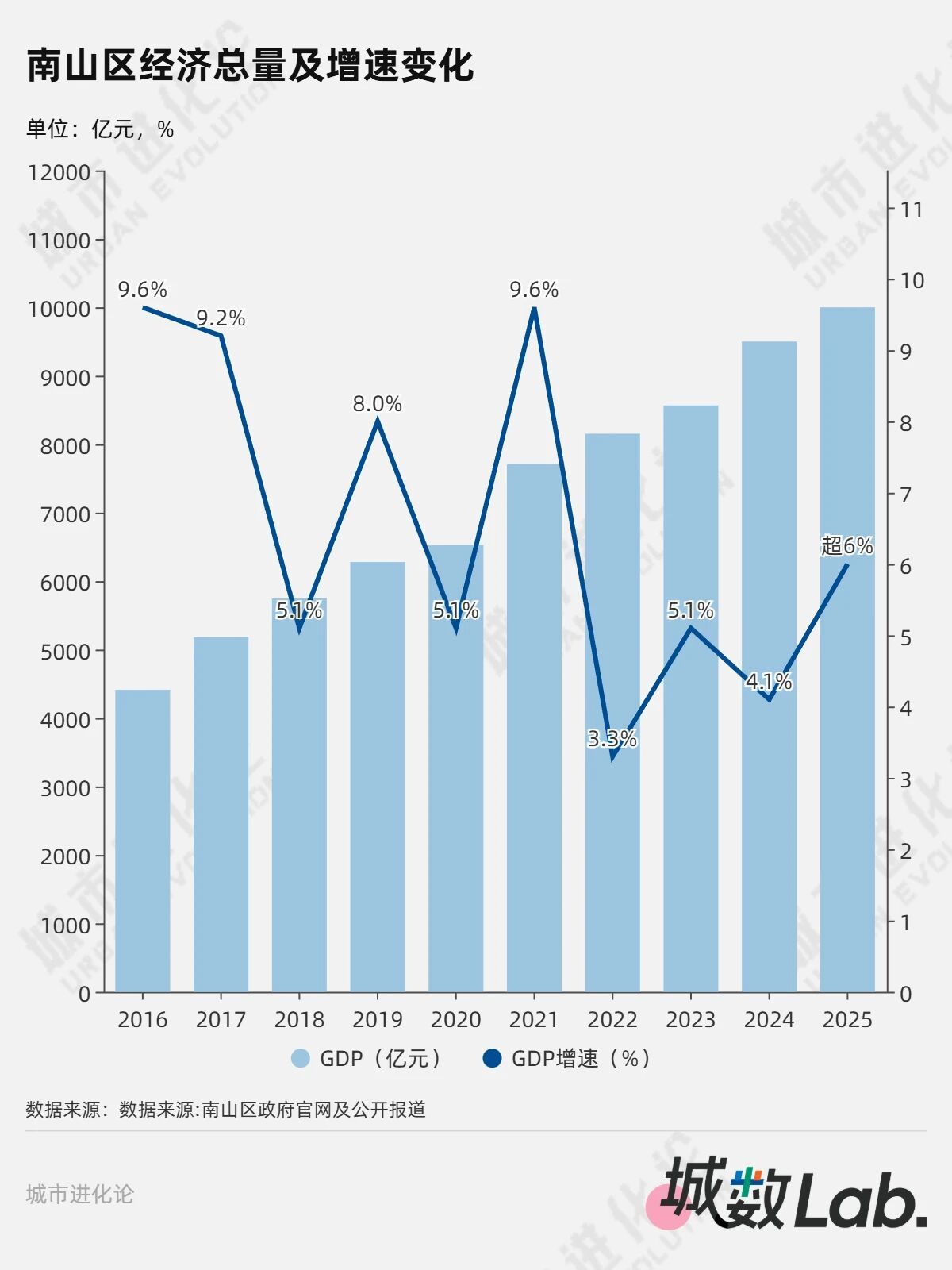
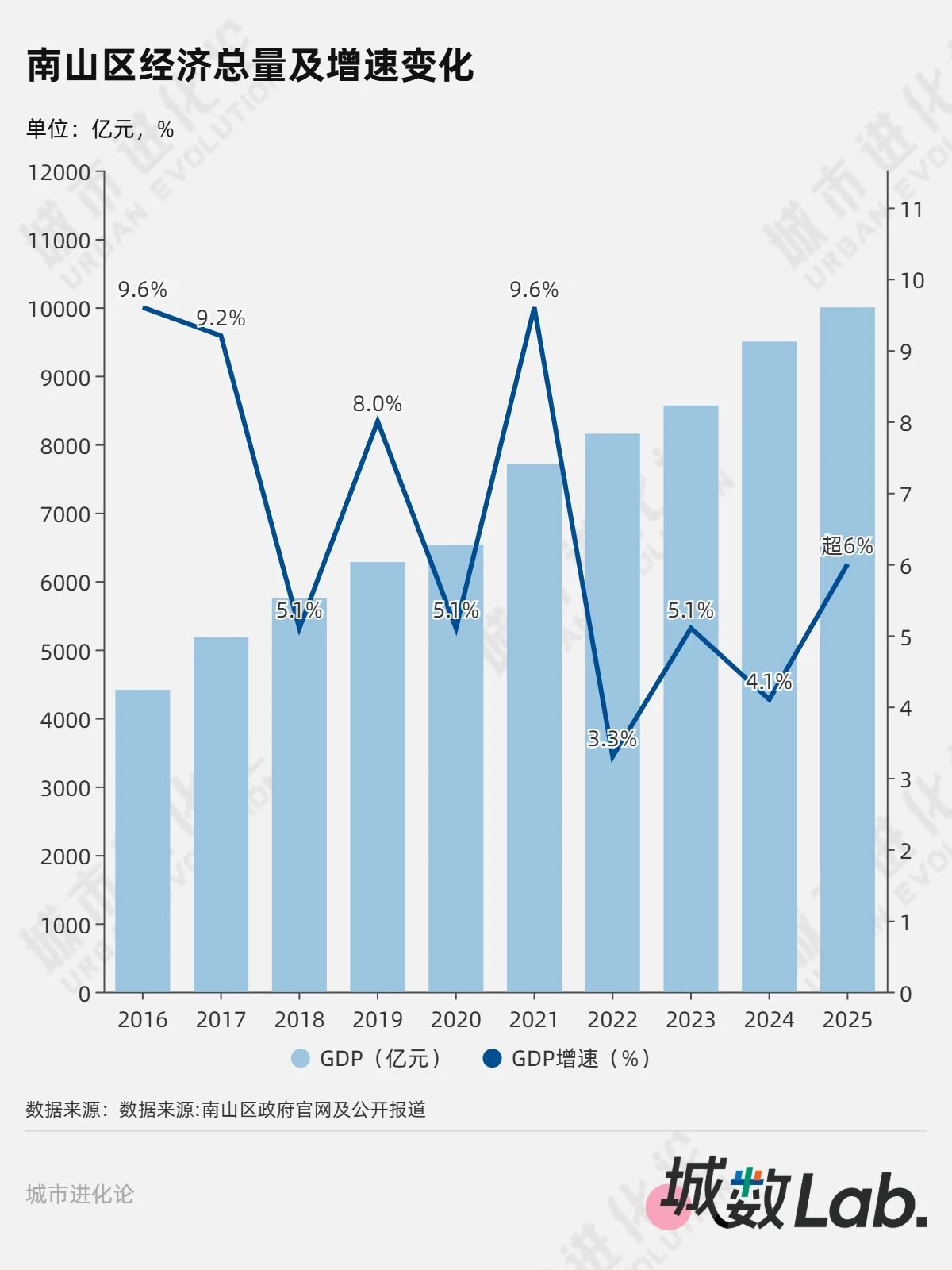
近日,深圳市南山区官宣2025年地区生产总值超万亿元,成为全国首个达到万亿级规模的区县级行政区。 这是什么概念?目前,全国GDP超万亿的城市也只有30个左右,南山区经济总量已经超过全国绝大多数地级市。 过去10年间,南山区经济总量从4411亿元跃升至超万亿元,近5年更是连跨4个千亿级台阶,以不足深圳1/10的土地,创造了超过1/4的GDP。 2025年,南山区每万人发明专利拥有量超860件,约为全国水平的22.9倍;研发投入强度高达7.87%,接近全国水平3倍。 战略性新兴产业占GDP比重达60%,高技术制造业和先进制造业占规上工业增加值比重分别达60.7%和58.6%,现代服务业占第三产业比重接近90%。 深圳南山之后,谁能成为下一个"万亿城区"? 这个"万亿城区"的含金量,可以看一组更直观的数据—— 2025年地均GDP达54亿元/平方公里,人均GDP超54万元、约为经济第一大省广东(11万元)的5倍; 全区拥有63.7万家市场主体、218家上市公司,相当于每平方公里就有超过1家上市公司,密度全国第一; 面积仅20平方公里的"最牛街道"粤海街道,汇聚了上百家上市公司和华为、腾讯、大疆、百度等科技大厂…… ...

城数Lab. | 中国城区“天花板”,吊打一众地级市
Mei Ri Jing Ji Xin Wen· 2026-02-01 08:06
这是什么概念?目前,全国GDP 超万亿的城市也只有30个左右,南山区经济总量已经超过全国绝大多数地级市。 过去10年间,南山区经济总量从4411亿元跃升至超万亿元,近5年更是连跨4个千亿级台阶,以不足深圳1/10的土地,创造了超过1/4的GDP。 每经记者|程晓玲 每经编辑|刘艳美 近日,深圳市南山区官宣2025年地区生产总值超万亿元,成为全国首个达到万亿级规模的区县级行政区。 战略性新兴产业占GDP比重达60%,高技术制造业和先进制造业占规上工业增加值比重分别达60.7%和58.6%,现代服务业占第三产业比重接近90%。 深圳南山之后,谁能成为下一个"万亿城区"? 这个"万亿城区"的含金量,可以看一组更直观的数据—— 2025年地均GDP达54亿元/平方公里,人均GDP超54万元、约为经济第一大省广东(11万元)的5倍; 全区拥有63.7万家市场主体、218家上市公司,相当于每平方公里就有超过1家上市公司,密度全国第一; 面积仅20平方公里的"最牛街道"粤海街道,汇聚了上百家上市公司和华为、腾讯、大疆、百度等科技大厂…… 科技巨头扎堆、经济密度之高,堪称中国城区经济发展的"天花板"。 南山的崛起之路,简单总 ...
广货出海记:一缕岭南味,万里故园情
Xin Lang Cai Jing· 2026-02-01 08:00
Group 1 - The article highlights the growing popularity of Guangdong products overseas, which serve as emotional connections for the Chinese diaspora, transcending mere commodities to become cultural symbols and carriers of nostalgia [1][3] - The New Hui Chenpi Village has successfully passed FDA testing for its Chenpi, with projected sales in the U.S. reaching 15 million RMB by 2025, reflecting a shift in lifestyle trends among overseas Chinese [3][4] - The market strategy focusing on "nostalgia" is supported by a strong cultural identity, with companies leveraging technology to meet overseas demand for traditional Guangdong foods, leading to increased sales of items like pre-packaged New Year dishes and preserved meats [4] Group 2 - Guangdong's foreign trade continues to lead China for 40 consecutive years, contributing 24.1% to the country's overall foreign trade growth, indicating the global appeal of Guangdong products [5] - The appeal of Guangdong goods extends beyond cultural circles, as evidenced by international consumers appreciating practical products like smart toilet seats, showcasing the global demand for quality and affordability [5] - Each Guangdong product carries a story from the Lingnan region, emphasizing the connection between goods and cultural heritage as they reach consumers worldwide [5]

从广东制造到全球智造,硬核广货畅销全球
Nan Fang Du Shi Bao· 2026-01-31 14:50
Core Insights - Guangdong products are transitioning from "Made in China" to "Intelligent Manufacturing Globally," showcasing innovation and quality as key advantages [1] - The "Guangdong Products Go Global" initiative aims to promote smart appliances and new energy vehicles internationally, reflecting Guangdong's commitment to innovation-driven consumption upgrades [1][2] Group 1: Global Market Performance - Guangdong's cross-border e-commerce import and export scale has expanded 66 times over nine years, accounting for over one-third of the national total, maintaining its position as the leading province [2] - By early 2026, Guangdong has established over 5,000 overseas branches, covering major economies across six continents, creating a comprehensive international layout [2][6] - The export value of Guangdong's home appliances reached 480 billion yuan in 2025, with a year-on-year growth of 12.3%, representing 35% of the national total [4][6] Group 2: Automotive Industry Growth - By 2025, Guangdong's new energy vehicle exports are projected to grow by approximately 120%, increasing its share of the national total to about 35% [3] - In 2025, Guangdong's automotive production is expected to exceed 5.7 million units, with new energy vehicles making up over 60% of this total [7] - BYD's ATTO 3 model is anticipated to rank among the top ten best-selling electric vehicles in Germany and France by 2025, highlighting its competitive edge in the European market [3] Group 3: Home Appliance Sector - Guangdong's home appliance industry, represented by brands like Gree, Midea, and TCL, has become a global leader through technological innovation and international expansion [4][6] - Midea has become the first domestic home appliance company to obtain the EU Product Environmental Declaration, marking a significant step towards becoming a global standard setter [9] - Gree's customized dehumidifiers have gained popularity in Southeast Asia, demonstrating the effectiveness of technology output over mere product exports [9] Group 4: Low-altitude Economy - Guangdong's low-altitude economy has surpassed 100 billion yuan, with over 15,000 related enterprises, capturing 70% of the global consumer drone market [5][8] - DJI leads the consumer drone market, while new entrants like Yihang are providing diverse low-altitude experiences [5][8] - The province has established 64 general airports and over 1,400 takeoff and landing points, enhancing its low-altitude infrastructure [8] Group 5: Cultural and Technological Impact - The internationalization of Guangdong products signifies a shift from simple product exports to technology and cultural exchange, enhancing China's global image [9] - Guangdong's products are not only recognized for their quality but also for their cultural significance, as seen in BYD's ATTO 3, which incorporates Chinese cultural elements [9][10] - The province's commitment to innovation and quality is expected to drive high-quality development and strengthen the global presence of "Chinese manufacturing" [10]


为什么说,天空的主导权,正在从硅谷转移到珠三角?
创业邦· 2026-01-31 01:12
Core Viewpoint - The article discusses the shift in dominance in the low-altitude economy, highlighting China's advancements in drone technology and infrastructure compared to the United States, emphasizing the differences in regulatory approaches and manufacturing capabilities [5][8][56]. Group 1: Low-altitude Economy in China - China's perspective on drones is that they are "flying servers" and "winged high-speed trains," aligning with its historical focus on infrastructure development [11][12]. - Shenzhen has established a comprehensive digital infrastructure for low-altitude operations, akin to building roads, which facilitates drone operations [14][15]. - The Civil Aviation Administration of China (CAAC) adopts a pragmatic regulatory approach, allowing for experimentation in designated areas, which contrasts with the U.S. focus on strict regulations [17][18]. Group 2: U.S. Regulatory Challenges - The U.S. Federal Aviation Administration (FAA) prioritizes manned aircraft, creating significant barriers for commercial drone operations, such as the "Visual Line of Sight" requirement [22][25]. - Despite having advanced drone technology, U.S. companies face bureaucratic hurdles that hinder commercial applications, leading to a lack of large-scale deployment [26][39]. - Cultural resistance, such as NIMBYism, further complicates the acceptance and integration of drones into American society [27]. Group 3: Manufacturing and Supply Chain - The article highlights the disparity in manufacturing capabilities, with China able to produce drones at a lower cost and higher efficiency due to its robust supply chain [33][34]. - U.S. attempts to create a domestic drone manufacturing ecosystem face challenges, as compliant U.S. drones are significantly more expensive and less capable than their Chinese counterparts [36][40]. - The cycle of limited commercial applications leading to high costs and low demand for U.S. drones is described as the "hardware curse" [40]. Group 4: Military Implications - The article notes that the use of inexpensive consumer drones in military conflicts has raised alarms in the U.S., prompting a reevaluation of drone strategies [44][45]. - China's approach to drone technology has evolved from consumer markets to military applications, showcasing a bottom-up innovation model [45][46]. - The U.S. is now attempting to rapidly develop affordable drones through initiatives like the "Replicator Initiative," but faces fundamental challenges in manufacturing without relying on Chinese supply chains [50][52]. Group 5: Future Outlook - The article concludes that the competition between the U.S. and China in the low-altitude economy will depend on who can better embrace innovation and tolerate experimentation [56][57]. - While the U.S. retains strengths in AI and advanced technologies, the current regulatory environment may hinder its ability to capitalize on drone technology [56].