迈瑞医疗

Search documents
医药生物行业双周报(2026、1、9-2026、1、22)-20260123
Dongguan Securities· 2026-01-23 05:17
Investment Rating - The report gives a "Market Weight" rating for the pharmaceutical and biotechnology industry, indicating that the industry index is expected to perform within ±10% of the market index over the next six months [26]. Core Insights - The SW pharmaceutical and biotechnology industry underperformed the CSI 300 index, declining by 0.75% from January 9 to January 22, 2026, which is approximately 0.46 percentage points lower than the CSI 300 index [11]. - Most sub-sectors within the industry recorded positive returns during the same period, with offline pharmacies and raw materials sectors leading with increases of 3.14% and 2.34%, respectively [12]. - Approximately 66% of stocks in the industry recorded positive returns, with the top performer, Baolait, seeing a weekly increase of 60.88% [13]. - The overall price-to-earnings (P/E) ratio for the SW pharmaceutical and biotechnology industry was approximately 52.01 times as of January 22, 2026, showing little change [19]. Summary by Sections 1. Market Review - The SW pharmaceutical and biotechnology industry lagged behind the CSI 300 index, with a decline of 0.75% from January 9 to January 22, 2026 [11]. - Most sub-sectors achieved positive returns, particularly offline pharmacies and raw materials, which rose by 3.14% and 2.34% respectively [12]. - About 66% of stocks in the industry had positive returns, with Baolait leading at a 60.88% increase [13]. - The industry’s P/E ratio was approximately 52.01 times, relative to the CSI 300's P/E ratio of 3.86 times [19]. 2. Industry News - Recent policy changes in Hebei Province have lifted restrictions on the quantity of drugs that hospitals can stock, allowing for more flexibility in drug procurement [24]. - The National Health Commission issued new medical treatment guidelines for trauma and burn victims to enhance emergency response capabilities [22][23]. 3. Company Announcements - Enhua Pharmaceutical announced the approval of a new drug registration certificate for a non-steroidal anti-inflammatory drug, which is expected to reduce the need for opioid pain relief post-surgery [25]. 4. Industry Outlook - The report suggests a focus on investment opportunities in the brain-computer interface sector, which is highlighted in the 14th Five-Year Plan, with ongoing policy support [26]. - Recommended stocks for attention include leading companies in medical devices, pharmaceutical retail, aesthetic medicine, and innovative drugs, among others [28].
AI医疗爆发,多股年内涨超30%
21世纪经济报道· 2026-01-23 04:53
Core Viewpoint - The AI healthcare sector is experiencing significant growth and interest in 2026, with the AI healthcare index rising over 11% in just 14 trading days, indicating a clear trend in capital market enthusiasm for this sector [1][2]. Market Performance - As of January 22, 2026, the AI healthcare index increased by over 11%, while the CSI Medical Index and Hang Seng Healthcare Index rose by 7.68% and 10.65%, respectively [1]. - Companies like Di'an Diagnostics and Baolait have seen their stock prices surge over 60%, with others like Weining Health and Chengdu Xian Dao also experiencing gains exceeding 30% [1]. Industry Growth Projections - According to Frost & Sullivan, the AI healthcare market in China is projected to grow from 8.8 billion yuan in 2023 to 315.7 billion yuan by 2033, with a compound annual growth rate (CAGR) of 43.1% [1]. Technological Advancements - Major tech companies are actively entering the AI healthcare space, with OpenAI launching a healthcare version of ChatGPT and other firms like Ant Group, Tencent, JD, and ByteDance developing AI healthcare models and applications [5][6]. - AI drug development is identified as the fastest-growing segment within AI healthcare, with companies like Insilico Medicine and WuXi AppTec significantly reducing drug development timelines [6][7]. Commercialization Challenges - Despite the enthusiasm, the commercialization of AI healthcare products is facing challenges, with many companies reporting losses. For instance, 24 out of 47 biomedicine companies forecasted losses or reduced profits for 2025 [10]. - Companies like KingMed Diagnostics and Anbiping are experiencing significant revenue declines, with Anbiping reporting a 28.29% drop in revenue year-on-year [10][11]. Regulatory Developments - Recent government policies are seen as a positive signal for the AI healthcare sector, with initiatives aimed at promoting and standardizing AI applications in healthcare [15][16]. - The National Healthcare Security Administration has clarified pricing for AI-assisted diagnostic services, which is expected to facilitate the integration of AI into routine clinical practice [15][16]. Future Outlook - Industry experts predict that 2026 will be a pivotal year for AI healthcare, with clearer payment structures and stronger financial backing expected to enhance commercialization prospects [16].


医疗创新ETF(516820)红盘向上,近五成生物医药公司业绩预喜
Xin Lang Cai Jing· 2026-01-23 02:39
Group 1 - The core viewpoint of the news highlights the positive performance of the medical and healthcare innovation sector, with the China Medical and Medical Device Innovation Index rising by 0.87% and several key stocks showing significant gains [1] - Over 50 biopharmaceutical companies have disclosed their 2025 performance forecasts, with nearly half (27 companies) expecting positive results, indicating a favorable outlook for the sector [1] - The CXO (Contract Research Organization) industry, particularly leading company WuXi AppTec, is projected to achieve approximately 45.46 billion yuan in revenue for 2025, reflecting a year-on-year growth of about 15.84%, and a net profit increase of approximately 102.65% [1] Group 2 - The National Healthcare Security Administration has introduced new policies to accelerate the promotion and adoption of surgical robots and related surgical consumables, which is expected to benefit the overall innovative medical device market [2] - Investors are advised to focus on two main investment themes: the surgical robot industry and its supply chain, as well as high-value consumables in minimally invasive surgery, orthopedics, gastroenterology, cardiovascular, and neurology [2] - The China Medical and Medical Device Innovation Index comprises 30 publicly listed companies with strong profitability and growth potential, with the top ten stocks accounting for 63.75% of the index [2]
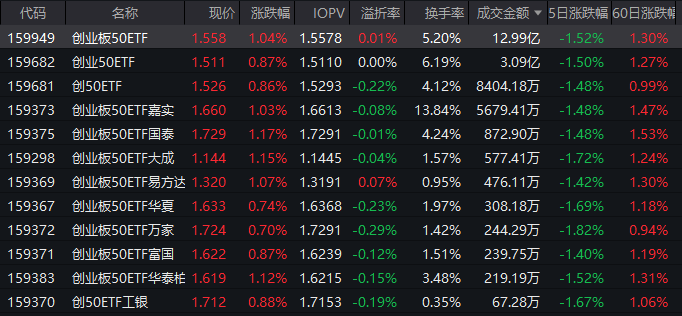
如何一键布局创业板核心资产?创业板50ETF(159949)单日成交近13亿 流动性居市场前列
Xin Lang Cai Jing· 2026-01-22 08:29
Market Performance - On January 22, the A-share market experienced a morning surge followed by a pullback, with the three major indices closing in the green, and the ChiNext Index rising nearly 1% [1][6] - The ChiNext 50 ETF (159949) increased by 1.04%, closing at 1.558 yuan, with a turnover rate of 5.20% and a transaction volume of 1.299 billion yuan, ranking first among similar ETFs [1][6] Liquidity and Trading Data - As of January 22, the ChiNext 50 ETF (159949) recorded a cumulative transaction amount of 38.006 billion yuan over the last 20 trading days, with an average daily transaction amount of 1.900 billion yuan; since the beginning of the year, the cumulative transaction amount over 14 trading days was 27.332 billion yuan, with an average daily transaction amount of 1.952 billion yuan [2][7] - The circulating scale of the ChiNext 50 ETF was 24.900 billion yuan as of January 21, 2026 [2][7] Fund Holdings and Performance - The latest quarterly report indicates that the top ten holdings of the ChiNext 50 ETF (159949) showed mixed performance, including stocks like CATL, Zhongji Xuchuang, and Mindray Medical [3][8] - The fund manager noted that the fourth quarter saw a return to structural market trends, with significant divergence in the ChiNext, particularly in sectors like AI and new energy [10] Investment Outlook - The ChiNext 50 ETF is viewed as a convenient tool for long-term investors interested in China's technology growth sector, with a three-year return of 35.16%, outperforming its benchmark and ranking 526th among 1,633 similar products [5][11] - Recommendations for investors include adopting a dollar-cost averaging strategy or phased investment to smooth out short-term volatility while closely monitoring the performance of constituent stocks and relevant policy developments [5][11]






AI医疗爆发三重奏:亢奋、焦虑与希望
2 1 Shi Ji Jing Ji Bao Dao· 2026-01-22 08:03
Core Viewpoint - The AI healthcare sector is experiencing significant growth and interest in 2026, with substantial increases in various healthcare indices and notable stock performance among key companies in the sector [1][2]. Market Performance - As of January 21, 2026, the AI healthcare index surged over 11%, while the CSI Medical Index and Hang Seng Healthcare Index rose by 8% and 11.67% respectively [1]. - Companies like Dean Diagnostics and Baolite have seen stock increases exceeding 60%, with others like Weining Health and Chengdu Xian Dao also showing gains over 20% [1]. Market Trends and Projections - The AI healthcare market in China is projected to grow from 8.8 billion yuan in 2023 to 315.7 billion yuan by 2033, reflecting a compound annual growth rate of 43.1% [2]. - The rapid advancement in AI healthcare applications is driven by technological breakthroughs, favorable policies, and increasing market demand [2]. Technological Developments - Major tech companies are actively entering the AI healthcare space, with OpenAI, Google, and domestic firms like Ant Group and Tencent launching various AI healthcare applications [4]. - Significant advancements have been made in AI-assisted diagnostics, medical imaging, and drug development, indicating a trend towards more efficient healthcare solutions [5][6]. Commercialization Challenges - Despite the enthusiasm, the commercialization of AI healthcare products faces challenges, including ethical concerns, regulatory risks, and slow progress in translating technological advancements into financial performance [10][11]. - As of January 21, 2026, over half of the 47 biomedicine companies that disclosed earnings forecasts reported losses or reduced earnings, highlighting the disparity between market excitement and actual financial results [10]. Regulatory Developments - Recent government initiatives aim to promote and standardize the application of AI in healthcare, with a focus on establishing high-quality data sets and clinical models by 2027 [13][14]. - The National Healthcare Security Administration has clarified pricing for AI-assisted diagnostic services, which is expected to enhance the commercial viability of AI healthcare products [14]. Future Outlook - Industry experts predict that 2026 will be a pivotal year for the commercialization of AI healthcare, driven by clearer payment structures and stronger market demand [13][14]. - The focus will likely be on AI applications in drug development, diagnostics, and operational efficiency, with expectations for rapid growth in the sector [14].
医保局推动实现全国医疗服务价格项目基本统一,医疗创新ETF(516820)持续获资金关注
Xin Lang Cai Jing· 2026-01-22 05:20
Group 1 - The core viewpoint of the news highlights the positive momentum in the medical innovation sector, driven by the National Healthcare Security Administration's initiatives to support pricing for innovative medical technologies [1][2] - The China Securities Index for medical and medical device innovation (931484) shows mixed performance among its constituent stocks, with notable gains from companies like Yingke Medical and New Horizon [1] - The Medical Innovation ETF (516820) has seen significant net inflows, totaling 51.78 million yuan over four days, indicating strong investor interest in the sector [1] Group 2 - CITIC Securities anticipates that the expansion of the National Healthcare Security Administration's pricing directory will facilitate faster national pricing and hospital admission processes for innovative medical devices, addressing previous challenges in the market [2] - The index comprises 30 publicly listed companies with strong profitability and growth potential, reflecting the overall performance of the medical and medical device sector [2] - As of December 31, 2025, the top ten weighted stocks in the index account for 63.75% of its total weight, including major players like WuXi AppTec and Mindray Medical [2]
中国医疗-中国医院调研:2026年保持谨慎乐观
2026-01-22 02:44
Summary of China Healthcare Industry Conference Call Industry Overview - **Industry**: China Healthcare Industry - **Report Date**: January 21, 2026 - **Sentiment**: Cautiously optimistic outlook for 2026 regarding hospital capital expenditures and market dynamics [1][2] Key Insights Capital Expenditure Trends - **Stable to Moderate Growth**: Hospital capital expenditures are expected to remain stable with moderate growth in 2026 [2] - **Survey Results**: 59% of surveyed hospital managers anticipate capital expenditure growth in 2026, up from 43% in late 2024, but still below 85% in late 2023 [3] - **Projected Growth Rate**: Expected capital expenditure growth of 4.7% in 2026, compared to 3.0% growth anticipated for 2025 [3] - **Actual Growth Expectations**: Respondents expect actual capital expenditure growth of 5.8% for 2025, indicating limited visibility on actual demand [3] Key Drivers of Expenditure - **Primary Drivers**: 1. Hospital Surplus (69%) 2. Patient Demand (50%) 3. Local Fiscal Budgets (44%) [3] - **Service Volume Constraints**: Factors such as Diagnosis-Related Group (DRG) payment limits and medical insurance settlements are seen as major constraints on service volume [3] Equipment and Technology Focus - **Investment Priorities**: Hospitals are prioritizing investments in AI, endoscopy, and imaging equipment, with a focus on surgical and flexible endoscopes, followed by CT and ultrasound [3] - **Weak Demand**: In vitro diagnostics are expected to remain weak [3] Company-Specific Insights Beneficiaries of Capital Expenditure Growth - **Mindray Medical (300760.SZ)**: Expected to benefit from a stable capital expenditure environment, with anticipated single-digit revenue growth in 2026. The company is expected to maintain a 16% share of planned capital expenditures [4][10] - **United Imaging (688271.SS)**: Anticipated to benefit from strong demand in high-end imaging, with projected revenue growth of approximately 21% in 2026 [4][11] - **New Industries (300832.SZ)**: Expected to face continued pricing pressure in in vitro diagnostics but may achieve above-industry growth due to healthy demand for chemical luminescence analyzers [4][12] - **Huatai Medical (688617.SS)**: Positioned to capitalize on the growing adoption of pulse field ablation technology, with projected revenue growth of 30% in 2026 [4][13] - **Guichuang Tongqiao (2190.HK)**: Expected to see revenue growth of around 30% driven by increased demand for neurointerventional and peripheral interventional procedures [4][15] Challenges for Global Players - **GE Healthcare**: Faces mixed impacts from increased capital expenditure and growing preference for local brands, which may offset some growth [4][16] - **Siemens Healthineers (SHL)**: Cautious outlook due to slow recovery in utilization rates and increased pricing pressure from procurement policies [4][17] - **Philips (PHIA)**: Similar cautious outlook with potential declines in market share for CT and ultrasound equipment [4][18] - **Olympus (7733.T)**: Expected to face challenges in maintaining market share in the digestive endoscopy market [4][19] - **Hologic (6869.T)**: Anticipated slowdown in clinical testing volumes and potential market share decline in hematology [4][20] Additional Observations - **Market Dynamics**: The report highlights a complex landscape for global medical technology companies in China, with both opportunities and pressures from local competition and procurement policies [4][16][17][18][19][20] - **Emerging Trends**: The shift towards local brands and the impact of procurement policies are significant trends that may reshape the competitive landscape in the healthcare sector [4][16][17][18][19][20]





医疗创新ETF(516820)连续4天净流入,机构称医疗器械迎来行业性投资机遇
Xin Lang Cai Jing· 2026-01-22 02:35
数据显示,截至2025年12月31日,中证医药及医疗器械创新指数(931484)前十大权重股分别为药明康 德、恒瑞医药、迈瑞医疗、爱尔眼科、片仔癀、新和成、华东医药、康龙化成、艾力斯、甘李药业,前 十大权重股合计占比63.75%。 风险提示:基金有风险,投资需谨慎。基金管理人承诺以诚实信用、勤勉尽责的原则管理和运用基金资 产,但不保证本基金一定盈利,也不保证最低收益。基金管理人提醒投资人基金投资的"买者自负"原 则,在做出投资决策后,基金运营状况与基金净值变化引致的投资风险,由投资人自行负担。基金的过 往业绩及其净值高低并不预示其未来业绩表现,基金管理人管理的其他基金的业绩不构成对本基金业绩 表现的保证。投资人购买基金,既可能按其持有份额分享基金投资所产生的收益,也可能承担基金投资 所带来的损失。投资人应当认真阅读《基金合同》《招募说明书》等基金法律文件,全面认识本基金的 风险收益特征和产品特性,并根据自身的投资目的、投资期限、投资经验、资产状况等判断基金是否和 投资人的风险承受能力相适应,理性判断市场,谨慎做出投资决策。本材料中相关信息来源于基金管理 人认为可靠的公开资料,相关观点、评估和预测仅反映当前的判 ...
新质生产力领航 大湾区外贸高质量发展启新程|“十五五”开局新气象
Zheng Quan Shi Bao· 2026-01-22 00:20
1月1日上午,粤港澳大湾区今年首趟中欧班列从广州东部公铁联运枢纽增城西站驶出,110个标准集装箱装满电子产品、日用百货等商品,预计14天后抵 达波兰马拉舍维奇。 这趟满载"大湾区制造"的班列,正是区域外贸高质量发展的生动注脚——在复杂多变的国际环境中,作为我国对外开放前沿的粤港澳大湾区,正以新质生 产力为核心驱动力,完成从规模扩张到质量提升的系统性转型,为"十五五"外贸发展筑牢根基。 结构升级显韧性 外贸"含新量"持续攀升 近年来,大湾区外贸顶住全球经济波动、地缘政治冲突等多重压力,实现发展动能的结构性转换,呈现总量稳增、质效齐升的鲜明特征。最新数据印证了 这一态势。2025年,粤港澳大湾区内地九市进出口总额达9.15万亿元,同比增长4.7%,占全国进出口总值的20.1%,对全国外贸贡献超1/4增量,创历史新 高。 龙头领路破局 全球化布局向纵深推进 面对"十五五"开局的新机遇与新挑战,大湾区龙头企业主动作为,通过产能优化、渠道拓展、品牌升级、组织革新等多维布局,在全球市场抢占先机,为 行业树立标杆。 消费电子领域的TCL电子,始终坚守"中高端"及"全球化"战略,构建起全方位海外布局体系。在产能与供应链层面, ...

新质生产力领航 大湾区外贸高质量发展启新程|“十五五”开局新气象
证券时报· 2026-01-22 00:12
1月1日上午,粤港澳大湾区今年首趟中欧班列从广州东部公铁联运枢纽增城西站驶出,110个标准集装箱装满电子产品、日用百货 等商品,预计14天后抵达波兰马拉舍维奇。 这趟满载"大湾区制造"的班列,正是区域外贸高质量发展的生动注脚——在复杂多变的国际环境中,作为我国对外开放前沿的粤港澳大湾区,正以新质生 产力为核心驱动力,完成从规模扩张到质量提升的系统性转型,为"十五五"外贸发展筑牢根基。 结构升级显韧性 外贸"含新量"持续攀升 近年来,大湾区外贸顶住全球经济波动、地缘政治冲突等多重压力,实现发展动能的结构性转换,呈现总量稳增、质效齐升的鲜明特征。最新数据印证了 这一态势。2025年,粤港澳大湾区内地九市进出口总额达9.15万亿元,同比增长4.7%,占全国进出口总值的20.1%,对全国外贸贡献超1/4增量,创历史新 高。 细分结构中,"向高向新"成为核心趋势。作为出口主力的机电产品表现亮眼,规模达4.07万亿元,增长7.6%,占九市出口总值近七成。其中,电子元件、 电工器材等传统优势产品出口稳步增长,"新三样"、3D打印机、无人机等智能绿色产品出口增速均超三成,成为拉动外贸增长的新引擎,彰显大湾区制 造业在全球产业 ...