
易方达

Search documents
商业航天、太空光伏迎来多重催化,光伏ETF易方达(562970)涨超5%,卫星ETF易方达(563530)涨超1.7%,资金持续净流入
Xin Lang Cai Jing· 2026-02-09 02:49
Group 1 - A-shares main indices have risen, with space photovoltaics and commercial sectors leading the gains; the photovoltaic ETF E Fund (562970) increased over 5% and has a year-to-date gain of over 20% [1] - The satellite ETF E Fund (563530) rose over 1.7% with a year-to-date increase of over 9% [1] - The industry is experiencing catalysts, including the successful launch of a reusable experimental spacecraft by China on February 7, which is expected to lead to a high-frequency launch normalization in commercial space by 2026 [1] Group 2 - A significant new stock listing is set for February 10, 2026, with Electric Science Blue Sky announcing its stock will be listed on the Shanghai Stock Exchange's Sci-Tech Innovation Board [2] - There is a rapid acceleration in overseas space computing and space photovoltaic layouts; Elon Musk stated that SpaceX and Tesla aim to produce 100 gigawatts of solar cells annually [2] - Continuous capital inflow into related sectors is noted, with the photovoltaic ETF E Fund (562970) seeing a net inflow of 95.3 million yuan in the last 10 days, and the satellite ETF E Fund (563530) experiencing a net inflow of 212 million yuan [2] - The photovoltaic ETF focuses on leading companies in the entire photovoltaic industry chain, benefiting significantly from global energy storage construction [2] - The satellite ETF covers core areas such as satellite manufacturing, launching, communication, navigation, remote sensing, and ground equipment, forming a comprehensive investment matrix that aligns with long-term industry development trends [2]
恒生科技指数大幅高开近2%,恒生科技ETF易方达(513010)上周净流入超18亿元
Mei Ri Jing Ji Xin Wen· 2026-02-09 02:03
Core Viewpoint - The Hong Kong stock market is experiencing increased activity, particularly in the technology sector, with significant inflows of capital and positive market sentiment leading to expectations of a rebound in stock prices [1] Group 1: Market Performance - The Hang Seng Technology Index opened 1.9% higher, while the CSI Hong Kong Stock Connect Internet Index rose by 2.0%, driven by large technology stocks [1] - Southbound capital saw a net inflow exceeding 56 billion yuan last week, marking the highest weekly inflow since late September of the previous year [1] - The Hang Seng Technology ETF (513010) recorded a net inflow of over 3 billion yuan on each trading day last week, totaling more than 1.8 billion yuan [1] Group 2: Investment Outlook - China Galaxy Securities reports that the technology sector remains a long-term investment focus, with reduced valuation pressure following recent corrections, suggesting potential for a rebound [1] - The Hang Seng Technology Index consists of the 30 largest stocks related to technology themes listed in Hong Kong, while the CSI Hong Kong Stock Connect Internet Index focuses on internet platform companies, including key AI enterprises [1] - Both indices have rolling price-to-earnings ratios below 25, positioned at the 24.3% and 20.8% percentiles since their inception [1] Group 3: Investment Products - The Hang Seng Technology ETF (513010) and the Hong Kong Stock Connect Internet ETF (513040) track the aforementioned indices, providing investors with a convenient way to invest in leading technology stocks in Hong Kong [1]
金融界财经早餐:国常会重磅!促进有效投资政策,深入谋划推动重大项目;证监会开年重拳出击,A股零容忍持续升级!央行连续15个月增持黄金;预制菜国标出炉(2月9日)
Jin Rong Jie· 2026-02-09 01:03
2月9日,金融界财经早餐,宏观政策、资本市场、行业板块、公司个股资讯一览: 一、今日财经资讯 1、李强主持召开国务院常务会议,研究促进有效投资政策措施。会议指出,促进有效投资对于稳定经 济增长、增强发展后劲具有重要作用。要创新完善政策措施,加力提效用好中央预算内投资、超长期特 别国债、地方政府专项债券等资金和新型政策性金融工具。要结合制定实施"十五五"规划,着眼于长远 发展需要和构筑未来竞争优势,在基础设施、城市更新、公共服务、新兴产业和未来产业等重点领域, 深入谋划推动一批重大项目、重大工程。要更好发挥央国企扩投资作用,加大力度支持民间投资发展, 形成促进有效投资的合力。 2、中国人民银行等八部门发布关于进一步防范和处置虚拟货币等相关风险的通知。通知指出,虚拟货 币不具有与法定货币等同的法律地位。比特币、以太币、泰达币等虚拟货币具有非货币当局发行等主要 特点,不具有法偿性,不应且不能作为货币在市场上流通使用。 3、国家外汇管理局2月7日发布的最新统计数据显示,2026年1月末,中国官方黄金储备为7419万盎司, 较2025年12月末增加4万盎司。目前,中国央行已连续15个月增持黄金。截至2026年1月末,我 ...
基金早班车丨FOF新发近300亿,从“固收+”迈向多元配置2.0
Sou Hu Cai Jing· 2026-02-09 00:49
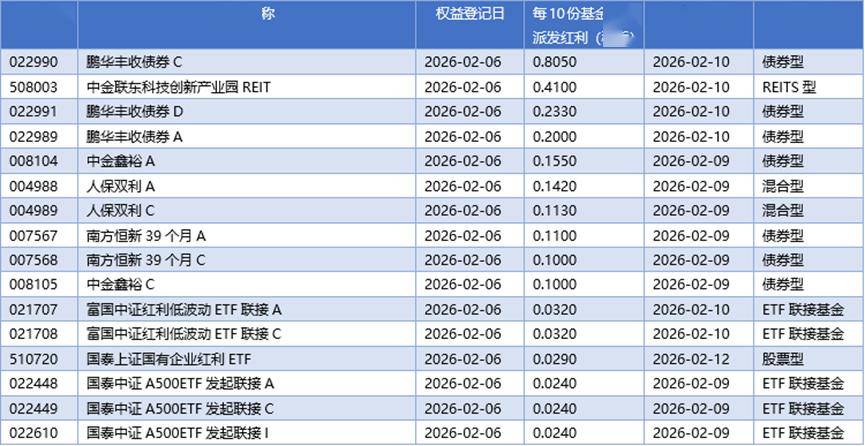
Group 1 - The public FOF market has seen a surge in activity at the beginning of 2026, with new products raising nearly 30 billion yuan, driven by strong demand from bank clients for diversified asset allocation in a low-interest-rate environment [1] - FOF is transitioning from a "fixed income+" dominated phase to a "multi-asset allocation" phase, utilizing a combination of stocks, bonds, commodities, and overseas assets to help investors manage market volatility and achieve stable growth [1] - On February 6, the A-share market experienced significant fluctuations, with the Shanghai Composite Index closing down 0.25% at 4065.58 points, and total market turnover reaching 2.16 trillion yuan, a decrease of 30.8 billion yuan from the previous trading day [1] Group 2 - On February 6, only one new fund was launched, primarily an equity fund, with the E Fund Hang Seng A-Share Electric Grid Equipment ETF aiming to raise 8 billion yuan; 16 funds distributed dividends, with the highest being 0.8050 yuan per 10 shares for the Penghua Harvest Bond Fund [2] - A total of 43 funds are set to be launched from February 9 to the end of the month, with a focus on equity funds, which account for nearly 80% of the new offerings, as institutions prepare for a potential spring market rally [2] - Fund managers are shifting strategies in response to increased market volatility, focusing on specific sectors or enhancing bottom-up stock selection, with an emphasis on preserving returns over seeking high gains in 2026 [2] Group 3 - Public fund institutions are increasingly launching Hong Kong-themed funds, with over 30 such funds reported since the beginning of the year, reflecting optimism about long-term investment opportunities in Hong Kong stocks, particularly in technology, consumer, and dividend sectors [3]

“巨无霸”缩水!宽基ETF开年大赎回 什么信号?
Sou Hu Cai Jing· 2026-02-09 00:49
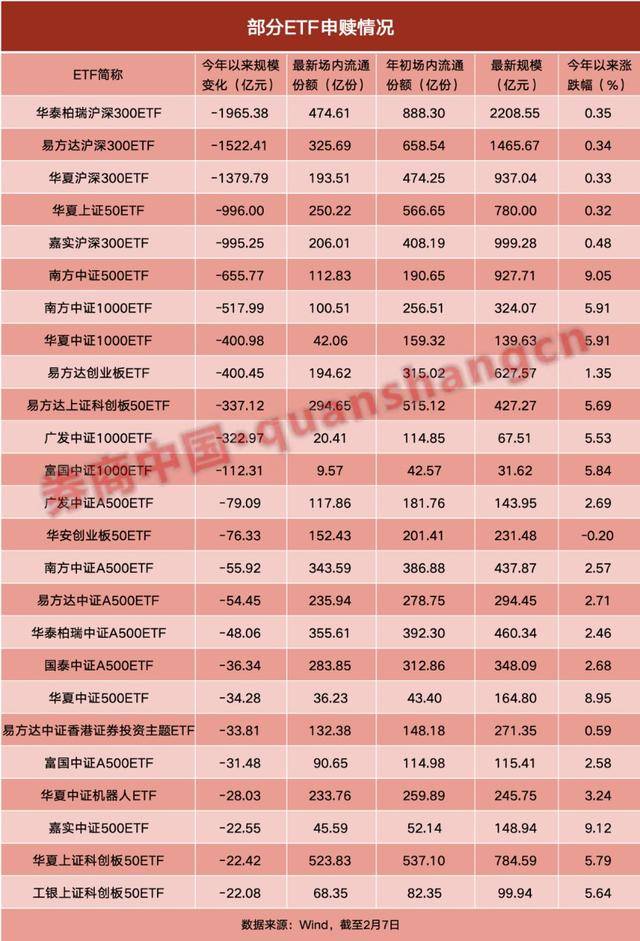
Core Viewpoint - The stock ETF market has experienced significant net outflows since the beginning of the year, with a total reduction of nearly 700 billion yuan in scale, primarily due to a decrease in shares rather than market declines [1][2][4] Group 1: ETF Market Overview - As of February 6, the total scale of stock ETFs is approximately 3.14 trillion yuan, down nearly 700 billion yuan since the beginning of the year [2] - There have been 17 trading days with net outflows out of 25 since the start of the year, with a peak single-day net outflow exceeding 130 billion yuan [2] - The largest contributors to the outflows include the Huatai-PB CSI 300 ETF, which saw a net outflow of 196.54 billion yuan, and both the E Fund and Huaxia CSI 300 ETFs, each with net outflows exceeding 100 billion yuan [3][4] Group 2: Specific ETF Performance - The Huatai-PB CSI 300 ETF's scale has dropped from 420 billion yuan to around 220 billion yuan, a decrease of over 50% [4] - The E Fund CSI 300 ETF has also seen a significant decline, with its scale dropping from over 300 billion yuan to 146.57 billion yuan [4] - The South China CSI 1000 ETF's shares decreased from 256.51 billion to 100.51 billion, marking a decline of 60.82% [4] Group 3: Market Sentiment and Future Outlook - Institutional investors are currently exhibiting a cautious risk preference, which is reflected in the outflows from broad-based ETFs despite positive average returns [6][7] - Analysts believe that the market is transitioning from liquidity-driven to earnings-driven dynamics, with a focus on performance validation in 2026 [8][9] - The outlook for 2026 remains optimistic, with expectations of continued growth in emerging industries and a resilient A-share and Hong Kong market [8][9]
“巨无霸”缩水!宽基ETF开年大赎回,什么信号?
证券时报· 2026-02-08 09:33
Core Viewpoint - The stock ETF market has experienced significant net outflows since the beginning of the year, with a total reduction of nearly 700 billion yuan, primarily driven by a decrease in shares rather than market declines [1][2][3]. Group 1: ETF Market Overview - As of February 6, the total scale of stock ETFs is approximately 3.14 trillion yuan, down nearly 700 billion yuan since the start of the year [3][6]. - The net outflow of stock ETFs has been observed for 17 out of the 25 trading days since the beginning of the year, with a peak single-day net outflow exceeding 130 billion yuan [3][6]. - The largest net outflows have been recorded in major ETFs such as Huatai-PB CSI 300 ETF, which saw a net outflow of 196.54 billion yuan, and both E Fund and Huaxia's CSI 300 ETFs, each with net outflows exceeding 100 billion yuan [5][6]. Group 2: Share Reduction and Performance - The share reduction in major ETFs has been substantial, with declines of 40% to over 60% in various products, including the Huatai-PB CSI 300 ETF, which saw a 46.57% drop in shares [2][6]. - Despite the outflows, the average performance of stock ETFs has been positive, with an average increase of 3.59% since the beginning of the year [8]. - Specific ETFs, such as the Southern CSI 500 ETF, have recorded significant outflows while still achieving positive returns, indicating a disconnect between fund flows and market performance [8]. Group 3: Institutional Insights and Future Outlook - Institutional investors remain cautious about short-term market risks, leading to the observed outflows, but they maintain a generally optimistic outlook for the investment landscape in 2026 [2][10]. - The market is expected to shift from liquidity-driven dynamics to profit-driven and performance-validated trends, with a focus on the intrinsic resilience of A-shares and Hong Kong stocks [2][10]. - Analysts suggest that the ongoing regulatory measures and the evolving market environment will continue to influence investor behavior and capital allocation strategies [9][11].

“巨无霸”缩水!宽基ETF开年大赎回,什么信号?
券商中国· 2026-02-08 08:19
Core Viewpoint - The stock ETF market has experienced significant net outflows since the beginning of the year, with a total reduction of nearly 700 billion yuan, primarily driven by a decrease in shares rather than market declines [1][2][3] Group 1: ETF Market Overview - As of February 6, the total scale of stock ETFs is approximately 3.14 trillion yuan, down nearly 700 billion yuan since the start of the year [3][6] - The largest net outflows have been observed in the Huatai-PB CSI 300 ETF, which saw a net outflow of 1965.38 billion yuan, while the E Fund and Huaxia's CSI 300 ETFs also experienced outflows exceeding 1000 billion yuan [5][6] - Over 675 stock ETFs recorded net outflows, accounting for over 50% of the 1240 products tracked [5][6] Group 2: Share Reduction and Performance - The share reduction in major ETFs has been significant, with declines of 40% to over 60% in various products, including the Huatai-PB CSI 300 ETF, which saw a 46.57% drop in shares [2][6] - Despite the outflows, the average increase in stock ETFs is 3.59%, indicating that the outflows are not due to poor performance [8] - Specific ETFs like the Southern CSI 500 ETF and the Southern CSI 1000 ETF have shown positive performance despite significant net outflows [8] Group 3: Institutional Investor Sentiment - Institutional investors are currently exhibiting a cautious risk preference, leading to the observed outflows from broad-based ETFs [8][9] - Analysts suggest that the market is transitioning from liquidity-driven to earnings-driven dynamics, with a focus on profitability verification in 2026 [10][11] - The outlook for 2026 remains optimistic, with expectations for continued growth in emerging industries and a resilient A-share and Hong Kong market [10][11]

AI模型遭遇瓶颈,AI应用或将普及?(周报333期)
Xin Lang Cai Jing· 2026-02-07 14:36
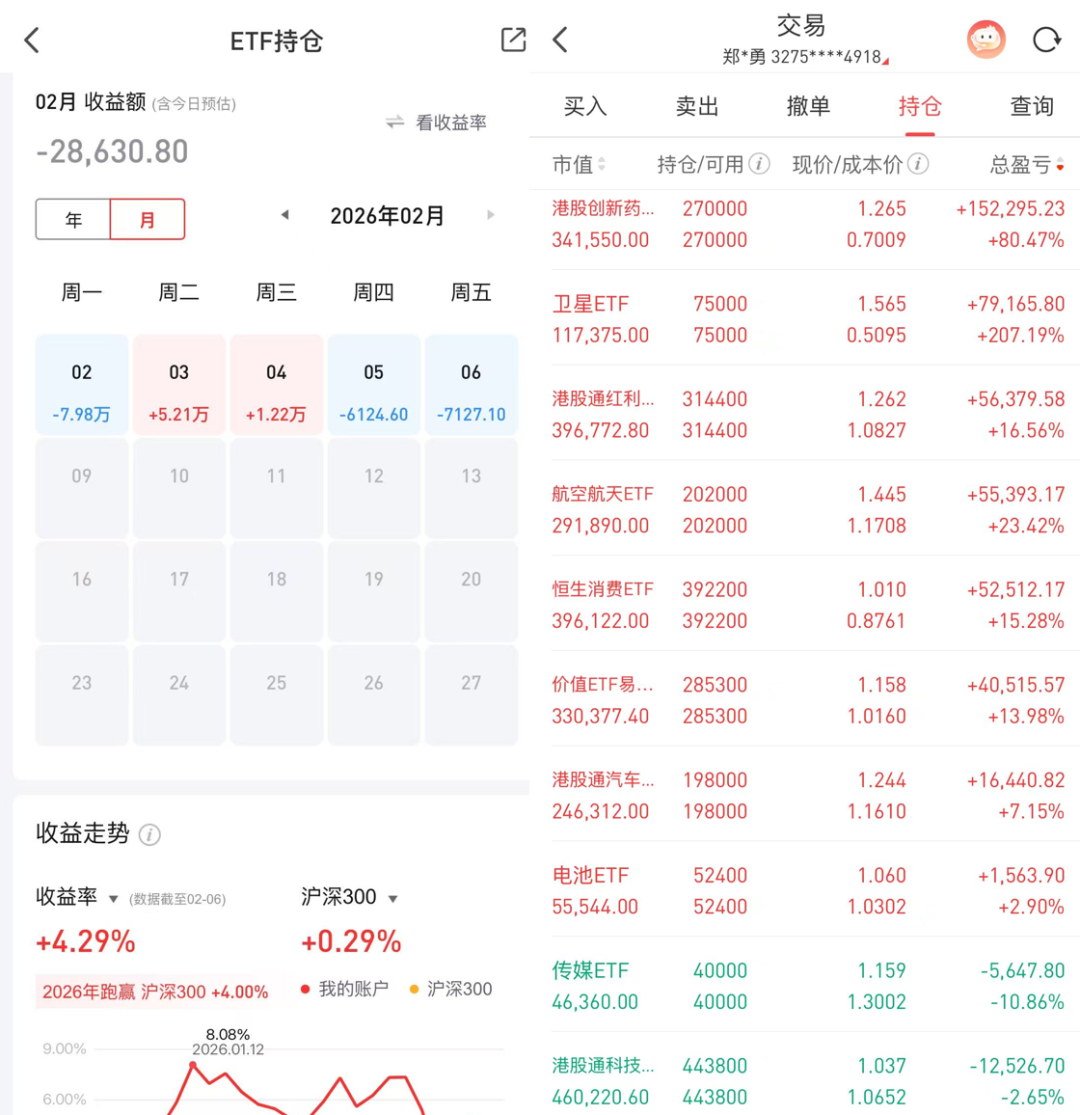
Summary of Key Points Core Viewpoint - The investment accounts managed by the company have experienced significant fluctuations, with a total loss of 204,000 yuan this week, bringing the year-to-date profit down to 324,000 yuan, with a yield of 3.52% [2][11]. Group 1: ETF Account - The ETF account started the year with an asset value of 2.5 million yuan and has recorded a profit of 112,000 yuan, yielding 5.40%, outperforming the CSI 300 index by 1.40% [3][12]. - No operations were conducted in the ETF account this week, resulting in a loss of 29,000 yuan, with a yield of -1.07% [3]. - The current core allocation focuses on Hong Kong stocks, particularly in sectors such as value, aerospace, and media, with recent profits driven by Hang Seng consumption and value ETFs [3]. Group 2: Certain Fund Account - The Certain Fund Account began the year with an asset value of 5.5 million yuan and has achieved a profit of 185,000 yuan, yielding 4.04%, also outperforming the CSI 300 index by 0.29% [5][12]. - This week, the account suffered a significant loss of 172,000 yuan, with a yield of -3.13% [5]. - The main holdings include resource active funds, technology active funds in A-shares, and Hang Seng Technology and Healthcare stocks [5]. Group 3: Fund Combination Account - The Fund Combination Account is primarily focused on long-term allocations, with recent operations including an increase of 10,000 yuan in both the "Safe Hamburger" and "Dividend Hamburger" strategies [8][10]. - The account's profits mainly stem from the "Medical Hamburger" and "Dividend Hamburger" strategies, which have performed well since their inception [10]. - The strategy emphasizes stable combinations, particularly suitable for new investors, with target yields of 5% per year for the "Safe Hamburger," 7% for the "Global Hamburger," and 10% for the "Dividend Hamburger" [10]. Group 4: Overall Performance - The total assets across all accounts amount to nearly 10 million yuan, with a cumulative profit of 324,000 yuan this year [2][11]. - The year-to-date performance has seen a decline, with the overall yield dropping significantly compared to earlier months [11].
机构称港股短期扰动已过,恒生中国企业ETF易方达(510900)助力布局港股核心资产
Sou Hu Cai Jing· 2026-02-06 15:06
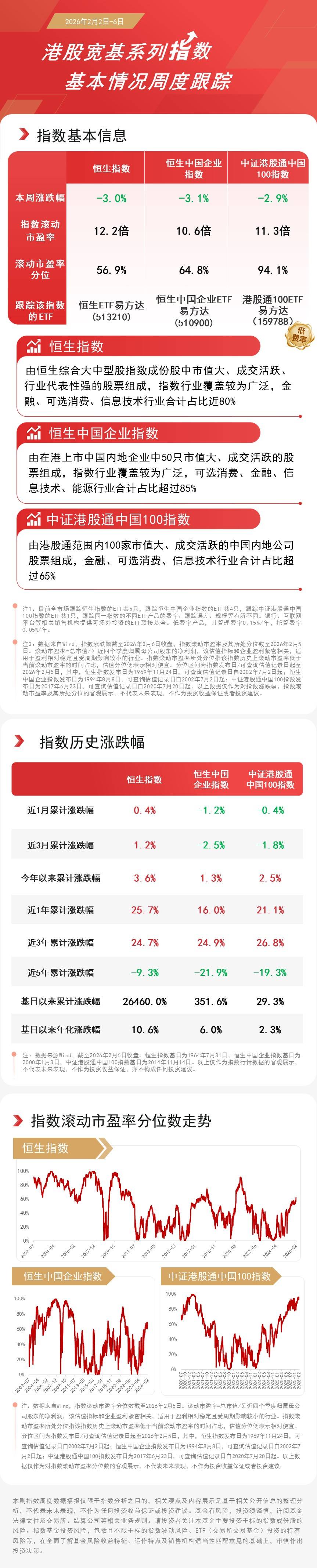
Market Performance - The Hang Seng Index fell by 3%, the Hang Seng China Enterprises Index decreased by 3.1%, and the CSI Hong Kong Stock Connect China 100 Index dropped by 2.9% this week [1] - The performance of the indices over the past month shows a cumulative change of 0.4% for the Hang Seng Index, -1.2% for the Hang Seng China Enterprises Index, and -0.4% for the CSI Hong Kong Stock Connect China 100 Index [6] Future Outlook - CITIC Securities anticipates that the earnings expectations for Hong Kong stocks have undergone significant adjustments, and the disturbances from internal and external capital factors have subsided [1] - The spring market trend for Hong Kong stocks since late December 2025 is expected to continue, with large-cap stocks showing relative gains and growth sectors supported by policy direction performing better [1] Index Composition - The Hang Seng China Enterprises Index consists of 50 large-cap and actively traded stocks listed in Hong Kong, covering sectors such as consumer discretionary, financials, information technology, and energy, which together account for over 85% of the index [4] - The CSI Hong Kong Stock Connect China 100 Index includes 100 large-cap and actively traded Chinese companies within the Hong Kong Stock Connect framework, with financials, consumer discretionary, and information technology making up over 65% of the index [4] Historical Performance - Over the past year, the cumulative performance shows a 25.7% increase for the Hang Seng Index, a 16.0% increase for the Hang Seng China Enterprises Index, and a 21.1% increase for the CSI Hong Kong Stock Connect China 100 Index [7] - The annualized performance since the base date indicates a 10.6% annualized return for the Hang Seng Index, 6.0% for the Hang Seng China Enterprises Index, and 2.3% for the CSI Hong Kong Stock Connect China 100 Index [7]
市场本周调整,关注A500ETF易方达(159361)、沪深300ETF易方达(510310)等产品中长期投资价值
Sou Hu Cai Jing· 2026-02-06 15:06
Market Overview - The three major A-share indices collectively adjusted this week, with the Shanghai Composite Index down by 1.3%, the CSI 500 Index down by 1.8%, the ChiNext Index down by 3.3%, the STAR Market 50 Index down by 5.8%, and the Hang Seng China Enterprises Index down by 3.1% [1][3]. Sector Performance - In terms of sector performance, photovoltaic equipment, batteries, power grid equipment, traditional Chinese medicine, banks, and home appliances saw the highest gains, while precious metals, semiconductors, storage chips, and AI applications experienced the largest declines [1]. Index Details - The CSI 300 Index consists of 300 large-cap stocks with good liquidity, covering 11 first-level industries [4]. - The CSI 500 Index includes 500 stocks with larger market capitalization and liquidity, covering 89 of the 93 third-level industries [4]. - The ChiNext Index is composed of 100 stocks from the ChiNext board, with a high proportion of strategic emerging industries, particularly in power equipment, communications, and electronics, which together account for nearly 60% [4]. - The STAR Market 50 Index includes 50 large-cap stocks from the STAR Market, with a significant focus on "hard technology," where semiconductors make up over 50% and combined with medical devices and photovoltaic equipment, they account for nearly 75% [4]. - The Hang Seng China Enterprises Index consists of 50 large-cap, actively traded stocks listed in Hong Kong, covering a wide range of industries, with consumer discretionary, information technology, finance, and energy sectors making up nearly 85% [4]. Valuation Metrics - The rolling price-to-earnings (P/E) ratios for the indices are as follows: CSI 300 at 14.1x, CSI 500 at 17.2x, ChiNext at 41.8x, STAR Market 50 at 162.9x, and Hang Seng China Enterprises at 10.6x [3]. - The rolling P/E ratio percentiles indicate that the CSI 300 is at the 62.9th percentile, CSI 500 at 75.0th percentile, ChiNext at 37.8th percentile, STAR Market 50 at 94.9th percentile, and Hang Seng China Enterprises at 64.8th percentile [3]. Historical Performance - Over the past month, the indices have shown the following cumulative performance: CSI 300 down by 2.8%, CSI 500 down by 1.2%, ChiNext down by 2.8%, STAR Market 50 down by 1.5%, and Hang Seng China Enterprises down by 1.2% [7]. - Year-to-date performance shows the CSI 300 up by 0.3%, CSI 500 up by 2.6%, ChiNext up by 1.0%, STAR Market 50 up by 5.8%, and Hang Seng China Enterprises up by 1.3% [7]. - Over the past year, the cumulative performance is as follows: CSI 300 up by 19.3%, CSI 500 up by 25.7%, ChiNext up by 48.8%, STAR Market 50 up by 39.6%, and Hang Seng China Enterprises up by 16.0% [7].
