银行

Search documents
银行股到顶了吗?
集思录· 2025-06-05 14:27
先说结论,不知道,但不要指望银行股的价格下跌到两年前。理由如下: 1、估值还不算高。 按照我的跟踪,银行股的估值最低的时候是2020年左右,现在银行股的 估值回到了2015年。从更长的时期看,银行股估值大概处于中间状态。 2、股息率还具有吸 引力。 虽然银行股息率回到了2015年的时候,但2015年一年期定存利率是2%左右,当下是 1%,银行4%的股息率仍然对用户存款具有一定的替代作用。 3、对抗通胀 历史上看,对抗 通胀最好的不是黄金、不是房地产,而是股票。 4、避险需要 中国经济经过前面几十年的发 展,未来将进入平稳期。大家调低了对于未来的乐观预期。相对来说,国家背书的银行股具 有更强的避险属性。 5、历史上的银行股走势台阶式上升。 平稳几年,猛涨几年,再平稳几 年,再猛涨几年,循环往复。 火锅008 假设你现在是某大行的董事长或行长,你的一天,可能是这样的:早上,打开全行的日度报 表,发现5月存款利率下调以来,零售存款连续10多天下滑,只能靠同业存单补一下负债的缺 口,导致存单的发行价格反而上行; 上午,6月初了,拿到了计财部提交的,6月全行经营数据,发现净息差,环比又收窄了 2bps,然后推算一下,二 ...


大额存单全面进入1时代 有储户称20万存3年利息少了两千
news flash· 2025-06-05 12:31
Core Insights - The interest rates for large time deposits have entered the "1" era, with many banks even removing 5-year large time deposit products from their offerings [1] - A specific example highlights that a deposit of 200,000 yuan for three years now yields approximately 2,000 yuan less in interest compared to three months ago, when rates were around 2% [1] - The recent wave of interest rate cuts has led to a general decline in large time deposit rates, resulting in reduced earnings for many depositors [1]
银行摒弃车贷“高息高返”背后
Bei Jing Shang Bao· 2025-06-03 14:57
Core Viewpoint - The automotive finance industry is undergoing a significant transformation as regulatory bodies have halted the "high interest, high rebate" practices, prompting a shift towards compliance and product innovation in a competitive market [1][4][7]. Group 1: Impact of Regulatory Changes - The cessation of "high interest, high rebate" policies has disrupted the sales strategies of automotive dealers, leading to a decline in customer incentives for financing options [4][5]. - Previously, dealers could offer substantial discounts through bank rebates, but the new regulations have diminished these financial advantages, causing potential buyers to reconsider their purchasing decisions [4][5]. - The regulatory changes aim to address unhealthy competition and ensure sustainable practices within the automotive finance sector [7][8]. Group 2: Financial Institutions' Challenges - Banks are facing increased operational pressures as the early repayment of loans reduces their income while maintaining fixed commission costs [8][9]. - The average loan duration for car financing is shorter than anticipated, leading to lower profitability for banks that relied on high commission models [8][9]. - The shift away from "high interest, high rebate" practices is expected to lead banks to focus more on the quality of services and products rather than solely on commission-based incentives [10][11]. Group 3: Future Directions for Automotive Finance - Financial institutions are encouraged to innovate their products and enhance service quality to attract customers in a more regulated environment [10][12]. - Building a healthy automotive finance ecosystem is crucial for banks to maintain competitiveness and customer acquisition in light of reduced rebates [10][11]. - The emphasis will be on creating value through improved approval processes and customer service rather than relying on commission structures [10][11].

欧洲央行监事会主席Buch:银行对私募市场的敞口可能带来偿付能力和流动性方面的风险,而这些风险可能未被风险管理框架充分识别和应对。
news flash· 2025-06-03 08:16
欧洲央行监事会主席Buch:银行对私募市场的敞口可能带来偿付能力和流动性方面的风险,而这些风 险可能未被风险管理框架充分识别和应对。 ...
银行应在支持小微企业发展上发挥更大作用
Zheng Quan Ri Bao· 2025-06-03 01:00
Core Viewpoint - Small and micro enterprises (SMEs) are crucial to the national economy, contributing to employment, innovation, and economic stability. High financing costs remain a significant barrier to their development. Recent measures from the National Financial Supervision Administration and eight other departments provide clearer policy guidance to address these financing challenges [1][2]. Financing Cost Reduction Strategies - Banks are encouraged to respond to policies by actively helping SMEs reduce comprehensive financing costs through various measures [1]. - Banks should consider the Loan Prime Rate (LPR) trends and their own funding costs when pricing loans for SMEs, ensuring that policy benefits reach them effectively [1]. - Internal fund transfer pricing (FTP) mechanisms should be optimized to provide greater interest rate discounts for SME loans, thereby lowering financing costs [1]. Fee Regulation and Loan Process Optimization - Banks must enhance internal management and strictly adhere to regulatory requirements by eliminating various illegal fee items [2]. - Collaboration with third-party institutions should be closely monitored to ensure transparent and reasonable fees, preventing increased financing costs for SMEs [2]. - Simplifying loan processes and reducing unnecessary intermediaries can help lower the time and hidden costs associated with SME financing [2]. Credit Loan Initiatives - To address the issue of insufficient collateral among SMEs, banks should increase the issuance of credit loans by utilizing multi-dimensional information such as tax payments and utility bills to create accurate credit profiles [2]. - The promotion of non-repayment of principal loans allows eligible SMEs to continue using loan funds without repaying the principal at maturity, alleviating cash flow pressures [2]. Risk Sharing Mechanisms - Strengthening cooperation with government departments and guarantee institutions to establish risk-sharing mechanisms is vital for banks to reduce financing risks and costs for SMEs [2]. - Utilizing government risk compensation funds and guarantee institutions can help banks offer more favorable interest rates and loan conditions to SMEs [2]. Mutual Benefits and Future Outlook - Assisting SMEs in lowering financing costs is not only a social responsibility but also an opportunity for banks to expand their business and enhance market competitiveness [3]. - The ongoing improvement of policies and financial innovations is expected to enable banks to play a more significant role in supporting SME development, contributing to the sustained healthy growth of the national economy [3].
节前稳一波,为什么是银行?
Sou Hu Cai Jing· 2025-05-29 08:57
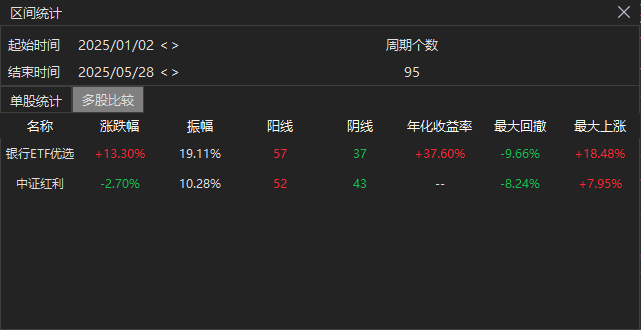
Group 1 - The A-share market is currently experiencing high trading volumes around 1 trillion, indicating a cautious sentiment among investors, with historical data showing a greater than 60% probability of a decline in the first week after the Dragon Boat Festival [1] - The banking sector is being viewed as a stable investment option due to its defensive characteristics, with the bank AH index outperforming the CSI Dividend Index this year [2][4] - The state-owned funds are actively supporting the banking sector, which constitutes over 10% of the total A-share market capitalization, contributing to the stability of bank stocks even during market downturns [3] Group 2 - The decline in deposit rates has made traditional savings less attractive, while over 70% of A-share listed banks offer dividend yields exceeding 4%, some even surpassing 8%, creating a significant advantage over the 10-year government bond yield of approximately 1.65% [4] - The bank AH index has shown a nearly 40% increase since the rebound in September last year, significantly outperforming major indices like the Shanghai Composite and CSI 300 [4][5] - The only ETF tracking the bank AH index is the Bank ETF Preferred, which has generated nearly 10% excess returns since last year through its dynamic allocation strategy [5]
星图金融研究院副院长薛洪言:银行消费贷不能局限在优质客群里“内卷”
Bei Jing Shang Bao· 2025-05-28 09:48
Core Viewpoint - Financial institutions play a crucial role in boosting consumer spending by accurately identifying consumer needs and optimizing product design to lower barriers for consumers, thereby encouraging them to spend more [3][4]. Group 1: Financial Institutions and Consumer Credit - Credit is a vital component in stimulating consumption, but many consumers face challenges such as insufficient loan amounts, complex procedures, and high effective interest rates when seeking loans [3]. - The high level of retail loan delinquency rates has led banks to shift their focus from scale to quality, raising the entry barriers for consumers deemed as "high-quality" [3][4]. - Financial institutions need to enhance the precision of their marketing strategies using big data for better customer matching and risk control [4]. Group 2: Strategic Recommendations - Banks should not limit their consumer loan offerings to only high-quality customers, as middle to high-risk customer segments represent untapped growth potential [4]. - With the economic recovery and improvement in household balance sheets, banks are expected to revise their retail loan strategies and lower entry barriers, providing more opportunities for borrowers to access low-interest, high-amount consumer loans [4]. Group 3: Policy and Market Dynamics - Financial support for consumption includes not only favorable credit policies but also the collaboration of monetary and fiscal policies, the establishment of efficient payment ecosystems, and the involvement of public funds and insurance [5]. - Recent regulatory measures have included extending loan terms and increasing loan limits, which have positively impacted large consumer goods such as automobiles and home appliances [5]. - The emergence of new consumer brands across various sectors, offering better quality-price ratios, has contributed to structural changes in consumption, highlighting the importance of supply-side upgrades to stimulate demand [5].

利率跌破1%,是中国经济转型必经之路,普通人如何守紧钱袋子?
Sou Hu Cai Jing· 2025-05-26 06:06
新一轮的财富大洗牌马上开始,普通人如何守紧钱袋子? 近日,多家银行下调存款利率,1年期存款的利率已经跌破1%,只有0.95%了,创下建国以来的历史最低位。 零字头利率的时代已经到来,咱们普通人存钱、买房、投资都会受到影响。 放在10年前,你把10万块存在银行里,1年的利息能有1500块,现在只剩下950块,肉眼可见地减少了。 那么问题来了,为什么利率会一降再降?这是中国经济当下的3个现实需求决定的。 第1个,还是老生常谈的提振消费。 今年3月份,全国存款已经突破160万亿,要知道,去年的GDP也才135万亿。 把存款利率调低,倒逼钱从银行里流出来,进入消费市场,才能扩大内需。 今年一季度,虽然GDP的增速有5.4%,但物价反倒还跌了,CPI下降了0.1%。 美国那边,虽然美联储死鸭子嘴硬,但年内降息板上钉钉,欧洲央行上个月刚降到了2.25%, 现在全球都处于降息周期,再加上关税的影响,中国也会跟着降息。 抛开数据不谈,对经济的体感怎么样,大家都深有体会。 所以面对内需问题,央行在不断地放大招,这个月降准降息,释放了超过万亿的资金,经过一系列的传导后,存款利率也跟着降了下来。 第2个,为了缓解银行的经营压力。 ...

被迫上调利率,银行利润快被卷到裤衩里了?
Sou Hu Cai Jing· 2025-05-25 19:18
Core Viewpoint - The recent increase in mortgage rates in Guangzhou, despite expectations of a rate cut by the central bank, reflects banks' strategies to maintain profitability while navigating market dynamics [1][3][4]. Group 1: Mortgage Rate Adjustments - Several banks in Guangzhou have adjusted the first-home mortgage rate from LPR minus 60 basis points to minus 50 basis points, raising the effective rate from 3% to 3.1% [3][4]. - This adjustment is a preemptive move by banks to protect their profit margins, especially as the LPR is anticipated to decrease [4][5]. Group 2: Market Dynamics - The current real estate market is experiencing a "spiral decline," where property owners are lowering prices to increase transaction volumes, leading to faster price drops [4][5]. - The strategy of "downward replacement" is gaining traction, where investors are selling higher-value properties to acquire lower-cost, high-rental-yield properties [5][6]. Group 3: Real Estate Tax Considerations - The implementation of a real estate tax is unlikely in the short term due to the current stabilization of the housing market, with legislative complexities further delaying its introduction [6][7]. - If a real estate tax is introduced, it may focus on property owners with multiple low-yield properties, while ordinary homeowners are expected to be exempt from taxation [8][9]. Group 4: Investment Perspective - The essence of housing is shifting towards residential use, with investment attributes diminishing, suggesting a need for investors to reassess their strategies [10][11]. - Enhancing personal income potential may be more beneficial than focusing solely on property price fluctuations [11].