
中国生物制药

Search documents
华创医药周观点:隐形正畸行业近况更新 2026/01/17
华创医药组公众平台· 2026-01-17 13:49
Core Viewpoint - The invisible orthodontics industry in China is experiencing a significant transformation, with leading manufacturers maintaining steady growth while smaller players face pressure due to pricing challenges. The market penetration of invisible orthodontics is expected to increase significantly in the coming years, driven by rising consumer awareness and demand for aesthetic solutions [12][25][31]. Market Overview - The CITIC Medical Index decreased by 0.72%, underperforming the CSI 300 Index by 0.15 percentage points, ranking 16th among 30 primary industries [7]. - The top ten stocks by growth this week included Baolait, Hualan, and Tianzhihang, while the bottom ten included Xiangrikui and 51 Changyao [7]. Industry and Stock Events - The invisible orthodontics market in China is projected to grow, with the penetration rate increasing from 11% in 2020 to an estimated 25% by 2030. The penetration rate for adults was 38.9% in 2020, while for children and adolescents, it was only 4.5% [17][24]. - The average selling price (ASP) of invisible orthodontics is under pressure due to increased competition and price wars among manufacturers, leading to a decline in market revenue growth compared to the number of cases [24][25]. - The leading companies, such as Times Angel and Invisalign, hold over 70% of the market share, with Times Angel maintaining growth in case numbers despite industry challenges [25][31]. Domestic Market Dynamics - The demand for invisible orthodontics is expanding in lower-tier cities, with the proportion of cases in third-tier and below cities rising from 22% in 2021 to 29% in 2023 [18]. - The market is witnessing a shift towards head manufacturers as smaller firms struggle to compete, leading to an accelerated market consolidation [25]. International Market Trends - The global invisible orthodontics market is expected to reach $4.8 billion by 2024, with North America dominating the market share at 56.9% [31][32]. - Chinese manufacturers are increasingly entering international markets, with Times Angel reporting a significant increase in overseas cases, which accounted for 39% of its total cases by 2024 [32]. Future Outlook - The invisible orthodontics industry is anticipated to continue its growth trajectory, with increasing consumer awareness and a shift towards aesthetic dental solutions. The market is expected to see further consolidation as smaller players exit due to competitive pressures [25][31].

华创医药投资观点&研究专题周周谈·第159期:隐形正畸行业近况更新-20260117
Huachuang Securities· 2026-01-17 12:20
Investment Rating - The report maintains a "Recommended" rating for the innovative drug sector, highlighting the potential for value re-evaluation as the proportion of innovative products increases [44]. Core Insights - The report emphasizes the transition of the innovative drug industry from quantity to quality, with a focus on differentiated and internationalized pipelines by 2025 [10]. - The medical device sector is experiencing a recovery in bidding volumes for imaging equipment, with a notable increase in home medical device markets due to subsidy policies [10]. - The report identifies a significant growth opportunity in the invisible orthodontics market, with penetration rates expected to rise from 14% in 2023 to 25% by 2030 [18]. Summary by Sections Market Overview - The report notes a 0.72% decline in the CITIC Medical Index, underperforming the CSI 300 Index by 0.15 percentage points, ranking 16th among 30 primary industries [6]. - The top ten performing stocks include Baolait, Hualan, and Tianzhihang, while the bottom ten include Xiangrikui and *ST Changyao [6]. Innovative Drugs - The innovative drug sector is expected to see a significant increase in the number of products, with projections of 30 products by 2027, including over 20 innovative drugs [44]. - The revenue share from innovative products is anticipated to exceed 50% by 2025, indicating a successful transition from generic to innovative products [44]. Medical Devices - The report highlights a recovery in bidding for imaging devices, with a projected significant increase in market size from Q4 2024 onwards [48]. - Home medical devices are benefiting from government subsidies, with companies like Yiyue expected to see sustained growth [48]. Invisible Orthodontics - The penetration rate of invisible orthodontics in China is significantly lower than in the U.S., with expectations for rapid growth due to rising economic levels and aesthetic demands [18]. - The market size for invisible orthodontics is projected to grow from 70 billion to 130 billion yuan from 2018 to 2023, with a CAGR of 13.4% [27]. Market Dynamics - The report indicates that the competitive landscape in the invisible orthodontics market is shifting towards leading manufacturers, with a focus on product differentiation and cost optimization [32]. - The report also notes that the domestic market is experiencing a consolidation phase, with smaller manufacturers facing challenges due to price competition [32].
同步内地市场,高开低走
Ge Long Hui· 2026-01-17 05:13
恒生医疗小幅高开后只需跳水,随后全天维持在低位盘整,截至收盘下跌0.83%。三生制药下跌 1.78%,百济神州下跌1.36%,京东健康下跌1.03%,康方生物、中国生物、药明生物等股均小幅收跌。 同步内地市场,高开低走后恒生指数收跌0.29%。恒生医疗跌幅居前,互联网、大消费、银行、科技等 均小幅收跌。 恒生科技高开低走后一路回撤,盘中所有反弹,但力度有限,截至收盘下跌0.13%,其中小米集团下跌 2.01%,快手下跌1.51%,京东集团下跌1.3%。 内容只是个人观点,仅供参考,不作为投资依据!欢迎关注交流,互相学习、共同探讨! 恒生银行冲高回落后全天震荡下行,截至收盘下跌0.28%。其中重庆银行下跌2.85%,光大银行下跌 2.4%,浙商银行、招商银行、中信银行等股跌幅均在1%上方;大新银行逆势上涨1.89%。 ...
中国生物制药拟12亿元收购赫吉亚100%股权 标的核心管线尚处于临床早中期阶段
Xin Lang Cai Jing· 2026-01-16 10:05
Core Viewpoint - China National Pharmaceutical Group (stock code: 01177.HK) announced the acquisition of Hegia Biotech for a total consideration of 1.2 billion RMB, marking a strategic move into the siRNA innovation drug sector [1][7] Group 1: Acquisition Details - The acquisition will be financed through a combination of cash and equity, with approximately 1.1 billion RMB paid in cash and the remaining 97 million RMB through the issuance of new shares at HKD 6.66 per share [1][7] - Following the transaction, Hegia will become a wholly-owned subsidiary of China National Pharmaceutical Group, integrating its R&D pipeline and technology platform into the company's chronic disease treatment strategy [1][7] Group 2: Hegia Biotech Overview - Founded in 2018, Hegia has emerged as a "dark horse" in the domestic siRNA field, leveraging its proprietary multi-organ targeted delivery technology [2][8] - Hegia's key advantages include a clinically validated liver delivery platform capable of "once-a-year" dosing, a dual-chain conjugation technology platform, and a neural delivery platform [2][8] - Hegia currently has four clinical-stage projects and over 20 preclinical projects, with the most advanced being Kylo-11, which targets lipoprotein(a) and has initiated a multi-center Phase II clinical trial in October 2025 [2][8] Group 3: Market Context and Valuation - The global market for siRNA is projected to reach USD 15 billion, with no approved targeted drugs currently available, indicating a pressing clinical need [2][8] - The acquisition valuation of 1.2 billion RMB corresponds to an 18.75x market cap/research spending ratio based on Hegia's R&D expenditure for 2024, which is considered low compared to similar overseas companies [3][9] - The acquisition is seen as a strategic move to fill gaps in China National Pharmaceutical Group's cardiovascular treatment portfolio and create synergies with existing chronic disease pipelines [2][3][9] Group 4: Financial Strength and Industry Trends - As of June 2025, China National Pharmaceutical Group had over 30 billion RMB in cash and liquid assets, providing a solid foundation for ongoing investments in innovative drugs [4][10] - The siRNA sector has become a focal point for global pharmaceutical companies, with a total transaction volume of USD 35 billion in 2025, reflecting a 40% year-on-year growth [4][10] - The competitive landscape includes established international players like Alnylam, which has a market cap exceeding USD 50 billion, and domestic companies like Reebio, which recently went public [4][10] Group 5: Challenges and Future Prospects - The acquisition faces challenges, including Hegia's core pipelines being in early to mid-clinical stages, requiring lengthy R&D and approval processes [5][12] - Hegia's external delivery technologies have not yet been clinically validated, and scaling production of siRNA drugs remains an industry bottleneck [5][12] - Despite these challenges, the acquisition's synergy potential is significant, as China National Pharmaceutical Group's industrial capabilities could help Hegia navigate the "valley of death" in biotech [6][12]

90后,一位医药并购女王诞生
投资界· 2026-01-16 03:39
Core Viewpoint - The article discusses the strategic acquisition of Hegia Biotech by China National Pharmaceutical Group, marking a significant move in the domestic pharmaceutical industry, particularly in the small nucleic acid drug sector, with a total price of 1.2 billion RMB [2][4]. Group 1: Acquisition Details - On January 13, 2025, China National Pharmaceutical Group announced the full acquisition of Hegia Biotech for 1.2 billion RMB, reinforcing its position in the small nucleic acid drug market [2][4]. - The acquisition process was notably swift, moving from initial discussions to final agreement in a short timeframe, indicating a strong strategic alignment between the two companies [3][4]. - Hegia Biotech has developed a unique delivery platform for siRNA, which is the first clinically validated system capable of long-term administration, showcasing its innovative capabilities [5]. Group 2: Leadership and Strategy - The article highlights the leadership of Xie Qirun, a member of the fourth generation of the Xie family, who has been pivotal in steering the company towards innovation and strategic acquisitions [7][9]. - Under Xie Qirun's leadership, the company has shifted its focus from generic to innovative drugs, with the number of innovative products increasing from 2 to 21 over ten years [10]. - The strategic acquisitions of Hegia and Lixin Pharmaceutical are part of a broader vision to position China National Pharmaceutical Group in the global pharmaceutical landscape, particularly targeting major markets in oncology and chronic diseases [10][11]. Group 3: Industry Context - The article draws parallels between the current acquisition strategies of Chinese pharmaceutical companies and historical moves by global pharmaceutical giants, emphasizing the growing trend of mergers and acquisitions as a core growth engine in the industry [12][13]. - It notes that the Chinese pharmaceutical sector is entering a "new era" of globalization, with a focus on innovative therapies and international market expansion [14]. - The anticipated expiration of patents for significant drugs in the coming years is expected to intensify competition for innovative sources, positioning Chinese companies favorably to participate in this global race [14].

90后,一位医药并购女王诞生
3 6 Ke· 2026-01-16 02:56
Core Viewpoint - The first domestic pharmaceutical merger of the year occurred when China National Pharmaceutical Group announced the acquisition of Hegia Biotech for 1.2 billion RMB, marking a strategic move to strengthen its position in the small RNA drug sector and expand into the global chronic disease treatment market [1][2]. Group 1: Acquisition Details - The acquisition price for Hegia Biotech is set at 1.2 billion RMB, and upon completion, Hegia will become a wholly-owned subsidiary of China National Pharmaceutical Group, retaining its founding team [2]. - Hegia Biotech has developed a unique liver-targeted delivery platform for siRNA, which is the only clinically validated system capable of long-term administration with a single injection per year [3]. - Hegia has a robust pipeline with four innovative drugs in clinical stages and over 20 candidates in preclinical development, covering various therapeutic areas [2][3]. Group 2: Strategic Implications - The acquisition is seen as a critical step in positioning China National Pharmaceutical Group for the next generation of drug paradigms, aiming for deep synergy with its existing clinical development and commercial expansion capabilities [3]. - The company has previously invested in the small RNA sector, indicating a systematic approach to securing next-generation drug technologies [3]. - The strategic focus on oncology and chronic diseases aligns with the anticipated market opportunities, as the company aims to create substantial value for shareholders through these acquisitions [9]. Group 3: Leadership and Historical Context - The acquisition highlights the leadership of Xie Qirun, a young executive from the fourth generation of the Xie family, who has been pivotal in steering the company towards innovation and strategic acquisitions [5][6]. - Under her leadership, the company has transitioned from having only two innovative products a decade ago to 21, with a significant increase in the revenue share from innovative drugs [9]. - The historical context of the Xie family’s involvement in the pharmaceutical industry dates back over a century, with a focus on biopharmaceuticals since the early 1990s [6][7]. Group 4: Industry Trends - The trend of mergers and acquisitions in the pharmaceutical industry is gaining momentum in China, mirroring global practices where large pharmaceutical companies acquire biotech firms to enhance their innovation capabilities [11][12]. - The Chinese pharmaceutical market is expected to see a surge in innovation-driven deals, with projections indicating a significant increase in the value of drug development and licensing agreements [12]. - The strategic direction of China National Pharmaceutical Group reflects a broader industry shift towards global competitiveness and the need for innovative therapies to meet growing healthcare demands [13].
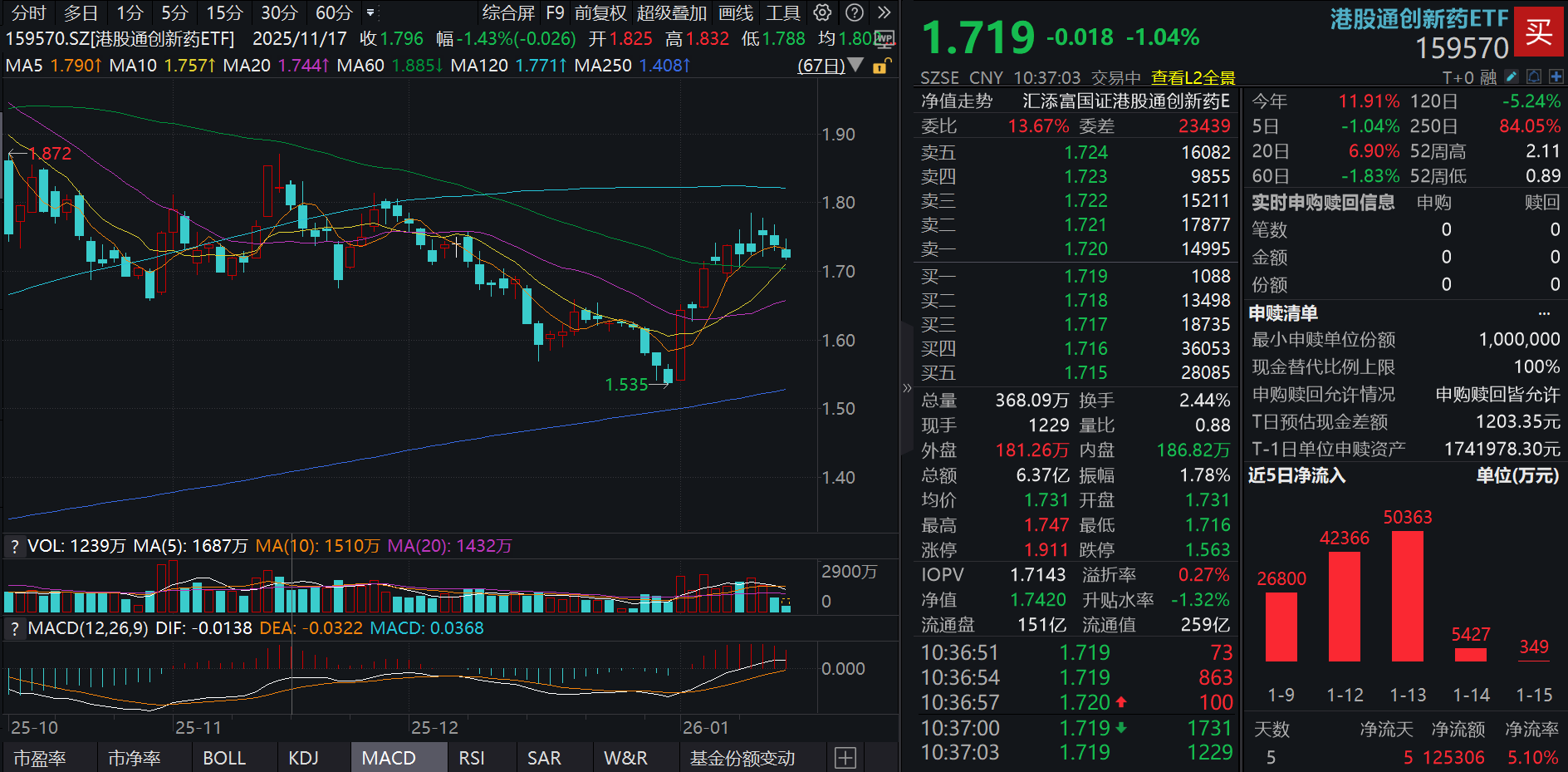
中国创新药企闪耀JPM大会,哪些新药值得关注?港股通创新药ETF(159570)跌逾1%,资金快速涌入,近5日“吸金”超12亿元!
Xin Lang Cai Jing· 2026-01-16 02:54
Group 1 - The core viewpoint of the news highlights the performance and trends of the Hong Kong innovative drug sector, particularly focusing on the Hong Kong Stock Connect Innovative Drug ETF (159570), which has seen significant capital inflow and is leading in scale among similar funds [1][2] - The 44th JPMorgan Healthcare Conference showcased several Chinese innovative pharmaceutical companies, emphasizing trends in gene and cell therapy, as well as AI in medicine, indicating a shift from "assets being bought" to "global value" for Chinese innovations [1][2] - The innovative drug sector is expected to reach new highs due to various catalysts, including the significant valuation gap between China and the US, ongoing business development (BD) transactions, and low current allocation of pharmaceutical theme funds in the market [2] Group 2 - Major stocks within the Hong Kong Stock Connect Innovative Drug ETF mostly experienced declines, with notable drops exceeding 1% for companies like BeiGene, China Biologic Products, and others, while CSPC Pharmaceutical showed a slight increase [2][3] - Key innovative drugs presented at the JPMorgan Conference include BeiGene's CDK4 products and the first BCL2 inhibitor approved in China, which highlights the competitive landscape and advancements in treatment options for various cancers [5][6] - The collaboration between Rongchang Biopharmaceutical and AbbVie on the PD-1/VEGF dual antibody RC148 is a significant development, with potential milestone payments and royalties, showcasing the growing internationalization of Chinese innovative drugs [9][10]
花旗:中国生物制药(01177)收购siRNA药企提升对外授权潜力 目标价10.8港元 评级“买入”
智通财经网· 2026-01-16 01:19
Core Viewpoint - Citigroup reports that China Biopharmaceutical (01177) has announced the acquisition of private biotech company Hygieia, specializing in small interfering RNA (siRNA) drugs, with a maximum base consideration of 1.2 billion RMB [1] Group 1: Acquisition Details - The acquisition is expected to enhance China Biopharmaceutical's innovation capabilities and licensing potential [1] - The deal solidifies the company's position as a leader among Chinese innovative pharmaceutical firms [1] Group 2: Hygieia's Contributions - Hygieia has developed several differentiated delivery platforms, with candidate drugs in its pipeline including Kylo-11, Kylo-12, Kylo-0603, HJY-10, and HJY-02 [1] - The acquisition will enable China Biopharmaceutical to establish a new generation of cardiovascular innovation pipeline [1] Group 3: Market Expansion - The deal strengthens the company's positioning in weight management and metabolic disease sectors [1] - It also expands into new frontiers in chronic disease management [1] Group 4: Financial Outlook - Citigroup sets a target price of HKD 10.8 and maintains a "Buy" rating for China Biopharmaceutical [1]
花旗:中国生物制药收购siRNA药企提升对外授权潜力 目标价10.8港元 评级“买入”
Zhi Tong Cai Jing· 2026-01-16 01:17
Core Viewpoint - Citigroup's report indicates that China Biologic Products (01177) has announced the acquisition of private biotech company Hygieia, which focuses on small interfering RNA (siRNA) drugs, with a maximum base consideration of 1.2 billion RMB [1] Group 1: Acquisition Details - The acquisition is expected to enhance China Biologic's innovation capabilities and licensing potential, solidifying its position as a leader among Chinese innovative pharmaceutical companies [1] - Hygieia has developed several differentiated delivery platforms, with a research pipeline that includes candidate drugs Kylo-11, Kylo-12, Kylo-0603, HJY-10, and HJY-02 [1] Group 2: Strategic Implications - Through this acquisition, China Biologic will establish a new generation of cardiovascular innovation pipeline, strengthening its presence in weight management and metabolic disease sectors [1] - The move also aims to expand into new frontiers in chronic disease management [1] Group 3: Market Outlook - Citigroup has set a target price of 10.8 HKD and maintains a "Buy" rating for China Biologic following this acquisition [1]
中国生物制药(01177.HK):全资收购赫吉亚 优势卡位进军小核酸赛道
Ge Long Hui· 2026-01-15 14:24
Company Overview - The company announced a 100% acquisition of Hejia Bio for a consideration of 1.2 billion yuan, which is adjustable [1] - The payment structure includes a mix of cash and equity, with 50% cash payment to founding shareholders on the closing date and the remaining 50% to be unlocked over 24 to 36 months [1] Industry Insights - Hejia Bio specializes in siRNA innovative drugs, focusing on three major chronic disease areas: weight management, cardiovascular, and neurological systems [1] - The core platform, MVIP, is the world's first clinically validated liver-targeted delivery platform capable of achieving long-lasting effects with annual injections [1] - The dual delivery technology addresses the industry challenge of achieving combined efficacy, while the neural targeting delivery platform aims for effective central and peripheral nervous system treatments [1] Strategic Implications - The acquisition is expected to enhance the company's capabilities in chronic disease management, addressing existing limitations in efficacy, safety, and patient compliance in current therapies [2] - The collaboration is anticipated to accelerate the clinical development and commercialization of Hejia Bio's products, leveraging the company's established R&D and sales channels [2] Financial Projections - The adjusted net profit forecasts for 2025 and 2026 remain at 4.47 billion yuan and 4.92 billion yuan, respectively, with an introduction of a 2027 adjusted net profit of 5.42 billion yuan [2] - The current stock price corresponds to adjusted P/E ratios of 23.8 and 21.0 for 2026 and 2027, respectively, with a target price of 8.90 HKD, indicating a potential upside of 28.8% [2]