
保利发展

Search documents
——2月信用债策略月报:关注长信用品种的博弈机会
Huachuang Securities· 2026-02-03 07:25
Group 1: Market Overview - In January, credit bond configuration sentiment was strong, leading to a significant compression of credit spreads, with 5-year credit spreads narrowing to the lowest point since 2025[12] - February's market outlook indicates a neutral to favorable pricing environment for bonds, with credit spreads expected to continue narrowing, particularly in the long-term credit segment[8] - The demand for credit bonds remains robust, especially for short-term products, driven by institutional investments and favorable monetary conditions[8] Group 2: Investment Strategies - For bonds with maturities of 5 years or less, focus on structural opportunities, particularly in the real estate sector, where sentiment is expected to improve[3] - Long-term credit bonds (over 5 years) are currently in a favorable positioning window, but investors should be cautious and take profits quickly as spreads compress[3] - Specific recommendations include targeting high liquidity bonds and those with favorable convexity, particularly in the 5.5-6 year and 7.5-8 year ranges[4] Group 3: Sector-Specific Insights - In the urban investment bond sector, low-grade bonds with maturities of 3 years or less still offer attractive yields, while medium to long-term bonds should focus on high-quality issuers[5] - The real estate bond market should concentrate on 1-2 year maturities, particularly for state-owned enterprises, as valuation recovery momentum is strong[5] - For coal bonds, short-term investments should be made cautiously, with a focus on high-rated issuers due to potential price fluctuations in the coal market[5]
——2月信用债策略月报:关注长信用品种的博弈机会-20260203
Huachuang Securities· 2026-02-03 06:32
Group 1 - The report highlights that the credit spread for bonds with maturities of 5 years or less is expected to compress further or maintain low volatility, with a focus on the influx of investment into long-duration credit bonds [2][3] - In January, the credit bond market showed strong sentiment, driven by the implementation of new fund fee regulations and strong institutional allocation, leading to a significant compression of credit spreads [12][15] - The report suggests that long-duration credit bonds are currently in a favorable positioning window, but trading should be executed with timely profit-taking [3][4] Group 2 - The strategy for credit bonds emphasizes identifying structural opportunities in the short to medium-term bonds while positioning for long-duration credits and ensuring timely exits [3][4] - The report indicates that the performance of credit bonds typically outperforms interest rate bonds, with credit spreads narrowing during February, influenced by seasonal factors and market dynamics [17][23] - The analysis of the secondary market shows a general decline in credit bond yields and a compression of credit spreads across various categories [8][15] Group 3 - The report discusses specific sector strategies, including opportunities in urban investment bonds, real estate bonds, coal bonds, and steel bonds, highlighting the importance of selecting high-quality issuers and considering market conditions [5][6] - It notes that the net financing of credit bonds has decreased year-on-year but increased month-on-month, with a rising proportion of long-duration issuances [9][22] - The report emphasizes the need for careful selection of bonds based on liquidity, convexity, and market conditions, particularly for long-duration credit bonds [4][5]
地产债情绪修复到哪里?
Guolian Minsheng Securities· 2026-02-03 06:10
Report Industry Investment Rating - Not provided in the given content Core Views of the Report - In 2026, real estate policies remain "stable". Policies for the resident sector focus on "burden - reduction", while those for real - estate enterprises prioritize risk prevention. The phasing - out of the "Three Red Lines" policy and other measures may have contributed to a certain repair of the trading sentiment of real - estate entities [5][10][12]. - Although real - estate bonds have increased in trading volume and average trading duration, the high - valuation ratio remains above 60%. It is recommended to trade real - estate entities cautiously and choose short - duration state - owned enterprises within 1Y [20]. - The credit bond market is active this week. Considering the possible stable and loose funds and the allocation demand of amortized debt funds, the spreads of each term are likely to remain low and may narrow further. Investment strategies include basic allocation of short - term credit products and enhancing returns by considering 5 - 10Y secondary perpetual bonds or 5Y urban investment and industrial bonds [27]. - Different regions' urban investment platforms have different investment logics. For example, "economic powerhouses" can appropriately extend the duration to 5 years, regions with debt - resolution policies can consider a duration of less than 3 years, and prefecture - level cities with strong industrial bases can choose a 3 - 5Y duration [41][42][43]. Summary by Relevant Catalogs 1. This Week's Real - Estate Hot Events 1.1 The Gradual Exit of the "Three Red Lines" Policy - On January 28, 2026, regulatory authorities no longer required real - estate enterprises to report "Three Red Lines" indicators monthly. The "Three Red Lines" policy was introduced in August 2020, which set standards for real - estate financing and implemented differentiated debt - scale management based on enterprises' "line - crossing" situations [5][8]. 1.2 A Review of Real - Estate - Related Policies Since 2026 - For the resident sector, policies since January 1, 2026, include VAT adjustments for housing sales, tax - refund policies for home - replacement, and interest - rate cuts for existing housing loans. For real - estate enterprises, policies focus on risk prevention, such as loan extensions for projects on the "white list" and the implementation of project - company systems and host - bank systems [10][12]. 2. How Far Has the Sentiment of Real - Estate Bonds Recovered? 2.1 Recent Trading Conditions in the Real - Estate Bond Market - In January 2026, the trading volume of industrial urban investment real - estate bonds gradually increased, while that of urban investment real - estate bonds fluctuated. The high - valuation trading ratio of both industrial and urban investment real - estate entities remained between 60 - 70%. The daily peak trading volume of industrial real - estate bonds was 9.332 billion yuan on January 26, and that of urban investment real - estate bonds was 5.344 billion yuan on January 13. The trading activity of industrial real - estate entities increased significantly within the month [14]. 2.2 How Far Has the Trading Sentiment of Popular Industrial Real - Estate Entities Recovered? - Except for Vanke, the average YTM of popular industrial real - estate entities increased in January 2026. Some entities showed a phenomenon of trading pulling up the duration, which may explain the increase in average trading YTM. However, entities like Cinda Investment and Huafa Co., Ltd. had significant increases in trading yields without a significant increase in average duration at the end of the month, and their trading deviated significantly from the valuation, indicating that there may still be a large number of sell - offs [19][20]. 3. Investment Strategies - The credit bond market is active this week, with the trading volume increasing to about 1.74 trillion yuan. The average trading duration of urban investment bonds and industrial bonds in the secondary market has increased. In the primary market, the issuance of urban investment financial bonds has decreased. Considering the possible stable and loose funds and the allocation demand of amortized debt funds, the spreads of each term are likely to remain low and may narrow further [27]. - Allocation plans include basic allocation of short - term credit products with relatively controllable credit risks and enhancing returns by considering 5 - 10Y secondary perpetual bonds or 5Y urban investment and industrial bonds. Some 5 - 10Y secondary perpetual bonds still show certain relative value, and attention can also be paid to 5Y securities company subordinated bonds and 10Y secondary capital bonds [27][31]. - For urban investment platforms in different regions, different investment logics are proposed. For "economic powerhouses" such as Guangdong, Jiangsu, etc., the duration can be appropriately extended to 5 years; for regions with significant debt - resolution policies, a duration of less than 3 years can be considered; for prefecture - level cities with strong industrial bases, a 3 - 5Y duration is recommended [41][42][43]. 4. Primary Market Tracking - Relevant figures are provided, including this week's credit bond issuance, financial bond issuance, credit bond exchange review and registration, and credit bond association registration completion, but specific data analysis is not elaborated in the summary part [56][59][63][66]. 5. Secondary Market Observation 5.1 The "Volume" of Secondary Market Transactions - Figures show this week's credit bond trading scale and quantity, urban investment bond trading scale by province, industrial bond trading scale by industry, and the weighted trading duration of urban investment and industrial bonds by province [68][72][79][80]. 5.2 The "Price" of Secondary Market Transactions - Figures show this week's urban investment bond yields by term and implied rating, industrial bond yields by enterprise type (state - owned and private enterprises), and financial bond yields by province and variety [81][82][83][84][85].


南方基金旗下房地产ETF(512200)涨超1%,连续5日获资金净流入,房地产行业企稳信号逐步显现
Xin Lang Cai Jing· 2026-02-03 05:08
截至2026年2月3日 11:14,南方基金旗下房地产ETF(512200)上涨1.14%,盘中换手3.86%,成交2.54亿 元。跟踪指数中证全指房地产指数成分股城建发展上涨10.09%,华夏幸福上涨7.19%,电子城上涨 4.12%,滨江集团,汇通能源等个股跟涨。 福建省住房和城乡建设厅发布《关于进一步促进房地产市场稳定发展的若干意见》,其中提出,实施购 房补贴。支持各地根据本地区经济和房地产发展情况,阶段性实施普惠性购房补贴、多孩家庭补贴、商 办用房补贴等补助政策。拓宽人才认定范围,支持不同层次人才通过购房补贴、贷款贴息等方式满足住 房需求。 房地产ETF(512200)紧密跟踪中证全指房地产指数,为反映中证全指指数样本中不同行业公司证券的整 体表现,为投资者提供分析工具,将中证全指指数样本按中证行业分类分为11个一级行业、35个二级行 业、90余个三级行业及200余个四级行业,再以进入各一、二、三、四级行业的全部证券作为样本编制 指数,形成中证全指行业指数。指数前十大权重股分别为保利发展、张江高科、万科A、招商蛇口、海 南机场、衢州发展、万通发展、新城控股、滨江集团、先导基电。 截至2月2日,房地产E ...
1月房地产市场解读及展望
2026-02-03 02:05
Summary of Real Estate Market Conference Call Industry Overview - The conference call discusses the real estate market in January 2026, highlighting significant trends and changes in the sector, particularly among the top 100 real estate companies [1][3][4]. Key Points Market Performance - In January 2026, the sales amount of the top 100 real estate companies decreased by 27.3% year-on-year and 49% month-on-month, indicating a significant market contraction [1][3]. - The top three companies experienced only a 1.7% decline, showcasing their stronger risk resilience compared to others [1][3]. - The second-hand housing market exceeded expectations, achieving a four-month consecutive increase, with transaction volumes reaching the second-highest point in 13 months [1][7]. New Housing Market - The new housing market in first-tier cities saw the largest decline, with transaction areas down by 28% year-on-year [1][12]. - In second-tier cities, Chengdu performed relatively well with a 39% decline, while third and fourth-tier cities maintained stable transaction volumes [1][12][13]. - New housing supply in 50 key cities dropped by 55% year-on-year and 62% month-on-month, marking the lowest level in 13 months [1][10]. Supply and Demand Dynamics - The supply and demand for new homes have significantly contracted, with developers showing low enthusiasm for launching new projects [1][6]. - High-quality projects in core urban areas, such as low-density villas, continue to perform well, while most new projects face pressure due to reduced demand [1][6][15]. Second-Hand Housing Market - The second-hand housing market is characterized by a price-driven demand, with many buyers opting for lower-priced homes [1][18][23]. - The market is experiencing a mismatch between new and old housing demands, with buyers favoring newer, more affordable second-hand homes [1][19]. Future Expectations - The market is expected to see a decline in new home sales in February 2026 due to the impact of the Spring Festival, with a continued divergence between new and second-hand homes [2][22]. - There is a noticeable trend of buyers, including those looking for improvements, shifting towards purchasing second-hand homes [22]. Land Market - The land market is currently not strongly correlated with the housing market, with low supply and demand levels observed [20][21]. - Developers are focusing on comprehensive value assessments for land acquisitions, which may not significantly boost new project launches [20][21]. Investment and Sales Forecast - The real estate sales growth for 2026 is projected to be around 5%, while investment growth is expected to be between 10% and 15% [26]. - The overall supply of new homes is anticipated to constrain sales, with significant limitations on the volume of land available for development [24][26]. Additional Insights - The market is witnessing a shift in buyer preferences, with a growing inclination towards larger, well-located properties, particularly in the second-hand market [22][23]. - The rental market dynamics are changing, with new rental properties becoming more appealing to younger generations compared to older housing stock [25]. This summary encapsulates the critical insights from the conference call, providing a comprehensive overview of the current state and future expectations of the real estate market.
中银晨会聚焦-20260203-20260203
Bank of China Securities· 2026-02-03 00:55
Core Insights - The public REITs market in China is expanding from infrastructure to commercial real estate, marking a new phase of development as per the announcement by the China Securities Regulatory Commission (CSRC) on December 31, 2025 [5][6][18] - The announcement defines commercial real estate REITs and outlines requirements for fund registration, management, and regulatory responsibilities, while still adhering to previous guidelines for infrastructure securities [5][6] - The first batch of commercial real estate REITs is expected to raise a total of 31.47 billion yuan, covering various commercial formats such as hotels, office buildings, and shopping centers [7][18] Summary by Sections Commercial Real Estate REITs Overview - The CSRC's announcement on December 31, 2025, signifies the dual development of commercial real estate and infrastructure REITs in China [5] - Commercial real estate REITs are defined as closed-end public funds that invest in commercial real estate asset-backed securities to acquire ownership or operational rights, generating stable cash flows from rents and fees [5][6] Regulatory Framework - The new business guidelines include the expansion of applicable scope to include commercial real estate REITs, with specific requirements for operational and financial disclosures [6] - Funds raised through public REITs can be used for acquiring existing assets, new investments, debt repayment, and working capital, but not for purchasing residential land [6] Initial Batch of REITs - Eight commercial real estate REITs have been submitted for approval, with expected fundraising ranging from 1.703 billion yuan to 7.47 billion yuan [7][8] - The underlying assets for these REITs are primarily located in core urban areas, with operational performance generally strong [7] Specific REITs Details - **Hua'an Jinjiang REIT**: Expected to raise 1.703 billion yuan, focusing on 21 hotels across 18 cities, with an average occupancy rate of 61.58% [8] - **Huitianfu Shanghai Real Estate REIT**: Expected to raise 4.002 billion yuan, with two office buildings in Shanghai showing a 100% occupancy rate [9] - **CICC Vipshop REIT**: Expected to raise 7.47 billion yuan, focusing on two outlet projects with high operational performance [10] - **Hua'an Lujiazui REIT**: Expected to raise 2.810 billion yuan, with assets including office and commercial projects in Shanghai [11] - **Hua'an Poly Development REIT**: Expected to raise 2.093 billion yuan, with assets in Guangzhou and Foshan [12] - **Hua'an Yintai REIT**: Expected to raise 4.2785 billion yuan, focusing on a shopping center in Hefei [13] - **Hua'an CapitaLand REIT**: Expected to raise 4.054 billion yuan, with assets in Shenzhen and Mianyang [14] - **Guotai Haitong Sasseur REIT**: Expected to raise 5.064 billion yuan, focusing on an outlet project in Xi'an [15] Market Potential - The commercial real estate sector in China has a substantial existing asset base, with over 9,000 retail properties and a total area exceeding 667 million square meters [18] - The introduction of commercial real estate REITs is expected to enhance asset liquidity and broaden financing channels for companies [18] Investment Recommendations - Companies that have proactively assessed and prepared for REIT issuance, such as Poly Development and Maoye Commercial, are likely to have a competitive advantage [19] - Focus on firms with stable and mature assets, such as China Resources Land and China Overseas Development, for potential investment opportunities [19]
百强房企再洗牌:7家新面孔杀入
Feng Huang Wang· 2026-02-03 00:41
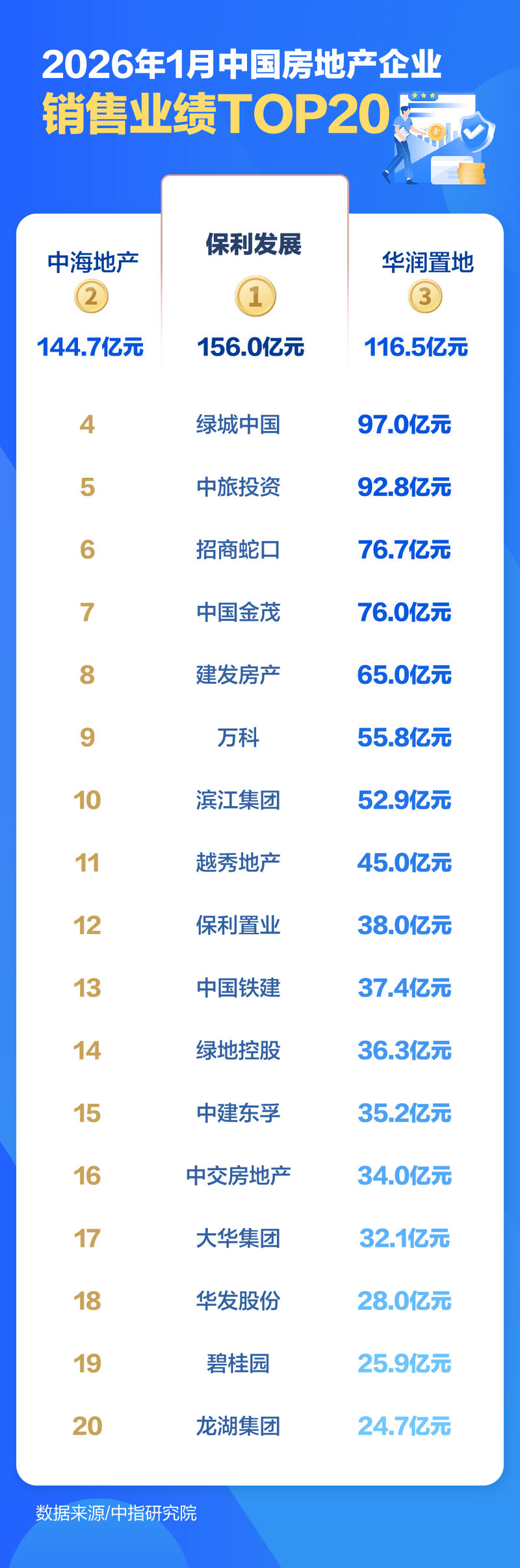
Core Viewpoint - The top 100 real estate companies in China are experiencing a significant reshuffling in their rankings as of January 2026, with a notable decline in overall sales figures compared to the previous year [2][3]. Group 1: Sales Performance - In January 2026, the total sales of the top 100 real estate companies reached 190.52 billion yuan, representing an 18.9% year-on-year decline [2]. - Only three companies achieved sales exceeding 10 billion yuan in January, a decrease of two compared to the same period last year [2]. - The number of companies with sales over 5 billion yuan increased to ten, up by two from the previous year [2]. Group 2: Ranking Changes - The top 10 rankings saw significant changes, with Poly Developments, China Overseas, and China Resources remaining in the top four, while Vanke dropped from fifth to ninth place [3]. - China Travel Investment emerged as a major dark horse, jumping from outside the top 40 to fifth place [3]. - China Jinmao rose from thirteenth to seventh, indicating intensified competition within the top tier [3]. Group 3: Performance of Private Enterprises - Among the 32 companies that experienced year-on-year growth in January, six private enterprises had growth rates exceeding 100% [3]. - Bangtai Group and China Construction Yipin entered the top 20 in sales, benefiting from strategic investments during market lows [3]. Group 4: New Entrants and Market Dynamics - Seven new companies entered the top 100 list in January, with four being small to medium-sized private enterprises [4]. - State-owned enterprises continue to dominate land acquisition, with companies like Yuexiu Property and China Resources maintaining strong investment levels [4]. Group 5: Policy and Market Outlook - The policy environment is shifting towards stabilizing expectations, with measures such as extended tax rebates and loan extensions being implemented [4]. - The market is expected to see a gradual release of demand in March, driven by promotional activities from real estate companies before the Spring Festival [5].




房企开年排位生变:“保中华”格局延续 最大黑马竟是它?
Xin Jing Bao· 2026-02-02 13:33
Core Viewpoint - In January 2026, the sales performance of the top 100 real estate companies in China showed a total sales amount of 190.5 billion yuan, reflecting a year-on-year decline of 18.9%, indicating a stable continuation of the downward trend observed in the previous year [5][10]. Group 1: Sales Performance - The total sales amount for the top 100 real estate companies in January 2026 was 190.5 billion yuan, which is a year-on-year decrease of 18.9%, consistent with the decline observed throughout the previous year [5][10]. - The top three companies in terms of total sales were Poly Developments (15.6 billion yuan), China Overseas Land & Investment (14.47 billion yuan), and China Resources Land (11.65 billion yuan) [5][10]. - The average sales amount for the top 10 companies was 9.33 billion yuan, down 11.6% year-on-year, while the average for companies ranked 11-30 was 2.6 billion yuan, down 25.6% [10]. Group 2: Market Dynamics - The decline in sales is attributed to a high base from January of the previous year, where core city markets were notably active [5][9]. - The new entrant, China Travel Investment, ranked 5th with a sales amount of 9.28 billion yuan, marking a significant rise from previous years [9]. - The sales performance of the top 10 companies remained relatively stable, with three companies showing year-on-year increases, while seven experienced declines [10]. Group 3: Future Outlook - Analysts expect that as the Chinese New Year approaches, real estate companies may increase marketing efforts, which could lead to a temporary boost in market activity [11]. - There is a need for coordinated policy efforts from both demand and supply sides to effectively restore market confidence [11].

今年已有3位地产高管转投物业企业
Mei Ri Jing Ji Xin Wen· 2026-02-02 13:01
1月27日,保利物业的4条公告打破了物业行业的平静,这距离该公司上一次关键人事变动已过去3年。 2023年1月,吴兰玉接任董事长,姚玉成空降出任总经理。而此次,因工作调整辞任总经理的姚玉成, 其职位由47岁的王英男接棒,后者履历几乎贯穿地产开发全链条。 头部物业企业的人事变动并非行业孤例,随着地产行业的深度调整,拥有稳定现金流的物业企业反而成 了"香饽饽",越来越多地产高管开始转投物业企业。《每日经济新闻》记者注意到,仅2026年以来,就 已有保利物业、建业新生活、弘阳服务等物业企业陆续迎来地产背景高管。 作为昔日地产板块的配套行业,物业行业正在成为房企核心人才的新赛场。 2026年开年就已经有三家物业企业迎来了地产高管,而如果追溯到2025年全年,这个名单就更长了。 比如雅生活的王海洋、荣万家的吴秋云、永升服务的林祝波等,一众地产老将纷纷接掌物业企业核心岗 位。 地产大佬去物业 2026年开年,多位地产老将奔赴物业赛道。 1月27日,保利物业连发4条公告,官宣管理层换血,深耕地产领域15年的王英男接棒姚玉成出任总经 理。 事实上,约半个月前,保利发展将运营管理中心与产品管理中心合并为不动产运营中心,集团架构 ...
商业不动产REITs点评:首批商业不动产REITs发行在即,存量盘活规模可期
Bank of China Securities· 2026-02-02 11:28
Investment Rating - The industry investment rating is "Outperform the Market," indicating that the industry index is expected to perform better than the benchmark index over the next 6-12 months [12]. Core Insights - The report highlights the imminent issuance of the first batch of commercial real estate REITs, with significant potential for revitalizing existing assets [1]. - The expansion of the public REITs market from infrastructure to commercial real estate marks a new phase in China's REITs development, with regulatory support aimed at enhancing issuance efficiency and encouraging asset integration [3]. - The report anticipates that commercial real estate REITs will accelerate in 2026, driven by policy support and the performance of initial projects, while emphasizing the importance of asset quality and operational capabilities for long-term success [3]. Summary by Sections Commercial Real Estate REITs Overview - The first batch of commercial real estate REITs is set to raise a total of approximately 314.7 billion yuan, covering various commercial formats such as hotels, office buildings, and shopping centers [3]. - The report details eight commercial real estate REITs that have been submitted for approval, with expected fundraising sizes ranging from 17.03 billion yuan to 74.7 billion yuan [5][6]. Specific REITs Details - **Huitianfu Shanghai Real Estate REIT**: Expected to raise 40.02 billion yuan, with underlying assets including two office buildings in Shanghai [5]. - **Huazhong Jinjiang REIT**: Expected to raise 17.03 billion yuan, focusing on 21 hotels across 18 cities [5]. - **CICC Vipshop REIT**: Expected to raise 74.7 billion yuan, with underlying assets in Zhengzhou and Harbin [5]. - **Huazhong Lujiazui REIT**: Expected to raise 28.10 billion yuan, with assets in Shanghai [6]. - **Huazhong Poly Development REIT**: Expected to raise 20.93 billion yuan, with assets in Guangzhou and Foshan [6]. - **Huazhong Yintai REIT**: Expected to raise 42.785 billion yuan, focusing on the Hefei Yintai Center [6]. - **Huazhong CapitaLand REIT**: Expected to raise 40.54 billion yuan, with assets in Shenzhen and Mianyang [6]. - **Guotai Haitong Sazhi Chuan REIT**: Expected to raise 50.64 billion yuan, focusing on the Sazhi Chuan outlet in Xi'an [6]. Market Potential and Future Outlook - The report emphasizes the substantial existing stock of commercial real estate in China, which provides a solid foundation for the development of commercial real estate REITs [3]. - The retail sector alone has over 9,000 concentrated commercial properties, while the hotel sector has approximately 1.764 million rooms, indicating a strong demand for asset revitalization through REITs [3]. - The report suggests that companies with mature and stable assets, such as Poly Development and Meiyue Commercial, are likely to have a competitive advantage in the REITs market [3].


