晶澳科技

Search documents
光伏产品取消出口退税,江苏超800MW海上风电项目获核准
GOLDEN SUN SECURITIES· 2026-01-11 05:56
证券研究报告 | 行业周报 gszqdatemark 2026 01 11 年 月 日 电力设备 光伏产品取消出口退税,江苏超 800MW 海上风电项目获核准 光伏:两部门宣布取消光伏等产品增值税出口退税,硅料电池组件价格上涨。近 日财政部、税务总局发布关于调整光伏等产品出口退税政策的公告:自 2026 年 4 月 1 日起,取消光伏等产品增值税出口退税。自 2026 年 4 月 1 日起至 2026 年 12 月 31 日,将电池产品的增值税出口退税率由 9%下调至 6%;2027 年 1 月 1 日 起,取消电池产品增值税出口退税。适时降低或取消光伏产品的出口退税,有助于 推动国外市场价格理性回归,降低我国面临的贸易摩擦的风险。据安泰科统计,本 周多晶硅 n 型复投料成交价格区间为 5.0-6.3 万元/吨,成交均价为 5.92 万元/吨, 周环比上涨 9.83%。n 型颗粒硅成交价格区间为 5.0-6.4 万元/吨,成交均价为 5.58 万元/吨,环比涨幅为 10.5%。据 Infolink,本周 N 型电池片价格如下:183N、 210RN 与 210N 均价再度上调,本周上升至每瓦 0.39 元人民 ...
晶科能源(688223):仰望星空布局星辰大海,脚踏实地光储扭亏可期
Guotou Securities· 2026-01-09 15:39
Investment Rating - The investment rating for the company is "Buy-A" with a 12-month target price of 7.35 yuan, while the current stock price is 6.18 yuan [5]. Core Insights - The company has signed a strategic cooperation agreement with Jingtai Technology to develop AI+robotics high-throughput perovskite solar cell technology, aiming to enhance competitive advantages in photovoltaic products [1][2]. - The perovskite tandem technology is seen as a key direction for the future of the photovoltaic industry, with the company achieving a new breakthrough in conversion efficiency of 34.76% for its TOPCon-based perovskite tandem cells [3]. - The energy storage business is expected to turn profitable soon, with a projected shipment volume of 3.3 GWh in the first three quarters of 2025 and plans for significant growth in 2026 [4]. Summary by Sections Strategic Cooperation - The collaboration aims to create the world's first AI-driven, robot-executed, and data-feedback closed-loop manufacturing line for tandem solar cells, significantly improving research and development efficiency [2]. - The new experimental line is expected to achieve a throughput of 1000 cells per day, enhancing R&D efficiency by a factor of 100 [2]. Technological Advancements - The company has improved its TOPCon cell efficiency to 27.79% and plans to upgrade 40%-50% of its existing capacity by the end of 2025, with mainstream models exceeding 640W [3]. - The strategic partnership is crucial for consolidating the company's long-term technological advantages and capturing the next generation of technology leadership [3]. Energy Storage Business - The company is deepening its strategic layout in the new energy storage sector, with a focus on large-scale and commercial energy storage projects, achieving an international order ratio of approximately 80% [4]. - The energy storage business is anticipated to contribute stable profits starting in 2026, supported by a production capacity of 17 GWh for system integration and 5 GWh for cell self-supply [4]. Financial Projections - The company is projected to have net profits of -4.5 billion yuan in 2025, followed by 2.13 billion yuan in 2026 and 3.57 billion yuan in 2027, indicating a significant turnaround [9]. - The company is compared with peers like Longi Green Energy, JA Solar, and Trina Solar, highlighting its leading position in TOPCon technology and rapid growth in the energy storage sector [9].

反内卷趋势无忧,太空光伏产业提速
Yin He Zheng Quan· 2026-01-09 15:34
Investment Rating - The report maintains a "Recommended" rating for the electric equipment industry [1] Core Insights - The report highlights that the trend of anti-involution is not a concern, and the space photovoltaic industry is accelerating [1] - The report discusses the recent regulatory actions in the photovoltaic sector, emphasizing the prohibition of monopolistic behaviors such as price and capacity coordination, while allowing compliance with cost-based sales and technology standard improvements [4] - The report notes a continued upward trend in industry prices, with expectations for profit recovery in 2026 as terminal demand gradually improves [4] - The rise of commercial space ventures is accelerating the development of space photovoltaic technology, with significant plans for satellite energy networks and high-efficiency energy generation [4] Summary by Sections Regulatory Environment - The market regulatory authority has halted self-regulatory actions related to the photovoltaic industry's silicon material integration platform, citing monopolistic concerns [4] - A collaborative governance framework is being established among enterprises, power generation entities, and associations to ensure compliance and quality standards [4] Industry Price Trends - The average transaction price for N-type silicon material has increased to 59,200 CNY per ton, reflecting a week-on-week increase of 9.83% [4] - Prices for N-type silicon wafers and battery cells have also seen upward adjustments, indicating a recovery in the industry [4] Space Photovoltaic Development - Elon Musk has announced plans to deploy a 100GW solar-powered satellite energy network annually, while China aims to establish gigawatt-level space data centers by 2035 [4] - Space photovoltaic technology is expected to achieve commercial viability within the next 10-15 years, driven by advancements in battery technology and reduced launch costs [4] Investment Recommendations - The report suggests focusing on companies with technological reserves in space photovoltaic, such as Junda Co., JinkoSolar, Trina Solar, and others [4] - It also recommends monitoring leading companies with strong advantages in new technologies, as well as those benefiting from anti-involution policies in the silicon material segment [4]
4月起 光伏产品出口退税归零 千亿产业 谁在窃喜?
Mei Ri Jing Ji Xin Wen· 2026-01-09 14:38
可以看出,若不能提高光伏产品价格以弥补出口退税政策调整的影响,光伏厂商业绩或将受到冲击。 据了解,2025年上半年,晶科能源海外业务占比超六成。其表示,公司凭借前瞻性的全球布局战略,不 仅深耕海外传统光伏市场,更敏锐捕捉海外高增长市场,实现2025年上半年逾六成的海外出货。公司在 日本光伏组件市场多年保持出货冠军,在沙特地区的市场份额大幅高于同业,在中东、东南亚、拉美区 域的多个光伏新兴市场实现市占率领跑。2025年上半年,公司在巴基斯坦的组件出货量便已达到2024年 全年的出货水平。 2025年上半年,晶科能源应收出口退税款期末账面价值为9.13亿元。 同期,天合光能境外业务收入为147.67亿元,占营收比例约为48%。2025年上半年,天合光能应收增值 税出口退税期初账面价值为0.21亿元。关于期末账面价值,天合光能并未列明。 晶澳科技境外业务占比同样接近五成。据2025年半年报,其境外业务收入118.42亿元,占比约为 49.54%。2025年上半年,晶澳科技应收出口退税款期初账面价值为0.18亿元,期末账面价值为0.25亿 元。 同期,隆基绿能光伏产品分部中,境外业务收入为123.68亿元,占光伏产品 ...



4月起,光伏产品出口退税归零,千亿产业,谁在窃喜?
Mei Ri Jing Ji Xin Wen· 2026-01-09 14:20
Group 1 - The Ministry of Finance and the State Taxation Administration announced the cancellation of the export VAT rebate for photovoltaic products starting April 1, 2026, reducing the rebate rate from 9% to 0% [1] - In the first ten months of 2025, photovoltaic exports reached $24.42 billion, which would result in a loss of approximately $2.2 billion (around 15.3 billion RMB) in rebates for large exporting companies [1] - If companies cannot raise prices to offset the impact of the export tax policy adjustment, their performance may be adversely affected [1] Group 2 - JinkoSolar's overseas business accounted for over 60% of its total shipments in the first half of 2025, maintaining a leading position in various international markets [2] - Trina Solar reported overseas revenue of 14.767 billion RMB, making up about 48% of its total revenue in the same period [2] - JA Solar's overseas business revenue was approximately 11.842 billion RMB, accounting for about 49.54% of its total revenue [2] Group 3 - Among the four major photovoltaic manufacturers, JinkoSolar has the highest proportion of overseas business, followed by Trina Solar and JA Solar, with LONGi Green Energy having the lowest [3] - Trina Solar's energy storage segment has made significant progress in expanding overseas markets, with a successful shipment of a 1.2 GWh energy storage system to Chile in July 2025 [3] - The export VAT rebate for battery products will be reduced from 9% to 6% starting April 1, 2026, and will be completely eliminated by January 1, 2027, providing a longer buffer period compared to photovoltaic products [3] Group 4 - The cancellation of export rebates may benefit manufacturers with a higher proportion of overseas production capacity [3] - Companies are increasingly establishing overseas production facilities, with JinkoSolar actively promoting global production and sales, including setting up factories in Southeast Asia and the U.S. [5]
电力设备行业点评报告:反内卷趋势无忧,太空光伏产业提速
Yin He Zheng Quan· 2026-01-09 09:20
Investment Rating - The report maintains a "Recommended" rating for the electric equipment industry [1] Core Insights - The report highlights that the trend of anti-involution is not a concern, and the space photovoltaic industry is accelerating [1] - The report discusses the recent regulatory actions in the photovoltaic sector, emphasizing the prohibition of monopolistic behaviors such as price and capacity coordination, while allowing compliance with cost-based sales and technology standard improvements [4] - The report notes a continued upward trend in industry prices, with expectations for profit recovery in 2026 as terminal demand gradually improves [4] - The rise of commercial space and the acceleration of the space photovoltaic industry are underscored, with significant plans for deploying solar energy networks in space [4] Summary by Sections Regulatory Environment - The market regulatory authority has halted self-regulatory actions related to the photovoltaic industry's silicon material integration platform, citing monopolistic concerns [4] - A collaborative governance framework is being established among enterprises, power generation entities, and associations to ensure compliance and quality standards [4] Industry Price Trends - The average transaction price for N-type silicon material has increased to 59,200 CNY per ton, reflecting a week-on-week increase of 9.83% [4] - Prices for N-type silicon wafers and battery cells have also seen upward adjustments, indicating a recovery in the industry [4] Space Photovoltaic Development - Elon Musk's plan to deploy 100GW of solar-powered satellites annually is highlighted, along with China's plans for gigawatt-level space data centers [4] - The report anticipates that space photovoltaic technology will become commercialized in the next 10-15 years, driven by decreasing launch costs and technological breakthroughs [4] Investment Recommendations - The report suggests focusing on companies with technological reserves in space photovoltaic, such as Junda Co., JinkoSolar, Trina Solar, and others [4] - It also recommends monitoring leading companies with strong advantages in new technologies, as well as those benefiting from anti-involution policies in the silicon material segment [4]
电力设备行业:反内卷趋势无忧,太空光伏产业提速
Yin He Zheng Quan· 2026-01-09 07:39
Investment Rating - The report maintains a "Recommended" rating for the electric equipment industry [1] Core Insights - The report highlights that the trend of anti-involution is not a concern, and the space photovoltaic industry is accelerating [1] - The report discusses the recent regulatory actions in the photovoltaic sector, emphasizing the prohibition of monopolistic behaviors such as price and capacity coordination, while allowing compliance with cost-based sales and technology standard improvements [4] - The report notes a continued upward trend in industry chain prices, with expectations for profit recovery in 2026 as terminal demand gradually warms up [4] - The rise of commercial space and the acceleration of the space photovoltaic industry are emphasized, with significant plans for deploying solar energy networks in space [4] Summary by Sections Regulatory Environment - The market regulatory authority has halted self-regulatory actions related to the photovoltaic industry's silicon material integration platform, citing monopolistic concerns [4] - The framework for collaborative governance among enterprises, power generation parties, and associations is outlined, focusing on compliance and quality standards [4] Industry Price Trends - Recent data indicates that the average transaction price for N-type silicon material has increased to 59,200 CNY per ton, reflecting a week-on-week increase of 9.83% [4] - Prices for N-type silicon wafers and battery cells have also seen upward adjustments, with average prices reaching 1.4 to 1.7 CNY per piece and 0.39 CNY per watt, respectively [4] Space Photovoltaic Development - Elon Musk's plan to deploy 100GW of solar energy satellites annually is highlighted, alongside China's phased deployment of gigawatt-level space data centers from 2025 to 2035 [4] - The report anticipates that space photovoltaic technology will become commercialized within the next 10-15 years, driven by decreasing launch costs and breakthroughs in battery technology [4] Investment Recommendations - The report suggests focusing on companies with technological reserves in space photovoltaic, including JunDa Co., JinkoSolar, Trina Solar, and others [4] - It also recommends attention to leading companies with strong advantages in new technologies, such as LONGi Green Energy and Aiko Solar [4] - Companies benefiting from anti-involution policies in the silicon material segment, such as Tongwei Co. and GCL-Poly Energy, are also highlighted [4] - The report advises monitoring companies that prioritize synergy in energy storage and are relatively independent from the main chain, such as Sungrow Power Supply and others [4]
电力设备:反内卷趋势无忧,太空光伏产业提速
Yin He Zheng Quan· 2026-01-09 07:03
Investment Rating - The report maintains a "Recommended" rating for the electric equipment industry [1] Core Insights - The report highlights that the trend of anti-involution is not a concern, and the space photovoltaic industry is accelerating [1] - The recent regulatory actions in the photovoltaic sector aim to prevent monopolistic behaviors while allowing compliance with cost-based sales and technology standards [4] - The prices in the industry continue to rise, indicating a recovery, with silicon material prices increasing by 9.83% week-on-week to 59,200 CNY/ton [4] - The commercial space sector is emerging, with plans for deploying solar energy satellites, which could lead to significant advancements in space photovoltaic technology [4] Summary by Sections Regulatory Environment - The market regulatory authority has halted self-regulatory actions related to silicon material integration in the photovoltaic industry, focusing on preventing monopolistic practices [4] - Compliance measures are being established to ensure fair competition among industry participants [4] Industry Performance - The prices of N-type silicon wafers and cells have seen increases, with N-type cell prices rising to 0.39 CNY/W and TOPCon module prices reaching 0.7 CNY/W [4] - The industry is expected to turn profitable in 2026 as terminal demand recovers [4] Technological Advancements - The report emphasizes the potential of space photovoltaic technology, which can generate energy continuously and is projected to become commercialized in the next 10-15 years [4] - The focus is on companies with technological reserves in space photovoltaics, such as Junda Co., JinkoSolar, Trina Solar, and others [4]
晶澳科技跌2.07%,成交额4.28亿元,主力资金净流出5329.34万元
Xin Lang Cai Jing· 2026-01-09 03:37
Core Viewpoint - JinkoSolar Technology Co., Ltd. has experienced a decline in stock price and significant financial losses in recent periods, indicating potential challenges in the solar energy sector [1][2]. Financial Performance - As of September 30, 2025, JinkoSolar reported a revenue of 36.809 billion yuan, a year-on-year decrease of 32.27% [2]. - The company recorded a net profit attributable to shareholders of -3.553 billion yuan, reflecting a year-on-year decrease of 633.54% [2]. Stock Market Activity - On January 9, JinkoSolar's stock price fell by 2.07%, trading at 11.85 yuan per share with a total market capitalization of 39.22 billion yuan [1]. - The stock has seen a year-to-date increase of 3.49%, with a 4.87% rise over the past 20 days, but a significant decline of 17.13% over the last 60 days [1]. Shareholder Information - The number of shareholders decreased by 17.24% to 147,800, while the average number of circulating shares per person increased by 20.84% to 22,370 shares [2]. - Major shareholders include Hong Kong Central Clearing Limited, holding 214 million shares, and other institutional investors with varying changes in their holdings [3]. Dividend History - JinkoSolar has distributed a total of 3.055 billion yuan in dividends since its A-share listing, with 2.415 billion yuan distributed over the last three years [3]. Business Overview - JinkoSolar, established on October 20, 2000, specializes in the research, production, and sales of silicon wafers, solar cells, and solar modules, as well as the development and operation of solar power plants [1]. - The company's main revenue sources are solar modules (91.10%), other businesses (5.85%), and solar power plant operations (3.05%) [1]. Industry Classification - JinkoSolar is classified under the power equipment sector, specifically in photovoltaic equipment and solar cell modules [1]. - The company is associated with concepts such as monocrystalline silicon, BIPV, TOPCon cells, Xiong'an New Area, and HJT cells [1].
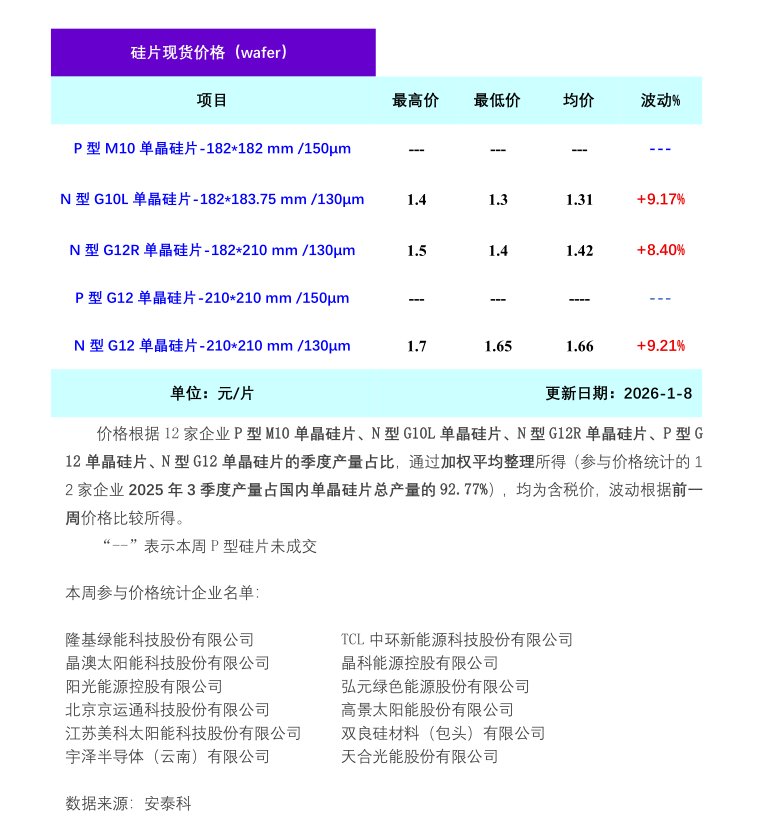
安泰科:硅片厂商挺价意愿强烈 单晶硅片价格继续上涨
Zhi Tong Cai Jing· 2026-01-08 13:40
Core Insights - The price of silicon wafers has continued to rise due to price support from silicon wafer manufacturers, downstream demand, and cost support from raw materials [1][2] Price Trends - N-type G10L monocrystalline silicon wafer (182*183.75mm/130μm) average transaction price is 1.31 yuan/piece, up 9.17% compared to the previous period - N-type G12R monocrystalline silicon wafer (182*210mm/130μm) average transaction price is 1.42 yuan/piece, up 8.40% compared to the previous period - N-type G12 monocrystalline silicon wafer (210*210mm/130μm) average transaction price is 1.66 yuan/piece, up 9.21% compared to the previous period [1][3] Market Dynamics - Downstream battery prices have significantly increased, with mainstream battery prices ranging from 0.37 to 0.39 yuan/W, up 18.75% compared to the previous period, while module prices remain stable at 0.66 to 0.68 yuan/W [1] - The supply side has seen a significant reduction in silicon wafer production, with December output at 47.7 GW, down 14.2% from November [2] - The overall operating rate in the industry remains stable, with major integrated companies operating at 50%-70% capacity [2] Price Stability and Future Outlook - Despite strong price increase intentions from silicon wafer manufacturers, the terminal component prices have not followed the upward trend, and battery manufacturers are planning to reduce production to alleviate supply-demand pressure, making it difficult for silicon wafer prices to maintain an upward trend in the short term [2]