饿了么

Search documents
高德邀餐饮商家免费入驻
Qi Lu Wan Bao· 2025-09-25 15:29
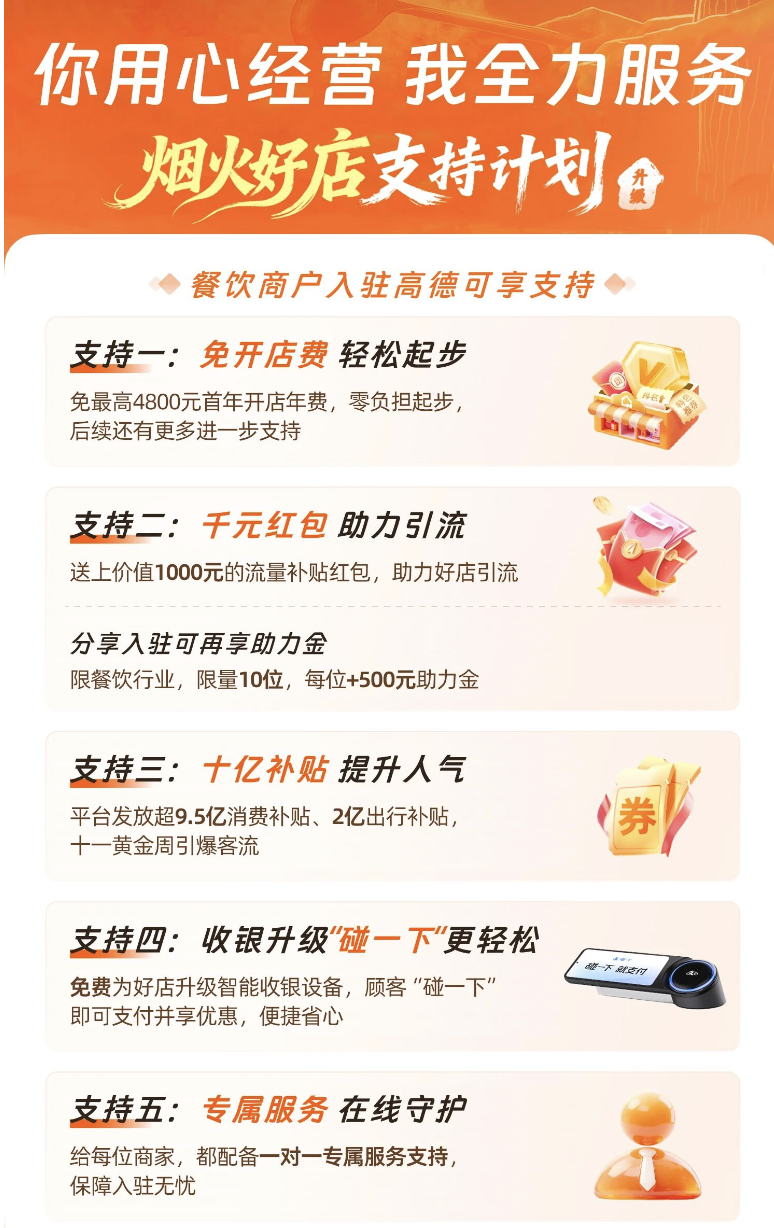
带着疑问,记者向高德地图打去了咨询电话。据客服介绍,商家若想参与"烟火好店活动",需先完成店铺在 高德APP的入驻流程,店铺成功入驻后,将在高德地图上正式显示。值得注意的是,该活动明确推出"免一 年年费"的优惠政策,但关于常规状态下的年费标准,客服表示,因活动为新推出,具体金额需商家入驻后,与 专属客户经理进一步沟通确认。 在商家最为关心的活动权益方面,客服介绍,"烟火好店活动"提供四大核心支持。 记者 张志恒 济南报道 9月23日,高德地图官方公众号发布信息,正式邀请全国餐饮商家免费入驻高德,并免除1年的入驻费。 记者随后采访了几位餐饮店老板得知,这几天他们已接到了高德打来的电话邀请。"记得三四年前入驻过 一次,也在上面做了团购套餐,但当时没掀起太大水花,目前还是先观望一下吧。"负责某连锁品牌的运营 经理全女士说。而经营着两家甜品店的许先生则表示,应该会入驻:"对店铺的曝光量有好处。" 数据显示,2025年国内餐饮市场已进入存量竞争红海,全国餐饮相关企业存量接近1700万家,门店总数接近 800万家,上半年新开门店302万家的同时,闭店数量也高达296万家,净增仅6万家。而高德的突袭,恰如一颗 投入沸水中的 ...
平台促销成本不得变相或直接转嫁商户
Qi Lu Wan Bao· 2025-09-25 12:51
Core Viewpoint - The introduction of the "Basic Requirements for the Management of Delivery Platform Services (Draft for Comments)" marks a new era of regulatory standards for the food delivery industry, focusing on food safety, merchant operational burdens, and rider rights protection, aiming to address public concerns and inject new vitality into the sector [1][9]. Group 1: Regulation and Market Competition - The draft addresses issues of "involution" competition among delivery platforms, which has intensified due to aggressive subsidy wars, leading to market disorder [2]. - It emphasizes the need for platforms to adhere to legal regulations, maintain fair competition, and clarify their responsibilities towards merchants and riders [2][9]. - Specific measures include optimizing platform fee structures, ensuring transparent pricing, and managing promotional activities to prevent unfair practices [2][8]. Group 2: Food Safety Standards - The draft introduces stringent requirements for merchant qualifications to combat "ghost restaurants," which operate without proper licenses, posing food safety risks [3][4]. - It mandates that merchants provide valid operating licenses and undergo thorough verification processes to ensure compliance [3][4]. - A new "order control prompt" mechanism will be implemented to monitor merchant order loads and prevent service overload during peak times, thereby maintaining food quality [4][10]. Group 3: Rider Rights and Welfare - The draft outlines comprehensive solutions for rider rights, focusing on fair compensation, work hours, and social security [6][10]. - It establishes limits on working hours and mandates rest periods for riders to prevent overwork and health risks [6][10]. - Platforms are required to disclose payment structures and ensure riders are not overburdened with excessive workloads [6][10]. Group 4: Merchant Rights and Responsibilities - The draft aims to alleviate the financial burdens on small and medium-sized merchants by prohibiting platforms from shifting promotional costs onto them [7][8]. - It requires platforms to transparently disclose fee structures and prohibits misleading promotional language that could disrupt market order [7][8]. - The regulations ensure that promotional prices cannot result in zero or negative transaction values, protecting merchants' interests [7][8][10]. Group 5: Overall Industry Impact - The new standards are designed to create a balanced ecosystem among platforms, merchants, and riders, promoting sustainable development within the food delivery industry [9]. - By integrating various regulatory requirements, the draft aims to enhance consumer trust and improve the overall image of the industry [9]. - The implementation of these regulations will require collaboration among multiple government departments to ensure effective enforcement [9].


小赛道,才有大机会
创业家· 2025-09-25 10:11
Core Viewpoint - Successful companies in China should focus on niche markets that others overlook, as small tracks can present significant opportunities. Companies should avoid spending in areas where they cannot compete and be willing to take bold risks in areas where they can succeed [1] Group 1: Course Overview - The "Black Horse Consumption Rise Selected Course" is scheduled from October 17 to 19 in Shenzhen, featuring renowned instructors from various industries [2][5] - The course aims to provide insights into product innovation and brand expansion, particularly in the context of the stock market era [6][8] Group 2: Japanese Manufacturing Insights - The success of Japanese companies since the 1980s serves as a model for emerging economies, emphasizing the transformation of technology into user-perceived value [7] - Companies like Sony and Uniqlo succeeded not solely due to advanced technology but by addressing consumer pain points and understanding consumption scenarios [7] Group 3: AI and Consumer Innovation - AI is reshaping the essence of consumption by redefining product value through algorithms, with future champions being those who can perfectly integrate demand with AI [7][10] - Examples include Plaud's recording card and Haivivi's toys, which leverage AI to enhance user experience and emotional connection [7] Group 4: Market Strategies - The course will cover strategies for becoming champions in niche markets amidst intense competition, focusing on AI's role in creating new product categories [10] - It will also address how to find a clear market position and leverage scalable innovative products for brand differentiation [10] Group 5: Globalization and Localization - The essence of globalization is to deeply bind China's supply chain capabilities with local market demands abroad, moving from simple export to localized coexistence [11] - Trust-building with local consumers is crucial for Chinese brands entering overseas markets, requiring a connection between brand stories and local needs [19]


外卖“新国标”,要来了!
中国基金报· 2025-09-25 09:49
Core Viewpoint - The introduction of a new national standard for food delivery platforms aims to regulate service management, enhance service quality, and alleviate the operational burden on merchants while promoting fair competition among platforms [4][5]. Group 1: Regulatory Framework - The draft standard, titled "Basic Requirements for Food Delivery Platform Service Management," has been publicly solicited for opinions, focusing on key issues such as platform fees and promotional activities [3][4]. - The standard is managed by the National Platform Economy Governance Standardization Technical Committee, with contributions from various organizations including the China Standardization Research Institute [4][6]. Group 2: Key Issues Addressed - The draft addresses significant issues in the food delivery industry, including "involution" competition, opaque and unreasonable platform fees, "ghost deliveries," and insufficient protection for delivery personnel [4][6]. - Specific requirements for fee management are outlined, mandating platforms to standardize fee items, publicly disclose fee information, and conduct compliance audits [6]. Group 3: Enhancements for Stakeholders - The draft emphasizes the need for platforms to ensure transparent promotional activities and fair pricing rules to maintain market order [6]. - It proposes systematic requirements for platforms regarding merchant management, including establishing standardized entry mechanisms and rigorous qualification audits [6][7]. - Delivery personnel's rights are highlighted, with requirements for fair income, working hours, and career development, promoting a sustainable rights protection mechanism [6][7]. Group 4: Operational Insights - The standard aims to integrate various regulatory requirements related to food safety, fair competition, and labor rights, optimizing the ecosystem of the food delivery industry [7]. - It provides actionable guidelines for food delivery platforms to transition from a unidimensional compliance focus to a multidimensional management optimization approach [7]. - The establishment of this standard is expected to enhance consumer trust and improve the overall image of the industry [7].

外卖行业迎来“新国标”!剑指行业内卷、幽灵外卖、平台不透明收费
Sou Hu Cai Jing· 2025-09-25 01:58
Core Viewpoint - The takeaway from the news is that the Chinese food delivery industry is set to undergo significant changes with the introduction of national standards for platform service management, aimed at promoting regulated development and addressing key industry pain points [1][3]. Group 1: New National Standards - The newly proposed standards will cover critical aspects such as platform fees, merchant management, and delivery personnel rights, marking the first time the industry will have national guidelines [1][3]. - The standards aim to curb the escalating "delivery wars" by ensuring promotional activities are transparent and rules are fair, addressing the issue of intense competition among platforms like Ele.me, JD, and Meituan [3][5]. Group 2: Transparency and Safety - The draft regulations will tackle the problem of opaque platform fees by mandating platforms to standardize fee items, publicly disclose fee information, and conduct compliance audits, addressing merchants' concerns about unclear charges [3][5]. - A comprehensive system for food safety regulation will be established, including strict merchant qualification checks and operational management to combat the "ghost delivery" phenomenon [3][5]. Group 3: Delivery Personnel Rights - The new regulations will focus on social security, labor compensation, and working hours, requiring platforms to standardize employment relationships and ensure fair income and working conditions for delivery personnel [5]. - The standards are managed by the newly established National Platform Economy Governance Standardization Technical Committee, with major delivery platforms participating in the development process [5]. Group 4: Industry Impact - Experts believe that the new standards will fill existing gaps in coordinating relationships among diverse stakeholders, providing actionable management guidelines for platform companies and enhancing consumer trust and the overall image of the industry [5].
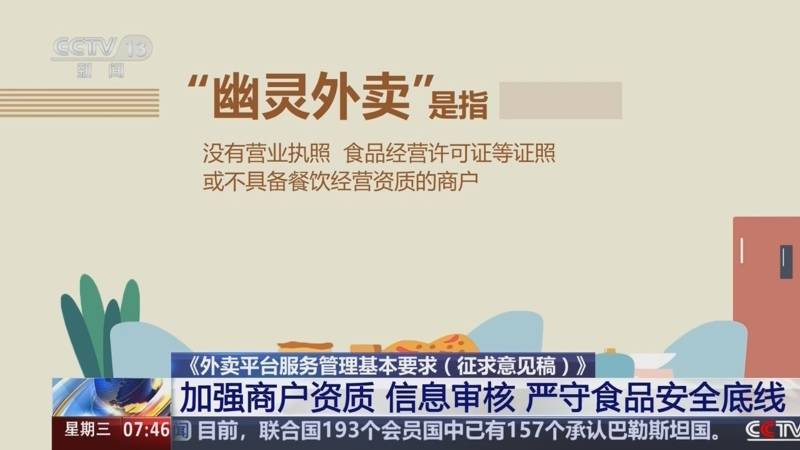
外卖平台服务“新国标”向社会征求意见 聚焦外卖平台治理之痛
Xin Hua Wang· 2025-09-24 09:46
Core Viewpoint - The introduction of a new national standard for food delivery platforms aims to regulate service management, enhance service quality, and address issues such as "involution" competition and transparency in platform fees [1][2][4]. Group 1: Regulatory Framework - The State Administration for Market Regulation has drafted the "Basic Requirements for Food Delivery Platform Service Management (Draft for Comments)" to standardize service management practices [1]. - The draft focuses on key issues such as "involution" competition, opaque and unreasonable platform fees, "ghost deliveries," and insufficient protection for delivery personnel [1][2]. Group 2: Fee and Promotion Management - The draft proposes specific requirements for fee management, including the need for platforms to standardize fee items, publicly disclose fee information, and conduct compliance audits [2]. - It also addresses "involution" competition by establishing requirements for price promotion management, ensuring promotional activities are transparent and rules are fair [2]. Group 3: Merchant and Delivery Personnel Management - The draft outlines systematic requirements for platforms regarding merchant management, emphasizing the establishment of a standardized admission mechanism and strict qualification audits for merchants [2]. - It focuses on protecting delivery personnel's rights, including social security, fair wages, working hours, and career development, promoting a sustainable rights protection mechanism [2][3]. Group 4: Overall Service Management Requirements - The draft sets overall requirements for platforms to operate legally, protect legal rights of all parties, maintain fair competition, fulfill social responsibilities, and promote multi-party governance [3]. - It emphasizes the need for coordination among various stakeholders in the food delivery industry, filling gaps in existing standards regarding stakeholder relationship management [3]. Group 5: Industry Impact - The development of a new national standard is expected to address societal concerns, promote a fair, orderly, and sustainable industry landscape, and enhance consumer trust and the overall image of the industry [4].
Q3本地生活-外卖配送调研
2025-09-24 09:35
Summary of the Conference Call Industry Overview - The takeaway from the conference call indicates a cooling trend in the food delivery market, with a notable decline in order volumes across platforms, particularly for Ele.me, which saw a daily order volume drop of approximately 20% by the end of August, reverting to levels seen at the end of June [1][2]. Key Points on Ele.me - **Order Volume Fluctuations**: In August 2025, Ele.me's order volume peaked with a growth of about 10% compared to July, but by September, it experienced a significant decline of nearly 30% compared to August, returning to levels seen in late June or early July [2]. - **Delivery Strategy Adjustments**: Ele.me is shifting its delivery strategy to focus on high-value orders, offering incentives such as bonuses for orders over 20 yuan to attract riders [1][5]. - **Operational Changes**: A major restructuring of Ele.me's delivery capacity has occurred, moving away from the "优加" model to new models including "专送", "UB", "蜂跑", and "众包". This aims to optimize resource allocation and improve delivery efficiency [1][6]. - **Cost Comparison with Meituan**: The average delivery cost for Meituan is approximately 4 yuan, while Ele.me's is around 5 yuan. There are regional price variations, with higher costs in the northwest and northeast regions compared to lower costs in southern and central China [1][9]. - **Rider Efficiency Improvement**: Post-pandemic, Ele.me's rider efficiency has improved to around 45, narrowing the gap with Meituan, which stands at 46-47. Previously, Meituan's efficiency was significantly higher [1][11]. Key Points on Meituan - **Performance Comparison**: Meituan has maintained a more stable order volume due to its focus on meal deliveries, which are less affected by seasonal changes compared to Ele.me's reliance on afternoon tea and milk tea orders [1][3]. - **Rider Management Strategy**: Meituan is adopting aspects of Ele.me's UB model, allowing merchants to manage some riders to reduce platform labor costs and enhance operational stability [4][19]. Additional Insights - **Rider Count Changes**: Ele.me's rider count remained stable in August but saw a reduction of about 20% in September due to decreased order volumes, translating to a loss of approximately 9,000 riders [4][13]. - **Market Dynamics**: Certain cities, particularly major urban centers and some tier-three and tier-four cities, have shown significant order growth, with some areas experiencing increases of 400-500% [12]. - **Delivery Model Differences**: The delivery models between Ele.me and Meituan differ, with Ele.me's UB model requiring more direct management of riders compared to Meituan's previous model, which was more platform-managed [19]. - **Winter Logistics Preparation**: Ele.me anticipates an increase in logistics demand during the winter holiday season and is adjusting its structure accordingly to meet this expected surge [22]. This summary encapsulates the critical insights from the conference call, highlighting the competitive landscape between Ele.me and Meituan, their operational strategies, and market dynamics.
【新华解读】外卖平台服务“新国标”向社会征求意见 聚焦外卖平台治理之痛
Xin Hua She· 2025-09-24 09:24
Core Viewpoint - The introduction of a new national standard for food delivery platforms aims to standardize service management, enhance service quality, and address key issues in the industry [1][2][5]. Group 1: Regulatory Framework - The State Administration for Market Regulation has drafted the "Basic Requirements for Food Delivery Platform Service Management (Draft for Comments)" to solicit public opinions [1]. - The new standard is managed by the National Platform Economy Governance Standardization Technical Committee, which includes major food delivery platforms in its development process [2]. Group 2: Key Issues Addressed - The draft focuses on addressing significant issues such as "involution" competition, lack of transparency in platform fees, "ghost deliveries," and insufficient protection for delivery personnel [1][2]. - Specific requirements for fee management include standardizing fee items, publicizing fee information, and conducting compliance audits [2]. Group 3: Delivery Personnel Rights - The draft emphasizes the protection of delivery personnel's rights, including social security, fair wages, working hours, and career development [3]. - It mandates platforms to establish fair and sustainable mechanisms for protecting delivery personnel's rights [3]. Group 4: Operational Guidelines - The standard provides actionable guidelines for food delivery platforms, focusing on integrating compliance across multiple dimensions, including food safety, fair competition, and labor rights [4]. - It aims to enhance overall service quality and efficiency within the food delivery industry [4]. Group 5: Industry Impact - The establishment of a new national standard is expected to address societal concerns, promote a fair and orderly industry landscape, and improve consumer trust and the overall image of the industry [5].
东莞分批解除“五停”,商超、外卖恢复营业
2 1 Shi Ji Jing Ji Bao Dao· 2025-09-24 09:21
Core Points - Dongguan has announced a phased lifting of the "Five Stops" measures (suspension of classes, work, production, transportation, and business) due to the diminishing impact of Typhoon Haikashan, with the emergency response level adjusted from Level I to Level III [1] - Various sectors including education, construction, and transportation are set to resume operations starting September 25, with specific guidelines for different types of work [2][3] Group 1: Education Sector - All educational institutions including primary, secondary, and higher education will gradually resume classes from September 25 [2] - The resumption includes kindergartens, vocational schools, and various training institutions [2] Group 2: Construction Sector - Construction activities at various sites will resume in an orderly manner from September 25, with certain types of work such as fishing vessels and high-altitude operations remaining suspended until further notice [2] Group 3: Industrial and Commercial Sector - Industrial parks, production bases, and factories will restart operations from September 24 [3] - Markets, shopping malls, supermarkets, and restaurants will also reopen, with major retailers like Rainbow, Walmart, and Hema Fresh confirming their reopening [3] - Essential supplies such as vegetables and meat are reported to be sufficient, encouraging citizens to shop in a staggered manner to avoid crowding [3] Group 4: Transportation Sector - Various transportation modes including public transport and highways will resume operations from September 24, with rail services starting on September 25 [3] Group 5: Safety Measures - Authorities will guide institutions and businesses to conduct safety checks before resuming operations, ensuring that potential hazards are addressed [5] - Continuous monitoring of weather conditions is advised for both businesses and citizens to ensure safety [5]
全国餐饮商家免费入驻高德会引发新一轮大战吗?
Qi Lu Wan Bao Wang· 2025-09-24 08:22
齐鲁晚报·齐鲁壹点 张志恒 9月23日,高德地图官方公众号发布信息,正式邀请全国餐饮商家免费入驻高德,并免除1年的入驻费。 记者随后采了几位餐饮老板得知,这几天已经接到了高德打来的电话邀请,也听同行朋友聊了几句。"记得三 四年前入驻过一次,也在上面做了团购套餐,但当时没有掀起太大的水花,目前还是观望一下吧。"负责某连 锁品牌的运营经理全女士向记者表示,她目前持观望态度。而经营着两家甜品店的许先生则表示,应该会入 驻:"这样对店铺的曝光量有好处。" 数据显示,2025年国内餐饮市场已进入存量竞争红海,全国餐饮相关企业存量已接近 1700 万家,门店总数接 近800万家,上半年新开门店302万家的同时,闭店数量也高达296万家,净增仅6万家。而高德的突袭恰如一 颗投入沸水的石子——其"扫街榜"已覆盖全国300余个城市的87万家餐厅,此次免佣政策推出又掀起了波澜。 带着疑问,记者向高德地图打去了客服电话,据客服人员介绍,商家若想参与 "烟火好店活动",需先完成店 铺在高德APP的入驻流程,而店铺成功入驻后,将能在高德地图上正式显示,方便消费者通过地图快速找到门 店位置。值得注意的是,该活动明确推出"免一年年费"的优 ...