
保利发展

Search documents
中国电力市场来了只“章鱼”,亦是“鲶鱼”?
2 1 Shi Ji Jing Ji Bao Dao· 2026-02-02 09:56
在英国首相斯塔默访华的一众随行企业名单中,一家名为章鱼能源(Octopus Energy)的企业颇受业内 关注。 2026年1月30日举行的中英商务论坛上,这家英国最大的电力交易公司与一家中国新兴能源企业达成了 合作——章鱼能源与碧澄能源将在华合资设立一家聚焦电力交易业务的公司,此举被视作近些年来中英 能源领域又一项标志性的进展。 事实上,上述合作的主角双方,都是各国能源领域的后起之秀。 碧澄能源的前身是保碧新能源,成立于2022年,早年因其是房地产龙头企业保利和碧桂园联合孵化跨界 新能源,受到业内关注。2025年,保碧新能源更名"碧澄能源",其最新股东包括普洛斯、淡马锡、蔚来 等旗下资本。 章鱼能源于2015年成立,这家公司仅用十年时间就迅速成长为英国本土最大电力供应商,并且与中国多 家能源企业互动频繁。 "章鱼"为何盯上中国的电力交易市场?它能否为中国智慧能源领域的发展带来"鲶鱼效应"呢? 合作仅用半年就谈妥 章鱼能源与碧澄能源计划设立的合资公司,将聚焦共建电力数字交易平台。 碧澄能源董事长兼首席执行官李文轩在接受媒体采访时透露,鉴于两家公司之间在业务层面形成天然互 补——碧澄能源所处的中国市场和应用范围 ...

A股上市房企去年预亏超两千亿
第一财经· 2026-02-02 08:23
2026.02. 02 本文字数:1871,阅读时长大约3分钟 作者 | 第一财经 孙梦凡 封图 | AI生成 Wind数据显示,截至目前已有65家A股上市房企发布业绩预告,其中去年预计实现盈利的房企仅16家,其余49家均出现不同程度的亏损,亏损房企数量 占比超七成。从"预亏"规模看,去年预计亏损超百亿的有5家,亏损规模较高的超八百亿。 在A股上市房企中,万科A目前亏损规模居首。该公司预计,2025年归属于上市公司股东的净利润亏损约820亿元,较上年同期亏损494.78亿元大幅扩 大;扣除非经常性损益后的净利润亏损约800亿元,上年同期亏损453.94亿元。 除了房开结算规模下降、毛利率处于低位、资产计提减值等行业普遍因素,万科去年业绩预亏的原因还有:部分经营性业务扣除折旧摊销后整体亏损, 部分非主业财务投资出现亏损;部分大宗资产交易和股权交易价格低于账面值。 华夏幸福、绿地控股、华侨城A、金地集团四家房企,去年"预亏"规模都超过百元,期内预计归母净利润数值分别为-240亿元~-160亿元、-190亿元 ~-160亿元、-155亿元~-130亿元、-135亿元~-111亿元,部分房企已经实质性"资不抵债"。 ...



上海新房淡季低位运行 高端项目成为抗跌主力
Zhong Guo Jin Rong Xin Xi Wang· 2026-02-02 08:05
Group 1 - The Shanghai new housing market entered a traditional sales off-season in January 2026, with both supply and demand showing a relatively weak performance. The total transaction area of commercial residential properties fell to 257,100 square meters, with 1,939 transactions, reflecting seasonal lows [1] - The land market also cooled down, with five residential land plots sold at the base price, indicating a more cautious investment strategy among real estate companies [1] - High-end projects in core areas showed resilience, highlighting a structural differentiation in the market despite the overall sluggishness [1] Group 2 - The top 30 real estate companies in Shanghai achieved a total sales revenue of 24.83 billion yuan in January 2026, with eight companies exceeding 1 billion yuan in sales. China Overseas Land & Investment led with 2.58 billion yuan, followed by China Merchants Shekou and Shanghai Xuhui City Investment [2] - In terms of sales area, eight companies sold over 20,000 square meters, with China Resources Land leading at 40,000 square meters. The top three in equity sales were China Overseas Land & Investment, Poly Developments, and China Resources Land [2] - High-end improvement projects became the absolute mainstay of the Shanghai new housing market, with the top 20 projects generating a total sales amount of 10.82 billion yuan. Anlan Shanghai topped the list with 2.18 billion yuan in sales [3] Group 3 - The land market showed a rational bottoming trend, with a total of 283,700 square meters of various land types launched in January, and 1.65 million square meters transacted. The residential land transaction area was 32,750 square meters, reflecting a cautious attitude among real estate companies in their investment decisions [3] - The market is expected to experience a "small spring" after the traditional off-season, as high-quality land parcels gradually enter the supply sequence. The focus will be on product value extraction in core locations [4]




A股上市房企去年预亏超两千亿
Di Yi Cai Jing· 2026-02-02 07:48
Core Insights - The overall performance forecast for real estate companies in 2025 indicates significant losses, with 49 out of 65 A-share listed companies expected to report losses, accounting for over 70% of the total [1][4] - Vanke A leads in projected losses, estimating a net profit loss of approximately 82 billion yuan, a substantial increase from the previous year's loss of about 49.48 billion yuan [1] - Other companies such as China Fortune Land Development, Greenland Holdings, and China Overseas Land & Investment also anticipate significant losses, with projections exceeding 10 billion yuan [2] Company Performance - Vanke A's projected net profit loss for 2025 is around 82 billion yuan, with a non-recurring loss of about 80 billion yuan, compared to previous losses of 49.48 billion yuan and 45.39 billion yuan respectively [1] - China Fortune Land Development expects a net profit loss between 24 billion and 16 billion yuan, while Greenland Holdings anticipates a loss between 19 billion and 16 billion yuan [2] - Poly Developments managed to maintain a slight profit, with a net profit of approximately 1.03 billion yuan, although this represents a 79.49% decrease year-on-year [3] Industry Overview - The total projected loss for the 49 companies is estimated to be between 202.6 billion and 235.2 billion yuan, indicating a severe downturn in the real estate sector [4] - The overall net profit for the 65 companies, including those expected to be profitable, is projected to be between -164 billion and -202.2 billion yuan, suggesting that the real estate sector may face losses exceeding 200 billion yuan [4] - The real estate market is still in a "de-inventory" phase, with pressures on sales and prices, although there are signs of stabilization in key cities [5]
房地产开发与服务26年第5周:坚定看好地产行情,商业不动产REITs首批挂牌
GF SECURITIES· 2026-02-02 06:53
Core Insights - The report maintains a bullish outlook on the real estate market, highlighting the significant debut of commercial real estate REITs, with the first batch of applications exceeding 32.1 billion RMB, accounting for 14% of the existing C-REITs market [5] - The cancellation of the "three red lines" policy marks a pivotal shift, indicating a return to orderly market development and improved financing channels for real estate companies [16][20] - The report notes a strong year-on-year increase in transaction volumes for both new and second-hand homes, with new home transactions in 50 cities up 3.3% week-on-week and 37.2% year-on-year [5][9] Group 1: Central Policies - The cancellation of the "three red lines" policy allows for a more market-oriented development of the real estate sector, which had previously constrained financing for weaker firms [16] - The central government is actively managing expectations and stabilizing the policy environment to facilitate a turning point in the real estate cycle [16] Group 2: Transaction Performance - New home transactions saw a week-on-week increase of 3.3% and a year-on-year increase of 37.2%, reflecting a recovery from last year's low base due to the Spring Festival [5][9] - Second-hand home transactions also showed significant growth, with a year-on-year increase of 154.9%, driven by a favorable comparison to last year's figures [9] Group 3: Market Dynamics - The report indicates that the new home supply has improved, with a week-on-week increase of 34.5%, which is unusual before the Spring Festival, suggesting increased developer confidence [5] - The second-hand market remains robust, with a year-on-year increase in visits and transactions, indicating sustained demand [5] Group 4: Land Market Performance - The land market showed weaker performance, with total land sales in 300 cities amounting to 12.7 billion RMB, down 20% week-on-week and 69% year-on-year [5] - The report highlights a supply of 7.93 million square meters, with a land absorption rate of 51%, indicating a dual weakness in supply and demand [5] Group 5: Company Performance and Recommendations - The report suggests that companies with strong investment fundamentals and low valuations, such as China Jinmao and China Overseas, are leading the sector [5] - The property management sector also performed well, with a 2.6% increase, outperforming the Hang Seng Index [5] Group 6: C-REITs Overview - The C-REITs composite return index rose by 0.36%, with 41 out of 78 REITs showing gains, particularly in the renewable energy and highway sectors [5]

晋宁还是得等风来
Sou Hu Cai Jing· 2026-02-02 06:50
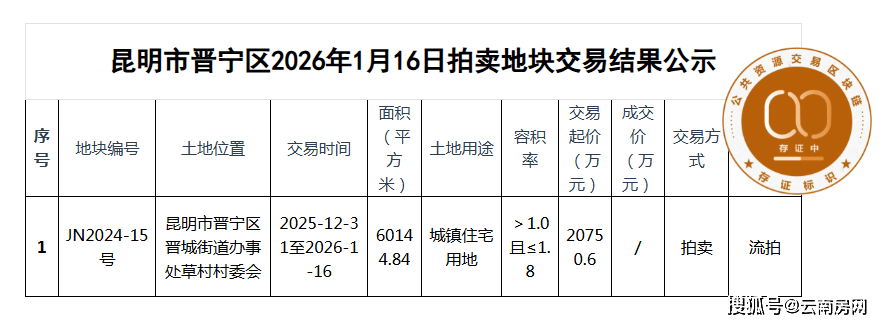
Core Viewpoint - The repeated failure of land auctions in the Jincheng area of Jinning District indicates a lack of market demand for the property, reflecting broader challenges in the real estate sector in the region [1][3]. Group 1: Land Auction Results - A residential land plot in Jincheng, Jinning District, failed to sell in two consecutive auctions, with the same area, floor area ratio, and starting price both times [2][3]. - The land was originally intended for the Huashan City Park project but was returned by the developer, leading to its re-auction [2][3]. Group 2: Real Estate Market Conditions - The real estate market downturn has significantly impacted suburban areas like Jinning more than the main urban districts, resulting in a lack of new projects and several bankruptcies among local developers [5][9]. - Two real estate companies, Yunnan Qiansheng Real Estate Co., Ltd. and Kunming Zhonghe Shidi Real Estate Co., Ltd., recently declared bankruptcy, leaving unfinished projects that need resolution [5]. Group 3: Historical Context and Development Trends - Jinning District was once a key beneficiary of urban expansion in Kunming, but policy shifts in 2021 have led to a slowdown in real estate development [7][10]. - The district had over 20 projects launched during the peak of real estate investment in 2019, but the current situation shows a stark contrast with a significant decline in new investments [7][9]. Group 4: Future Potential - Despite current challenges, Jinning District has favorable conditions for real estate development, particularly in the tourism and wellness sectors, contingent on a stabilization of the national real estate market and improved integration with Kunming [10].
研报掘金丨华源证券:首予招商蛇口“买入”评级,深耕核心城市,央企平台优势凸显
Ge Long Hui A P P· 2026-02-02 05:25
Core Viewpoint - The report from Huayuan Securities indicates that China Merchants Shekou is the real estate operation platform under China Merchants Group, focusing on development, asset operation, and property services as its three core pillars [1] Group 1: Business Strategy - The company is building a diversified business structure with a focus on "rent and purchase coexistence, light and heavy combination" [1] - It aims to leverage the industrial synergy and financing advantages of China Merchants Group to deepen its presence in key economic zones such as the Greater Bay Area, Yangtze River Delta, and Chengdu-Chongqing region [1] Group 2: Market Position and Performance - Despite short-term profit pressure due to adjustments in the real estate market, the company maintains a leading sales scale in the industry [1] - The company is focusing on land acquisition with an emphasis on intensity [1] Group 3: Financial Strength and Shareholder Returns - The company has significant financing advantages and places importance on shareholder returns [1] - Comparable companies selected include Poly Developments, China Overseas Development, and Jianfa International Group, all of which have state-owned enterprise backgrounds and focus on first- and second-tier cities [1] Group 4: Future Outlook - In the context of industry adjustments and increasing differentiation, the company is expected to benefit from its low financing cost advantage and core city focus strategy, leading to steady performance recovery and value reassessment [1] - The initial coverage gives a "buy" rating for the company [1]
地产股重估拉开帷幕-后续怎么看
2026-02-02 02:22
地产股重估拉开帷幕,后续怎么看?20260130 摘要 2026 年地产板块大概率向上,但当前政策尚未有实质性改变,财政态 度是关键,去库存和化解风险工作仍在研判阶段,需观察基本面是否展 现积极迹象。 一线城市房价走势需谨慎,虽有积极迹象但尚不能确认企稳,需等待三 四月份传统成交旺季验证,无强力政策或经济预期变化,过程可能不会 一帆风顺。 四季度主动基金全面减配 A 股开发商,深度减持保利、招商蛇口等,增 持港股开发商如华润置地、万象及贝壳,反映资金对博弈地产基本面及 政策风险意愿趋冷。 推荐关注存货充足、质量好的大票如华润、中海、招商蛇口,以及出租 质量高、周转快的标的如建发国际和滨江,新中控股及其母公司新城发 展,以及先发股份也值得关注。 新中控股转型为以商业为主导的轻资产运营模式,先发股份因稳定增长 前景受推荐,未来 2-3 年有望实现商业模式升级,带来戴维斯双击效应。 Q&A 2026 年地产股的整体趋势如何? 四季度以来基金持仓情况如何变化? 四季度主动基金持仓显示,A 股开发商全面减配,如保利、招商蛇口等主流公 司均被深度减持。而港股开发商则表现较好,如华润置地、万象及贝壳等持仓 提升明显。这反映 ...
中国地产:政策预期的 “踏空焦虑”—— 销售与政策的双向辩论-China_Property_Fear_of_Missing_Out_A_Two-Way_Debate_on_Policy_Expectation__Sales
2026-02-02 02:22
Summary of China Property Sector Conference Call Industry Overview - **Industry**: China Property Sector - **Key Focus**: Market expectations, policy changes, sales performance, and investment opportunities Core Insights 1. **Investor Positioning**: Many investors in Hong Kong, Singapore, and overseas have been underweight in the China property sector, while sectors like metals, mining, tech, and healthcare are well-owned. There is a shift towards increasing exposure in the property sector due to fear of missing out on potential recovery [1][2] 2. **Sales and Investment Trends**: Secondary sales improved in January, with a month-on-month increase compared to December. However, new home sales remain weak, with a year-on-year decline of approximately 30% expected to persist into Q1 2026 due to last year's high base [2][4] 3. **Policy Easing Expectations**: Positive market sentiment in January was driven by expectations of policy easing, including VAT cuts and adjustments to down payment requirements for commercial properties. The easing of the "three red lines" policy indicates that deleveraging targets may have been met [2][15] 4. **Opportunistic Window**: There is a belief that an opportunistic window may exist from January to March before the National People's Congress meeting and FY25 earnings reports, suggesting potential for strategic investments during this period [2] 5. **Stock Picks**: Recommended stocks include China Overseas Land & Investment (COLI), Jinmao, and Greentown, which are expected to benefit from land acquisition growth and ample saleable resources in 2026. CR Land is noted for its strong fundamentals but is already well-owned [3] 6. **Secondary Market Activity**: Secondary transaction volumes improved to approximately 26,038 units in the week ending January 25, 2026, reflecting a 19% year-on-year increase. This is seen as a positive sign for market confidence [3][9] 7. **New Home Sales Performance**: New home sales increased by 15% week-on-week but are still down approximately 30% year-on-year. The primary sales trend remains uncertain and is not yet sustainable [4][11] 8. **Land Acquisition Trends**: Significant increases in land acquisition costs were noted for several companies, with Jinmao seeing a 78% increase year-on-year. In contrast, Vanke and Longfor reported substantial declines in land acquisition values [17] Additional Important Points - **Policy Support**: Recent supportive policies include lowering the minimum down payment for commercial property mortgages and extending tax refund policies for home buyers [15][16] - **Market Sentiment**: The market's positive response to policy changes indicates a potential shift in investor sentiment towards the property sector, despite ongoing challenges in new home sales [2][4] - **Valuation Insights**: The sector's valuations are being closely monitored, with recommendations varying from buy to neutral based on individual company fundamentals [20] This summary encapsulates the key discussions and insights from the conference call regarding the China property sector, highlighting both opportunities and ongoing challenges.
2026年房地产市场趋势展望
2026-02-02 02:22
Summary of Real Estate Market Trends and Company Insights Industry Overview - The real estate market in January 2026 saw a significant decline in sales, with the top 100 real estate companies experiencing a year-on-year decrease of 27.3%. However, the top 10 companies showed relative stability with an average decline of 18%, outperforming the overall average. Notably, China Resources and China Overseas achieved positive growth, while Poly experienced a slight decline [1][2]. - The industry is facing dual challenges of shrinking performance and insufficient land reserves. Some companies that have not acquired land in recent years are experiencing severe performance declines, and even existing land may not be economically viable for development [1][4]. Key Market Trends - In January 2026, the national land auction volume across 300 cities dropped by 90% month-on-month and 48% year-on-year, with transaction amounts decreasing by 60% year-on-year. This indicates a cautious investment attitude among real estate companies, with the land market's heat significantly lower than the same period last year [1][5]. - The new housing market is underperforming, with transaction volumes decreasing by 32% month-on-month and 20% year-on-year. Major cities like Shanghai and Shenzhen saw declines of 46% and 39%, respectively [1][7][8]. - The second-hand housing market showed a month-on-month increase of 16% and over 30% year-on-year, but prices continue to decline, with first-tier and strong second-tier cities experiencing price drops of 10%-15% over the past year [1][11]. Challenges Facing Real Estate Companies - Real estate companies are grappling with continuous performance shrinkage and insufficient land reserves. Some companies are facing year-on-year declines of 70%-80% or more. The lack of confidence among developers is expected to lead to a double-digit decline in new construction investment indicators [3][12]. - The overall market trend is expected to continue downward, with sales and prices likely to decrease, although the rate of decline in transaction volumes may narrow [3][12]. Regional Market Insights - In cities like Hangzhou and Nanjing, the real estate market has seen significant declines in absorption rates, with Nanjing's rate dropping to an unprecedented low of 2% in January 2026 despite discounts on available projects [10]. - In Beijing and Shanghai, some hotspots have shown signs of price stabilization in the second-hand market, attributed to reduced willingness to lower prices by sellers and the entry of bottom-fishing buyers. However, this does not indicate overall market stability [18]. Future Outlook - The expectation for 2026 is that there will be no strong stimulus policies introduced, with any local government measures likely to have limited impact. The overall judgment for 2026 remains cautious, anticipating continued declines in sales and prices [12][16]. - The supply of new housing is expected to increase in March 2026, but the overall market performance may still be disappointing compared to the previous year due to lower supply and insufficient policy support [15]. Conclusion - The real estate industry is currently in a challenging phase characterized by declining sales, cautious investment behavior, and a lack of viable land for development. The market outlook for 2026 remains pessimistic, with expectations of continued price declines and cautious consumer sentiment.