
申菱环境

Search documents
AI散热需求引爆液冷板块 联想成被低估的核心玩家
Ge Long Hui· 2025-11-13 07:07
Core Viewpoint - The liquid cooling server sector in the A-share market has experienced a significant surge, driven by increasing computing power demands and supportive policies, with Lenovo Group emerging as a key player in this field [1][2]. Industry Overview - The explosive growth of the liquid cooling server sector is attributed to the exponential increase in computing power requirements, particularly due to the scaling of generative AI and large model training, which traditional air cooling systems cannot adequately support [1]. - The Chinese government's "dual carbon" goals and digital economy strategies are providing strong momentum for the development of liquid cooling technologies, with specific targets set for increased penetration rates by 2025 [2]. Company Positioning - Lenovo Group has established a comprehensive "full-stack" liquid cooling capability, covering core technology research, complete solution design, and lifecycle services, positioning itself as a leader in the liquid cooling market [2]. - Lenovo's Neptune liquid cooling system has become an industry benchmark, with over 80,000 units deployed globally across various critical sectors, demonstrating its technological maturity and compliance with international standards [2][3]. Competitive Advantages - Lenovo's liquid cooling solutions have been validated through numerous high-profile projects, showcasing their adaptability and efficiency, such as achieving a PUE of 1.1 in automotive data centers and reducing energy consumption by 30% in educational institutions [3]. - Strategic partnerships with leading chip manufacturers like NVIDIA and AMD enhance Lenovo's competitive edge, particularly with the introduction of advanced AI server solutions [3]. Financial Performance - Lenovo's liquid cooling business reported a 68% year-on-year revenue growth in Q1 2025, reflecting strong market demand and performance [4]. - The global server cooling market is projected to experience substantial growth, with estimates indicating a market size of $17.6 billion by 2027, driven by increased AI server shipments and rising liquid cooling penetration rates [4].

从标准制定到全球出海 联想液冷:被低估的核心玩家
Zhi Tong Cai Jing· 2025-11-13 07:01
Core Viewpoint - The liquid cooling server sector in the A-share market has experienced a significant surge, driven by increasing demand for computing power and supportive policies, highlighting the competitive advantages of Lenovo Group in this field [1][2]. Group 1: Market Dynamics - The explosion of the liquid cooling server sector is a result of the exponential increase in computing power demand and policy support, particularly due to the rise of generative AI and large model training [2]. - Traditional air cooling technology is inadequate for high-density computing clusters, with AI servers consuming 10-20 times the power of standard servers, necessitating a shift to liquid cooling technology [2]. - The Chinese government has included "efficient cooling technology" in its list of key low-carbon technologies, aiming for a significant increase in liquid cooling penetration from 15% to 38% by 2025 [2]. Group 2: Lenovo's Competitive Edge - Lenovo Group has developed a comprehensive "full-stack" liquid cooling capability, covering core technology research, complete solution design, and lifecycle services, making it a pioneer in the liquid cooling sector since 2006 [3]. - Lenovo's Neptune liquid cooling system has become an industry benchmark, with over 80,000 units deployed globally across various critical sectors, including AI, supercomputing, and finance [3][4]. - The company has established long-term strategic partnerships with leading chip manufacturers like NVIDIA and AMD, enhancing its competitive position in the liquid cooling market [4]. Group 3: Financial Performance and Growth Outlook - Lenovo's liquid cooling business reported a 68% year-on-year revenue growth in Q1 2025, reflecting strong market demand [5]. - The global server cooling market is projected to grow significantly, with estimates of 111%, 77%, and 26% annual growth from 2025 to 2027, reaching $17.6 billion by 2027 [5]. - Lenovo is well-positioned to increase its market share in this expanding market due to its technological leadership, rich case studies, and robust ecosystem [5].
从标准制定到全球出海 联想(00992)液冷:被低估的核心玩家
智通财经网· 2025-11-13 06:17
Core Viewpoint - The A-share liquid cooling server sector has experienced a significant surge, driven by increasing computing power demands and supportive policies, with Lenovo Group emerging as a key player in the market despite short-term stock price fluctuations [1][2]. Industry Overview - The liquid cooling server sector's growth is attributed to the exponential increase in server computing power density, particularly due to the rise of generative AI and large model training, which traditional air cooling systems cannot adequately support [1]. - The Chinese government's "dual carbon" goals and digital economy strategies are providing strong momentum for the development of liquid cooling technologies, with specific targets set for increased penetration rates by 2025 [2]. Company Positioning - Lenovo Group has established a comprehensive "full-stack" liquid cooling capability, covering core technology research, complete solution design, and lifecycle services, positioning itself as a leader in the liquid cooling space [2]. - Lenovo's Neptune liquid cooling system has become an industry benchmark, with over 80,000 units deployed globally across various critical sectors, demonstrating its technological maturity and compliance with international standards [2][3]. Competitive Advantages - Lenovo's liquid cooling solutions have been validated through numerous successful implementations in major projects, showcasing their adaptability and efficiency in various applications, such as automotive and educational sectors [3]. - Strategic partnerships with leading chip manufacturers like NVIDIA and AMD enhance Lenovo's competitive edge, particularly with the introduction of advanced AI server solutions [3]. Financial Performance - Lenovo's liquid cooling business reported a 68% year-on-year revenue growth in Q1 2025, reflecting strong market demand and performance [4]. - The global server cooling market is projected to experience substantial growth, with estimates indicating a market size of $17.6 billion by 2027, driven by increased AI server shipments and rising liquid cooling penetration rates [4].
政策+算力双轮驱动!这一概念股全线拉升!
Zheng Quan Ri Bao Zhi Sheng· 2025-11-13 05:41
Core Insights - The liquid cooling technology is gaining prominence in the digital economy era, driven by the "dual carbon" strategy and the national project "East Data West Computing" [1][2] - The capital market has responded positively, with the liquid cooling sector index rising by 2.22% and a total transaction volume of 58.358 billion yuan on November 13 [1] Industry Overview - Data centers, while being the engine of the digital economy, are also significant energy consumers, facing pressure to transform under the "dual carbon" strategy [2] - By 2025, data centers are required to improve energy efficiency by 30%, with a target Power Usage Effectiveness (PUE) of below 1.3, marking a critical threshold for operational viability [2] Technology and Market Dynamics - Traditional air cooling methods are inadequate for meeting the new efficiency standards, necessitating revolutionary cooling solutions like liquid cooling [2] - Liquid cooling technology can potentially reduce overall energy consumption in data centers by over 30%, with its cooling efficiency being significantly higher than that of air cooling [2] Competitive Landscape - The liquid cooling market is expanding rapidly, with companies like Zhongshi Technology and Wanma Technology increasing their investments in liquid cooling solutions [3] - The liquid cooling technology is evolving towards more efficient and intelligent systems, with two main types: cold plate liquid cooling and immersion liquid cooling, each with distinct advantages and cost implications [3] Future Trends - The immersion liquid cooling technology is expected to become mainstream as costs decrease, and it will likely integrate with AI and IoT for smarter thermal management [3]



A股液冷概念股强势
Ge Long Hui A P P· 2025-11-13 05:31
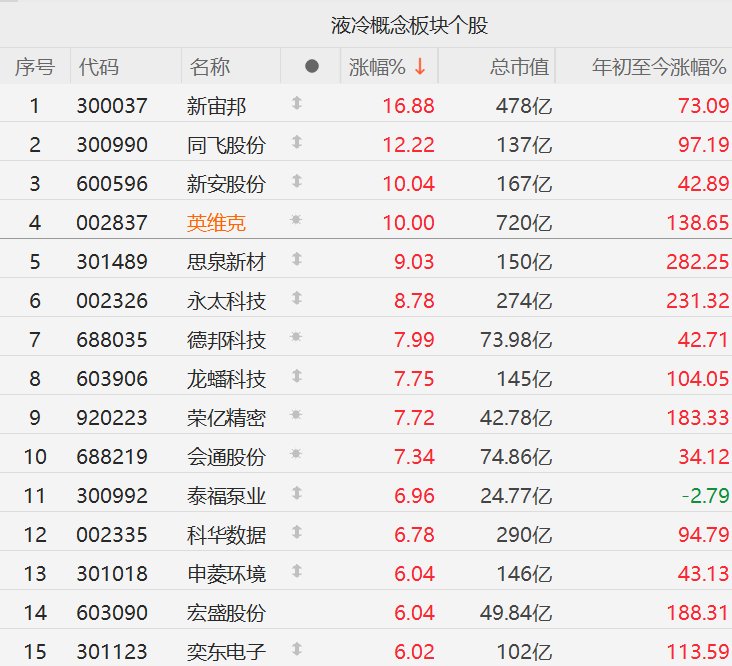
Core Viewpoint - The liquid cooling concept stocks in the A-share market have shown strong performance, driven by a report from Morgan Stanley indicating an increase in the total value of cooling components for the next-generation Vera Rubin NVL144 platform, which is expected to rise by 17% to approximately $55,710 (around 400,000 RMB) per cabinet [1] Summary by Category Stock Performance - Xinjubang (新宙邦) surged over 16%, with a year-to-date increase of 73.09% and a total market value of 47.8 billion RMB [2] - Tongfei Co., Ltd. (同飞股份) rose over 12%, with a year-to-date increase of 97.19% and a total market value of 13.7 billion RMB [2] - Xin'an Co., Ltd. (新安股份) increased by 10.04%, with a year-to-date increase of 42.89% and a total market value of 16.7 billion RMB [2] - Yingweike (英维克) reached a 10% increase, with a year-to-date increase of 138.65% and a total market value of 72 billion RMB [2] - Six other companies, including Siquan New Materials (思泉新材) and Yongtai Technology (永太科技), also reported significant gains ranging from 6% to 9% [1][2] Market Insights - The report from Morgan Stanley highlights a growing trend in the liquid cooling sector, indicating a robust demand for advanced cooling solutions in data centers [1] - The anticipated increase in cooling component value reflects the industry's shift towards more efficient thermal management technologies [1]


申菱环境股价涨5.02%,银河基金旗下1只基金重仓,持有2万股浮盈赚取5.2万元
Xin Lang Cai Jing· 2025-11-13 03:26
Core Insights - The stock of Shunling Environment increased by 5.02%, reaching 54.38 CNY per share, with a trading volume of 239 million CNY and a turnover rate of 2.27%, resulting in a total market capitalization of 14.468 billion CNY [1] Company Overview - Shunling Environment was established on July 3, 2000, and went public on July 7, 2021. The company is located in Shunde District, Foshan City, Guangdong Province [1] - The main business involves air environment regulation equipment, focusing on specialized air conditioning systems. The company integrates R&D, manufacturing, marketing, engineering installation, and operational maintenance to provide comprehensive environmental control solutions for various applications [1] - The revenue composition is as follows: equipment accounts for 82.94%, solutions and services for 16.68%, and other sources for 0.38% [1] Fund Holdings - According to data, one fund under Galaxy Fund holds a significant position in Shunling Environment. The Galaxy Yield Mixed Fund (151002) held 20,000 shares in the third quarter, representing 0.81% of the fund's net value, ranking as the tenth largest holding [2] - The Galaxy Yield Mixed Fund was established on August 4, 2003, with a current size of 175 million CNY. Year-to-date returns are 8.33%, ranking 6221 out of 8145 in its category, while the one-year return is 8.58%, ranking 5677 out of 8059 [2] Fund Manager Profiles - The fund manager of Galaxy Yield Mixed Fund is Zheng Kecheng, who has a tenure of 17 years and 225 days, managing assets totaling 714 million CNY. The best return during his tenure is 124.06%, while the worst is -8.1% [3] - Co-manager Wei Xuan has been in the role for 3 years and 270 days, overseeing assets of 1.791 billion CNY. The best return during her tenure is 16.5%, with the worst being -1.81% [3]
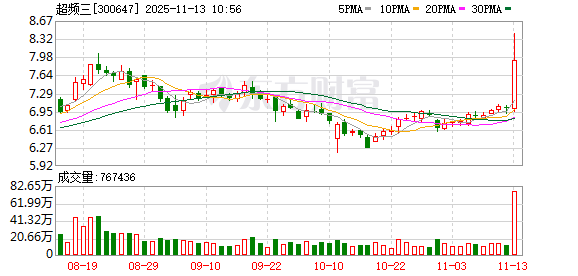
液冷服务器板块持续上扬,超频三触及20cm涨停
Mei Ri Jing Ji Xin Wen· 2025-11-13 02:55
Group 1 - The liquid cooling server sector is experiencing a significant upward trend, with multiple companies seeing substantial stock price increases [2] - Overclocking Three has reached a 20% limit up, indicating strong market interest and investor confidence [2] - Companies such as Tongfei Co., Ltd. and Invec have also reported notable gains, with increases of over 10% and 7% respectively [2] Group 2 - Jinfu Technology and Shenling Environment are also following the upward trend, suggesting a broader positive sentiment in the liquid cooling server industry [2]

粤企赴江苏招才热度高 1600多家次单位释放超3.8万个岗位
Nan Fang Ri Bao Wang Luo Ban· 2025-11-11 09:27
Group 1 - The "Million Talents Gathering in Nanyue" autumn recruitment event will take place in Jiangsu from November 11 to 13, 2025, featuring multiple on-site recruitment activities at renowned universities [1] - Over 1,600 companies and institutions from Guangdong have registered for the event, offering more than 38,000 quality job positions, with over 18,000 positions available on-site [1] - The event will provide high-value job opportunities, with over 27,000 positions offering salaries between 80,000 to 200,000 yuan, and 10 positions exceeding 1 million yuan [1] Group 2 - Companies are offering additional support for graduates, such as free accommodation and personalized training programs, to alleviate concerns for young talent [2] - Jiangsu is a key region for talent recruitment due to its dense higher education resources, making this event a significant opportunity for Guangdong companies to enhance their brand image and connect with research resources [2] - The demand for talent in AI and digitalization is increasing significantly, prompting companies to seek collaboration with key universities in Jiangsu to improve talent supply and demand matching [2]
北美光通信企业当季业绩表现亮眼,英伟达、谷歌推进太空算力部署
2025-11-10 03:34
Summary of Conference Call Records Industry Overview - The conference call discusses the rapid development of the space computing industry, particularly in commercial aerospace, with major tech companies like NVIDIA and Google launching initiatives such as the Starlink project and Project Suncatch, respectively, to deploy advanced computing capabilities in space [1][2][3] - China is also making significant strides in this area, planning to launch between 1,000 to 3,000 satellites to support its three-body computing constellation, with Potevio Technology as a key supplier [1][3] Key Points and Arguments Space Computing - NVIDIA's Starlink initiative aims to send its first H100 GPU to space by November 2025, while Google's Project Suncatch plans to launch satellites equipped with TPU 6 chips by 2027 [2] - The efficiency of space computing, powered by solar energy, is several times greater than ground-based power, addressing energy shortages [2] - The commercial model for space computing is gradually taking shape, with companies like Nanjing Blue Tower exploring B-end services through satellite interconnectivity [1][3] AI Industry - There is ongoing debate regarding the existence of a bubble in the AI industry, highlighted by OpenAI's projected investment of $1.4 trillion against a quarterly revenue of over $4 billion and losses exceeding $10 billion [4] - Concerns have been raised about the low return on investment (ROI) for cloud service providers in North America, but the long-term growth potential of AI remains strong despite short-term financial data [4][6] Optical Communication Industry - The optical communication sector is experiencing significant growth, with strong demand for 1.6T optical modules and second-generation optical modules, alongside a robust supply chain for optical chips and lasers [5][7] - Companies like Lumentum and Coherent Finisar reported better-than-expected earnings, driven by data center interconnectivity and expanding production capabilities [7] - The demand for 1.6T modules is expected to reach 20 to 30 million units by 2026, while 800G demand could reach 40 to 50 million units [7] Additional Important Insights - Liquid cooling technology is highlighted as a key area of interest, with NVIDIA projecting a market size of $7 billion by 2026, indicating a significant growth opportunity [2][6] - The optical communication industry is seeing technological advancements and capacity expansions, with companies like ZTE pushing for new technology applications [5][7] - Investors are encouraged to focus on leading companies in the optical communication space, such as Zhongji Xuchuang and Tianfu Technology, as well as laser chip companies like Yuanjie Technology and Shijia Photonics [7]

产业链供需两旺景气度回升,六氟价格延续上行 | 投研报告
Zhong Guo Neng Yuan Wang· 2025-11-10 03:28
Core Viewpoint - The new energy vehicle (NEV) industry is experiencing significant growth, with record production and sales figures in September, driven by favorable policies and an improving supply-demand structure [1][2]. Industry Overview - In September, NEV production reached 1.617 million units, and sales hit 1.604 million units, marking year-on-year increases of 23.7% and 24.6% respectively [1][2]. - From January to September 2025, NEV production and sales totaled 11.243 million and 11.228 million units, reflecting year-on-year growth of 35.2% and 34.9% [1][2]. - The supply side is seeing continuous innovation from battery and main engine manufacturers, with positive feedback from demand and ongoing policy support [2]. Price Dynamics - The industry has undergone significant price declines, but the supply-demand balance is improving, with industry associations and companies actively optimizing capacity and supply to stabilize prices and ensure profitability [2]. - The overall price level in the supply chain is at a historical low, with signs of stabilization and recovery. Certain segments, such as lithium hexafluorophosphate, are experiencing strong demand and tight supply, leading to price increases [2]. Investment Strategy - The industry is rated positively, with expectations for price recovery in the supply chain by 2025. Companies that are likely to deliver excess returns are being prioritized, particularly in areas such as robotics, solid-state batteries, and liquid cooling technologies [3]. - Key companies in the main materials sector include CATL, Shangtai Technology, and Hunan Youneng [4]. Market Performance - The NEV index, lithium battery index, fuel cell index, charging pile index, and energy storage index showed varied performance, with the lithium battery index increasing by 4.43% [5]. - Notable stock performances include Huasheng Lithium Battery and Kechuan Technology, which saw increases of 61.2% and 34.7% respectively, while companies like Keda Li and Xian Dao Intelligent experienced declines [5]. Price Trends in Supply Chain - Lithium carbonate prices are at 80,300 CNY/ton, down 0.3% from last week, while lithium hydroxide is at 75,500 CNY/ton, down 0.4% [7]. - Other material prices include nickel at $14,900/ton, cobalt at 384,000 CNY/ton, and lithium iron phosphate at 34,800 CNY/ton, with various fluctuations noted [7].