
Snowflake Inc.

Search documents
Can Salesforce's Data 360 Push Drive Its Next Phase of Sales Growth?
ZACKS· 2026-01-13 14:11
Core Insights - Salesforce, Inc. (CRM) is focusing on Data 360, previously known as Data Cloud, to stimulate growth as revenue expansion has slowed to single digits, with year-over-year revenue increases of 7.6%, 9.8%, and 8.6% in the first three quarters of fiscal 2026 [1][5] Group 1: Data 360 Strategy - Data 360 is central to Salesforce's strategy to address slowing top-line growth, combining various data tools into a unified offering to help companies manage and activate their data in real time [2] - The integration of Data 360 with other tools like Agentforce and Mulesoft is enabling enterprises to analyze data and apply AI across operations, potentially driving higher-value contracts for Salesforce [3] Group 2: Financial Performance - Data 360 and Agentforce generated $1.4 billion in recurring revenues in Q3 of fiscal 2026, marking a 114% year-over-year increase, with expectations that the data-related business could reach around $10 billion annually by fiscal 2027 [4] - The Zacks Consensus Estimate predicts revenue growth of 9.5% and 11% for fiscal 2026 and 2027, respectively, indicating a potential path for Salesforce to reaccelerate growth [5] Group 3: Competitive Landscape - Salesforce faces increased competition from Microsoft Corporation (MSFT) and Snowflake Inc. (SNOW) in the data cloud sector, with Microsoft leveraging its Azure Data platform and Snowflake focusing solely on data management [6][7][8] Group 4: Valuation and Estimates - Salesforce shares have decreased by 19.8% over the past year, contrasting with the Zacks Computer – Software industry's growth of 10.5% [9] - The company trades at a forward price-to-earnings ratio of 20.07, significantly lower than the industry average of 28.31 [13] - The Zacks Consensus Estimate for fiscal 2026 and 2027 earnings suggests year-over-year increases of approximately 15.3% and 10.4%, respectively, with upward revisions in estimates over the past 30 days [16]


2026年美股软件股将逆袭!巴克莱力挺:AI变现助力估值重塑 优选赛富时、甲骨文、DigitalOcean
智通财经网· 2026-01-13 08:11
Core View - Barclays has a positive outlook on the 2026 prospects for U.S. software stocks, citing stable macroeconomic conditions and IT spending, low valuation levels, and current market disfavor towards the sector [1] - The analysts expect significant revenue contributions from AI in application software and infrastructure software, which will help shift market sentiment [1] Software Stock Ratings and Target Price Adjustments - Barclays adjusted ratings and target prices for several software stocks, highlighting key changes: - CoreWeave: Hold, target price $90 - Datadog: Buy, target price $215 - Dynatrace: Buy, target price $62 - Elastic: Buy, target price $107 - Five9: Buy, target price $29 - HubSpot: Buy, target price $575 - Klaviyo: Buy, target price $43 - Microsoft: Buy, target price $610 - Monday.com: Buy, target price $202 - Paycom Software: Hold, target price $185 - Commerce.com: Reduce, target price $3 - Paylocity: Hold, target price $164 - Similarweb: Buy, target price $12 - Sprout: Buy, target price $26 - Workday: Buy, target price $280 - ZoomInfo Technologies: Hold, target price $12 - Appian: Reduce, target price $34 - Lightspeed Commerce: Hold, target price $14 - DigitalOcean: Buy, target price $63 - JFrog: Buy, target price $70 - MongoDB: Buy, target price $480 - Salesforce: Buy, target price $338 - Teradata: Reduce, target price $27 - UiPath: Hold, target price $16 [1] Cartesian Logistics Systems Group - Barclays upgraded Cartesian Logistics Systems Group from Hold to Buy, raising the target price from $106 to $105, citing a positive turning point in their Q3 2026 performance [2] - Analysts believe the company has overcome its most challenging period, with organic growth rates accelerating from a low point earlier in the fiscal year [3] Snowflake - Barclays downgraded Snowflake from Buy to Hold, lowering the target price from $290 to $250, while still recognizing it as a top software asset with strong revenue growth [2] - The analysts noted limited future upside potential despite a 42% stock price increase in 2025 [2] DoubleVerify - Barclays downgraded DoubleVerify from Buy to Hold, maintaining a target price of $12, citing significant underperformance compared to the software industry [4] - Analysts expressed concerns over the sustainability of revenue growth following a decline in Q3 growth [4] GitLab - Barclays downgraded GitLab from Hold to Reduce, lowering the target price from $42 to $34, attributing the downgrade to execution issues and a challenging macro environment [5] - Analysts noted that recent adjustments may take time to yield results, with expectations of underperformance in the current year [5]






高盛-研究深度解析-大型软件股启动
Goldman Sachs· 2026-01-13 01:10
Investment Rating - The report indicates a positive outlook for major software companies like Microsoft, Oracle, Salesforce, and ServiceNow for 2026, driven by AI's potential to boost global GDP by $4.5 trillion, with software companies capturing 10% to 25% of the value created for end customers [2]. Core Insights - The AI application market is projected to reach approximately $450 billion, providing growth momentum for the industry, although competition may offset some benefits [1][2]. - Existing SaaS leaders such as Microsoft, Salesforce, and ServiceNow are expected to maintain significant positions in the enterprise software landscape through 2030, necessitating platform restructuring and product integration to enhance user adoption and monetization [1][4][5]. - The period from 2026 to 2031 is anticipated to be a golden era for AI enterprise applications, requiring companies to integrate workflows, break down data silos, and meet compliance and security standards [1][6]. - Long-term investment in software companies should focus on their self-innovation capabilities and the construction of intellectual property moats, alongside market adaptability and unit economics [1][7]. Summary by Sections AI Market Potential - The AI market is expected to grow significantly, with a potential market size of $450 billion, driven by increased adoption rates and improved competitive dynamics [1][2]. Major Software Companies - Companies like Microsoft, Salesforce, and ServiceNow are positioned to lead in the AI-driven enterprise software market, requiring them to innovate and integrate their offerings effectively [4][5][8]. Emerging Opportunities - New entrants such as Sierra and Writer are highlighted as potential disruptors in the software industry, indicating that opportunities still exist despite the maturity of the tech sector [5]. Investment Considerations - When selecting software stocks for long-term investment, factors such as self-innovation, core technology moats, market fit, and unit economics are crucial [7]. - ServiceNow and Oracle are identified as companies with significant value discovery potential, supported by their strategic positioning and operational capabilities [8]. Security Software Sector - Leading security software platforms like CrowdStrike, CloudFlare, and Palo Alto Networks are expected to thrive due to the essential nature of security in digital transformation, presenting multiple growth pathways [9].

Stocks Retreat on Concerns Over Fed Independence
Yahoo Finance· 2026-01-12 14:57
Economic Indicators - December CPI is expected to remain unchanged from November at +2.7% y/y, while December core CPI is anticipated to rise to +2.7% y/y from +2.6% y/y in November [1] - October new home sales are projected to decline by -10.6% m/m to 715,000 [1] - November PPI final demand is expected to increase by +2.7% y/y, with core PPI also expected to climb by +2.7% y/y [1] - November retail sales are anticipated to increase by +0.5% m/m and +0.4% m/m excluding autos [1] - December existing home sales are expected to rise by +2.2% m/m to 4.22 million [1] - Weekly initial unemployment claims are expected to increase by +7,000 to 215,000 [1] - January Empire manufacturing survey is expected to rise by +4.9 to 1.0 [1] - December manufacturing production is expected to fall by -0.1% m/m [1] - January NAHB housing market index is expected to increase by +1 to 40 [1] Federal Reserve and Market Reactions - Fed Chair Powell stated that the Federal Reserve received grand jury subpoenas from the Justice Department, which could lead to a criminal indictment related to his congressional testimony [2] - Concerns about Fed independence have increased due to the Trump administration's criticism, leading to a "Sell America" sentiment in US asset markets [3] - The 10-year T-note yield rose by +2 bp to 4.19% amid these concerns [3] - March 10-year T-notes are down by -4 ticks, with the yield up by +2.6 bp to 4.191% [6] - The 10-year breakeven inflation rate rose to a 1.75-month high of 2.30% [6] Stock Market Movements - The S&P 500 Index is down -0.23%, the Dow Jones is down -0.58%, and the Nasdaq 100 is down -0.27% [4] - Credit card companies and bank stocks are declining after President Trump announced that lenders must cap interest rates at 10% for one year, with Synchrony Financial down more than -7% [10] - Mining stocks are rising as gold and silver prices reached new all-time highs, with Hecla Mining up more than +8% [11] - Shake Shack reported preliminary Q4 revenue of $400.5 million, below its forecast, leading to a decline of more than -2% in its stock [12] - ANI Pharmaceuticals is up more than +8% after forecasting 2026 net revenue of $1.055 billion to $1.1185 billion, exceeding consensus expectations [14]
美洲软件_将软件板块覆盖延伸至智能工作流十年周期_买入 MSFT、ORCL、NOW;卖出 ADBE、DDOGAmericas Technology_ Software_ Assuming Software Sector Coverage into the Decade of Agentic Workflow_ Buy MSFT, ORCL & NOW; Sell ADBE & DDOG
2026-01-12 02:27
Summary of Key Points from the Conference Call Industry Overview - Coverage has been assumed for the Software Sector and 12 additional companies, indicating a constructive outlook on AI adoption as a positive tailwind for the Software Total Addressable Market (TAM) over the next 5-10 years [1][7][8] - The Software TAM is expected to grow significantly, with projections suggesting a TAM of $2.8 trillion by 2037, representing a 30% increase from current estimates [19][21] Core Companies and Recommendations - **Buy Ratings**: Microsoft (MSFT), Oracle (ORCL), Salesforce (CRM), ServiceNow (NOW), Snowflake (SNOW), and Navan (NAVN) are recommended for purchase due to their strong positioning in the evolving software landscape [7][8] - **Sell Ratings**: Adobe (ADBE) and Datadog (DDOG) are recommended for sale due to competitive pressures and growth challenges [7][8] Key Debates in the Software Sector 1. **AI Infrastructure**: The ability of infrastructure software companies to convert initial AI compute shares into sustainable, profitable businesses is crucial. Companies like Microsoft and Oracle are expected to optimize their capital expenditures and improve gross margins from below 40% to over 60% [9][10] 2. **Application Software Disintermediation**: There is a risk that traditional SaaS leaders may be disintermediated by AI-native companies. The competition is expected to heighten as new technology cycles emerge, with a focus on companies that are further along in repurposing their tech stacks [9][10] 3. **Value Accrual in Software Stack**: The orchestration of agents and LLMs across various layers of the software stack is seen as a key area for value capture. Microsoft and ServiceNow are positioned well to leverage their existing IP in this space [10][19] Financial Metrics and Projections - Microsoft is expected to drive significant upside in Azure revenue by 2026, while Oracle is anticipated to show improved visibility into gross profit growth [9][10] - The report suggests that the average software company has increased gross profit per employee by 35% from 2021 to 2025, although there are risks of gross margin compression in the medium term [34] AI Adoption and Market Dynamics - AI adoption is projected to be uneven, creating opportunities for new competition. However, the overall sentiment is that the signals for uptake will be positive by 2026 [8][20] - The report emphasizes that the value unlocked by AI will likely outweigh the impact of increased competition, reversing trends observed in 2025 [20] Additional Insights - The Software TAM is divided into "scaffolding" (2/3) and "agentic" (1/3), with expectations that AI will drive incremental growth tied to enterprise adoption [25][30] - The report highlights the importance of competitive moats, such as ecosystems and network effects, which cannot be easily replicated, thus providing a buffer against competition [34] Conclusion - The Software sector is poised for growth driven by AI adoption, with specific companies positioned to capitalize on this trend. Investors are advised to focus on companies with strong competitive advantages and clear paths to revenue growth in the evolving landscape [30][34]


下一个万亿AI赛道,上下文图谱,才是AI创业的真正机会
3 6 Ke· 2026-01-09 12:39
Core Argument - The debate in Silicon Valley centers around whether AI, particularly Agents, will replace SaaS systems. Jamin Ball argues that Agents will not eliminate traditional Systems of Record but will increase the demand for accurate underlying data [1][2][7]. Group 1: Context Graph as a Valuable Asset - The concept of a Context Graph is introduced as the "second asset" of companies in the AI era, capturing decision traces that traditional Systems of Record fail to document [5][9]. - Traditional enterprise software created a trillion-dollar ecosystem by managing authoritative data and workflows, but the focus is now shifting to how these systems can survive the transition to AI Agents [6][7]. - The key distinction is made between rules that guide Agents and decision traces that provide context for specific cases, highlighting the need for Agents to access both [8][10]. Group 2: Limitations of Existing Systems - Existing Systems of Record often fail to capture critical decision-making processes, leading to a lack of context that Agents require to function effectively [10][11]. - Examples of unrecorded decision-making include exceptions known only to employees, past precedents, and cross-system judgments that are not documented in existing systems [10][11]. - The inability of current SaaS giants to capture the full context of decisions limits their ability to evolve into the next generation of systems that can leverage AI effectively [16][18]. Group 3: Opportunities for Startups - Startups in the Agent system space have structural advantages as they operate on the orchestration layer, capturing decision-making processes in real-time [20][22]. - Three paths for startups are identified: replacing existing record systems, targeting specific workflows, or creating entirely new record systems that capture decision traces [24][25][26]. - The emergence of observability for Agents is highlighted as a new infrastructure, allowing companies to monitor Agent behavior and decision quality [27][28]. Group 4: Signals for Entrepreneurs - Entrepreneurs should look for signals indicating high human input and high variability in decision-making processes as opportunities for automation through Agents [29]. - The existence of roles like RevOps and DevOps indicates a gap in current software ecosystems, suggesting a need for solutions that can capture cross-functional context [29][30]. - The ultimate question remains whether the next trillion-dollar platform will be built by simply adding AI to existing data or by capturing actionable decision traces [31].

8家公司,54位亿万富豪:揭秘美国顶级“造富工厂”
3 6 Ke· 2026-01-09 12:33
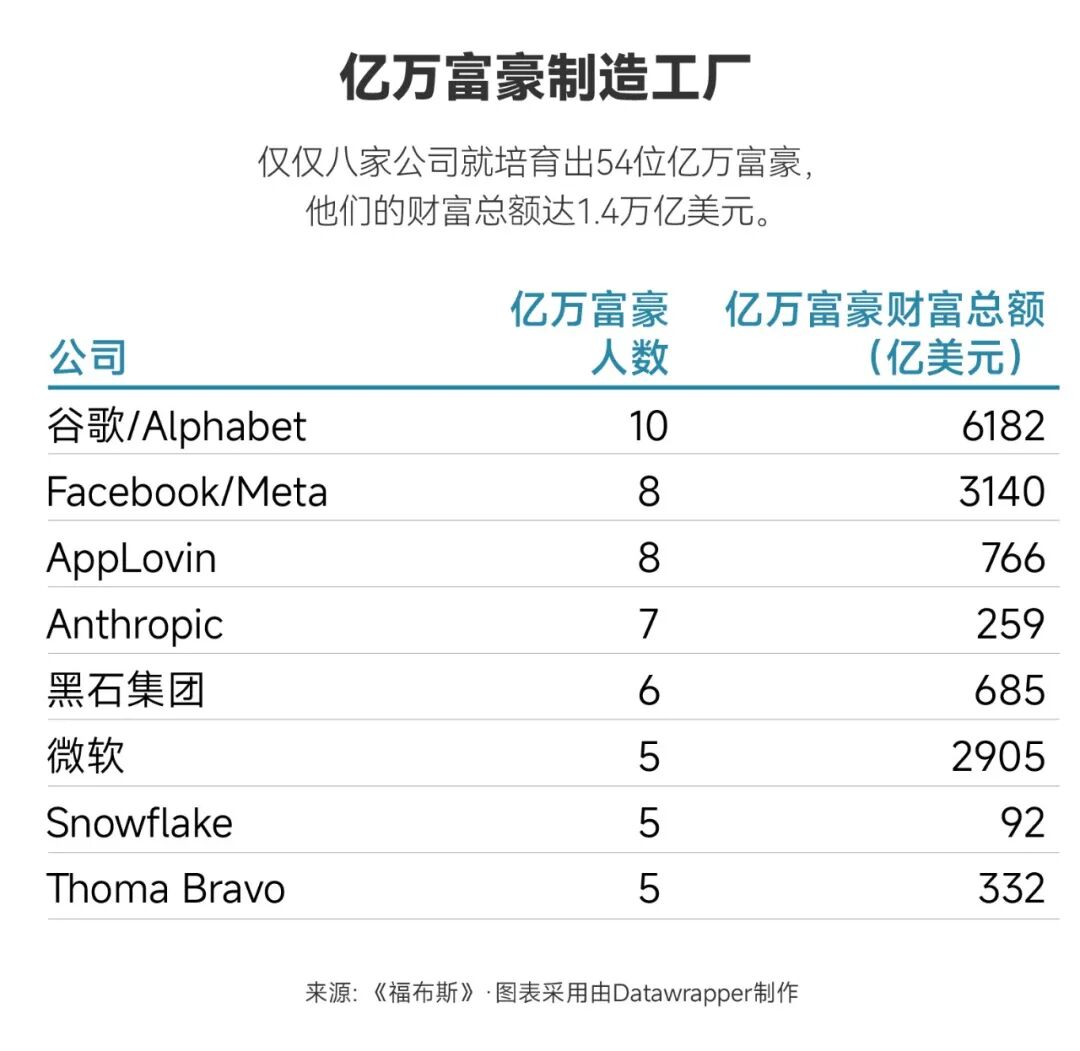
Core Insights - Anthropic, an AI startup, is preparing to launch its Claude 4 chatbot in January 2025, aiming to compete with products like ChatGPT and Gemini while seeking over $60 billion in funding, making it one of the highest-valued AI companies globally [1][2] - The rise of billionaires in the tech industry is largely attributed to companies like Google, Meta, Microsoft, and emerging firms like Anthropic and AppLovin, which have seen significant stock price increases driven by investor enthusiasm for AI [2][3] - Alphabet, Google's parent company, has created the most billionaires, totaling 10 individuals with a combined wealth exceeding $600 billion [4][6] Company Summaries - **Anthropic**: Founded by former OpenAI employees, Anthropic has quickly entered the AI race with its chatbot Claude, achieving a valuation of $60 billion by early 2025 and creating seven billionaires among its founders [16] - **AppLovin**: This digital advertising company has produced eight billionaires since its NASDAQ listing in 2021, with its stock price increasing over 1000% since then, reaching a market cap close to $250 billion [2][14] - **Google/Alphabet**: The company has generated 10 billionaires, including co-founders Larry Page and Sergey Brin, with a total wealth of $618.2 billion among them [8][10] - **Meta**: Facebook's parent company has created eight billionaires, including Mark Zuckerberg, with a total wealth of $314 billion [12] - **Microsoft**: The tech giant has five billionaires, including Bill Gates and Steve Ballmer, with a combined wealth of $290.5 billion [19][21] - **Blackstone**: This investment firm has produced six billionaires, with a total wealth of $68.5 billion [17] - **Snowflake**: The cloud services company has five billionaires, with a total wealth of $9.2 billion [22] - **Thoma Bravo**: This investment firm has also created five billionaires, with a total wealth of $33.2 billion [24]



Wall Street Lunch: JPMorgan To Take Over Apple Card From Goldman Sachs (undefined:JPM)
Seeking Alpha· 2026-01-08 19:16
Group 1: JPMorgan Chase and Apple Card Acquisition - JPMorgan Chase has agreed to acquire the Apple credit card program from Goldman Sachs, enhancing its position in consumer credit [5][6] - The Apple Card, which has approximately $20 billion in balances, will continue to offer key features such as 3% cash back and a high-yield savings account until the deal closes in about two years [6] - This acquisition reinforces JPMorgan's dominance in the credit card market, as it was the top U.S. issuer in 2024 with over $1.344 trillion in purchase volume [7] Group 2: Goldman Sachs Earnings Impact - Goldman Sachs anticipates that the acquisition will contribute approximately $0.46 per share to its Q4 2025 earnings [7] Group 3: Costco and Tariffs - Costco Wholesale is experiencing a rally following a strong December sales report, with expectations of a favorable resolution on tariffs potentially coming soon [8] Group 4: Snowflake Stock Upgrade - Snowflake has seen an increase in stock value after Argus Research upgraded it to Buy from Hold, setting a price target of $300, citing its importance for enterprises in generative and agentic AI applications [9] Group 5: BlackRock and Blackstone Clarification - BlackRock is mistakenly associated with large-scale single-family rental ownership, but it does not purchase or own single-family rental homes; this is primarily the domain of Blackstone [10][11] Group 6: January Stock Performance Insights - BofA notes that lower-quality stocks have historically outperformed higher-quality stocks in January, with a significant trend observed since 1987 [12] - The analysis highlights that funds are entering January with elevated quality exposure, while low-quality stocks that are underweight in long-only funds but rated Buy by BofA analysts include Amcor, Camden Property Trust, Healthpeak Properties, Devon Energy, and Hasbro [13]




There's a New Prince of U.S. Stocks. Play its Ascent With GGLL
Etftrends· 2026-01-08 14:54
Core Insights - Nvidia (NVDA) remains the leader in market capitalization among U.S. equities, while Alphabet (GOOGL) has surpassed Apple (AAPL) for the second position, marking a significant shift in market value dynamics [1] - The Direxion Daily GOOGL Bull 2X Shares (GGLL) ETF aims to deliver 200% of the daily performance of Alphabet shares, presenting a trading opportunity for aggressive investors [1][2] Company Performance - Alphabet's stock has increased nearly 60% over the past year, making GGLL an attractive option for short-term traders [2] - The performance of Alphabet's AI initiatives, particularly the Gemini project, is expected to create trading opportunities for GGLL throughout the year [3][4] AI Developments - Analysts have noted that Gemini's share of website visits and app average monthly active users rose to 22.5% and 13.2% in December, up from 17.7% and 11.7% in November, indicating strong growth in user engagement [4] - Snowflake's integration of Gemini 3 into its Cortex AI offering highlights Alphabet's leadership in AI innovation and its potential for monetization [4][5] Market Outlook - AI exposure is anticipated to be a significant catalyst for Alphabet shares, with HSBC Global Investment Research setting a price target of $370, indicating substantial upside potential [5] - The ongoing development of AI is viewed as the beginning of a megacycle, with expected positive impacts on global productivity and GDP [6]


Jim Cramer on Snowflake: “I Think the Stock Is, Quite Frankly, a Buy”
Yahoo Finance· 2026-01-08 12:45
Core Insights - Snowflake Inc. (NYSE:SNOW) is perceived as a buy despite recent negative market reactions, with CEO Sridhar Ramaswamy being highlighted as a strong leader [1] - The company operates a cloud platform that consolidates data for analysis, application development, information sharing, and AI utilization [1] - The stock is currently affected by a broader market decline in AI-related stocks, which some analysts believe is due to concerns over a potential bubble that has already burst [1] Company Overview - Snowflake Inc. provides a cloud platform that enables organizations to aggregate their data for various analytical and operational purposes [1] - The platform supports the development of data applications and facilitates information sharing, leveraging AI to address business challenges [1] Market Context - The stock is categorized within a cohort experiencing a downturn, particularly in the AI sector, which has faced scrutiny regarding valuation bubbles [1] - There is a belief that while Snowflake has potential, other AI stocks may present better upside opportunities with lower associated risks [1]