农业银行

Search documents
银行角度看1月社融:开局平稳,财政靠前发力、信贷观察节后开工
ZHONGTAI SECURITIES· 2026-02-14 10:41
Investment Rating - The industry investment rating is "Overweight" (maintained) [1] Core Insights - The report indicates that the social financing (社融) in January 2026 reached a new historical high for the same period, with an increase of 7.22 trillion yuan, which is 165.4 billion yuan more than the same period last year, exceeding the consensus expectation of 6.51 trillion yuan [4][7] - The report highlights that credit growth has slowed, with a notable decrease in loans to enterprises, while government bonds and corporate bonds have seen significant increases [4][12] - The liquidity and deposit situation shows a narrowing gap between M1 and M2 growth rates, with total deposits increasing by 8.09 trillion yuan, a year-on-year increase of 3.8 trillion yuan [18][20] Summary by Sections Social Financing Situation - In January 2026, social financing increased by 7.22 trillion yuan, up 165.4 billion yuan year-on-year, with a cumulative year-on-year growth rate of 8.2%, slightly down by 0.1 percentage points from December 2025 [4][7] - The main contributors to the increase were government bonds and bank acceptance bills, while credit growth was notably lower [8][9] Credit Situation - The total RMB loans increased by 4.71 trillion yuan in January, which is 420 billion yuan less than the same period last year, with a year-on-year growth rate of 6.1% [12][14] - The report details that household loans increased by 127 billion yuan year-on-year, while corporate loans decreased by 330 billion yuan [12][14] Liquidity and Deposit Situation - M1 and M2 growth rates both increased in January, with M1 growing by 4.9% and M2 by 9.0%, leading to a narrowing of the gap between the two [18][20] - Total deposits increased by 8.09 trillion yuan, with a year-on-year growth of 9.9%, while household deposits showed a significant decrease [20] Investment Recommendations - The report suggests a shift in the investment logic for bank stocks from "pro-cyclical" to "weak-cyclical," emphasizing the attractiveness of high dividend yields during periods of economic stagnation [23] - Two main investment lines are recommended: regional banks with strong certainty and large banks with high dividends [23]
21家系统重要性银行名单出炉!钱未存在这些银行里,有危险吗?
Sou Hu Cai Jing· 2026-02-14 09:50
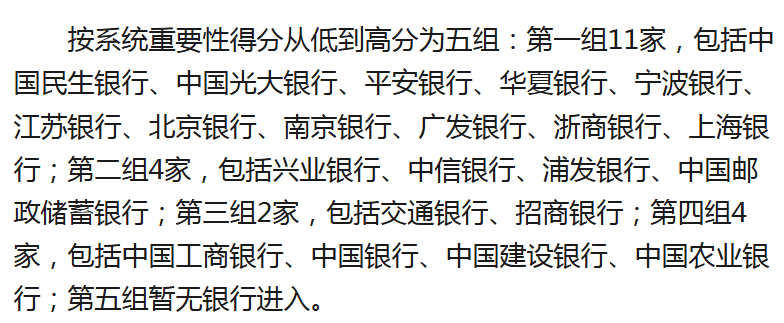
央行正式公布了最新的全国系统性重要银行名单,共计21家商业银行入选。需特别说明的是,该名单明确排除了中国人民银行以及三家政策性银行,唯有具 备商业性质的银行方能入围。 21家银行按重要性程度被划分为四组:第一组包含11家银行,如民生银行、上海银行等,属于级别最低的梯队;第二组有兴业银行、中信银行、浦发银行和 邮储银行4家;第三组则纳入交通银行与招商银行;第四组作为最高级别,仅包含中国工商银行、中国农业银行、中国银行、中国建设银行四大国有银行。 值得注意的是,第五组目前暂无银行入选。 从整体规模看,截至2024年6月,我国银行业金融机构法人总数达4425家,而系统重要性银行仅占21席,占比不足0.5%。 这种稀缺性恰恰印证了它们的特殊性——入选银行不仅品牌响亮,更以庞大体量形成"大而不能倒"的市场认知,任何一家若出现经营风险,至少会对区域金 融系统产生重大冲击,其资产规模与业务辐射范围均属行业顶尖。 对于普通储户而言,将资金存入这21家系统重要性银行堪称"安心之选"。即便是第一组银行,也因获得央行隐性背书而具备极高安全性,储户无需过度担忧 单一账户存款规模限制,可放心进行大额储蓄。 那么未入选的4000多家存款 ...

“扫货”港股金融圈!银、保双线出击 平安人寿再度举牌国寿H股
2 1 Shi Ji Jing Ji Bao Dao· 2026-02-14 09:01
Core Viewpoint - Ping An Life has increased its stake in China Life's H-shares, surpassing the 10% threshold, indicating a strategic move to build a substantial high-dividend financial asset pool in the Hong Kong market [1][4]. Group 1: Investment Actions - Ping An Life's investment in China Life's H-shares reached 10.12% after acquiring approximately 1,089.50 million shares at an average price of 33.2588 HKD per share [4]. - This is not the first time Ping An has increased its stake in a peer company; it previously acquired shares in China Pacific Insurance and China Life in August 2025, triggering initial stake notifications [2][3]. - The company has been actively buying shares in major banks, including Agricultural Bank of China, with its stake rising from 5% to 20.10% by the end of 2025 [5][6]. Group 2: Investment Strategy - Ping An's investment strategy focuses on asset-liability matching, ensuring that investments align effectively with its liability business [1][7]. - The company employs a "three criteria" principle for investments, assessing reliability, growth potential, and sustainable dividends [7]. - Analysts suggest that the motivations behind Ping An's stake increases can be categorized into two types: seeking stable dividend cash flows and targeting companies with strong return on equity (ROE) [7].



(新春走基层)辽宁凌源:“北方花都”迎春忙 金融活水暖农心
Xin Lang Cai Jing· 2026-02-14 08:17
Core Viewpoint - The article highlights the growth of the flower industry in Lingyuan, Liaoning, particularly in Xiaocunzi Town, showcasing how financial support has enabled local farmers to thrive and meet market demands during the peak sales season for New Year flowers [1][5]. Group 1: Industry Development - Lingyuan is known as the "Flower Capital of the North," with a flower industry that has evolved from small-scale trials to a complete industrial chain focusing on flower seedling breeding, large-scale planting, and sales of New Year flowers [1][3]. - The peak sales season for New Year flowers occurs from late December to early January, with significant demand leading to a surge in orders for local flower farmers [3][4]. Group 2: Financial Support - The Agricultural Bank of China’s Liaoning Chaoyang branch has actively engaged with local farmers to understand their financial needs, providing tailored financial products like "Huinong e-loan" to support their operations [3][5]. - A specific case is highlighted where a farmer received a loan of 3 million yuan, which alleviated financial pressures and allowed for timely fulfillment of orders [4][5]. Group 3: Employment and Community Impact - The expansion of the flower industry has created numerous job opportunities in sorting, packaging, and logistics, allowing local villagers to earn a decent income without leaving their homes [6]. - The article emphasizes the connection between the flower industry and community prosperity, illustrating how financial resources have contributed to a better quality of life for local residents [6].


1月金融数据点评:存款开门更红,债券融资靠前
KAIYUAN SECURITIES· 2026-02-14 08:15
Investment Rating - The industry investment rating is "Overweight" (maintained) [1] Core Insights - The report highlights a significant rebound in M1 and M2 growth rates due to the Spring Festival effect and proactive marketing by banks, with January M1 growth at 4.9% and M2 at 9.0% [3] - January saw a notable increase in new RMB deposits, totaling 8.09 trillion yuan, significantly higher than the previous year's 4.32 trillion yuan, driven by corporate, fiscal, and non-bank deposits [3] - The report indicates a shift towards short-term loans, with January's new RMB loans at 4.71 trillion yuan, reflecting a decrease in medium to long-term loans [4][5] - The investment suggestion emphasizes the need to monitor credit and deposit maturity windows in March, with large banks and quality regional banks expected to benefit from expansion and performance certainty [5] Summary by Sections Deposit and Loan Trends - January's new RMB deposits were 8.09 trillion yuan, with corporate deposits increasing by 2.82 trillion yuan, fiscal deposits by 1.22 trillion yuan, and non-bank deposits by 2.56 trillion yuan [3] - The structure of loans shows a significant increase in short-term loans, with corporate short-term loans up by 3.1 trillion yuan, while medium to long-term loans decreased by 2.8 trillion yuan [5] Social Financing - The total social financing in January was 7.22 trillion yuan, with a stock growth rate of 8.2%, reflecting a slight decrease from the previous month [4] - Direct financing, including corporate and government bonds, saw a year-on-year increase, indicating a shift in financing methods [4] Investment Recommendations - The report recommends focusing on banks with strong balance sheet expansion capabilities, specifically mentioning Citic Bank and Suzhou Bank, while also highlighting beneficiaries like Agricultural Bank, Industrial and Commercial Bank, Jiangsu Bank, and Chongqing Bank [5]

报价虚高结算缩水 黄金回收这些套路要小心
Sou Hu Cai Jing· 2026-02-14 08:12
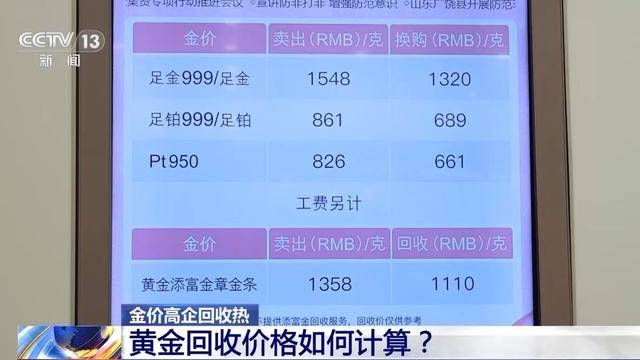
Core Viewpoint - Recent surges in international and domestic gold prices have led consumers to cash in their gold holdings, resulting in increased inquiries about gold recycling and "old for new" exchanges [1] Group 1: Main Recycling Channels - The primary gold recycling channels include banks, brand-authorized stores, and companies with precious metal recycling qualifications [1][4] - Banks typically only repurchase gold bars sold by them and require original packaging and certificates, generally not accepting jewelry [1][4] - Brand-authorized stores mainly recycle their own brand products, while qualified companies can recycle various types of precious metal products [1] Group 2: Price Calculation and Consumer Choices - The repurchase price for gold is calculated based on the current Shanghai Gold Exchange price, purity, weight, and deducting handling fees [6] - Consumers are advised to understand the pricing structure and choose the right recycling channel, as different channels may have varying requirements and prices [2][6] Group 3: Consumer Cautions and Common Issues - Consumers should be wary of inflated quotes, reduced settlement amounts, and weight discrepancies during the recycling process [7][9] - Some unscrupulous merchants may manipulate the gold's appearance or misrepresent its purity to lower the offered price [11][13] - It is recommended that consumers verify the current market price and monitor the weighing and testing process to protect their rights [13][16] Group 4: New Regulations and Best Practices - A new standard for "old for new" gold exchanges has been established, mandating that businesses must have legal qualifications and trained personnel [14] - The standard requires that the gold verification process be monitored and that consumers are present during destructive testing, with results documented [14] - To avoid disputes, consumers should confirm the weight of gold, gather necessary documentation, check current gold prices, and retain transaction receipts [16]
农行西藏分行“十四五”末各项贷款余额达2024亿元
Zhong Guo Xin Wen Wang· 2026-02-14 07:56
Core Viewpoint - The Agricultural Bank of China Tibet Branch is significantly increasing its financial support for major projects, with a focus on infrastructure and rural revitalization, achieving record loan balances and growth rates [1][3][4]. Group 1: Financial Performance - By the end of the 14th Five-Year Plan, the bank's major project loan balance exceeded 76.3 billion RMB, with total loan balances reaching 202.4 billion RMB, an increase of 93.8 billion RMB, representing an 86.43% growth compared to the end of the 13th Five-Year Plan [1]. - In 2025, the bank plans to issue a total of 94.6 billion RMB in loans, an increase of 27.4 billion RMB, marking the highest annual loan issuance in its history [3]. Group 2: Rural Revitalization Initiatives - The bank has established a comprehensive "1+N" rural revitalization service system, focusing on agricultural support, with county-level loan balances exceeding 150 billion RMB, accounting for 74% of total loans [3]. - Innovative financial products such as "Yak Industry Loan" and "Smart Animal Husbandry Loan" have been promoted, with rural industry loans increasing by 21.2 billion RMB since the end of 2019 [3]. Group 3: Financial Services Expansion - The bank is extending its financial services to remote areas through the "Galsang Flower" financial service initiative, with loan balances in 21 border counties reaching 31.6 billion RMB, an increase of 20.5 billion RMB since the end of 2019 [3]. - The bank aims to contribute more to national unity and the high-quality development of Tibet by enhancing its financial services [4].
我国系统重要性银行名单发布,共计21家
Xin Lang Cai Jing· 2026-02-14 07:12
第五组,暂无银行进入。 记者2月13日从中国人民银行了解到,近期中国人民银行、国家金融监督管理总局开展了2025年度我国 系统重要性银行评估,认定21家国内系统重要性银行,其中国有商业银行6家、股份制商业银行10家、 城市商业银行5家。 中国人民银行表示,下一步将持续夯实系统重要性银行附加监管,促进系统重要性银行安全稳健经营和 健康发展,更好服务实体经济高质量发展。 按系统重要性得分从低到高分为五组: 第三组2家,包括:交通银行、招商银行; 第四组4家,包括:中国工商银行、中国银行、中国建设银行、中国农业银行; 第一组11家,包括:中国民生银行、中国光大银行、平安银行、华夏银行、宁波银行、江苏银行、北京 银行、南京银行、广发银行、浙商银行、上海银行; 第二组4家,包括:兴业银行、中信银行、浦发银行、中国邮政储蓄银行; 来源:央视新闻 ...
固收点评 20260214:二级资本债周度数据跟踪(20260209-20260213)-20260214
Soochow Securities· 2026-02-14 06:39
Report Industry Investment Rating - Not provided in the content Core Viewpoints - This week (from February 9th to February 13th, 2026), there were no new secondary capital bonds issued in the inter - bank and exchange markets [1] - The weekly trading volume of secondary capital bonds this week was approximately 204.5 billion yuan, a decrease of 70.6 billion yuan compared to last week. The top three bonds in terms of trading volume were 25 Bank of China Secondary Capital Bond 02BC, 25 Bank of China Secondary Capital Bond 03A(BC), and 25 Agricultural Bank of China Secondary Capital Bond 04A(BC) [2] Summary by Relevant Catalogs Primary Market Issuance - No new secondary capital bonds were issued in the inter - bank and exchange markets from February 9th to February 13th, 2026 [1] Secondary Market Transactions - **Trading Volume**: The total weekly trading volume of secondary capital bonds was about 204.5 billion yuan, down 70.6 billion yuan from last week. The top three bonds in trading volume were 25 Bank of China Secondary Capital Bond 02BC (13.209 billion yuan), 25 Bank of China Secondary Capital Bond 03A(BC) (8.914 billion yuan), and 25 Agricultural Bank of China Secondary Capital Bond 04A(BC) (8.217 billion yuan) [2] - **Regional Trading Volume**: The top three regions in terms of trading volume were Guangdong Province (about 155.3 billion yuan), Shandong Province (about 16.5 billion yuan), and Shanxi Province (about 8.5 billion yuan) [2] - **Yield to Maturity**: As of February 13th, for 5Y secondary capital bonds, the yield to maturity of AAA -, AA +, and AA - rated bonds changed by - 6.56BP, - 6.91BP, and - 6.91BP respectively compared to last week; for 7Y bonds, the changes were - 8.84BP, - 5.66BP, and - 5.66BP; for 10Y bonds, the changes were - 6.53BP, - 4.86BP, and - 4.86BP [2] Top 30 Bonds with Valuation Deviation - **Overall Situation**: This week, the overall valuation deviation of the weekly trading average price of secondary capital bonds was not large. The proportion of discount transactions was greater than that of premium transactions, and the discount amplitude was larger than the premium amplitude [3] - **Discount Bonds**: The top three bonds with the highest discount rates were 17 Binhai Rural Commercial Secondary 01 (- 0.5685%), 23 Huaxing Bank Secondary Capital Bond 01 (- 0.4765%), and 22 Industrial and Commercial Bank of China Secondary Capital Bond 04B (- 0.4336%). The implicit ratings of China Central Depository & Clearing Co., Ltd. were mainly AAA -, AA, and AA +, and the bonds were mostly from Beijing, Shanghai, and Tianjin [3] - **Premium Bonds**: The top three bonds with the highest premium rates were 21 Huishang Bank Secondary 01 (0.5063%), 23 Hankou Bank Secondary Capital Bond 02 (0.4304%), and 23 Tianjin Bank Secondary Capital Bond 01 (0.3847%). The implicit ratings of China Central Depository & Clearing Co., Ltd. were mainly AA +, AAA -, and AA, and the bonds were mostly from Beijing, Zhejiang, and Fujian [3]
跌入熊市!超10万亿“大溃败”!两大巨头,疯狂减持
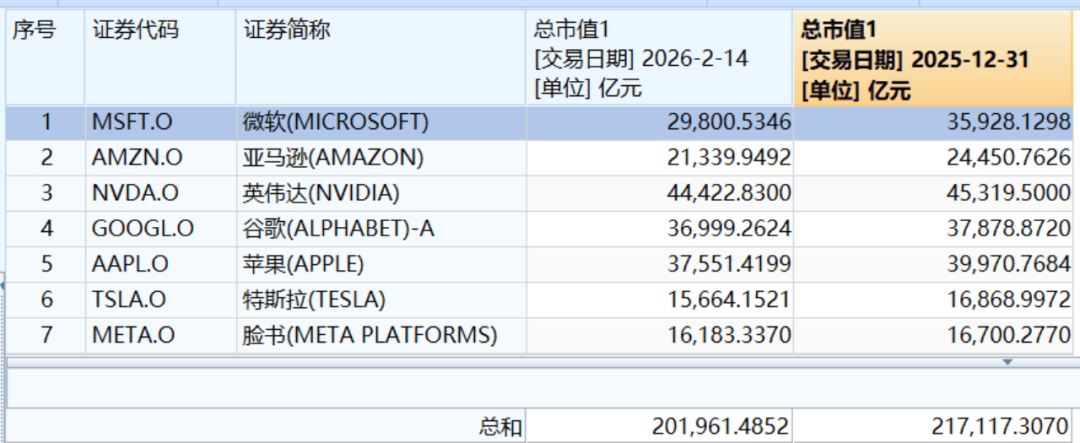
Sou Hu Cai Jing· 2026-02-14 06:32
Core Viewpoint - Amazon's stock price has experienced a nine-day decline, entering a technical bear market, making it the second member of the "Mag7" (the seven largest U.S. tech companies) to do so, following Microsoft. The total market value of the Mag7 has decreased by approximately $1.51 trillion this year [1][2]. Group 1: Stock Performance - Amazon's stock closed at $198.79 per share, down over 23% from its recent peak [2]. - Microsoft was the first Mag7 member to enter a bear market, with its stock down 27.8% from its recent high as of Friday's close [2]. - Meta is on the verge of entering a bear market, having declined 19.6% from its peak, just 0.4% away from the 20% threshold [2]. Group 2: Institutional Selling - UBS and Goldman Sachs have significantly reduced their holdings in several major U.S. tech stocks, as indicated in their recent 13F filings with the SEC [2][4]. - UBS reduced its stake in Nvidia by 10.57 million shares, representing an 11.47% decrease, and also reduced its positions in Microsoft, Apple, Amazon, and Google by varying percentages [4]. - Goldman Sachs also reduced its holdings in Microsoft, Tesla, Broadcom, and Meta, with reductions ranging from 5.86% to 13.51% [4]. Group 3: Market Trends and Influences - The decline in the Mag7 stocks coincides with similar trends in the A-share market, indicating a potential shift in global investment styles [5]. - Factors contributing to this trend include investor skepticism regarding the return on investment from AI expenditures by tech giants and a potential negative shift in free cash flow due to increased capital expenditures [5]. - The U.S. short-term liquidity market is showing signs of strain, with overnight reverse repos dropping to a low of $3.77 billion, indicating a tightening liquidity environment [5].