南极电商

Search documents
吴声2025年度演讲:场景革命十年,哲学生活方式到来
创业邦· 2025-08-04 00:09
Core Insights - The article emphasizes the concept of "scene creation" as a driving force behind the evolution of new business models and brands in the AI era, highlighting the importance of designing specific scenarios to foster innovation and user engagement [5][15][21]. Group 1: Scene Creation and Brand Evolution - The evolution of brands like San Yi Niao and Red Star Macalline illustrates how understanding user needs and creating tailored solutions can lead to significant business transformations [10][12]. - The concept of "effective time" is replacing "effective space" as the core standard in home living, indicating a shift towards personalized experiences in smart home solutions [10]. - The "scene brand evolution" is characterized by a dual process of deconstruction and emergence, driven by unique situational endowments in various fields [14]. Group 2: AI and Technological Integration - The article discusses the emergence of "Agentic AI" and its potential to reshape productivity and efficiency, although it notes that many applications are still in the exploratory phase [17][19]. - The integration of AI into everyday scenarios is seen as a pathway to enhance user experiences and create new value propositions, as demonstrated by companies like Xiaomi and Star Charging [29][32]. Group 3: Consumer Engagement and Experience - The rise of platforms like Xiaohongshu showcases how real-time connections and user-generated content can redefine consumer engagement and brand value [25][26]. - The concept of "NOW" emphasizes the importance of immediate connections and experiences in the digital age, where traditional metrics of engagement are being replaced by real-time interactions [22][40]. Group 4: Physical and Digital Integration - The article highlights the need for seamless integration between physical spaces and digital experiences, as seen in the collaboration between companies like Fenjun Media and Alipay [35]. - The evolution of human-machine interaction is discussed, with a focus on creating fluid and intuitive experiences that enhance user engagement [41][43]. Group 5: Cultural and Community Engagement - The development of localized cultural spaces, such as the "New Species Space" project, illustrates the importance of community engagement and cultural relevance in modern business strategies [72][73]. - The article emphasizes the role of emotional connections and personal narratives in shaping consumer experiences, particularly in the context of emerging brands and products [69][70].


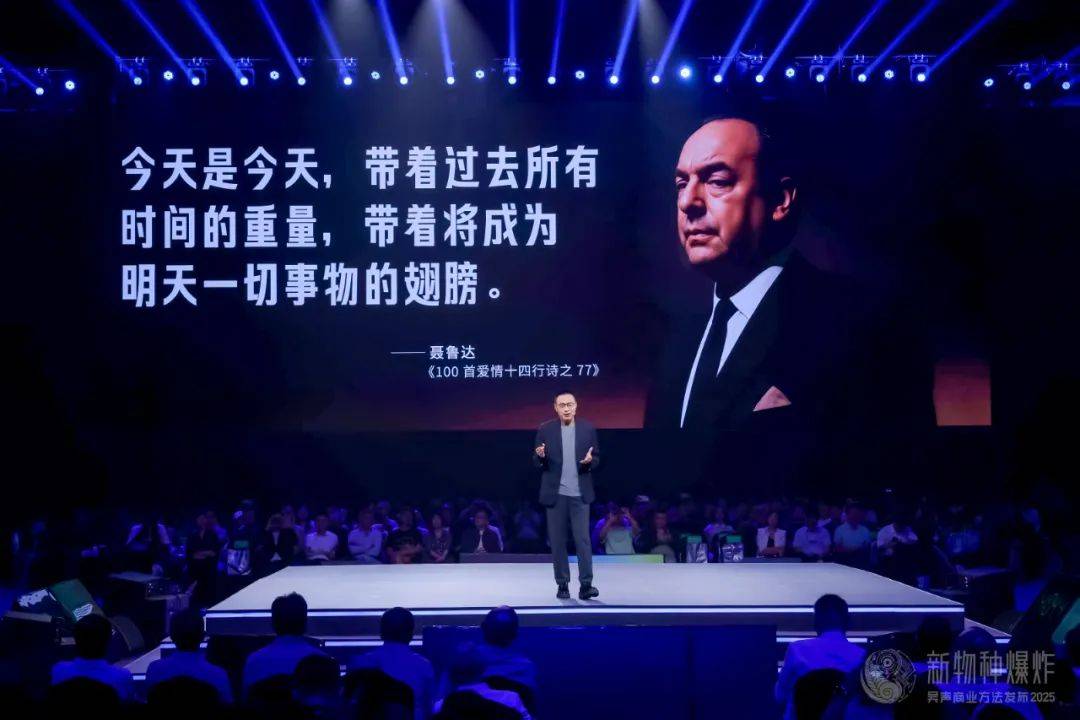
吴声2025年度演讲:词是旧的,意义才是新的
Hu Xiu· 2025-08-03 14:09
Core Insights - The event "New Species Explosion 2025" emphasizes the significance of AI in reshaping business through a philosophical lifestyle cycle, focusing on the reconstruction of meaning in specific scenarios [1][2][21] - The presentation outlines four innovative methods for "meaning reconstruction": NOW (connection in the present), FLOW (smooth human-machine interaction), HERE (narrative beyond presence), and EGO (consensus of self) [1][22][26] Group 1: Scene Creation and Evolution - The concept of "scene creation" has evolved over the past decade, highlighting the importance of well-designed scenarios in driving the growth of new business entities [6][14] - The case of "Three Wings Bird" illustrates the transition from product-focused strategies to personalized home scene customization, emphasizing the need for effective time management over mere spatial efficiency [9][10] - Red Star Macalline's transformation into an "AI home life destination" showcases the integration of home appliances, furniture, and decoration into a cohesive business model [12][14] Group 2: Instant Emergence and Meaning Reconstruction - The notion of "instant emergence" suggests that the evolution of AI applications will occur through meticulously designed scenarios, avoiding superficial trends [15][19] - The advancements in AI technology, such as Amazon's robotics and Google's Gemini Robotics, indicate a shift towards cognitive capabilities, although the full potential of AI remains to be realized [17][19] - The potential economic impact of AI is significant, with projections suggesting a GDP growth of 20-30%, indicating a transformative phase for society [19] Group 3: Connection and User Engagement - The concept of NOW emphasizes the importance of real-time connections facilitated by AI, which compresses processes and enhances user engagement [26][29] - The success of brands like Three Squirrels demonstrates the effectiveness of a decentralized organizational model that aligns with the values of younger consumers [34][35] - Xiaomi's approach to integrating consumer electronics into the automotive sector exemplifies the restructuring of organizational systems to enhance connectivity and efficiency [36] Group 4: Fluid Human-Machine Interaction - The evolution of human-machine interaction is characterized by the emergence of "intelligent agents" that enhance user experiences through seamless integration [47][50] - The concept of "physical AI" is reshaping interactions in the physical world, allowing for a more intuitive and responsive environment [57][59] - Brands like AAC Technologies are pioneering the integration of sensory technology to create immersive human-machine interactions [58][59] Group 5: Narrative Beyond Presence - The importance of physical presence in retail is highlighted through the innovative store concepts of brands like Anta, which create immersive and community-focused experiences [80][81] - The shift towards experiential retail emphasizes the need for physical spaces to resonate with digital narratives, enhancing customer engagement [84][85] - The concept of "here" as a narrative tool underscores the significance of local culture and community in shaping brand experiences [91][93] Group 6: Consensus of Self - The emphasis on individual uniqueness and collective consensus is illustrated through brands like Mao Geping, which focus on personalized beauty experiences [106][107] - The concept of "new balanceism" in health and wellness reflects a growing societal focus on achieving equilibrium in the face of rapid technological change [110][113]
吴声2025年度演讲:场景革命十年,哲学生活方式到来
凤凰网财经· 2025-08-03 14:04
Core Viewpoint - The article discusses the ongoing AI scene revolution and its impact on business, emphasizing the need for reconstructing meaning in specific scenarios to adapt to the evolving landscape of consumer needs and technological advancements [5][22][28]. Group 1: Scene Creation and Evolution - The concept of "scene creation" has evolved over the past decade, highlighting the importance of well-designed scenarios in driving the growth of new business entities [13][21]. - Companies like Sanwing Bird and Red Star Macalline exemplify the evolution of scene brands, focusing on personalized solutions and integrating various home-related services to enhance consumer experience [16][19]. - The article notes that understanding user needs within specific scenarios is crucial for brands to innovate and adapt in the AI era [17][21]. Group 2: Instant Emergence and Meaning Reconstruction - The term "instant emergence" refers to the necessity of believing in the emergence of scenarios at every technological moment, which is essential for navigating the rapid changes brought by AI [24][26]. - The article emphasizes that AI's evolution is not just about technology but also involves a cognitive revolution that redefines human existence and experience [26][28]. - The reconstruction of meaning in everyday life is highlighted as a key aspect of the AI scene revolution, where philosophical considerations become integral to understanding technology's role [28][30]. Group 3: Connection and Interaction - The article introduces the concept of "NOW," focusing on the importance of real-time connections in the attention economy, as exemplified by platforms like Xiaohongshu [35][36]. - The evolution of human-machine interaction is discussed, with an emphasis on creating seamless experiences that enhance user engagement and satisfaction [55][56]. - The emergence of "smart agents" as a new form of digital self is highlighted, showcasing how AI can enhance user experiences by understanding and anticipating needs [56][59]. Group 4: Physical and Digital Integration - The integration of physical and digital experiences is emphasized, with examples of companies like Xiaomi and Jiumu showcasing how they leverage AI to enhance user interactions in real-world scenarios [42][73]. - The article discusses how brands are rethinking physical spaces to create meaningful consumer experiences, transforming retail environments into engaging community hubs [82][84]. - The rise of emotional commerce, particularly through collectible toys, reflects a shift towards products that resonate with consumers' identities and emotions [89][90].
吴声2025年度演讲:场景革命十年,哲学生活方式到来
3 6 Ke· 2025-08-03 13:34
Group 1 - The core theme of the event is "Momentary Emergence," focusing on the AI scene revolution and its impact on business and philosophy [3][16] - Wu Sheng, the founder of Scene Laboratory, emphasizes the importance of reconstructing meaning coordinates in specific scenarios [3][22] - The event outlines four innovative methods for "meaning reconstruction": NOW (connection in the moment), FLOW (smooth human-machine interaction), HERE (narrative beyond presence), and EGO (the core question of self) [3][22] Group 2 - The evolution of scene creation over the past decade is highlighted, showcasing how meticulously designed scenarios drive the growth of new species in business [9][15] - The case of Sanwing Bird illustrates the shift from product-focused to solution-oriented approaches in smart home scenarios, emphasizing personalized family scene customization [11][15] - Red Star Macalline's transformation into an "AI home life destination" reflects the deep understanding of lifestyle changes brought by AI, integrating home appliances, furniture, and decoration [13][15] Group 3 - The concept of "Momentary Emergence" suggests that the future of AI applications will evolve through carefully designed scenarios, avoiding superficial trends [16][20] - The advancements in AI technology, such as Amazon's robotics and Google's Gemini Robotics, indicate a shift towards cognitive capabilities in machines [18][20] - The potential economic impact of AI is significant, with projections suggesting a possible GDP growth of 20-30% due to AI advancements [20] Group 4 - The "philosophical lifestyle cycle" is introduced, emphasizing the need to find and reconstruct meaning coordinates in everyday life through specific scenarios [22][24] - The importance of user-generated content (UGC) in platforms like Xiaohongshu is highlighted, showcasing its role in connecting people and information in real-time [27][29] - The concept of "effective time" is emerging as a new standard in family living, replacing the traditional focus on effective space [11][15] Group 5 - The evolution of physical retail spaces, such as Anta's innovative store designs, reflects a shift towards creating immersive and community-oriented shopping experiences [63][64] - The integration of AI in physical spaces is transforming how consumers interact with products, enhancing the overall shopping experience [60][65] - The rise of emotional commerce, particularly in the context of trendy toys, illustrates the changing landscape of consumer engagement and brand connection [70][71]
南极电商(002127) - 关于公司使用闲置自有资金购买理财产品的进展公告
2025-08-03 07:45
证券代码:002127 证券简称:南极电商 公告编号:2025-035 关于公司使用闲置自有资金购买理财产品的进展公告 南极电商股份有限公司 关于公司使用闲置自有资金购买理财产品的进展公告 本公司及董事会全体成员保证信息披露内容的真实、准确、完整,没有虚 假记载、误导性陈述或重大遗漏。 南极电商股份有限公司(以下简称"公司")2024年年度股东大会审议通过了《关于使用 闲置自有资金购买理财产品的议案》,授权董事长审批使用公司及合并报表范围内下属子公 司暂时闲置的自有资金用于购买理财产品的额度为250,000万元(人民币);投资类型为安全 性高、流动性好、保本型或低风险型的理财产品或固定收益类证券(除股票、证券投资基金、 无担保债券等有价证券及其衍生品),期限不超过12个月,在上述额度及期限范围内可循环 滚动使用。 现将公司 2025 年 7 月份使用闲置自有资金购买理财产品的事项公告如下: | 序 | 受托人名 | 产品名称 | 产品类型 | 委托理财 金额(万 | 预计年化 | 起始日 | 到期日 | 资金 | 关联 | | --- | --- | --- | --- | --- | --- | --- | ...

南极电商(002127)7月31日主力资金净流出1016.56万元
Sou Hu Cai Jing· 2025-07-31 09:50
Core Points - The stock price of Nanji E-commerce (002127) closed at 3.7 yuan on July 31, 2025, down 0.8% with a turnover rate of 1.53% and a trading volume of 303,300 hands, amounting to 113 million yuan in transaction value [1] - The latest financial report for the first quarter of 2025 shows total revenue of 729 million yuan, a year-on-year increase of 2.03%, while net profit attributable to shareholders decreased by 128.54% to 13.63 million yuan, and non-recurring net profit fell by 149.91% to 18.79 million yuan [1] - The company has a current ratio of 4.819, a quick ratio of 4.652, and a debt-to-asset ratio of 15.26% [1] Investment and Business Activities - Nanji E-commerce has made investments in 29 companies and participated in 6 bidding projects [2] - The company holds 748 trademark registrations and 122 patents, along with 3 administrative licenses [2] Company Background - Nanji E-commerce Co., Ltd. was established in 1999 and is located in Suzhou, primarily engaged in business services [1] - The registered capital of the company is approximately 2.45 billion yuan, with paid-in capital of about 97.84 million yuan [1]
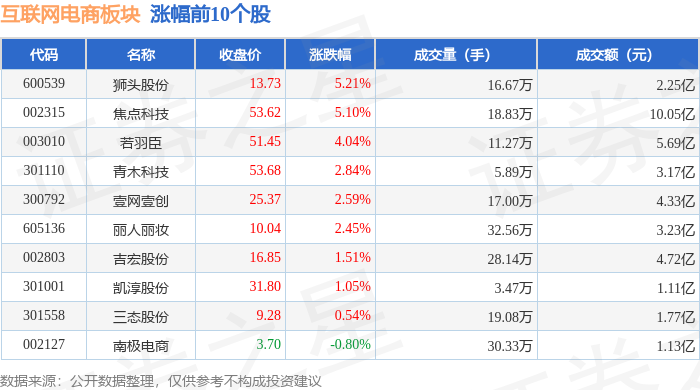
互联网电商板块7月31日涨0.27%,狮头股份领涨,主力资金净流入5493.53万元
Zheng Xing Xing Ye Ri Bao· 2025-07-31 08:32
Market Overview - The internet e-commerce sector increased by 0.27% on July 31, with Lionhead Co., Ltd. leading the gains [1] - The Shanghai Composite Index closed at 3573.21, down 1.18%, while the Shenzhen Component Index closed at 11009.77, down 1.73% [1] Top Performers - Lionhead Co., Ltd. (600539) closed at 13.73, up 5.21% with a trading volume of 166,700 shares and a transaction value of 225 million [1] - Focus Technology (002315) closed at 53.62, up 5.10% with a trading volume of 188,300 shares and a transaction value of 1 billion [1] - Ruogang Chen (003010) closed at 51.45, up 4.04% with a trading volume of 112,700 shares and a transaction value of 569 million [1] Underperformers - ST Tongpu (600365) closed at 3.02, down 4.13% with a trading volume of 87,000 shares and a transaction value of 26.64 million [2] - Cross-Border Communication (002640) closed at 5.28, down 2.94% with a trading volume of 1,629,300 shares and a transaction value of 868 million [2] - New Xunda (300518) closed at 13.68, down 2.36% with a trading volume of 50,300 shares and a transaction value of 69.49 million [2] Capital Flow - The internet e-commerce sector saw a net inflow of 54.94 million from institutional investors, while retail investors experienced a net outflow of 27.42 million [2][3] - Focus Technology (002315) had a net inflow of 70.51 million from institutional investors, while retail investors saw a net outflow of 55.89 million [3] - Lionhead Co., Ltd. (600539) experienced a net inflow of 2.22 million from institutional investors, with a significant net outflow of 26.10 million from retail investors [3]





传媒行业财务总监2024年平均薪酬95.26万元 年初至今受到5次行政监管措施、3次行政处罚
Xin Lang Zheng Quan· 2025-07-30 09:59
Core Insights - The average salary of CFOs in the A-share market reached 76.03 million yuan in 2024, with a total of 4.243 billion yuan for all CFOs [1] - In the media industry, the average salary for CFOs was 95.26 million yuan, with a total salary expenditure of 1.08 billion yuan [2][3] - There is a positive correlation between the educational background of CFOs and their salary levels, with master's degree holders earning an average of 105.95 million yuan, while those with bachelor's and associate degrees earned 87.9 million yuan and 61.58 million yuan, respectively [3] Salary Distribution - The highest-paid CFO in the media industry is Ye Wei from 37 Interactive Entertainment, earning 4.9866 million yuan in 2024, an increase of 428,200 yuan from the previous year [4] - The lowest-paid CFO is Yu Yu from Zhejiang Shusu Culture, with a salary of 23,400 yuan due to a short tenure [5] - The fastest revenue growth in 2024 was seen in Jiayun Technology, with a revenue increase of 108.30% to 1.572 billion yuan [5] Age and Tenure - The average age of CFOs in the media industry is 47.4 years, with the oldest being 63 years old and the youngest at 35 years [4] - Some CFOs had short tenures, such as Wang Kuangming from Simai Media, who served less than a year [7] Regulatory Actions - In 2024, media industry CFOs faced five administrative regulatory measures and three administrative penalties for various compliance issues [8][9] - Specific cases include penalties for non-compliance with financial reporting and disclosure regulations, with fines reaching up to 800,000 yuan [9]






2025年中国袜子行业政策汇总、产业链图谱、发展现状、竞争格局及发展趋势研判:市场格局高度分散,TOP10品牌占比不足5%[图]
Chan Ye Xin Xi Wang· 2025-07-25 01:38
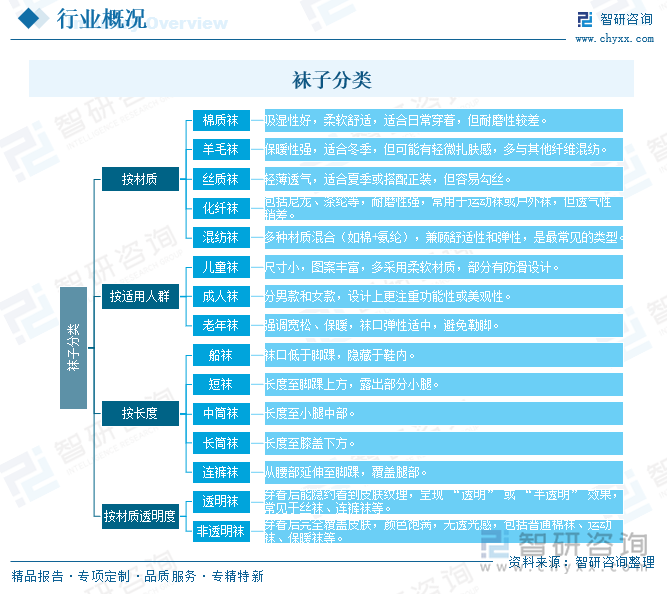
Overview - Socks are essential clothing items that are widely used in daily life, characterized as fast-moving consumer goods with a relatively low average price compared to other textile and apparel products, making the sock market a vast opportunity [1][9] - In 2024, China's sock sales are projected to reach 12.229 billion pairs, generating a revenue of 101.074 billion yuan, with non-transparent socks accounting for over 60% of the market [1][9] - As living standards improve and consumer preferences evolve, there is a growing demand for comfort, functionality (such as antibacterial, moisture-wicking, and odor-resistant features), and fashion, leading to increased opportunities in niche markets [1][9] Market Policies - The Chinese government has implemented various policies to support the development of the textile and apparel industry, including initiatives to promote fashionable domestic products and enhance the innovation of traditional brands [4][6] - Key policies include the promotion of cultural and tourism consumption, support for the innovation of time-honored brands, and the encouragement of high-quality development in the textile sector [4][6] Industry Chain - The upstream of the sock industry includes suppliers of raw materials such as cotton, wool, silk, and synthetic fibers, as well as equipment manufacturers for sock production [7] - The midstream consists of sock manufacturing companies, while the downstream includes various sales channels such as supermarkets, department stores, specialty shops, wholesale markets, and e-commerce platforms [7] Competitive Landscape - The sock industry in China is characterized by a low entry barrier, resulting in a large number of participants, primarily small and medium-sized enterprises, leading to a highly fragmented market [11] - In 2024, the top 10 brands in the sock market accounted for less than 5% of the total market share, indicating significant competition and product homogeneity [11] Company Analysis - **Langsha Co., Ltd.**: One of the world's largest sock manufacturers with advanced digital equipment and a daily production capacity exceeding 4 million pairs. In 2024, Langsha's revenue reached 380 million yuan with a gross profit of 77 million yuan, resulting in a gross margin of 20.38% [13] - **Jiansheng Group Co., Ltd.**: A leading manufacturer of knitted sports apparel, producing 500 million pairs of cotton socks annually. In 2024, the company's revenue was 2.574 billion yuan, with knitted sports socks accounting for 60.61% of total sales [15] Development Trends - The demand for socks is becoming increasingly diversified, with consumers seeking additional functionalities such as anti-slip, antibacterial, and odor-resistant features [17] - Smart socks equipped with sensors to monitor foot health and adjust temperature and humidity are expected to become a market trend, providing personalized experiences for consumers [17]




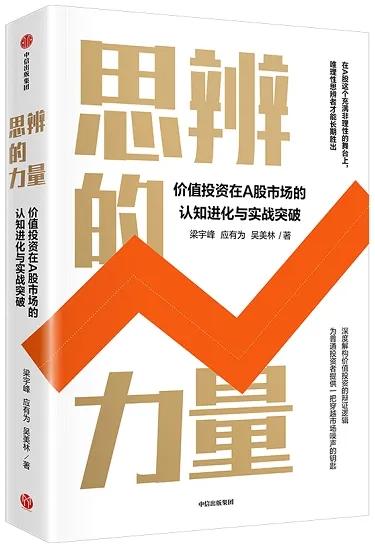
《思辨的力量》|价值投资在A股市场的认知进化与实战突破
Cai Jing Wang· 2025-07-24 04:22
Core Viewpoint - "Thinking" is a core capability required for value investing, representing the need to dialectically view value investment as both simple and complex, requiring adherence to basic common sense while also evolving with the times [1][11]. Group 1: Value Investing in A-Share Market - The A-share market is suitable for value investing due to a stable economic growth and the presence of many excellent entrepreneurs and companies [2]. - Since 2021, many well-known companies have seen stock price declines exceeding 70%, leading to skepticism about the effectiveness of value investing in China [2][3]. - The decline of core assets since 2021 is attributed to the return of value principles rather than the failure of value investing [2][3]. Group 2: Misunderstandings of Value Investing - Many individuals misunderstand value investing as merely buying good companies and avoiding poor stocks, which oversimplifies its essence [3]. - The performance of traditional stocks like coal, banks, and utilities has surged since 2021, indicating that the market's previous neglect of these stocks was misguided [3]. Group 3: Challenges of Value Investing - Value investing is effective and replicable, but only about 1% of investors truly practice it due to its frequent inefficacy and the long periods of underperformance [4][5]. - The nature of value investing often requires contrarian decision-making, which is challenging due to human psychological weaknesses [4]. Group 4: Book Overview and Structure - The book aims to clarify misconceptions about value investing, providing practical insights on how to apply value investing principles effectively [11][12]. - It categorizes content into three parts: basic principles and methods of value investing, challenges and difficulties faced, and various investment opportunities [6][7][8].