华润置地

Search documents
西部证券晨会纪要-20260203
Western Securities· 2026-02-03 03:06
Group 1: Domestic Policy - The unified market policy will become an important policy line for 2026 and the "14th Five-Year Plan," emphasizing the need to deepen and transcend "involution" [1][5][6] - The focus will be on governance of local government behavior and related reform measures, covering areas such as anti-monopoly, local government investment attraction, and tax system reform [5][6][27] - The policy's impact will extend from industries like photovoltaics, lithium batteries, and new energy vehicles to electricity, transportation, technology, and data [5][6] Group 2: Company Analysis - Yum China (09987.HK) - The Western fast food market is expected to exceed 300 billion yuan by 2025, with a growth rate of 10.3%, led by the hamburger segment, which holds a 70.6% market share [8][9] - Yum China maintains a strong market position with a 27.5% share, and the market concentration is high, with the top five companies accounting for 44% of the market [8][9] - The company has a large store network with a low closure rate, reaching 17,514 stores by Q3 2025, and a compound annual growth rate (CAGR) of 9% from 2014 to 2024 [9] - The company has a strong local innovation capability, with 5.75 million members contributing to 57% of sales, and maintains healthy profit margins of 18.5% for KFC and 13.4% for Pizza Hut [9][10] - The company is expected to generate revenues of $11.7 billion, $12.4 billion, and $13.1 billion from 2025 to 2027, with net profits of $900 million, $1 billion, and $1.1 billion respectively, leading to a price-to-earnings ratio of 19, 18, and 16 times [8][10] Group 3: Real Estate Industry - In January 2026, the top 100 real estate companies saw a 24.7% year-on-year decline in sales, although the decline was less severe than in previous months [18][20] - The sales area also decreased by 29.5% year-on-year, indicating a continued downward trend in the market [18][20] - The top three companies in the industry achieved a slight year-on-year increase of 0.2%, while other segments experienced significant declines [18][20] - Companies focused on first and second-tier cities showed a smaller decline in sales compared to those in lower-tier cities, with a difference of approximately 11% [19][20] - Recommendations include focusing on second-hand housing intermediaries like Beike and quality state-owned enterprises such as China Resources Land and China Overseas Development [20]
2026年,东莞要开5座“王炸”商业项目
3 6 Ke· 2026-02-03 02:20
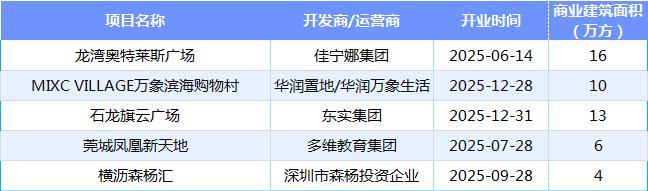
Core Insights - Dongguan's commercial market is set for significant expansion in 2025, with five new commercial projects adding approximately 490,000 square meters of retail space, bringing the total to over 7 million square meters across 115 projects by the end of the year [1][2]. Group 1: New Commercial Projects in 2025 - Longwan Outlets Plaza opened on June 14, 2025, with a total commercial area of 160,000 square meters, marking Dongguan's first outlet project in the main urban area [1][2]. - MIXC VILLAGE opened on December 28, 2025, featuring 100 international discount stores within a 100,000 square meter area, establishing a new consumption landmark in the coastal bay area [1][2]. - Shilong Qiyun Plaza commenced operations on December 31, 2025, with a size of 130,000 square meters, becoming the largest centralized commercial space in northern Dongguan [1][2]. - Dongguan Phoenix New World launched on July 28, 2025, with 60,000 square meters of commercial space revitalizing the old city area [1][2]. - Hengli Senyanghui opened on September 28, 2025, as the first revitalized centralized commercial space in Hengli Town, filling a gap in quality commercial consumption [1][2]. Group 2: Retail Brand Expansion - Major retail brands are accelerating their presence in Dongguan, with Sam's Club planning to open in 2026, IKEA set to debut in early February 2026, and Hema expanding its footprint in various towns [2]. Group 3: Future Developments in 2026 - In 2026, Dongguan plans to launch five major commercial projects, adding over 400,000 square meters of retail space, focusing on high-end retail, cultural tourism integration, and ecological districts [3]. - Pengrui Tianyue Plaza, a super complex with 117,000 square meters of high-end commercial space, is set to open in Q4 2026, featuring major brands like AEON Supermarket and Huawei's largest experience store [4][5][7]. - Dongguan MixC, a flagship commercial project with approximately 230,000 square meters, is expected to open at the end of 2026, positioned as a leading urban commercial flagship [8][10]. - Songshan Lake Happy Coast, an urban cultural tourism commercial landmark, will open in Q4 2026, integrating ecological and cultural tourism elements [11][13]. - The Hill Qifeng Mountain Road, Dongguan's first mountain park-style commercial street, is set to open in 2026, focusing on outdoor and cultural experiences [14][16]. - The historical cultural district on Zhongshan Road in Shilong Town is undergoing renovation, with a total investment of 550 million yuan, aiming to create a vibrant historical shopping area [17]. Group 4: Overall Market Transition - Dongguan's commercial landscape is transitioning from quantity to quality, with significant projects like MixC, Tianyue Plaza, and Happy Coast addressing gaps in high-end commercial, cultural tourism, and ecological experiences, reflecting the city's commitment to becoming a "Quality Consumption Capital" [17].


1月房地产市场解读及展望
2026-02-03 02:05
Summary of Real Estate Market Conference Call Industry Overview - The conference call discusses the real estate market in January 2026, highlighting significant trends and changes in the sector, particularly among the top 100 real estate companies [1][3][4]. Key Points Market Performance - In January 2026, the sales amount of the top 100 real estate companies decreased by 27.3% year-on-year and 49% month-on-month, indicating a significant market contraction [1][3]. - The top three companies experienced only a 1.7% decline, showcasing their stronger risk resilience compared to others [1][3]. - The second-hand housing market exceeded expectations, achieving a four-month consecutive increase, with transaction volumes reaching the second-highest point in 13 months [1][7]. New Housing Market - The new housing market in first-tier cities saw the largest decline, with transaction areas down by 28% year-on-year [1][12]. - In second-tier cities, Chengdu performed relatively well with a 39% decline, while third and fourth-tier cities maintained stable transaction volumes [1][12][13]. - New housing supply in 50 key cities dropped by 55% year-on-year and 62% month-on-month, marking the lowest level in 13 months [1][10]. Supply and Demand Dynamics - The supply and demand for new homes have significantly contracted, with developers showing low enthusiasm for launching new projects [1][6]. - High-quality projects in core urban areas, such as low-density villas, continue to perform well, while most new projects face pressure due to reduced demand [1][6][15]. Second-Hand Housing Market - The second-hand housing market is characterized by a price-driven demand, with many buyers opting for lower-priced homes [1][18][23]. - The market is experiencing a mismatch between new and old housing demands, with buyers favoring newer, more affordable second-hand homes [1][19]. Future Expectations - The market is expected to see a decline in new home sales in February 2026 due to the impact of the Spring Festival, with a continued divergence between new and second-hand homes [2][22]. - There is a noticeable trend of buyers, including those looking for improvements, shifting towards purchasing second-hand homes [22]. Land Market - The land market is currently not strongly correlated with the housing market, with low supply and demand levels observed [20][21]. - Developers are focusing on comprehensive value assessments for land acquisitions, which may not significantly boost new project launches [20][21]. Investment and Sales Forecast - The real estate sales growth for 2026 is projected to be around 5%, while investment growth is expected to be between 10% and 15% [26]. - The overall supply of new homes is anticipated to constrain sales, with significant limitations on the volume of land available for development [24][26]. Additional Insights - The market is witnessing a shift in buyer preferences, with a growing inclination towards larger, well-located properties, particularly in the second-hand market [22][23]. - The rental market dynamics are changing, with new rental properties becoming more appealing to younger generations compared to older housing stock [25]. This summary encapsulates the critical insights from the conference call, providing a comprehensive overview of the current state and future expectations of the real estate market.
中银晨会聚焦-20260203-20260203
Bank of China Securities· 2026-02-03 00:55
Core Insights - The public REITs market in China is expanding from infrastructure to commercial real estate, marking a new phase of development as per the announcement by the China Securities Regulatory Commission (CSRC) on December 31, 2025 [5][6][18] - The announcement defines commercial real estate REITs and outlines requirements for fund registration, management, and regulatory responsibilities, while still adhering to previous guidelines for infrastructure securities [5][6] - The first batch of commercial real estate REITs is expected to raise a total of 31.47 billion yuan, covering various commercial formats such as hotels, office buildings, and shopping centers [7][18] Summary by Sections Commercial Real Estate REITs Overview - The CSRC's announcement on December 31, 2025, signifies the dual development of commercial real estate and infrastructure REITs in China [5] - Commercial real estate REITs are defined as closed-end public funds that invest in commercial real estate asset-backed securities to acquire ownership or operational rights, generating stable cash flows from rents and fees [5][6] Regulatory Framework - The new business guidelines include the expansion of applicable scope to include commercial real estate REITs, with specific requirements for operational and financial disclosures [6] - Funds raised through public REITs can be used for acquiring existing assets, new investments, debt repayment, and working capital, but not for purchasing residential land [6] Initial Batch of REITs - Eight commercial real estate REITs have been submitted for approval, with expected fundraising ranging from 1.703 billion yuan to 7.47 billion yuan [7][8] - The underlying assets for these REITs are primarily located in core urban areas, with operational performance generally strong [7] Specific REITs Details - **Hua'an Jinjiang REIT**: Expected to raise 1.703 billion yuan, focusing on 21 hotels across 18 cities, with an average occupancy rate of 61.58% [8] - **Huitianfu Shanghai Real Estate REIT**: Expected to raise 4.002 billion yuan, with two office buildings in Shanghai showing a 100% occupancy rate [9] - **CICC Vipshop REIT**: Expected to raise 7.47 billion yuan, focusing on two outlet projects with high operational performance [10] - **Hua'an Lujiazui REIT**: Expected to raise 2.810 billion yuan, with assets including office and commercial projects in Shanghai [11] - **Hua'an Poly Development REIT**: Expected to raise 2.093 billion yuan, with assets in Guangzhou and Foshan [12] - **Hua'an Yintai REIT**: Expected to raise 4.2785 billion yuan, focusing on a shopping center in Hefei [13] - **Hua'an CapitaLand REIT**: Expected to raise 4.054 billion yuan, with assets in Shenzhen and Mianyang [14] - **Guotai Haitong Sasseur REIT**: Expected to raise 5.064 billion yuan, focusing on an outlet project in Xi'an [15] Market Potential - The commercial real estate sector in China has a substantial existing asset base, with over 9,000 retail properties and a total area exceeding 667 million square meters [18] - The introduction of commercial real estate REITs is expected to enhance asset liquidity and broaden financing channels for companies [18] Investment Recommendations - Companies that have proactively assessed and prepared for REIT issuance, such as Poly Development and Maoye Commercial, are likely to have a competitive advantage [19] - Focus on firms with stable and mature assets, such as China Resources Land and China Overseas Development, for potential investment opportunities [19]
百强房企再洗牌:7家新面孔杀入
Feng Huang Wang· 2026-02-03 00:41
Core Viewpoint - The top 100 real estate companies in China are experiencing a significant reshuffling in their rankings as of January 2026, with a notable decline in overall sales figures compared to the previous year [2][3]. Group 1: Sales Performance - In January 2026, the total sales of the top 100 real estate companies reached 190.52 billion yuan, representing an 18.9% year-on-year decline [2]. - Only three companies achieved sales exceeding 10 billion yuan in January, a decrease of two compared to the same period last year [2]. - The number of companies with sales over 5 billion yuan increased to ten, up by two from the previous year [2]. Group 2: Ranking Changes - The top 10 rankings saw significant changes, with Poly Developments, China Overseas, and China Resources remaining in the top four, while Vanke dropped from fifth to ninth place [3]. - China Travel Investment emerged as a major dark horse, jumping from outside the top 40 to fifth place [3]. - China Jinmao rose from thirteenth to seventh, indicating intensified competition within the top tier [3]. Group 3: Performance of Private Enterprises - Among the 32 companies that experienced year-on-year growth in January, six private enterprises had growth rates exceeding 100% [3]. - Bangtai Group and China Construction Yipin entered the top 20 in sales, benefiting from strategic investments during market lows [3]. Group 4: New Entrants and Market Dynamics - Seven new companies entered the top 100 list in January, with four being small to medium-sized private enterprises [4]. - State-owned enterprises continue to dominate land acquisition, with companies like Yuexiu Property and China Resources maintaining strong investment levels [4]. Group 5: Policy and Market Outlook - The policy environment is shifting towards stabilizing expectations, with measures such as extended tax rebates and loan extensions being implemented [4]. - The market is expected to see a gradual release of demand in March, driven by promotional activities from real estate companies before the Spring Festival [5].




智通港股通持股解析|2月3日





智通财经网· 2026-02-03 00:32
Core Insights - The top three companies by Hong Kong Stock Connect holding ratios are China Telecom (00728) at 70.97%, Green Power Environmental (01330) at 68.68%, and Haotian International Construction Investment (01341) at 66.96% [1] - Tencent Holdings (00700), Pop Mart (09992), and Yangtze Optical Fibre and Cable (06869) saw the largest increases in holding amounts over the last five trading days, with increases of +2.954 billion, +1.333 billion, and +1.183 billion respectively [1] - Conversely, China Mobile (00941), Zijin Mining (02899), and Alibaba-W (09988) experienced the largest decreases in holding amounts, with reductions of -2.026 billion, -1.856 billion, and -1.609 billion respectively [2] Group 1: Top Holding Ratios - China Telecom (00728) has a holding of 9.851 billion shares, representing 70.97% [1] - Green Power Environmental (01330) has a holding of 0.278 billion shares, representing 68.68% [1] - Haotian International Construction Investment (01341) has a holding of 7.430 billion shares, representing 66.96% [1] Group 2: Recent Increases in Holdings - Tencent Holdings (00700) increased by +2.954 billion, with a change of +4.9354 million shares [1] - Pop Mart (09992) increased by +1.333 billion, with a change of +5.8896 million shares [1] - Yangtze Optical Fibre and Cable (06869) increased by +1.183 billion, with a change of +13.9887 million shares [1] Group 3: Recent Decreases in Holdings - China Mobile (00941) decreased by -2.026 billion, with a change of -2.5982 million shares [2] - Zijin Mining (02899) decreased by -1.856 billion, with a change of -4.69103 million shares [2] - Alibaba-W (09988) decreased by -1.609 billion, with a change of -0.98507 million shares [2]
地产图谱|开年土地市场降温 越秀、石家庄城发投领跑权益拿地榜
Xin Jing Bao· 2026-02-02 15:22
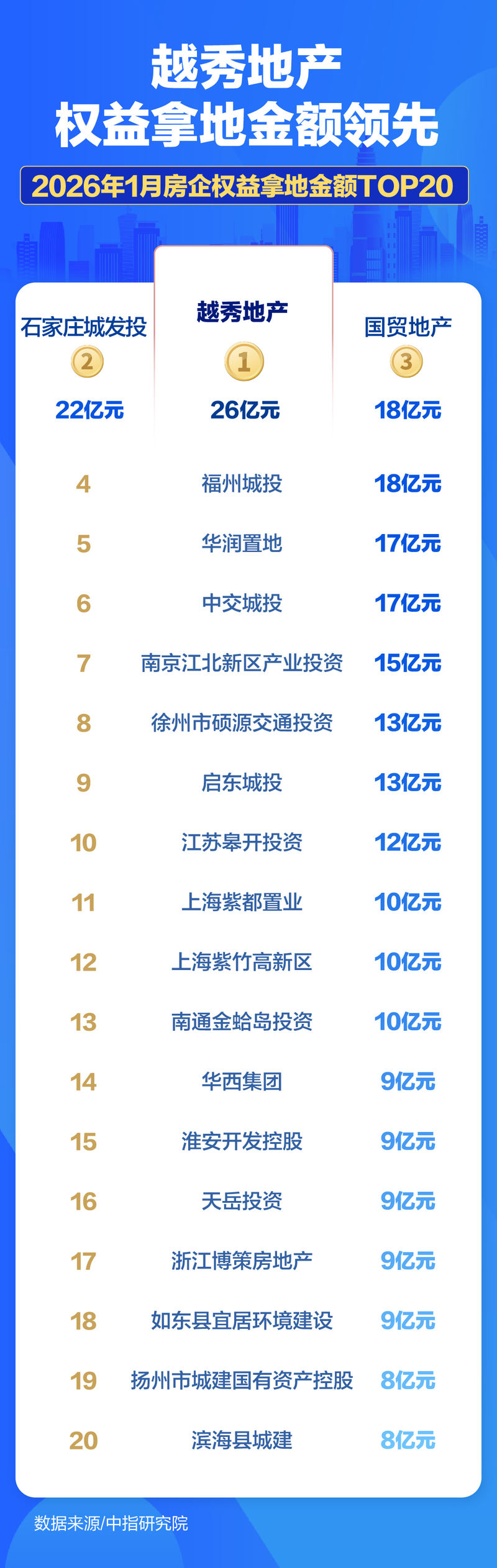
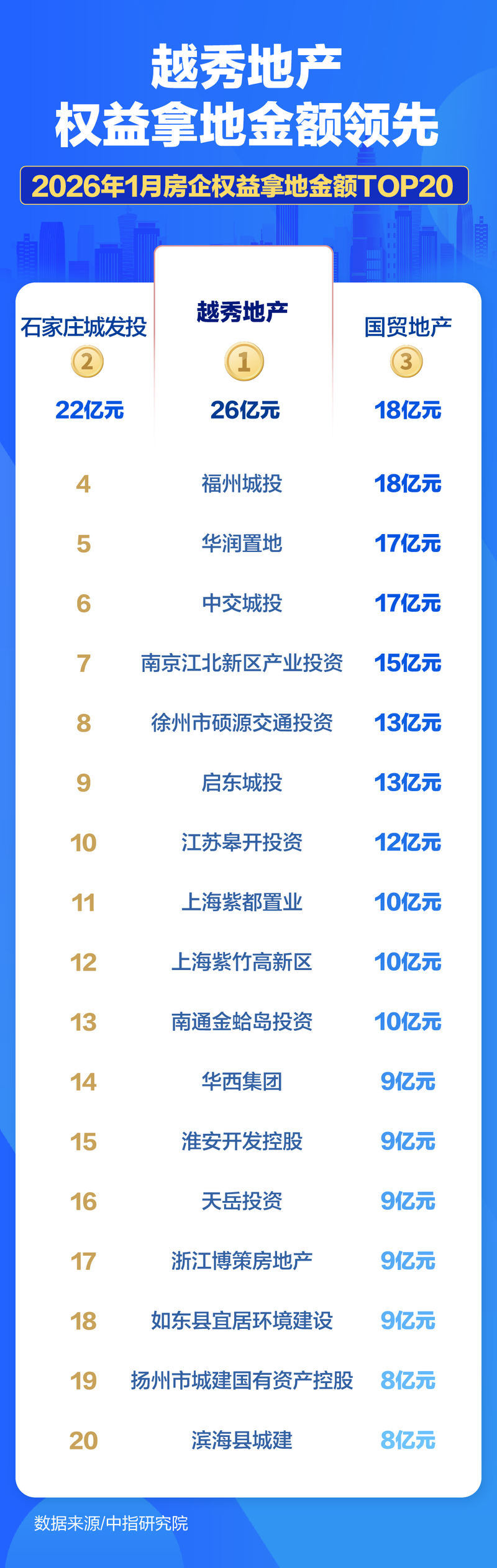
1月淡季房企拿地规模收缩 | 7 | 南京江北新区产业投资 15亿元 | | | --- | --- | --- | | 8 | 徐州市硕源交通投资 | 13亿元 | | 9 | 启东城投 | 13亿元 | | 10 | 江苏皋开投资 | 12亿元 | | 11 | 上海紫都量业 | 10亿元 | | 12 | 上海紫竹高新区 | 10亿元 | | 13 | 南通金蛤岛投资 | 10亿元 | | 14 | 华西集团 | 9亿元 | | 15 | 淮安开发控股 | 9亿元 | | 16 | 天岳投资 | 9亿元 | | 17 | 浙江博策房地产 | 9亿元 | | 18 | 如德县宣居环境建设 | 9亿元 | 据中指研究院数据,2026年1月,TOP100企业拿地总额579.9亿元,同比下降52.1%。 传统淡季下,1月份土地市场供需偏弱,百强房企拿地总额同比减半。市场呈现显著分化:一方面,整体拿地规模 收缩,仍是央企、国企拿地。此外还有包括石家庄城发投在内的地方城投拿地;另一方面,核心城市稀缺优质地 块仍受关注,为市场注入信心。 业内人士认为,随着各地供地计划推出及专项债收储闲置土地工作推进,尤其是核心城区优 ...
开年土地市场降温,越秀、石家庄城发投领跑权益拿地榜
Xin Jing Bao· 2026-02-02 13:57
传统淡季下,1月份土地市场供需偏弱,百强房企拿地总额同比减半。市场呈现显著分化:一方面,整体拿地规模 收缩,仍是央企、国企拿地。此外还有包括石家庄城发投在内的地方城投拿地;另一方面,核心城市稀缺优质地 块仍受关注,为市场注入信心。 业内人士认为,随着各地供地计划推出及专项债收储闲置土地工作推进,尤其是核心城区优质地块的出让,将推 动房企拿地热情回升。 1月淡季房企拿地规模收缩 | 7 | 南京江北新区产业投资 15亿元 | | | --- | --- | --- | | 8 | 徐州市硕源交通投资 | 13亿元 | | 9 | 启东城投 | 13亿元 | | 10 | 江苏皋开投资 | 12亿元 | | 11 | 上海紫都量业 | 10亿元 | | 12 | 上海紫竹高新区 | 10亿元 | | 13 | 南通金蛤岛投资 | 10亿元 | | 14 | 华西集团 | 9亿元 | | 15 | 淮安开发控股 | 9亿元 | | 16 | 天岳投资 | 9亿元 | | 17 | 浙江博策房地产 | 9亿元 | | 18 | 如德县宣居环境建设 | 9亿元 | 据中指研究院数据,2026年1月,TOP100企业拿地 ...
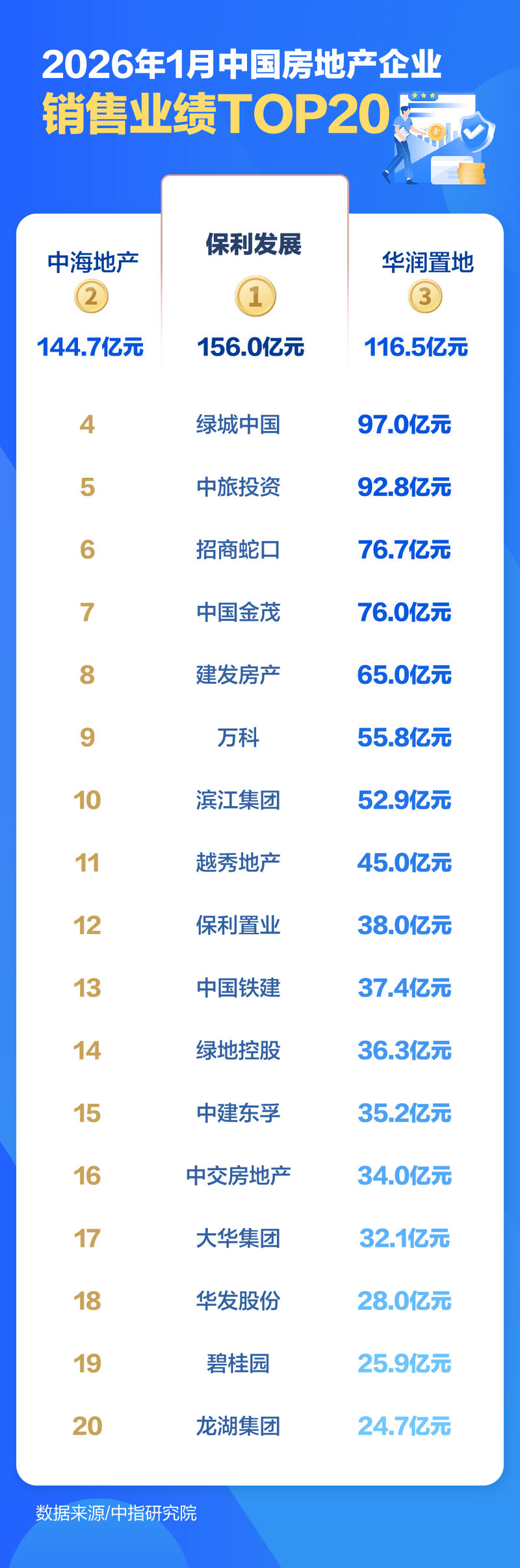
房企开年排位生变:“保中华”格局延续 最大黑马竟是它?
Xin Jing Bao· 2026-02-02 13:33
Core Viewpoint - In January 2026, the sales performance of the top 100 real estate companies in China showed a total sales amount of 190.5 billion yuan, reflecting a year-on-year decline of 18.9%, indicating a stable continuation of the downward trend observed in the previous year [5][10]. Group 1: Sales Performance - The total sales amount for the top 100 real estate companies in January 2026 was 190.5 billion yuan, which is a year-on-year decrease of 18.9%, consistent with the decline observed throughout the previous year [5][10]. - The top three companies in terms of total sales were Poly Developments (15.6 billion yuan), China Overseas Land & Investment (14.47 billion yuan), and China Resources Land (11.65 billion yuan) [5][10]. - The average sales amount for the top 10 companies was 9.33 billion yuan, down 11.6% year-on-year, while the average for companies ranked 11-30 was 2.6 billion yuan, down 25.6% [10]. Group 2: Market Dynamics - The decline in sales is attributed to a high base from January of the previous year, where core city markets were notably active [5][9]. - The new entrant, China Travel Investment, ranked 5th with a sales amount of 9.28 billion yuan, marking a significant rise from previous years [9]. - The sales performance of the top 10 companies remained relatively stable, with three companies showing year-on-year increases, while seven experienced declines [10]. Group 3: Future Outlook - Analysts expect that as the Chinese New Year approaches, real estate companies may increase marketing efforts, which could lead to a temporary boost in market activity [11]. - There is a need for coordinated policy efforts from both demand and supply sides to effectively restore market confidence [11].

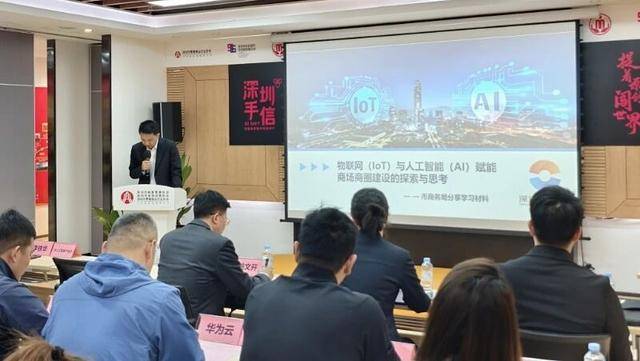
“AI+零售”提速!深圳商超与AI企业将擦出怎样的火花?
Sou Hu Cai Jing· 2026-02-02 12:55
Group 1 - The core event was a "special matchmaking meeting between retail enterprises and AI technology companies" held in Shenzhen, focusing on industry integration, application scenarios, and policy implementation [1][3] - Shenzhen aims to become a leading city in AI, with the AI industry expected to exceed 360 billion yuan by the end of 2024, and over 2,800 typical enterprises already established [3] - The "Action Plan for Accelerating the Development of the AI Terminal Industry in Shenzhen (2025-2026)" targets an AI terminal industry scale of over 800 billion yuan by 2026, with a goal of reaching 1 trillion yuan [3] Group 2 - Various companies presented practical cases demonstrating how AI can empower the retail sector, including a three-in-one smart operation model in the Houhai business district by China Resources Land [4] - Cloud Tianli focused on smart security, explaining how AI technology can enhance safety and management efficiency in commercial environments [4] - Lingzhi Digital Technology shared its self-developed AI model aimed at reconstructing the entire retail value chain [4] Group 3 - The Shenzhen Smart Retail Association emphasized the need to break down barriers between supply and demand to facilitate precise matching of AI technology with commercial scenarios [6] - The association is actively organizing resources to connect key areas, such as the Qianhai Baozhong business district, with AI technology companies to accelerate smart construction [6] - Shenzhen's government has introduced financial support policies for retail enterprises undergoing digital transformation, with project funding up to 15 million yuan and enterprise funding up to 30 million yuan [6]