晶澳科技

Search documents
电力设备及新能源行业之光伏电池设备专题报告:暗线潜影织金络,晶硅叠层启玄机
Dongguan Securities· 2025-12-29 09:34
Group 1 - The photovoltaic industry is expected to enter a new development cycle, with China's new installed capacity reaching 277.2 GW in 2024, a year-on-year increase of 27.8%, and a cumulative installed capacity of 886.7 GW by the end of 2024, reflecting a compound annual growth rate of 39.8% from 2015 to 2024 [18][19] - The penetration rate of photovoltaic power generation in China has increased from 0.4% in 2014 to 9.8% in 2024, surpassing the global average, indicating significant growth potential in the future [20][24] - The industry is currently facing "involution" competition, leading to a supply-demand imbalance and widespread losses among companies, necessitating a shift from price competition to value competition driven by technological innovation [3][28] Group 2 - Capital expenditure in the photovoltaic industry is significantly decreasing, with a 46.4% year-on-year decline in 2025, indicating a strategic shift towards focusing on advanced technologies rather than blind expansion [47][48] - The BC technology penetration rate is rapidly increasing, with market share expected to rise to 5.0% in 2024, up 4.1 percentage points from 2023, providing a differentiated and high-margin breakthrough for photovoltaic companies [67][68] - The efficiency of perovskite solar cells has reached new heights, with the potential for further industrialization and cost reduction, making them a strategic focus for the future [9][34] Group 3 - The central economic work conference has emphasized the need to deeply rectify "involution" competition, which is particularly prevalent in the photovoltaic industry, aiming to enhance quality and efficiency rather than scale [32][33] - The market is witnessing a structural adjustment, with leading companies focusing on building long-term competitive advantages through investments in next-generation technologies, such as BC and perovskite cells [48][64] - The recent procurement adjustments by China Huaneng Group for high-efficiency components, increasing the share of components with conversion efficiency of 23.8% and above to 58.3%, signal a shift towards high-quality development in the industry [71]





晶澳科技(002459) - 关于签订募集资金监管协议之补充协议的公告
2025-12-29 09:15
| 债券代码:127089 | 债券简称:晶澳转债 | | | --- | --- | --- | | 证券代码:002459 | 证券简称:晶澳科技 | 公告编号:2025-121 | 晶澳太阳能科技股份有限公司 关于签订募集资金监管协议之补充协议的公告 甲方二:义乌晶澳太阳能科技有限公司、曲靖晶澳太阳能科技有限公司(简 称"甲方二",与"甲方一"合称"甲方") 乙方:存放募集资金的商业银行(简称"乙方") 丙方:中信证券股份有限公司(简称"丙方") 本公司及董事会全体成员保证信息披露的内容真实、准确、完整,没有虚 假记载、误导性陈述或重大遗漏。 晶澳太阳能科技股份有限公司(以下简称"公司")于2025年7月22日召开 第六届董事会第四十二次会议、第六届监事会第二十三次会议,审议通过了《关 于使用部分闲置募集资金暂时补充流动资金的议案》,为提高公司募集资金使用 效率,进一步降低财务成本,同意公司在确保募集资金投资项目正常实施的前提 下,使用不超过9.30亿元的闲置募集资金暂时补充流动资金,该资金仅限于与主 营业务相关的生产经营使用,使用期限自董事会审议通过之日起不超过12个月, 到期后将及时归还到公司募集资 ...

反内卷后光伏产业链涨价-盈利修复带动光伏行情回归
2025-12-29 01:04
Summary of Key Points from Conference Call Industry Overview - The solar industry is currently experiencing a reversal of "involution," aimed at avoiding price competition and achieving reasonable profitability, which is driving a comprehensive price recovery across the industry chain [1][2] - Despite a potential temporary decline in global solar installations in 2026, multiple factors such as AI and IDC electricity demand, overseas power shortages, and domestic policy expectations may support overall demand, potentially exceeding market expectations [1][3] Core Insights and Arguments - Recent price increases in the solar sector are primarily driven by the reversal of involution, which is expected to gradually expand profitability across various segments of the industry [2] - The sixth round of power transmission and distribution bidding is progressing steadily, with a total bid amount of approximately 13 billion RMB, indicating ongoing development in ultra-high voltage distribution network renovations [3][10] - The solar industry chain's value recovery presents certain investment opportunities, with the main industry chain's price-to-book ratio currently at a low level, indicating potential for systematic value reconstruction [4] Key Companies to Watch - Recommended companies in the solar sector include Tongwei Co., GCL-Poly Energy, LONGi Green Energy, Tianhe Energy, JA Solar, JinkoSolar, Daqo New Energy, and GCL New Energy, all of which possess strong competitiveness and growth potential within the main industry chain [5] Data Center Developments - The recent release of H200 chip supply is expected to significantly drive domestic AIGC (Artificial Intelligence Generated Content) construction, supported by government policies aimed at enhancing computing power [6] - Companies such as Zhongheng Electric, Shenghong Co., Magpow and Oulu Tong are highlighted for their advantageous positions in HVDC and server power supply sectors [6] Lithium Battery Materials - The lithium battery materials segment is experiencing price recovery due to supply-demand dynamics, with advancements in solid-state battery materials and new equipment such as sulfide electrolytes and voltage devices [7] - Companies to focus on include Xiapu New Energy, Zhongyi Technology, and equipment providers like Lacnor and Xian Dao Intelligent, as well as traditional material companies like Enjie [7] Energy Storage Sector - There is a high and reasonable market expectation for future large-scale energy storage demand, particularly for AIDC (Artificial Intelligence Data Center) applications, which can enhance power supply stability and emergency response [8] - Companies such as Sungrow Power, Canadian Solar, and De Ye Co. are noted for their strong development potential in the energy storage field [8] Wind Power Industry - The wind power sector saw a 110% year-on-year increase in installations in November, benefiting from strong installation expectations as the 14th Five-Year Plan concludes [9] - Companies to watch include Goldwind Technology, Mingyang Smart Energy, and Yunda Co., with additional opportunities in overseas markets for companies like Dayin Heavy Industry and Zhenjiang Co. [9] Grid Investment Dynamics - The ongoing sixth round of power transmission and distribution bidding, with a total bid amount of approximately 13 billion RMB, indicates a steady development trajectory for ultra-high voltage distribution network renovations [10]
2025年1-10月中国太阳能电池(光伏电池)产量为68840.3万千瓦 累计增长11.6%
Chan Ye Xin Xi Wang· 2025-12-27 02:55
Core Viewpoint - The solar battery industry in China is experiencing a decline in production in October 2025, with a year-on-year decrease of 8.7%, despite a cumulative growth of 11.6% from January to October 2025 [1][1]. Group 1: Industry Overview - In October 2025, China's solar battery (photovoltaic battery) production reached 67.94 million kilowatts, marking an 8.7% decrease compared to the same month in the previous year [1]. - From January to October 2025, the cumulative production of solar batteries in China was 688.403 million kilowatts, reflecting a growth of 11.6% year-on-year [1]. Group 2: Companies Mentioned - Listed companies in the solar energy sector include Longi Green Energy (601012), Tongwei Co., Ltd. (600438), Sungrow Power Supply Co., Ltd. (300274), JA Solar Technology Co., Ltd. (002459), Trina Solar Limited (688599), TBEA Co., Ltd. (600089), Chint Electric Co., Ltd. (601877), and TCL Zhonghuan Renewable Energy Technology Co., Ltd. (002129) [1]. Group 3: Research Report - The report titled "2026-2032 China Solar Battery Industry Competition Status and Investment Decision-Making Suggestions" was published by Zhiyan Consulting, a leading industry consulting firm in China [1].





反内卷不能只靠自律,还要靠法律,这场会议给出清晰信号
Tai Mei Ti A P P· 2025-12-27 00:52
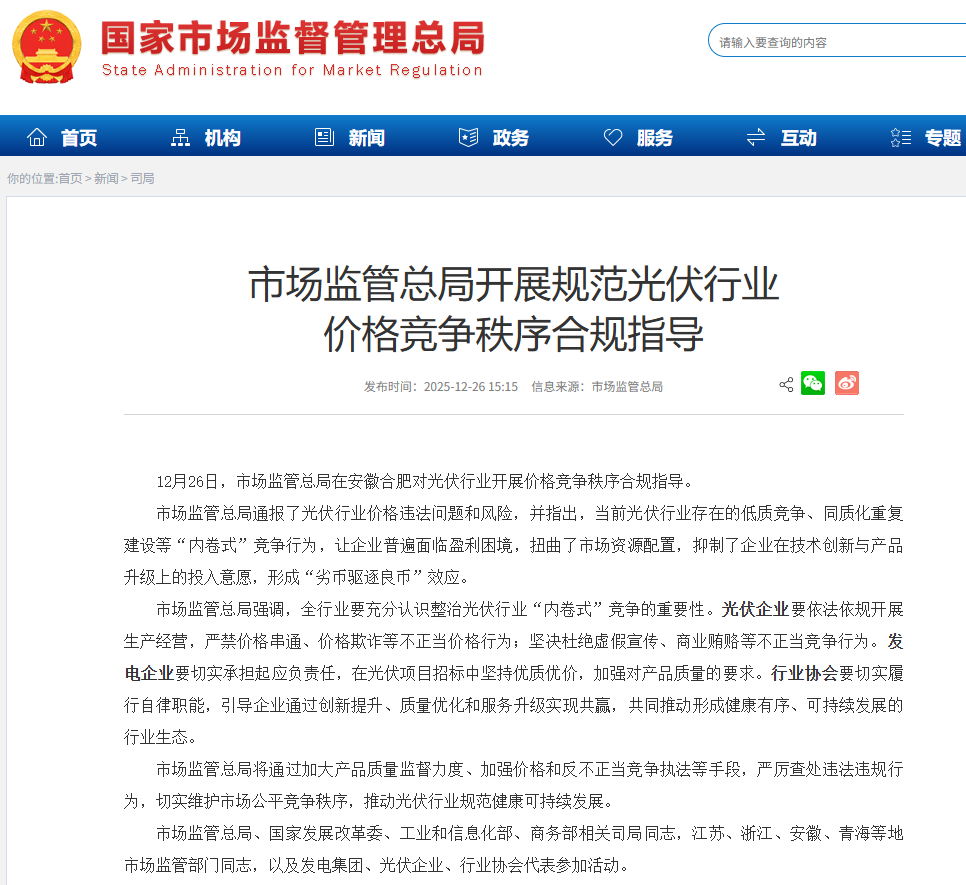
文 | 赶碳号科技 12月26日,权威媒体新华社、人民日报等均报道了光伏行业的一则重磅新闻,标题为《市场监管总局开展规范光伏行业价格竞争秩序合规指导》。正文如 下: 12月26日,市场监管总局在安徽合肥对光伏行业开展价格竞争秩序合规指导。 市场监管总局通报了光伏行业价格违法问题和风险,并指出,当前光伏行业存在的低质竞争、同质化重复建设等"内卷式"竞争行为,让企业普遍面临盈利 困境,扭曲了市场资源配置,抑制了企业在技术创新与产品升级上的投入意愿,形成"劣币驱逐良币"效应。 市场监管总局强调,全行业要充分认识整治光伏行业"内卷式"竞争的重要性。光伏企业要依法依规开展生产经营,严禁价格串通、价格欺诈等不正当价格 行为;坚决杜绝虚假宣传、商业贿赂等不正当竞争行为。发电企业要切实承担起应负责任,在光伏项目招标中坚持优质优价,加强对产品质量的要求。行 业协会要切实履行自律职能,引导企业通过创新提升、质量优化和服务升级实现共赢,共同推动形成健康有序、可持续发展的行业生态。 市场监管总局将通过加大产品质量监督力度、加强价格和反不正当竞争执法等手段,严厉查处违法违规行为,切实维护市场公平竞争秩序,推动光伏行业 规范健康可持续发 ...
【安泰科】单晶硅片周评-硅片企业集体上调报价 成交价格涨幅明显(2025年12月25日)
中国有色金属工业协会硅业分会· 2025-12-26 09:29
Core Viewpoint - The article highlights a significant increase in silicon wafer prices driven by supply contraction, demand recovery, and rising costs, with specific price changes noted for various types of silicon wafers and solar cells [1][2]. Price Changes - N-type G10L monocrystalline silicon wafer (182*183.75mm/130μm) average transaction price is 1.2 yuan/piece, up 2.56% week-on-week [1][3]. - N-type G12R monocrystalline silicon wafer (182*210mm/130μm) average transaction price is 1.31 yuan/piece, up 9.17% week-on-week [1][3]. - N-type G12 monocrystalline silicon wafer (210*210mm/130μm) average transaction price is 1.52 yuan/piece, up 1.33% week-on-week [1][3]. Market Dynamics - Supply reduction from silicon wafer manufacturers is expected to decrease production by approximately 5% in December compared to November, with companies controlling sales and showing a clear reluctance to sell at low prices [2]. - The significant rise in silver prices has led to an increase in downstream battery prices, with mainstream battery prices rising to 0.31-0.33 yuan/W, up 10.3% week-on-week [1][2]. - Despite the increase in silicon wafer prices, overall transaction volume remains limited due to cautious procurement strategies from component manufacturers and a lack of clear recovery in end-user demand [2]. Production Rates - The overall operating rate in the silicon wafer industry remains stable, with leading companies operating at rates of 50% and 48%, while integrated companies operate between 50% and 70% [2]. - If price transmission within the industry chain proceeds smoothly, the silicon wafer market is expected to continue its positive trend by the end of the month [2].
新能源发电行业2026年投资策略:反内卷大势不改,新技术推动升级
Bank of China Securities· 2025-12-26 06:19
Overview - The report maintains a "stronger than market" rating for the renewable energy sector, highlighting that the demand for offshore wind power in China and Europe is increasing, leading to a rise in foundation demand and profit recovery for wind turbines. The "anti-involution" policy is expected to continue driving the photovoltaic sector, particularly with the expansion of perovskite technology. Overall, while short-term installation demand for renewable energy globally may be weak, there are structural opportunities in the market [1]. Key Points Supporting the Rating - The "anti-involution" trend is stabilizing wind turbine prices, enhancing profitability for manufacturers. China's offshore wind projects are becoming economically viable, contributing significantly to installed capacity. The demand for offshore wind in Europe and emerging markets is also on the rise [3]. - In the photovoltaic sector, the "anti-involution" policy remains the main theme, with a focus on the potential for capacity exits in battery and module production, as well as the industrialization potential of perovskite technology. Investment should prioritize growth-oriented new technology directions and the main industry chain benefiting from the "anti-involution" trend [3]. Investment Recommendations - For wind power, the report suggests prioritizing investments in the turbine segment, which is expected to recover profitability, and in the foundation segment that is progressing quickly in Europe. The offshore wind market is projected to grow significantly, with a focus on deep-sea projects [3]. - In the photovoltaic sector, the report emphasizes the importance of monitoring the "anti-involution" policy's impact on the industry, particularly regarding the exit of inefficient capacity and the enhancement of efficiency in battery and module production [3]. Long-term Outlook for Renewable Energy Demand - The report indicates that China's renewable energy demand is expected to remain robust in the long term, with an average annual installation capacity of over 400GW projected from 2025 to 2035. This is driven by the country's energy security needs and the ongoing transition to a low-carbon economy [13][16]. - The "136 Document" is noted for guiding the development of renewable energy projects towards market-oriented pricing, which is expected to stabilize project returns and promote high-quality development in the sector [31]. Photovoltaic Sector Insights - The report anticipates a moderate decline in photovoltaic installations in 2026 due to a phase of pre-installation in 2025, with projected installations of 290GW in 2025 and 180GW in 2026, reflecting a year-on-year decrease of 38% [33]. - The report highlights that the European photovoltaic market is facing growth challenges, with a forecasted installation of 64.2GW in 2025, indicating a slight decline. The U.S. market is also expected to experience pressure on growth due to policy adjustments [34][37]. Perovskite Technology Potential - Perovskite technology is identified as a key area for enhancing competitiveness in the photovoltaic manufacturing sector, with expectations for significant breakthroughs in industrialization by leading manufacturers in 2026 [33][44].


中银证券:产业链涨价成趋势 终端开始接受高价组件
智通财经网· 2025-12-26 03:36
Group 1 - The core viewpoint of the report is that the photovoltaic industry is undergoing a "de-involution" process, characterized by two main routes: orderly exit of backward production capacity and stable continuation of new quality capacity [1][3] - Central state-owned enterprises are actively responding to the price increase of photovoltaic components, with a trend of rising bidding prices observed [2][3] - The industry is seeing a positive change in the price of components, with leading companies raising their component quotes and a strong willingness to maintain prices in the intermediate links of the supply chain [4] Group 2 - The "de-involution" strategy is a key focus for the photovoltaic industry, aiming to stabilize product prices and eliminate unhealthy competition [3] - Specific measures proposed by the government include promoting the orderly exit of backward capacity, curbing low-price competition, ensuring product quality, and supporting industry self-discipline [2][3] - Investment recommendations include companies such as Junda Co., Trina Solar, JA Solar, JinkoSolar, and LONGi Green Energy, with a focus on the potential for profit improvement in battery and component sectors [4]

光伏行业动态点评:产业链涨价成趋势,终端开始接受高价组件
Bank of China Securities· 2025-12-26 02:57
电力设备 | 证券研究报告 — 行业点评 2025 年 12 月 26 日 强于大市 光伏行业动态点评 产业链涨价成趋势,终端开始接受高价组件 光伏'反内卷'分为两条具体路线,'推动落后产能有序退出'、'新增优 质产能平稳接续'正在稳步推进中,表观层面产业链积极挺价,央国企也已 积极响应,看好高效电池组件溢价;维持行业 强于大市 评级。 支撑评级的要点 《电力设备与新能源行业 12 月第 4 周周报》 20251221 中银国际证券股份有限公司 具备证券投资咨询业务资格 电力设备 证券分析师:武佳雄 jiaxiong.wu@bocichina.com 证券投资咨询业务证书编号:S1300523070001 证券分析师:顾真 投资建议 光伏'反内卷'稳步推进,'推动落后产能有序退出'、'新增优质产 能平稳接续'正在进行中,表观层面产业链积极挺价,央国企也已积极 响应,看好高效电池组件溢价。推荐钧达股份、天合光能、晶澳科技、 晶科能源、隆基绿能,建议关注通威股份、协鑫科技、大全能源、双良 节能、弘元绿能。 评级面临的主要风险 原材料价格出现不利波动;国际贸易摩擦风险;新技术进展不达预期; 新能源政策风险;消纳风险 ...
研判2025!中国光伏检测设备行业相关政策、发展现状、企业分析及未来前景展望:光伏产业供过于求,导致行业内企业业绩短期承压[图]
Chan Ye Xin Xi Wang· 2025-12-26 01:17
Core Viewpoint - The photovoltaic testing equipment industry is experiencing rapid growth driven by the expansion of photovoltaic cell and module production capacity, leading to increased demand for testing equipment and higher quality standards in production processes [1][3][6]. Industry Overview - Photovoltaic testing equipment is essential for assessing the performance, quality, safety, and reliability of photovoltaic components and systems, playing a crucial role in the development of the photovoltaic industry [3][4]. - The market size of China's photovoltaic testing equipment industry is projected to reach 2.101 billion yuan in 2024, representing a year-on-year increase of 4.9% [1][7]. Industry Policies - Recent government policies have been implemented to promote the development of the photovoltaic industry, including guidelines for updating and replacing equipment to improve efficiency standards [4][6]. - The 2024-2025 energy conservation and carbon reduction action plan emphasizes the construction of large-scale photovoltaic bases in desert areas, which will further drive the demand for testing equipment [4][6]. Market Dynamics - The cumulative installed capacity of photovoltaic systems in China increased from 204.2 GW in 2019 to 886.66 GW in 2024, with new installations rising from 30.1 GW to 277.17 GW during the same period [6]. - The rapid growth in installed capacity is expected to lead to increased demand for testing equipment to ensure quality control and operational efficiency [6][10]. Competitive Landscape - The photovoltaic testing equipment market is dominated by a few large manufacturers from Europe, the United States, and Japan, while domestic companies in China are rapidly improving their technology and quality [8][9]. - Key players in the Chinese market include Shanghai Optoelectronics Technology Co., Ltd., Shenzhen Huashengchang Technology Co., Ltd., and others, with varying performance and revenue trends [8][9]. Development Trends - The industry is moving towards greater automation and intelligence in testing processes, integrating visual defect detection systems to enhance production efficiency and reduce labor costs [10][11]. - As the focus shifts from quantity to quality, there is an increasing demand for high-performance testing equipment, prompting continuous technological innovation within the industry [11]. - Global expansion is accelerating, with Chinese companies establishing production bases in Southeast Asia and the Middle East to meet international market demands and comply with global testing standards [12].