翰宇药业

Search documents
最高涨超100倍!A股八大热门赛道业绩“增长王”出炉
Zhong Guo Zheng Quan Bao· 2025-08-31 00:51
Core Insights - A-share listed companies have reported significant profit growth in various sectors, with a total of 5,424 companies disclosing their semi-annual reports, showcasing strong performance in industries such as comprehensive services, agriculture, steel, and technology [1] Sector Summaries Ground Equipment Sector - The ground equipment segment has seen a remarkable increase of 107.85% this year, with 9 out of 15 companies reporting a year-on-year profit growth. Notably, Nairui Radar achieved a staggering profit increase of 866.97% [2] PCB Sector - The PCB sector has risen by 93.12% this year, with 73 out of 112 companies reporting profit growth. Honghe Technology led the sector with a profit increase of 10,587.74%. The demand for PCBs is driven by a growing need for computing power, with global server sales projected to reach $95.2 billion in Q1 2025, a 134.1% year-on-year increase [3] CPO Sector - The CPO sector has increased by 79.05%, with significant profit growth from leading companies. Shijia Photon reported a profit increase of 1,712%, while Xinyi Sheng saw a 355.68% increase. Analysts expect CPO technology to gain traction between 2026 and 2027 [4][5] AI Chip Sector - The AI chip sector has grown by 62.62%, with 22 out of 35 companies reporting profit growth. Yuboxun achieved a profit increase of 1,455.37%. The demand for AI computing power is expected to further expand, with new technologies enhancing chip performance [6] Rare Earth Permanent Magnet Sector - The rare earth permanent magnet sector has increased by 62.12%, with 41 out of 58 companies reporting profit growth. Huahong Technology led with a profit increase of 3,480.57%. The sector is benefiting from rising prices and sustained demand [7] Humanoid Robot Sector - The humanoid robot sector has seen a 54.30% increase, with 107 out of 163 companies reporting profit growth. Tianyu Digital achieved a profit increase of 453.67%. The industry is experiencing rapid development, with major companies investing in intelligent robotics [8] Liquid Cooling Sector - The liquid cooling sector has risen by 49.94%, with 77 out of 106 companies reporting profit growth. Gaolan Co. reported a profit increase of 1,438.57%. The market is undergoing a revaluation as liquid cooling technology expands into various applications [9] Innovative Drug Sector - The innovative drug sector has increased by 44.05%, with 71 out of 145 companies reporting profit growth. Hanyu Pharmaceutical achieved a profit increase of 1,504.3%. The sector is expected to transition from capital-driven to profit-driven growth by 2025 [10]
医药“暖春”悬而未决:临床需求与市场周期博弈之解在哪?
2 1 Shi Ji Jing Ji Bao Dao· 2025-08-30 07:44
Core Viewpoint - The pharmaceutical industry, particularly biotech companies, is expected to experience a significant market upturn from late 2024 to mid-2025, supported by global market growth and strong performance in the Chinese pharmaceutical market [1][3]. Market Trends - The rapid growth of BD (business development) activities, the reopening of the Sci-Tech Innovation Board, and the performance of Hong Kong's secondary market indicate that the industry is entering a valuation recovery phase [1]. - Despite some biotech companies experiencing substantial stock price increases, many investors have not yet recouped their costs due to the timing of investments [1][2]. Investment Landscape - High-quality companies that address clinical needs are more likely to survive market downturns, while many biotech firms have failed to navigate the recent market challenges [2]. - The current secondary market appears prosperous, but from the perspective of primary market entrepreneurs, it is still in a winter phase [2]. Challenges and Opportunities - The difficulty of listing biotech companies in both China and the U.S. has led to diversified financing channels, with investors focusing on asset quality and clinical research data [3]. - The demand for high-quality, cost-effective products is increasing due to global aging populations and limited healthcare funding [4]. Global Positioning - Chinese innovators have significantly narrowed the development gap with the U.S., with a reported 38% year-on-year increase in overseas licensing deals, totaling $60.8 billion in the first half of 2025 [5][6]. - The shift from generic to original drug development in China is expected to have a profound impact on the global pharmaceutical market [6]. R&D Efficiency - China leads globally in R&D efficiency from "1 to 10," while the U.S. remains dominant in "0 to 1" development [6]. - The ability to produce unique products, particularly in ADC (antibody-drug conjugates), is attributed to China's strong engineering capabilities [9]. Future Growth Areas - The most promising research areas for capital investment are in immunology and metabolic/cardiovascular fields [7]. - The market is witnessing a divide, with leading companies leveraging innovation and digital empowerment, while smaller firms face greater pressure due to homogenized competition [6][10]. Strategic Directions - Companies are encouraged to explore new financing models, such as RWA (Real World Asset) tokenization, to better access markets [11]. - The focus on license-out opportunities and the promotion of inclusive healthcare are critical strategies for pharmaceutical companies [12].

减肥药概念涨1.80%,主力资金净流入27股
Zheng Quan Shi Bao Wang· 2025-08-29 12:50
Group 1 - The weight loss drug concept sector increased by 1.80%, ranking 6th among concept sectors, with 33 stocks rising, including Puris with a 20% limit up, and Haoyuan Pharmaceutical, Medisi, and Xinnowei with increases of 13.70%, 8.96%, and 7.30% respectively [1][2] - The leading stocks in terms of net inflow of main funds in the weight loss drug sector included Heng Rui Pharmaceutical with a net inflow of 5.35 billion yuan, followed by Hanyu Pharmaceutical, Fosun Pharmaceutical, and Kailai Ying with net inflows of 819.35 million yuan, 618.34 million yuan, and 589.18 million yuan respectively [2][3] Group 2 - The main fund inflow ratios for stocks in the weight loss drug sector were led by Puris at 21.03%, followed by Nawei Technology at 11.85% and Sunshine Nuohe at 8.90% [3][4] - The stocks with significant daily trading volume and net inflow ratios included Heng Rui Pharmaceutical with a daily increase of 5.08% and a turnover rate of 1.60%, and Hanyu Pharmaceutical with a daily increase of 3.34% and a turnover rate of 13.37% [3][4] Group 3 - The weight loss drug sector saw a total net inflow of 5.52 billion yuan, with 27 stocks experiencing net inflows, and 6 stocks receiving over 500 million yuan in net inflows [2][3] - The stocks that experienced the largest declines included Dezhan Health, *ST Sansheng, and Borui Pharmaceutical, with decreases of 1.81%, 1.74%, and 1.60% respectively [1][6]

本土创新药企全球化之路突围,投资人关注这些重点
第一财经· 2025-08-29 11:21
Core Viewpoint - The article discusses the necessary steps for Chinese innovative pharmaceutical companies to evolve into multinational corporations (MNCs) in the global market, emphasizing the importance of R&D speed, differentiation advantages, and the overall quality of scientists involved in the process [3][5]. Summary by Sections Current Landscape of Innovative Drugs in China - In the first half of 2025, China saw over 50 transactions related to innovative drugs, with upfront payments for license-out deals totaling $3.3 billion and total transaction amounts reaching $48.484 billion [4]. - The National Medical Products Administration approved 43 innovative drugs in the first half of 2025, marking a 59% year-on-year increase, nearing the total of 48 for the entire year of 2024 [4]. - China's innovative drug R&D pipeline accounts for approximately 25% of the global total, with around 3,000 clinical trials conducted annually, placing it among the world leaders [4]. Key Elements for Competing Globally - R&D speed is identified as a core element for the development of Chinese innovative drug companies, especially in the AI era, where scientific advancements occur rapidly [5]. - Ensuring the authenticity of R&D data is crucial, as issues with data integrity have led to disputes in some international ventures [5]. - Investment logic is clearer in areas such as immunology, metabolism, cardiovascular diseases, and Alzheimer's disease, where the potential for drug development is promising [5]. Investment Perspectives - From an acquisition standpoint, the development prospects of innovative drug projects can be assessed based on their market segment and lifecycle stage, with a preference for projects in the growth phase [6]. - Differentiation advantages and R&D efficiency are critical; drugs that can demonstrate unique clinical value and maintain a leading development pace are more likely to succeed [6]. Pathways to Becoming MNCs - Chinese innovative drug companies can leverage their experiences in the domestic healthcare system to expand into Southeast Asia and Africa, where population growth is expected [9]. - The concept of Real World Asset (RWA) tokenization is emerging as a new avenue for companies to participate in capital markets, exemplified by recent projects like the one by Hanyu Pharmaceutical [9]. - The valuation of innovative drug companies in overseas licensing deals is currently based on net assets, indicating potential for significant premium in areas like scientific teams and market size [9]. Strategies for Global Market Entry - Companies should adopt a product-centric approach to penetrate each country's market, which includes building local talent teams and manufacturing facilities [10]. - Establishing a robust sales network and understanding local regulations are essential for successful market entry [10]. - The example of BeiGene illustrates the lengthy process of global market integration, highlighting the need for careful assessment of time and financial investments required for such expansions [10].


本土创新药企全球化之路突围 投资人关注这些重点
Di Yi Cai Jing· 2025-08-29 10:29
Core Viewpoint - The article discusses the necessary steps for Chinese innovative pharmaceutical companies to evolve into multinational corporations (MNCs) in the global market, emphasizing the importance of research speed, differentiation advantages, and the overall quality of scientists [1][2]. Group 1: Market Performance and Trends - In the first half of 2025, China saw over 50 transactions related to innovative drugs, with upfront payments for license-out deals totaling $3.3 billion and total transaction amounts reaching $48.484 billion [2]. - The National Medical Products Administration reported that 43 innovative drugs were approved in the first half of 2025, marking a 59% year-on-year increase, nearing the total of 48 for the entire year of 2024 [2]. - China's innovative drug R&D pipeline accounts for approximately 25% of the global total, with around 3,000 clinical trials conducted annually, placing it among the world leaders [2]. Group 2: Key Factors for Success - The Chief Scientist of Shanghai Pharmaceuticals, Cai Xuejun, highlighted that in the AI era, research speed is crucial for the development of Chinese innovative drug companies, along with ensuring the authenticity of research data [2][3]. - Investment logic is clearer in areas such as immunity, metabolism, cardiovascular diseases, and Alzheimer's disease, with a focus on the potential for drug development and returns [3]. - Companies must enhance their unique core competencies and align their research with clinical needs while being willing to abandon less promising projects [3]. Group 3: Investment Considerations - Baiyang Pharmaceutical Group's VP of Research Management, Li Lihua, emphasized evaluating innovative drug projects based on their market segment, lifecycle, differentiation advantages, and R&D efficiency [4]. - Projects in emerging segments with no established products carry higher risks, while those in growth phases, like Alzheimer's disease, are more favorable for investment [4]. Group 4: Pathways to Becoming MNCs - Data indicates that by 2024, the number of innovative drugs under development in China will reach 3,575, positioning the country as a global leader [5]. - The CEO of Sullivan Jieli Trading Bao, Wan Yong, noted that Chinese companies can leverage their experiences in universal healthcare systems to expand into Southeast Asia and Africa, where population growth is expected [6]. - The concept of Real World Asset (RWA) tokenization is emerging as a new avenue for pharmaceutical companies to participate in capital markets, exemplified by Hanyu Pharmaceutical's recent project [6]. Group 5: Strategies for Global Expansion - To become true MNCs, pharmaceutical companies should adopt a product-driven approach to enter each country's market, establishing local teams and adapting to local regulations [7]. - Building a local sales network and ensuring drug registration and marketing are essential for success in foreign markets [7]. - The example of BeiGene, which has achieved drug sales in the U.S. and Europe, illustrates the lengthy process of global market entry, which can exceed five years [7].
本土创新药企全球化之路突围,投资人关注这些重点
Di Yi Cai Jing· 2025-08-29 09:49
Core Insights - The key factors for Chinese innovative pharmaceutical companies to stand out in the global competition include research and development speed, differentiation advantages, and the overall quality of scientists [1][3]. Group 1: Market Trends - In the first half of 2025, the number of transactions related to innovative drugs in China exceeded 50, with disclosed upfront payments for license-out transactions totaling $3.3 billion and total transaction amounts reaching $48.484 billion [2]. - The National Medical Products Administration reported that 43 innovative drugs were approved in the first half of 2025, a 59% year-on-year increase, nearing the total of 48 for the entire year of 2024 [2]. - China's innovative drug research pipeline accounts for approximately 25% of the global total, with around 3,000 clinical trials conducted annually, placing it among the world's leaders [2]. Group 2: Key Elements for Success - The speed of research and development is crucial in the AI era, and ensuring the authenticity of research data is also vital, as some companies have faced disputes due to data issues during international expansion [3]. - Investment logic is clearer in areas such as immunology, metabolism, cardiovascular diseases, and Alzheimer's disease, where the potential for drug development is promising [3]. - Companies must enhance their unique core competencies while understanding clinical needs and being willing to abandon less promising projects during the R&D phase [3]. Group 3: Investment Considerations - From an acquisition perspective, the lifecycle and maturity of the drug's market segment are critical; investors prefer projects in the growth phase with established breakthroughs [4]. - Differentiation in clinical value is essential for drugs that aim to enter international markets, and the efficiency of R&D can significantly impact a drug's competitive position [4]. Group 4: Global Expansion Strategies - By 2024, the number of innovative drugs under development in China reached 3,575, making it a global leader [5]. - The cumulative increase of the Hang Seng Biotechnology Index has reached 90.66% this year, significantly outperforming the Nasdaq Biotechnology Index [5]. Group 5: Practical Pathways for Companies - Chinese innovative pharmaceutical companies can leverage their experiences in universal healthcare systems to expand into Southeast Asia and Africa, where population growth is expected [6]. - The concept of "real-world asset" (RWA) tokenization is emerging as a new option for companies to participate in capital markets by packaging their drug-related rights [6]. Group 6: Transitioning to Multinational Corporations (MNCs) - The current overseas business development pricing for domestic innovative drugs is based on net asset valuation, indicating potential for significant premium in areas like scientific teams and market size [7]. - To become true MNCs, companies should establish local teams and manufacturing facilities while adapting to local regulations and building sales networks [7]. - The example of BeiGene illustrates the lengthy process of global market entry, emphasizing the need for careful assessment of time and financial investments required for international expansion [7].

78.92亿元资金今日流出医药生物股
Zheng Quan Shi Bao Wang· 2025-08-28 14:05
Market Overview - The Shanghai Composite Index rose by 1.14% on August 28, with 22 out of 28 sectors experiencing gains, led by the communication and electronics sectors, which increased by 7.14% and 5.53% respectively [1] - Conversely, the coal and agriculture sectors saw declines of 0.81% and 0.73% respectively, while the pharmaceutical and biotechnology sector fell by 0.20% [1] Capital Flow Analysis - The main capital outflow from the two markets totaled 44.343 billion yuan, with five sectors experiencing net inflows. The electronics sector led with a net inflow of 10.553 billion yuan, followed by the communication sector with 4.998 billion yuan [1] - In contrast, 26 sectors faced net capital outflows, with the computer sector experiencing the largest outflow of 11.007 billion yuan, followed by the pharmaceutical and biotechnology sector with an outflow of 7.892 billion yuan [1] Pharmaceutical and Biotechnology Sector Performance - The pharmaceutical and biotechnology sector had a net outflow of 7.892 billion yuan, with 474 stocks in the sector. Out of these, 121 stocks rose, including 2 that hit the daily limit, while 346 stocks declined [2] - Notably, the top three stocks with the highest net inflow were Tibet Pharmaceutical with 320 million yuan, followed by Furuide with 293 million yuan, and Jimin Health with 126 million yuan [2] - The sector's outflow was dominated by WuXi AppTec, which saw a net outflow of 596 million yuan, followed by Borui Pharmaceutical and Hanyu Pharmaceutical with outflows of 548 million yuan and 339 million yuan respectively [3]


猴痘概念下跌0.91%,7股主力资金净流出超5000万元
Zheng Quan Shi Bao Wang· 2025-08-28 13:50
Group 1 - The monkeypox concept sector declined by 0.91%, ranking among the top declines in concept sectors, with leading decliners including Aladdin, Tsinghua Tongfang, and Hongyuan Pharmaceutical [1] - Among the 61 stocks in the monkeypox concept sector, 17 stocks saw price increases, with Kangchen Pharmaceutical, Botao Bio, and Yipin Hong leading the gains at 3.17%, 2.18%, and 1.82% respectively [1] - The monkeypox concept sector experienced a net outflow of 1.397 billion yuan from main funds today, with Han Yu Pharmaceutical seeing the largest outflow of 339 million yuan [2][3] Group 2 - The top gainers in the monkeypox concept sector included Kangchen Pharmaceutical, Jihigh Development, and Lepu Medical, with net inflows of 27.1 million yuan, 17.6 million yuan, and 12.5 million yuan respectively [4] - The stocks with the largest net outflows in the monkeypox concept sector included Han Yu Pharmaceutical, Zhongsheng Pharmaceutical, and Weixin Bio, with outflows of 339 million yuan, 114 million yuan, and 99.5 million yuan respectively [2][3] - The overall performance of the monkeypox concept sector reflects a challenging market environment, with significant capital outflows impacting stock prices [2][4]



【26日资金路线图】两市主力资金净流出超450亿元 基础化工等行业实现净流入
Zheng Quan Shi Bao· 2025-08-26 15:44
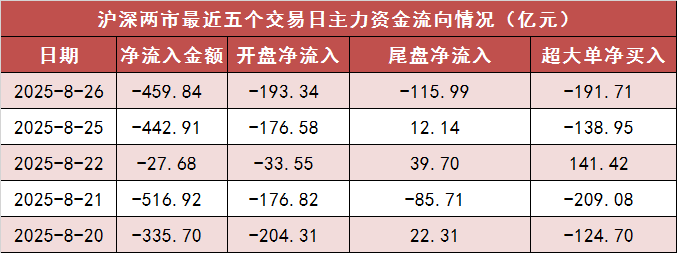
Market Overview - The A-share market experienced an overall decline on August 26, with the Shanghai Composite Index closing at 3868.38 points, down 0.39%, while the Shenzhen Component Index rose 0.26% to 12473.17 points, and the ChiNext Index fell 0.76% to 2742.13 points. The total trading volume for both markets was 26,790.2 billion yuan, a decrease of 4,621.17 billion yuan from the previous trading day [1]. Capital Flow - The net outflow of main funds from the Shanghai and Shenzhen markets exceeded 450 billion yuan, with an opening net outflow of 193.34 billion yuan and a closing net outflow of 115.99 billion yuan, totaling 459.84 billion yuan for the day [2]. - The CSI 300 index saw a net outflow of 116.17 billion yuan, while the ChiNext index experienced a net outflow of 285.79 billion yuan [2][4]. Sector Performance - The basic chemical industry recorded a net inflow of 30.35 billion yuan, with a growth of 0.66%, driven by companies like Wanhua Chemical. The agriculture, forestry, animal husbandry, and fishery sector saw a net inflow of 21.45 billion yuan, increasing by 1.28%, led by Muyuan Foods [5]. - Conversely, the pharmaceutical and biological sector faced a significant net outflow of 172.04 billion yuan, declining by 0.78%, with Hanyu Pharmaceutical being a notable contributor to this outflow. The defense and military industry also saw a net outflow of 119.31 billion yuan, down 0.95% [5]. Institutional Activity - The top stocks with net institutional purchases included GoerTek, which rose by 10.01% with a net buy of 99.57 million yuan, and Zhongyou Capital, which fell by 7.06% but still saw a net buy of 95.35 million yuan. Other notable mentions include Hongjing Technology and Chengfei Integration, with net buys of 84.68 million yuan and 81.55 million yuan, respectively [8].
【26日资金路线图】两市主力资金净流出超450亿元 基础化工等行业实现净流入
证券时报· 2025-08-26 12:47
Market Overview - The A-share market experienced an overall decline on August 26, with the Shanghai Composite Index closing at 3868.38 points, down 0.39%, while the Shenzhen Component Index rose 0.26% to 12473.17 points, and the ChiNext Index fell 0.76% to 2742.13 points. The total trading volume across both markets was 26,790.2 billion yuan, a decrease of 4,621.17 billion yuan from the previous trading day [1]. Capital Flow - The net outflow of main funds from the two markets exceeded 450 billion yuan, with a total net outflow of 459.84 billion yuan for the day. The opening net outflow was 193.34 billion yuan, and the closing net outflow was 115.99 billion yuan [2]. - The CSI 300 index saw a net outflow of 116.17 billion yuan, while the ChiNext index experienced a net outflow of 285.79 billion yuan [2]. Sector Performance - The basic chemical industry saw a net inflow of 30.35 billion yuan, with a growth of 0.66%, driven by companies like Wanhua Chemical. The agriculture, forestry, animal husbandry, and fishery sector had a net inflow of 21.45 billion yuan, increasing by 1.28%, led by Muyuan Foods [4]. - Conversely, the pharmaceutical and biological sector faced a significant net outflow of 172.04 billion yuan, declining by 0.78%, with companies like Hanyu Pharmaceutical being major contributors to this outflow. The defense and military industry also saw a net outflow of 119.31 billion yuan, down 0.95% [4]. Institutional Activity - Notable institutional buying included companies such as GoerTek, which saw a net purchase of 99.57 million yuan, and Zhongyou Capital, which had a net purchase of 95.35 million yuan. Other significant net purchases were made in Hongjing Technology and Chengfei Integration [7]. - On the other hand, companies like Lio Group and China Rare Earth experienced substantial net selling, with outflows of 38,045.40 million yuan and 12,138.91 million yuan, respectively [7]. Stock Ratings - Companies such as Junsheng Electronics and AVIC Shenyang Aircraft Company received positive ratings from various institutions, with target price increases of 16.52% and 29.52%, respectively [8].