
浦发银行

Search documents
并购贷款新规落地满月:银行战略棋局浮出水面
Zhong Guo Zheng Quan Bao· 2026-02-04 20:29
Core Insights - The implementation of the new regulations for merger and acquisition (M&A) loans has prompted banks to actively expand their M&A loan business, aiming to establish competitive advantages through early entry into the market [1][2] - The new regulations have broadened the scope of M&A loans, allowing for equity acquisitions and optimizing loan conditions, which is expected to enhance banks' asset yield [2][3] Group 1: Market Dynamics - Several banks, including Industrial and Commercial Bank of China (ICBC), China Construction Bank, and Shanghai Pudong Development Bank, have entered the M&A loan market since the new regulations were introduced on December 31, 2025, initiating a "first deal competition" [1][2] - Beijing Bank successfully executed the first M&A loan under the new regulations, providing 21 million yuan to support a private technology company's acquisition of a 35% stake in another firm, with a financing ratio of 60% and a three-year term [1] Group 2: Regulatory Changes - The new M&A loan regulations have evolved from strict to more flexible frameworks, introducing three key changes: expanding the applicable scope of M&A loans, optimizing loan conditions, and setting differentiated qualification requirements for banks [2][4] - The regulations allow for a higher proportion of control-type M&A loans in relation to the total transaction value and extend the maximum loan term [2] Group 3: Strategic Importance - M&A loans are increasingly recognized for their potential to enhance banks' asset yields, especially in the context of narrowing interest margins and sluggish growth in traditional lending [3] - The M&A loan business is characterized by strong customer loyalty, high comprehensive returns, and significant barriers to entry, making it a strategic focus for banks aiming to differentiate themselves in a competitive landscape [3] Group 4: Challenges and Opportunities - Despite the growth potential, the complexity and specialization required for M&A loans present challenges for banks, which must navigate multiple stakeholders and legal relationships [4] - Banks are encouraged to develop a comprehensive ecosystem that includes M&A facilitation, financing, and post-investment management to effectively compete in the M&A finance sector [4]





易方达创业板成长交易型开放式指数证券投资基金发起式联接基金基金经理变更公告
Shang Hai Zheng Quan Bao· 2026-02-04 19:10
Group 1 - The announcement date for the change of fund manager for the E Fund ChiNext Growth ETF is February 5, 2026 [1] - Liu Wenkuai continues to serve as the fund manager at E Fund Management Co., Ltd [1] - The fund is referred to as "ChiNext Growth ETF E Fund" in the market [1] Group 2 - E Fund Management Co., Ltd participated in the offline subscription for the initial public offering of China Electronics Technology Blue Sky Technology Co., Ltd [2] - The offering price for China Electronics Technology Blue Sky is set at 9.47 yuan per share [2] - The joint lead underwriter for this issuance is Guotai Junan Securities Co., Ltd, which is also the custodian for some of E Fund's public funds [2]

华夏基金管理有限公司关于华夏中证全指食品交易型开放式指数证券投资基金流动性服务商的公告
Shang Hai Zheng Quan Bao· 2026-02-04 19:10
根据《公开募集证券投资基金运作管理办法》《公开募集证券投资基金信息披露管理办法》及相关法律 法规、各基金基金合同及招募说明书等规定,在履行规定审批程序并经基金托管人同意后,华夏基金管 理有限公司(以下简称"本公司")旗下部分公募基金参与了中电科蓝天科技股份有限公司(以下简 称"电科蓝天")首次公开发行人民币普通股(A股)的申购。电科蓝天本次发行的保荐人(联席主承销 商)中信建投证券股份有限公司(以下简称"中信建投证券")为本公司旗下部分公募基金的托管人,联 席主承销商国泰海通证券股份有限公司(以下简称"国泰海通证券")为本公司旗下部分公募基金的托管 人以及部分公募基金托管人上海浦东发展银行股份有限公司(以下简称"浦发银行")、国信证券股份有 限公司(以下简称"国信证券")的重大关联方。电科蓝天本次发行价格为人民币9.47元/股,由发行人与 联席主承销商根据网下发行询价报价情况,综合评估公司合理投资价值、可比公司二级市场估值水平、 所属行业二级市场估值水平等方面,充分考虑网下投资者有效申购倍数、市场情况、募集资金需求及承 销风险等因素协商确定。本公司旗下中信建投证券、国泰海通证券、浦发银行、国信证券托管的公募基 ...

业务增长新风口!银行拓展并购贷款业务
Zhong Guo Zheng Quan Bao - Zhong Zheng Wang· 2026-02-04 15:49
Core Insights - The implementation of the "Commercial Bank M&A Loan Management Measures" has created new growth opportunities for commercial banks, with several banks actively expanding their M&A loan business to build competitive advantages through case accumulation and brand development [1][4] Group 1: Regulatory Changes and Market Response - The new M&A loan regulations allow for a broader application of loans, including support for equity-based mergers, which is expected to facilitate resource optimization and transformation for traditional industries [1][4] - Banks like Shanghai Pudong Development Bank view the new regulations as a chance to enhance service capabilities and expand their service boundaries, leading to a multi-faceted growth in M&A loan business across various branches [2][3] Group 2: Initial Successes and Competitive Landscape - Since the introduction of the new regulations, banks have begun a "first deal competition," with Beijing Bank successfully providing a loan of 21 million yuan for a 35% equity stake in a private listed technology company, marking one of the first innovative practices under the new guidelines [3] - Industrial and Commercial Bank of China issued a 299 million yuan loan to support a company's acquisition of core assets, representing the first control-type M&A loan after the new regulations came into effect [3] Group 3: Growth Potential and Profitability - The M&A loan business has seen a compound annual growth rate of nearly 30% among leading banks, indicating a growing recognition of the financial value of M&A loans as a means to enhance intermediate business and overall revenue amid narrowing interest margins [4][5] - The new regulations are expected to release significant market potential, particularly in key national strategic areas such as technological innovation and manufacturing upgrades, allowing banks to rapidly scale their business [5] Group 4: Challenges and Strategic Shifts - Despite the growth potential, the complexity and specialization of M&A loans present challenges for commercial banks, necessitating a shift from being mere credit providers to offering comprehensive financial services that include financing, advisory, and post-transaction management [6][7] - Banks are encouraged to build specialized teams and enhance their understanding of industries to better match the complexity of M&A loans with appropriate risk management systems [7]

【财经分析】首批A股上市银行2025年业绩快报出炉 净利全线飘红、息差企稳托底基本面
Xin Hua Cai Jing· 2026-02-04 12:16
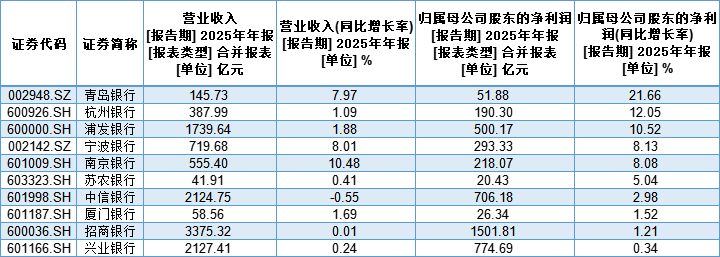
Core Viewpoint - The performance reports of 10 A-share listed banks indicate overall steady growth in profitability and asset quality, with expectations for continued improvement in 2026 as net interest margin decline is expected to narrow and credit costs continue to decrease [1][2]. Profitability - All 10 A-share listed banks reported year-on-year growth in net profit for 2025, with notable performance from city commercial banks [2]. - Qingdao Bank achieved a net profit of 5.188 billion yuan, marking a 21.66% year-on-year increase, leading the group of disclosed banks [2]. - Other banks such as Ningbo Bank, Nanjing Bank, and Hangzhou Bank also surpassed 10 billion yuan in net profit, with year-on-year growth rates of 8.13%, 8.08%, and 12.05% respectively [2][3]. Revenue Growth - Except for CITIC Bank, all other banks reported positive revenue growth for 2025 [4]. - Nanjing Bank recorded the highest revenue growth at 10.48%, reaching 55.54 billion yuan, while Qingdao Bank and Ningbo Bank reported revenue of 14.573 billion yuan and 71.968 billion yuan, with growth rates of 7.97% and 8.01% respectively [4][5]. - The revenue growth of city commercial banks and rural commercial banks showed some differences, with Nanjing Bank benefiting from strong net interest income growth [4]. Asset Quality - The asset quality of the 10 listed banks remained stable, with most reporting a steady or declining non-performing loan (NPL) ratio [6][9]. - Qingdao Bank's NPL ratio decreased to 0.97%, down 17 basis points from the previous year, indicating improved asset quality [9][10]. - The provision coverage ratio for Qingdao Bank increased to 292.3%, reflecting a continuous improvement in core asset quality indicators [10]. Market Outlook - Analysts expect that the net interest margin for listed banks will stabilize, with a slight narrowing of the decline anticipated in 2026 [8][9]. - The first quarter of 2026 is projected to see a significant increase in credit issuance, with January alone expected to account for over 30% of the annual total [8]. - The overall credit growth is expected to remain robust, supported by favorable monetary policy adjustments [8].




银行业月报:行业盈利温和修复,关注优质区域行-20260204
Ping An Securities· 2026-02-04 10:08
Investment Rating - The industry investment rating is "Outperform the Market" (maintained) [1][38] Core Viewpoints - The industry is experiencing profound changes in funding structure, leading to a shift towards reallocation rather than trading. The continuous expansion of passive indices has brought stable capital inflows, and the high dividend yield of the banking sector, currently averaging 4.50%, is attracting long-term funds such as insurance capital. Regulatory measures aimed at guiding long-term capital into the market are expected to sustain the attractiveness of dividend allocation value [2][10] - The 2025 annual performance reports indicate a recovery in revenue and profit, with asset quality showing steady improvement. As of the end of January, ten banks reported their 2025 performance, with most showing a year-on-year increase in revenue and profit. Notably, Qingdao Bank, Nanjing Bank, and Shanghai Pudong Development Bank maintained high growth rates in net profit and revenue, with growth rates of 21.7%, 8.1%, and 10.5% respectively [3][6][7] Summary by Sections Performance Overview - Revenue and profit are recovering, with asset quality improving. The average year-on-year growth rate of net profit for the ten banks is 7.2%, with a quarter-on-quarter increase of 0.6 percentage points. The average non-performing loan (NPL) ratio decreased by 2 basis points to 0.94% [6][7][8] - The average loan growth rate for the ten banks increased from 10.1% in the first three quarters of 2025 to 15.5% for the full year, indicating a positive loan issuance trend [6][7] Market Trends - In January 2026, the banking sector declined by 6.18%, underperforming the CSI 300 index by 7.83 percentage points, ranking last among 30 sectors [14] - Individual bank performances varied, with Qingdao Bank, Ningbo Bank, and Hangzhou Bank showing increases of 16.5%, 10.2%, and 5.8% respectively [15] Macro and Liquidity Tracking - The manufacturing PMI for January was 49.30%, a decrease of 0.80 percentage points from the previous month. The CPI for December was 0.80% year-on-year, while the PPI was -1.90% [25][22] - In January, the one-year and five-year LPR remained stable at 3.0% and 3.50% respectively. The interbank lending rates for 7D, 14D, and 3M changed to 1.61%, 1.68%, and 1.78% respectively [28][26] Credit and Social Financing Data - In December 2025, new RMB loans increased by 910 billion, a year-on-year decrease of 80 billion, with a balance growth rate of 6.40%. Corporate loans increased by 1.07 trillion, while household loans decreased by 91.6 billion [29][32] - The social financing scale increased by 2.21 trillion in December, with a year-on-year growth rate of 8.30% [32]


股份制银行板块2月4日涨1.51%,招商银行领涨,主力资金净流入11.33亿元
Zheng Xing Xing Ye Ri Bao· 2026-02-04 08:56
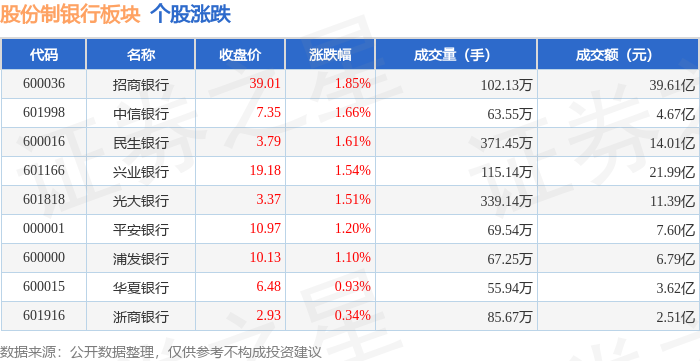
Group 1 - The banking sector saw an increase of 1.51% on February 4, with China Merchants Bank leading the gains [1] - The Shanghai Composite Index closed at 4102.2, up 0.85%, while the Shenzhen Component Index closed at 14156.27, up 0.21% [1] - Key stocks in the banking sector showed various performance metrics, with China Merchants Bank closing at 39.01, up 1.85%, and CITIC Bank at 7.35, up 1.66% [1] Group 2 - The banking sector experienced a net inflow of 1.133 billion yuan from main funds, while retail and speculative funds saw net outflows of 0.351 billion yuan and 0.782 billion yuan, respectively [1] - Major banks like China Merchants Bank and Industrial Bank had significant net inflows of 1.642 billion yuan and 0.322 billion yuan, respectively, indicating strong institutional interest [1] - In contrast, banks like Everbright Bank and CITIC Bank faced net outflows of 0.549 billion yuan and 0.239 million yuan, reflecting weaker retail sentiment [1]

金价上演“过山车”行情 短期震荡加剧,中长期支撑未改
Sou Hu Cai Jing· 2026-02-04 07:11
近日,全球黄金市场迎来剧烈波动,国际现货金价在短短数日内经历了从历史高位跳水至强势反弹的"过山车"走势,国内金价同步联动震荡,引发投资者广 泛关注。多家机构及业内人士表示,短期政策预期扰动与资金获利了结放大了价格波动,而中长期支撑金价的核心逻辑未发生根本性改变。 据悉,此次金价波动始于1月下旬的强势冲高。1月29日,伦敦金现最高逼近每盎司5600美元关口,创下阶段性新高,国内黄金T+D价格同步攀升,金店零售 金价一度突破1500元/克。然而,强势上涨后随即迎来史诗级回调,1月30日伦敦金现单日跌幅近一成,2月2日更是跌破4500美元/盎司,国内黄金T+D价格也 随之回落,部分投资者遭遇短期浮亏,不少网友在社交平台感慨"短短几天坐了一趟过山车",有投资者表示,前期浮赢大幅缩水后,为保本选择及时离场, 最终仅获得微薄收益。 业内专家提醒广大投资者,黄金的核心角色应是家庭资产配置中的"压舱石"和"保险单",主要功能是对冲极端风险、平抑资产组合波动,而非"一夜暴富"的 投机工具。他建议,普通投资者可采用"定期定额积存"的方式参与黄金投资,克服"追涨杀跌"的人性弱点,长期平滑持有成本,同时需密切关注美联储政策 动向、美 ...

并购新规后首批项目落地 浦发银行精准赋能产业升级
Zhong Guo Jin Rong Xin Xi Wang· 2026-02-04 07:04
Core Viewpoint - The implementation of the new regulations for merger and acquisition (M&A) loans by the National Financial Regulatory Administration marks a significant upgrade in China's M&A financial support system, with banks like SPDB quickly adapting to these changes to facilitate industrial transformation and upgrading [1][2]. Group 1: New Regulations Overview - The new regulations expand the scope of M&A loans to include equity-based acquisitions for the first time and increase the maximum proportion of controlling M&A loans to 70%, with loan terms extended to ten years [2]. - These adjustments aim to enhance the alignment between financial supply and M&A market demand, injecting new momentum into high-quality economic development by revitalizing existing resources and promoting new investments [2]. Group 2: SPDB's Response and Strategy - SPDB views the new regulations as an opportunity to enhance service capabilities and broaden service boundaries, quickly organizing to identify and advance projects that meet the new regulatory requirements [3]. - The bank positions M&A loans not just as a financing product but as a "super product" that integrates various financial services, aiming to provide comprehensive solutions that combine financing and strategic insights for businesses [3]. Group 3: Support for Various Industries - SPDB's M&A loan business is thriving, with significant funding directed towards technology innovation and industrial digitalization, including a loan of 144 million yuan for a cybersecurity acquisition and 350 million yuan for a fintech company to enhance its data analysis capabilities [4]. - The bank also supports traditional industries in their transformation, such as providing 644 million yuan for a biopharmaceutical asset acquisition and assisting a heavy industry company in acquiring a specialized equipment firm to strengthen industry collaboration [4]. Group 4: Support for State-Owned Enterprises and Regional Development - SPDB has actively supported state-owned enterprise reforms, providing 130 million yuan for a local state-owned enterprise's resource integration project and 850 million yuan for a core state-owned enterprise in Shenzhen [5]. - The bank's Chengdu branch successfully executed an early-stage equity-based technology M&A loan, demonstrating the unique value of M&A finance in attracting investment and fostering local industrial growth [5]. Group 5: Future Outlook - SPDB plans to continue aligning with national strategic directions and market trends, aiming to provide efficient and valuable financial support for corporate mergers and acquisitions, thereby contributing to the development of a modern industrial system and new productive forces [6].
“业绩亮眼+部署升级” 银行业以高质量发展护航“十五五”开局
Jin Rong Shi Bao· 2026-02-04 01:47
Core Viewpoint - The banking industry is focusing on supporting the real economy through strategic transformation and risk management, with a clear emphasis on high-quality development and service to key sectors [1][3][8]. Group 1: Performance of Listed Banks - Several A-share listed banks, including China Merchants Bank, CITIC Bank, and Shanghai Pudong Development Bank, have reported significant growth in both operating income and net profit for 2025, indicating a recovery in profitability [2]. - CITIC Bank and Shanghai Pudong Development Bank have both entered the "10 trillion yuan club," with total assets of 10.13 trillion yuan and 10.08 trillion yuan respectively, marking growth rates of 6.28% and 6.55% year-on-year [2]. - The overall trend for joint-stock banks in 2025 is characterized by stable scale, optimized structure, risk control, and improved efficiency, showcasing strong resilience against economic cycles [2]. Group 2: Strategic Focus on Real Economy - The banking sector is shifting from "scale expansion" to "high-quality development," with a focus on precise strategies to support the real economy and address cyclical fluctuations [3][6]. - Major state-owned banks have emphasized the importance of serving the real economy in their 2026 operational plans, aligning their actions with national strategic directives [4]. - Agricultural Bank of China is prioritizing support for rural revitalization, while Bank of China aims to enhance its global capabilities and services [4]. Group 3: Digital Transformation and Innovation - Digital transformation is becoming a key support for banks to enhance their service efficiency to the real economy, with initiatives like "AI+" being implemented to innovate service models and improve decision-making [5]. - Postal Savings Bank is pursuing a comprehensive upgrade strategy focusing on digitalization and value-driven growth, aiming for high-quality development [5]. Group 4: Financial Resource Allocation - The banking industry is actively channeling more financial resources into key areas such as expanding domestic demand, technological innovation, and supporting small and micro enterprises [6][8]. - Banks are adjusting their strategic layouts to focus on the "five major financial articles," enhancing the precision and effectiveness of their services to the real economy [6]. - Notable growth in technology finance loans has been reported, with Hangzhou Bank and Nanjing Bank showing increases of 23.44% and 19.49% respectively [6][7]. Group 5: Regional and Sectoral Support - Banks are increasingly focusing on regional development and industrial upgrades, with initiatives to strengthen local financial services and support manufacturing sector transformations [7]. - The emphasis on supporting small and micro enterprises has led to significant growth in inclusive finance loans, with Hangzhou Bank and Nanjing Bank reporting increases of 17.06% and 17.46% respectively [7]. - The banking sector is aligning its services with national strategies in areas such as technological innovation, green development, and rural revitalization [8].