赛诺菲

Search documents
CORRECTING and REPLACING Dynavax Investor Alert: Kahn Swick & Foti, LLC Investigates Adequacy of Price and Process in Proposed Sale of Dynavax Technologies Corporation - DVAX
Businesswire· 2025-12-30 15:19
Core Viewpoint - The proposed sale of Dynavax Technologies Corporation to Sanofi is under investigation for its adequacy in price and process, with concerns that the offered price may undervalue the company [1]. Group 1: Proposed Transaction Details - Dynavax shareholders are set to receive $15.50 in cash for each share they own as part of the proposed sale to Sanofi [1]. - The transaction is structured as a tender offer, indicating that timing may be critical for shareholders [3]. Group 2: Legal Investigation - Kahn Swick & Foti, LLC, led by former Louisiana Attorney General Charles C. Foti, Jr., is investigating whether the sale price and the process leading to it are adequate [1]. - Shareholders who believe the transaction undervalues Dynavax are encouraged to discuss their legal rights with KSF [2].


基石药业-b(02616):以临床开发为引擎、稳健迈入研发2.0阶段,创新布局前沿管线及领域
Ping An Securities· 2025-12-30 14:06
Investment Rating - The report gives a "Buy" rating for CStone Pharmaceuticals (2616.HK) for the first time [1]. Core Views - CStone Pharmaceuticals is transitioning into R&D 2.0, focusing on innovative pipelines and cutting-edge technologies, with a strong emphasis on clinical development as the driving force [6][11]. - The company has successfully launched four innovative drugs and has a pipeline of 16 candidate drugs, indicating robust growth potential [6][11]. - The financial outlook shows a projected revenue increase from 1.95 billion CNY in 2025 to 6.33 billion CNY in 2027, reflecting a strong recovery trajectory [7]. Summary by Sections 1. Clinical Development as the Engine - CStone Pharmaceuticals was established in 2016, focusing on clinical development and innovative R&D in oncology and immune diseases [11]. - The company has a concentrated shareholding structure, with major shareholders including WuXi Healthcare Ventures (11.84%) and Pfizer (7.91%) [14]. - Cash management is stable, with a focus on core R&D investments, and the company reported a revenue of 0.49 billion CNY in the first half of 2025 [17][18]. 2. R&D Pipeline and Innovations - The company is advancing into R&D 2.0, focusing on multi-targeted therapies and ADC technologies, with key projects like CS2009 (a tri-specific antibody) and CS5001 (ROR1 ADC) in clinical trials [22]. - CS2009 has shown promising early efficacy and safety data, with an overall response rate (ORR) of 12.2% in clinical trials [35]. - CS5001 is in clinical 1b phase, demonstrating a 70% ORR in preliminary data, indicating strong potential for further development [18][22]. 3. Financial Projections - Revenue projections indicate a decline in 2025 to 1.95 billion CNY, followed by significant growth to 4.64 billion CNY in 2026 and 6.33 billion CNY in 2027 [5][7]. - The company is expected to narrow its net losses, with a forecasted loss of 0.91 billion CNY for 2024 and 0.23 billion CNY for 2027 [5][7]. 4. Market Context - The global market for immune checkpoint inhibitors (ICIs) is projected to grow significantly, reaching 58.53 billion USD in 2025 and expected to exceed 100 billion USD by 2029 [22][25]. - The report highlights the importance of dual-targeting strategies in cancer treatment, which could lead to deeper and more durable responses [22][29].
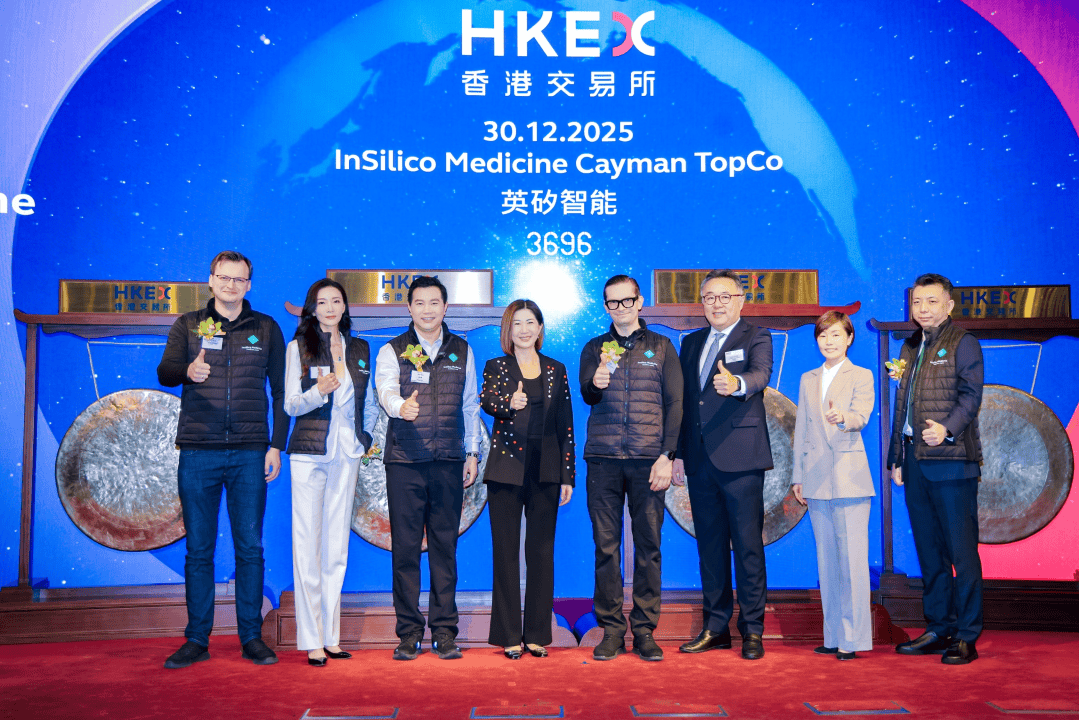
AI制药独角兽英矽智能登陆港交所
Sou Hu Cai Jing· 2025-12-30 12:48
Core Viewpoint - The company Insilico Medicine, driven by generative artificial intelligence, successfully listed on the Hong Kong Stock Exchange, raising a total of HKD 2.277 billion, marking the highest fundraising for a biotech IPO in Hong Kong this year [1][3]. Group 1: IPO Details - Insilico Medicine's IPO was priced at HKD 24.05 per share, with an opening increase of 45.5% to HKD 35.00 per share [3]. - The IPO was co-sponsored by Morgan Stanley, CICC, and GF Securities, with a total issuance of 94.6905 million shares, where the Hong Kong public offering accounted for 10% and was oversubscribed by approximately 1,427.37 times, securing over HKD 328.349 billion in subscription funds [5]. - The international offering accounted for 90% and was oversubscribed by 26.27 times, setting a record for non-18A Hong Kong healthcare IPOs [5]. Group 2: Investor Participation - Insilico Medicine attracted 15 cornerstone investors, including Eli Lilly, Tencent, Temasek, Schroders, UBS, Oak Tree Capital, E Fund, and Taikang Life, enhancing its credibility in the global pharmaceutical and investment landscape [6]. - Notably, Eli Lilly and Tencent participated as cornerstone investors for the first time in a biotech company, while Oak Tree Capital returned to the Hong Kong biotech market as a cornerstone investor [6]. Group 3: Company Overview and Innovation - Insilico Medicine utilizes its proprietary Pharma.AI platform and advanced automated laboratories to accelerate drug discovery, focusing on unmet medical needs in areas such as fibrosis, oncology, immunology, pain, obesity, and metabolic disorders [7]. - The company has ten molecules that have received clinical trial approval, with Rentosertib being the most advanced candidate for treating idiopathic pulmonary fibrosis, having completed Phase 2a clinical studies with positive results [7]. - Compared to traditional drug development timelines of approximately 4.5 years, Insilico Medicine has reduced the average time from project initiation to clinical candidate nomination to 12 to 18 months for over 20 self-developed projects from 2021 to 2024 [7][8]. Group 4: Future Plans and Funding Allocation - Following the IPO, Insilico Medicine plans to allocate approximately 48% of the raised funds for further clinical development of key pipeline candidates, 20% for early drug discovery and development, 15% for developing innovative generative AI models and related validation studies, 12% for further development and expansion of automated laboratories, and 5% for operational funds and other general corporate purposes [9].
上百款新药正在临床开发!寡核苷酸疗法为这些罕见病患者点亮新希望
Xin Lang Cai Jing· 2025-12-30 11:04
Core Insights - Oligonucleotide therapies are emerging as a significant breakthrough in the treatment of rare diseases, with over a dozen therapies approved globally and hundreds in clinical research, promising to benefit more patients in the future [1][14][15] Industry Developments - The global landscape has seen more than ten oligonucleotide therapies approved for rare diseases, providing new treatment options for conditions such as Amyotrophic Lateral Sclerosis (ALS), Duchenne Muscular Dystrophy (DMD), and Hemophilia [1][14] - There are currently over a hundred oligonucleotide therapies in clinical development targeting various rare diseases, including siRNA and antisense oligonucleotide (ASO) therapies [2][14] Recent Approvals and Innovations - In August, Ionis Pharmaceuticals received FDA approval for the LICA drug Dawnzera (donidalorsen) for preventing hereditary angioedema (HAE) attacks in patients aged 12 and older, marking it as the first RNA-targeted drug for HAE [4][18] - Ionis Pharmaceuticals and Sobi announced the approval of ASO drug Tryngolza (olezarsen) in the EU for treating genetically confirmed familial chylomicronemia syndrome (FCS) [4][19] - Alnylam Pharmaceuticals' siRNA therapy Amvuttra (vutrisiran) was approved by the FDA in March for treating patients with transthyretin amyloidosis with cardiomyopathy [5][19] Clinical Trial Progress - NS Pharma reported positive results from the long-term extension study of ASO therapy brogidirsen for DMD, showing effective exon 44 skipping and stable maintenance of motor function in patients [7][21] - RIBOMIC's umedaptanib pegol showed promising results in a Phase 2 trial for achondroplasia in children, with many patients experiencing improved height growth rates [7][21] - Ionis Pharmaceuticals' ASO therapy zilganersen demonstrated significant results in stabilizing walking speed in Alexander disease patients, with plans for a new drug application to the FDA in 2026 [8][22] WuXi TIDES Platform - WuXi TIDES has established an integrated solution for oligonucleotide and peptide therapies, covering custom synthesis, conjugation, process development, and CMC, facilitating the transition of innovative projects into clinical stages [1][11][26] - The platform offers comprehensive CRDMO services from drug discovery to commercial production, supporting high-throughput synthesis and custom synthesis for various oligonucleotides [11][26][27] Future Outlook - The company aims to continue leveraging its integrated CRDMO model to empower the development of various new drugs, including oligonucleotide therapies, to bring more effective treatments to patients [12][27]




Dynavax Investor Alert: Kahn Swick & Foti, LLC Investigates Adequacy of Price and Process in Proposed Sale of Dynavax Technologies Corporation - DVAX

Businesswire· 2025-12-29 23:37
Core Viewpoint - The proposed sale of Dynavax Technologies Corporation to Sanofi is under investigation by former Louisiana Attorney General Charles C. Foti, Jr. and the law firm Kahn Swick & Foti, LLC to assess the fairness of the transaction and the process leading to it [1] Group 1: Transaction Details - Shareholders of Dynavax Technologies Corporation are set to receive $221.50 in cash for each share they own as part of the proposed sale to Sanofi [1]

Sanofi buys hep B vaccine maker for $2.2bn
Yahoo Finance· 2025-12-29 15:58
Core Viewpoint - Sanofi is set to acquire Dynavax for approximately $2.2 billion, enhancing its vaccine portfolio amid changing vaccine policies in the US [1][4] Group 1: Acquisition Details - The acquisition price is $15.50 per share in cash, with the deal expected to close in the first quarter of 2026 [1] - Sanofi will gain Dynavax's hepatitis B vaccine HEPLISAV-B, which was approved in the US in 2017 and in Europe in 2021 [2] - Sanofi currently lacks a hepatitis B vaccine in its portfolio, having previously partnered with MSD for a vaccine that is now solely commercialized by MSD [2] Group 2: Product and Market Insights - HEPLISAV-B is administered in a two-dose regimen within one month, contrasting with competitors GSK's Engerix-B and MSD's Recombivax HB, which require three doses over six months [3] - HEPLISAV-B generated sales of $268.4 million in 2024, with Dynavax projecting net product revenue of $305 million to $325 million for 2025 [3] - GlobalData forecasts that HEPLISAV-B will achieve annual sales of $677 million by 2031 [3] Group 3: Industry Context and Regulatory Changes - The acquisition comes amid significant regulatory changes, as the CDC has altered its guidance, no longer recommending hepatitis B vaccination for all US newborns, leading to volatility in the vaccine sector [4] - Analyst Matt Phipps noted that the deal value is slightly below the net present value for HEPLISAV-B, but the acquisition aligns with addressing regulatory concerns and investor expectations for value creation [4] Group 4: Future Prospects - Dynavax's pipeline includes a shingles vaccine candidate, Z-1018, currently in Phase I/II trials, which has shown comparable efficacy to GSK's Shingrix while having fewer adverse reactions [5] - The shingles market is significant, with Shingrix generating £3.4 billion globally for GSK in 2024, indicating the potential market size for Z-1018 [6]
【报告】医药生物行业定期报告:从供需看,中国创新药能从海外分成多少钱?(附下载)
Xin Lang Cai Jing· 2025-12-29 13:40
Group 1: Market Overview - The CITIC Pharmaceutical Index increased by 1.2% during the week of June 3-6, 2025, outperforming the CSI 300 Index by 0.3 percentage points, ranking 16th among CITIC's primary industry classifications [1] - Year-to-date, the CITIC Pharmaceutical and Biotechnology Index has risen by 8.3%, surpassing the CSI 300 Index by 9.9 percentage points, ranking 5th among CITIC's industry classifications [1] - The top five performing stocks for the week included Yiming Pharmaceutical (+33.09%), Wanbangde (+32.59%), Anglikang (+30.28%), Xinnowei (+21.36%), and Haichen Pharmaceutical (+20.93%) [1] Group 2: Patent Cliff and Market Opportunities - By 2037, 27 blockbuster drugs with projected sales exceeding $4 billion in 2024 will face patent expiration, creating a market opportunity of over $240 billion for new entrants [2][12] - China is positioned as a core player in global innovative drug supply, leveraging its technological platforms and research efficiency, with the highest number of clinical pipelines in cell therapy, ADC, and bispecific antibodies [2][21] - The projected revenue from licensing agreements for Chinese projects from 2020 to 2025 is estimated to generate approximately $8.2 billion in net profit, translating to a potential market capitalization increase of $81.7 billion based on a 10x PE ratio [2] Group 3: Investment Recommendations - Focus on authorized blockbuster products with overseas clinical progress, including companies like Kangfang Biotech, Kelun Biotech, and Sanofi [2] - Potentially significant products for licensing out include Innovent Biologics, CSPC Pharmaceutical Group, and Zai Lab [2] - Companies with approved products showing strong commercialization performance include BeiGene, Kingsoft Biotech, and Hutchison China MediTech [2] Group 4: Mid to Long-term Investment Strategy - The investment strategy emphasizes three main lines: innovation, recovery, and policy support [4] - The innovation line focuses on biopharmaceuticals with competitive advantages in international markets and companies with second growth curves in pharmaceuticals [4] - The recovery line anticipates a rebound in medical device tenders and consumer healthcare, while the policy line supports high-dividend companies and encourages mergers and acquisitions [4]



医药生物行业周报(12月第4周):医疗器械有望开启大航海时代-20251229
Century Securities· 2025-12-29 10:39
Investment Rating - The report does not explicitly state an investment rating for the industry, but it suggests a positive outlook for the medical device sector, indicating potential for growth and innovation [2][3]. Core Insights - The medical device sector is expected to enter a "great sailing era" with the initiation of centralized procurement for drug-coated balloons and urological intervention consumables, indicating a significant policy shift that could benefit domestic manufacturers [3]. - The report highlights that after extensive centralized procurement, domestic medical device manufacturers have gained substantial market share, leading to a concentration of the industry towards leading enterprises, which are expected to benefit from scale effects and favorable export policies [3]. - The report emphasizes the potential for domestic medical device companies to replicate the path of domestic pharmaceutical companies, using centralized procurement to drive innovation and enhance global competitiveness [3]. Market Weekly Review - The pharmaceutical and biotechnology sector experienced a slight decline of 0.18% from December 22 to December 26, underperforming compared to the Wind All A index (2.78%) and the CSI 300 index (1.95%) [8]. - Among sub-sectors, raw materials (2.05%), blood products (1.28%), and medical research outsourcing (0.77%) showed gains, while hospitals (-2.82%), pharmaceutical distribution (-1.8%), and offline pharmacies (-1.3%) faced declines [8]. - Notable individual stock performances included Hongyuan Pharmaceutical (59.4%), Luyuan Pharmaceutical (37.3%), and Huakang Medical (21.1%) with significant gains, while ST Bailin (-18.5%), Huaren Health (-15.8%), and Haiwang Biological (-14.9%) saw substantial losses [11]. Industry News and Key Company Announcements - The National Medical Products Administration announced new regulations for the management of medical device export sales certificates, effective May 1, 2026, which aims to facilitate the export of Chinese medical devices [13]. - The centralized procurement for high-value medical consumables has officially started, marking a significant policy development in the industry [13]. - Sanofi reached an acquisition agreement with Dynavax for $2.2 billion, highlighting ongoing consolidation in the pharmaceutical sector [13]. - Notable collaborations and agreements were reported, including licensing agreements and partnerships among various pharmaceutical companies, indicating active M&A and collaboration trends in the industry [16][17].
Delayed MS Decision and Trial Miss Add to Sanofi’s R&D Challenges
Yahoo Finance· 2025-12-29 08:13
Core Insights - Sanofi is facing significant challenges in its research and development pipeline, particularly with its experimental multiple sclerosis drug tolebrutinib, which has experienced delays in regulatory decisions and disappointing clinical trial results [2][3][4]. Group 1: Regulatory Delays and Clinical Trials - The US FDA has delayed its decision on tolebrutinib, which is under review for non-relapsing secondary progressive multiple sclerosis, moving the action date beyond December 28, marking a second delay from an initial September expectation [4]. - Sanofi reported that tolebrutinib failed to demonstrate efficacy in slowing disability progression in a late-stage trial for primary progressive multiple sclerosis, which represents about 10% of MS cases [5]. - Analysts have expressed concerns that these setbacks could diminish confidence in Sanofi's future drug portfolio, especially following earlier weak results from treatments for eczema and smokers' lungs [3]. Group 2: Market Implications - The delay in the FDA decision could potentially reduce the likelihood of tolebrutinib's approval and raise doubts about the projected peak annual sales of approximately €1.4 billion [5]. - Competing treatments, such as those developed by Roche, have shown better outcomes, which may further impact Sanofi's market position [5]. Group 3: Future Outlook - Despite current challenges, tolebrutinib has received breakthrough therapy designation from the FDA and remains under regulatory review in the EU, indicating some ongoing potential for the drug [6]. - Sanofi is characterized as an R&D-driven, AI-powered biopharma company focused on improving patient outcomes while pursuing sustainable growth [7].
Trump’s Market Mania: A Rollercoaster of Tariffs, Deals, & Battleships
Stock Market News· 2025-12-28 18:00
Trade Relations and Tariffs - President Trump announced a new 100% tariff on Chinese goods and fresh limits on tech exports, effective November 1st, 2025, reminiscent of previous tariff announcements that led to significant market declines [2] - The S&P 500 technology index dropped 4%, and the semiconductor sector fell 6.3% following the announcement, with Alibaba and JD.com shares declining 8.4% and 6.2% respectively [2] - The average U.S. tariff rate has climbed to nearly 17%, the highest since 1935, generating approximately $30 billion per month for the Treasury [5] Pharmaceutical Industry Developments - President Trump announced lower drug price deals with nine pharmaceutical companies, including Amgen and Merck, in exchange for aligning U.S. drug prices with those in other developed nations and receiving a three-year exemption from tariffs on pharmaceutical ingredients [6] - Analysts expressed mixed views, with some predicting negligible effects on sales and profits, while others saw potential positive momentum for the sector into 2026 [7][8] Technology Sector and AI Chips - NVIDIA Corporation received approval to resume shipping high-performance AI chips to China, subject to a 25% federal fee on each chip sold, which could benefit the U.S. Treasury [4] - Following the announcement, NVIDIA shares rose between 2% and 4%, indicating market optimism about re-entering a significant market [4] Military and Defense Industry - President Trump unveiled plans for a new Navy "battleship" as part of an expanded naval fleet, with the first vessel, the USS Defiant, set to begin construction soon [9] - Shares of South Korean shipbuilder Hanwha Ocean surged 12.5% following the announcement, reflecting market enthusiasm for defense contracts [10] Market Performance and Economic Indicators - The S&P 500 is nearing the 7,000 mark with an 18% gain for the year, while the Nasdaq Composite is up 22%, driven by strong performance in technology and AI sectors [13] - Despite tariff-induced volatility, the market has shown resilience, with traditional safe havens like gold and silver experiencing significant price increases [13]