上海银行

Search documents
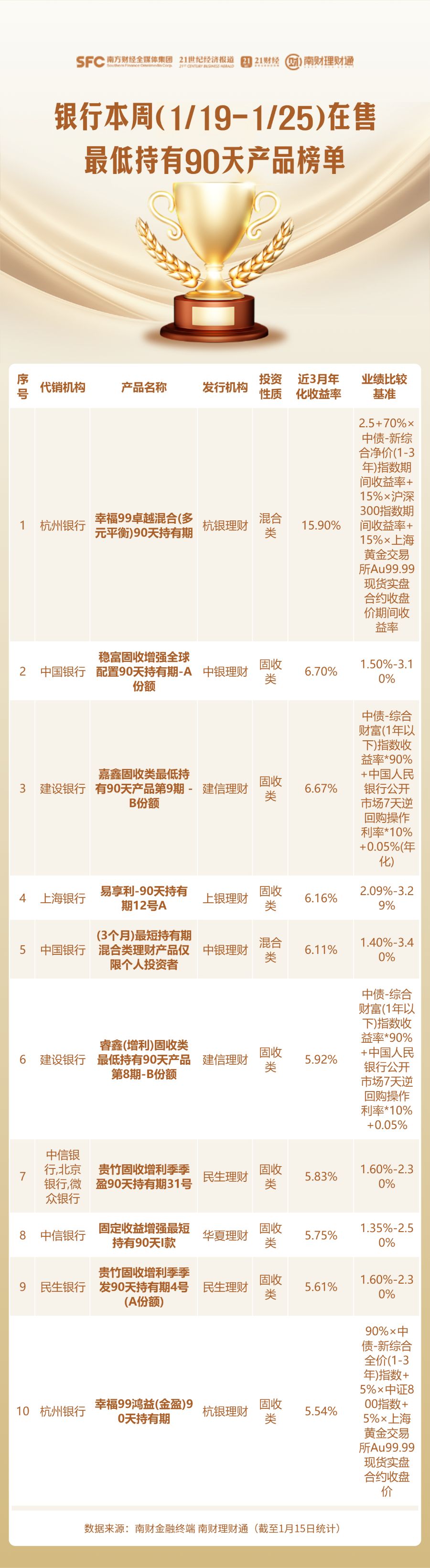
代销银行持有期产品排名出炉!混合类产品收益领先
2 1 Shi Ji Jing Ji Bao Dao· 2026-01-19 09:35
| 序 代销机构 | 产品名称 | 发行机构 | 投资 性质 | 近3月年 化收益率 | 业绩比较 基准 | | --- | --- | --- | --- | --- | --- | | | | | | | 2.5+70%× | | | | | | | 中债-新综 | | | | | | | 合净价(1-3 | | | | | | | 年)指数期 | | | | | | | 间收益率+ | | | | | | | 15%×沪深 | 本期,南财理财通重点关注最低持有期人民币公募产品的业绩表现,按照90天、180天、365天持有期限分类对产品业绩进行排 名,业绩指标采用年化收益率,计算区间与持有期限相同,如90天持有期产品的业绩计算区间为近三月年化收益率,同机构同 系列同投资周期产品保留一只参与排名。 统计代销机构(28家):工商银行、中国银行、农业银行、邮储银行、建设银行、交通银行、招商银行、中信银行、光大银 行、民生银行、兴业银行、浦发银行、广发银行、浙商银行、华夏银行、平安银行、恒丰银行、渤海银行、北京银行、宁波银 行、江苏银行、上海银行、南京银行、杭州银行、徽商银行、微众银行、网商银行、百信银行。 需要 ...

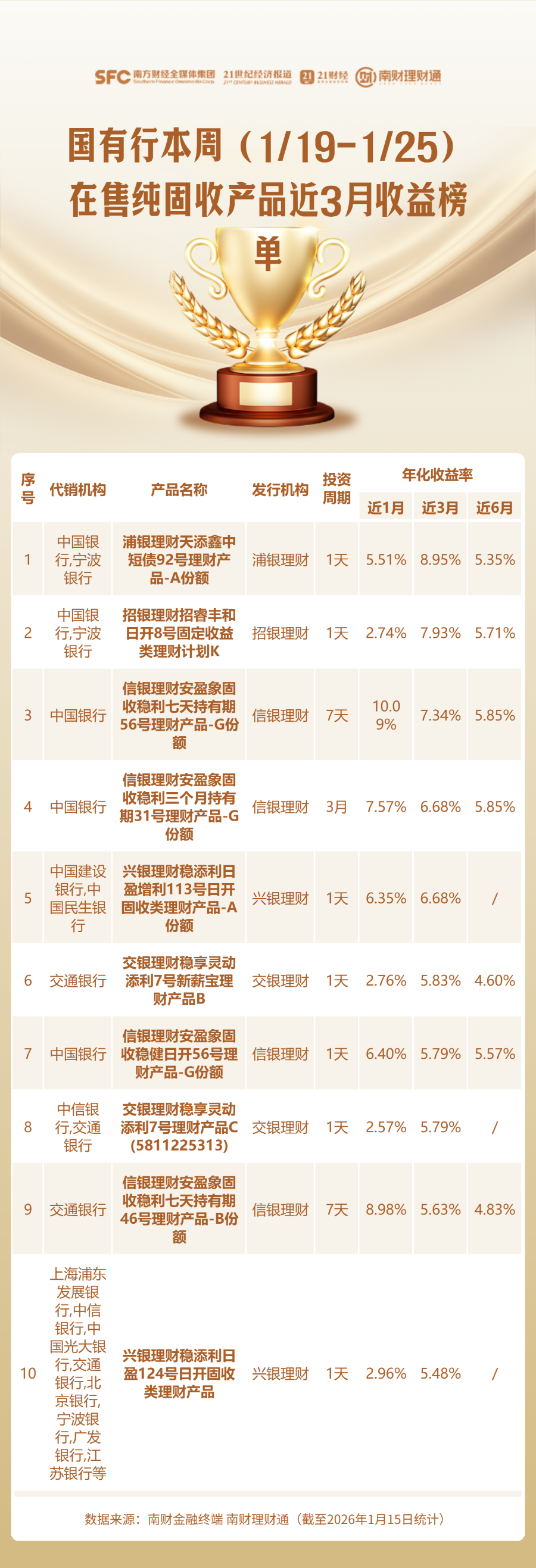
本周在售纯固收:股份行、城商行理财公司产品收益领先
2 1 Shi Ji Jing Ji Bao Dao· 2026-01-19 09:16
本期,课题组重点关注理财公司发行的纯固收产品,从代销渠道为投资者筛选出表现较优的在售产品。 为提供有效的选品参考,榜单展示了产品近一月、近三月及近六月的年化业绩,并按照近三月年化收益率进行排序,以此反映 其在近期市场波动中的多维度收益表现。 统计代销机构(28家):工商银行、中国银行、农业银行、邮储银行、建设银行、交通银行、招商银行、中信银行、光大银 行、民生银行、兴业银行、浦发银行、广发银行、浙商银行、华夏银行、平安银行、恒丰银行、渤海银行、北京银行、宁波银 行、江苏银行、上海银行、南京银行、杭州银行、徽商银行、微众银行、网商银行、百信银行。 需要特别提醒的是:本榜单对理财产品"在售"状态的判断基于其投资周期推算。但实际情况中,部分产品可能因额度售罄,或 银行针对不同客户展示的产品清单存在差异而无法购买。因此,建议投资者以代销银行APP的实际展示为准。 此外,南财理财通虽力求客观公正,但不对本评价榜信息的真实性、完整性和准确性作任何保证,排名信息仅供参考。 | 를 | 代销机构 | 产品名称 | 发行机构 | 投资 周期 | | 年化收益率 | | | --- | --- | --- | --- | --- ...
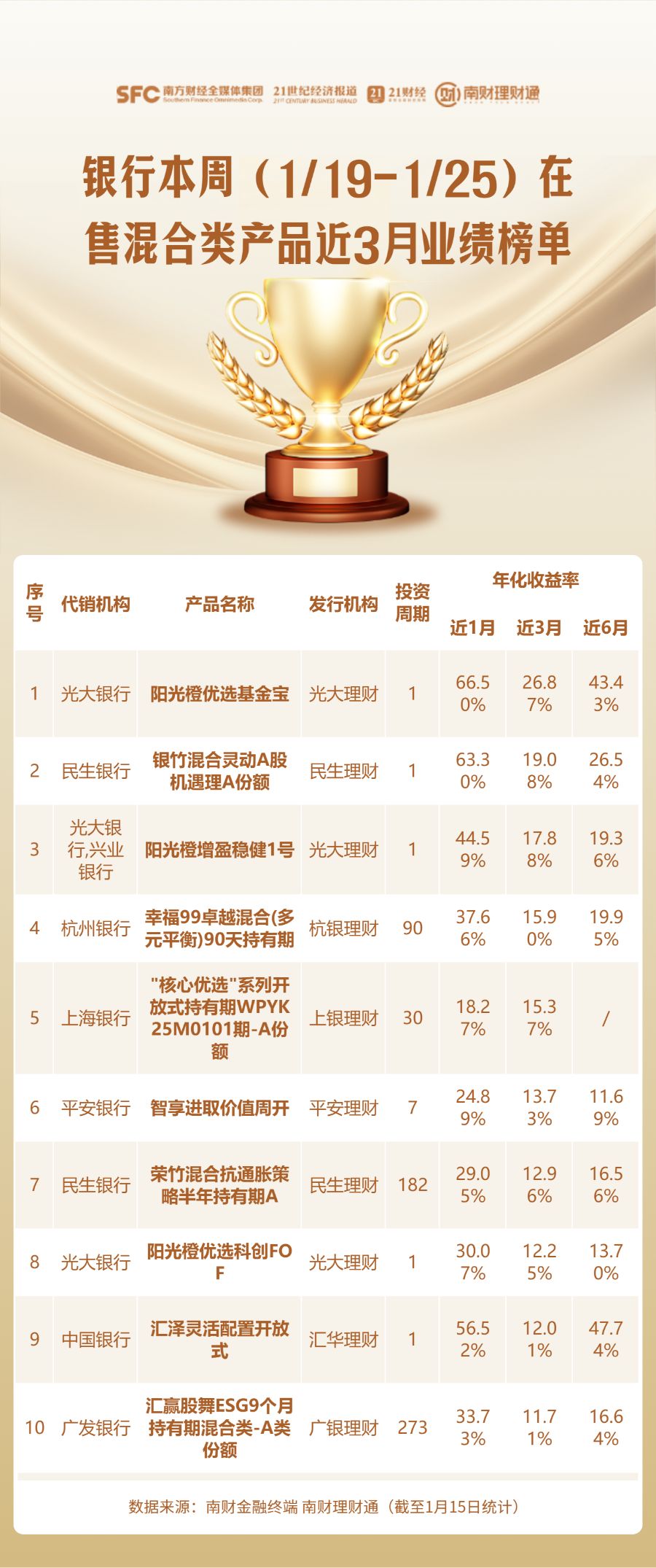
混合类产品短期收益亮眼,近1月年化冲破60%
2 1 Shi Ji Jing Ji Bao Dao· 2026-01-19 09:02
Group 1 - The focus of the research group is on mixed-asset products issued by wealth management companies, highlighting superior performing products available for sale through distribution channels [1] - A ranking list is provided, showcasing the annualized performance of products over the last month, three months, and six months, sorted by the three-month annualized yield to reflect multidimensional performance amid recent market fluctuations [1] - A total of 28 distribution institutions are involved, including major banks such as Industrial and Commercial Bank of China, Bank of China, Agricultural Bank of China, and others [1] Group 2 - The ranking list includes specific products with their respective annualized yields: for example, the "阳光橙优选基金宝" from 光大银行 has a one-month yield of 66.5%, a three-month yield of 26.8%, and a six-month yield of 43.4% [3] - Other notable products include "机遇理A份额" from 民生银行 with a three-month yield of 8% and "阳光橙墙盈稳健1号" from 光大银行 with a three-month yield of 8% [4] - The data is sourced from 南财金融终端 and 南财理财通, with statistics as of January 15 [4]
城商行板块1月19日跌1.02%,宁波银行领跌,主力资金净流出1.99亿元
Zheng Xing Xing Ye Ri Bao· 2026-01-19 08:58
| 代码 | 名称 | 主力净流入(元) | 主力净占比 游资净流入(元) | | 游资净占比 散户净流入 (元) | | 散户净占比 | | --- | --- | --- | --- | --- | --- | --- | --- | | 601229 | 上海银行 | 8968.35万 | 15.81% | -3980.86万 | -7.02% | -4987.49万 | -8.79% | | 601009 南京银行 | | 7407.67万 | 13.88% | -72.48万 | -0.14% | -7335.19万 | -13.74% | | 002142 宁波银行 | | 4222.74万 | 3.42% | -290.35万 | -0.23% | -3932.39万 | -3.18% | | 600926 杭州银行 | | 412.25万 | 0.36% | 1306.21万 | 1.15% | -1718.46万 | -1.51% | | 002936 郑州银行 | | 224.03万 | 2.13% | 156.72万 | 1.49% | -380.75万 | -3.62% | | 600 ...


华泰研究:结构性降息落地,融资逆周期调节
HTSC· 2026-01-19 03:10
Investment Rating - The report maintains an "Overweight" rating for the securities and banking sectors, while also suggesting a positive outlook for the insurance sector [10][40]. Core Insights - The report highlights a structural monetary policy shift with a focus on "increasing quantity and reducing price," indicating potential for further interest rate cuts and reserve requirement ratio reductions [12][41]. - The A-share market remains active, with an average daily trading volume of 3.47 trillion yuan and a financing balance exceeding 2.7 trillion yuan, marking a new high [12][28]. - The report emphasizes the importance of the recent increase in the minimum margin requirement for financing from 80% to 100%, which aims to stabilize market conditions and reduce leverage [14][18]. Securities Sector Summary - The securities sector is expected to benefit from improved market conditions, with a focus on high-quality brokerage firms such as CITIC Securities and Guotai Junan [3][27]. - The report notes that the recent increase in financing margin requirements is a regulatory measure to control leverage and stabilize market sentiment [14][15]. - CITIC Securities reported a 38% year-on-year increase in net profit for 2025, reflecting strong performance in brokerage and investment banking [27]. Insurance Sector Summary - The insurance sector is advised to focus on high-quality leading companies, as the market has recognized the strong performance of life insurance sales [39]. - The report indicates that the main drivers for insurance stock prices are currently on the asset side rather than the liability side, leading to some price corrections [12][39]. Banking Sector Summary - The banking sector is characterized by a stable performance, with major banks like Shanghai Bank and Nanjing Bank recommended for investment due to their solid fundamentals [3][40]. - The report highlights a decrease in social financing growth, primarily due to high government debt base effects, but notes an increase in corporate loans [42][43]. - The Central Bank's recent policies suggest room for further interest rate cuts, which could enhance the banking sector's profitability [41][40].





2026年中国中小银行行业政策、产业链、资产规模、竞争格局及趋势研判:数字化转型与绿色金融深化,推动中小银行资产规模与竞争力同步提升[图]
Chan Ye Xin Xi Wang· 2026-01-19 01:16
Core Viewpoint - The small and medium-sized banks in China play a crucial role in supporting the long-term development of the economy by fostering private enterprises and small businesses, thus contributing to local economic prosperity and advancing financial market reforms [1][9]. Summary by Sections 1. Overview of the Small and Medium-Sized Banking Industry - Small and medium-sized banks are generally defined as all banks excluding the six major state-owned banks. They include national joint-stock banks, urban commercial banks, rural commercial banks, private banks, credit cooperatives, and village banks [3][10]. 2. Industry Policies - The Chinese government has shown significant attention to the development of small and medium-sized banks, continuously optimizing the policy environment to support industry growth. For instance, in January 2025, the government issued guidelines to enhance rural banking services and support small enterprises [5][6]. 3. Industry Chain - The upstream of the small and medium-sized banking industry includes IT service providers, payment platforms, financial market participants, and hardware/software suppliers. The midstream consists of the banks themselves, while the downstream includes consumers and businesses utilizing banking services [7][8]. 4. Current Development Status - Small and medium-sized banks have significantly expanded their total assets, reaching 192.25 trillion yuan in 2024, a year-on-year increase of 6.39%. By November 2025, total assets are projected to reach 201.6 trillion yuan, with a growth rate of 6.49% [1][9]. 5. Competitive Landscape and Key Enterprises - The competitive landscape of the small and medium-sized banking industry shows a clear tiered structure. The first tier includes major banks like China Merchants Bank and Shanghai Pudong Development Bank, while the second tier consists of regional banks like Beijing Bank and Shanghai Bank. The third tier includes numerous local rural financial institutions [14][15]. 6. Development Trends - Digital transformation is becoming a core competitive advantage for small and medium-sized banks, with a focus on data-driven operations and enhanced customer experiences through technology [18]. - Green finance is transitioning from concept to practice, with banks expected to integrate environmental risk assessments into their lending processes and develop specialized products to support sustainable initiatives [19]. - Regional and specialized operations are expected to deepen, with banks focusing on local economic characteristics and developing tailored financial solutions for small and micro enterprises [21].



银行周报(2026/1/12-2026/1/16):12月收支表:居民存款边际活化,中小银行配债意愿或有下降-20260118
GUOTAI HAITONG SECURITIES· 2026-01-18 07:44
Investment Rating - The report assigns an "Accumulate" rating for the banking sector [5] Core Insights - In December, there are signs of marginal activation in household savings deposits, while medium to long-term loans from small and medium-sized banks show significant growth. The bond market experienced fluctuations, leading to a potential decrease in the willingness of small and medium-sized banks to allocate bonds [2][3] Summary by Sections Liabilities - Personal deposits increased by CNY 428.7 billion year-on-year, with demand deposits and time deposits increasing by CNY 100 billion and decreasing by CNY 39.1 billion respectively. There is a trend of time deposits migrating from small and medium-sized banks to large banks, with large banks and small banks seeing increases of CNY 75.9 billion and decreases of CNY 115 billion respectively [3] - Corporate deposits decreased by CNY 134.3 billion year-on-year, with demand deposits and time deposits decreasing by CNY 191.2 billion and increasing by CNY 172.7 billion respectively. Small and medium-sized banks contributed significantly to the increase in time deposits, with a year-on-year increase of CNY 118.3 billion in December [3] - Non-bank deposits decreased by CNY 3.2 trillion year-on-year, with large banks and small banks seeing decreases of CNY 3.1 trillion and increases of CNY 63.8 billion respectively. The significant increase in non-bank deposits is attributed to a low base effect from the self-regulatory mechanism for interbank demand deposits in 2024 [3] - Financial bonds increased by CNY 44.9 billion year-on-year, with large banks and small banks seeing increases of CNY 14.2 billion and CNY 30.7 billion respectively [3] Assets - Loans decreased by CNY 50.9 billion year-on-year, primarily due to a decrease in non-bank loans. Short-term loans and medium to long-term loans increased by CNY 86.2 billion and CNY 33.9 billion respectively. Large banks saw significant increases in short-term loans, while small banks showed a contrasting trend [4] - Bond investments decreased by CNY 909.8 billion year-on-year, with large banks and small banks seeing decreases of CNY 35.2 billion and CNY 874.6 billion respectively. The fluctuations in the bond market have led to a potential decrease in the willingness of small and medium-sized banks to allocate bonds, while they have increased their holdings in repurchase agreements by CNY 778 billion year-on-year [4]
企业端发力支撑信贷
HTSC· 2026-01-16 12:01
Investment Rating - The report maintains a "Buy" rating for several banks, including Chengdu Bank, Chongqing Rural Commercial Bank, Nanjing Bank, Industrial and Commercial Bank of China, Shanghai Bank, and China Construction Bank, while recommending "Hold" for Chongqing Rural Commercial Bank [8][35]. Core Insights - The report highlights that corporate lending has become the main driver of credit growth, with December's new loans reaching 910 billion yuan, exceeding expectations, while household loans contracted significantly [2][5]. - The total social financing for 2025 is projected to be 35.6 trillion yuan, an increase of 3.34 trillion yuan year-on-year, supported mainly by government bonds [5][12]. - The report indicates a recovery in corporate bond financing, with December seeing an increase of 1.54 billion yuan, while government bond financing decreased significantly due to a high base effect from the previous year [3][5]. Summary by Sections Credit Growth - December's new loans amounted to 910 billion yuan, with corporate loans increasing by 1.07 trillion yuan, while household loans decreased by 916 billion yuan [2][5]. - The overall loan growth rate for December was 6.4%, remaining stable compared to November [2][12]. Social Financing - The total social financing in December was 2.21 trillion yuan, with a year-on-year decrease of 646.2 billion yuan, primarily due to fluctuations in government bonds [1][5]. - For the entire year of 2025, social financing is expected to grow significantly, driven by government support [5][12]. Monetary Supply - M1 and M2 growth rates for December were 3.8% and 8.5%, respectively, with M1 showing a decline due to limited demand for corporate current funds [4][12]. - New deposits in December reached 1.68 trillion yuan, with a year-on-year increase of 3.08 trillion yuan [4][12]. Investment Recommendations - The report recommends specific stocks for investment, including Chengdu Bank (target price 23.25 yuan), Nanjing Bank (target price 14.78 yuan), and Industrial and Commercial Bank of China (target price 8.31 yuan) [11][35].
这一次,宝能姚振华,真急了
创业家· 2026-01-16 10:16
Core Viewpoint - The auction of Qoros Automotive's core assets has become a critical issue for Yao Zhenhua, highlighting the financial struggles of Baoneng Group and the potential loss of significant investments [4][30]. Group 1: Qoros Automotive Auction and Financial Implications - The second auction of Qoros Automotive's assets is set to start with a starting price of 860 million yuan, significantly lower than the estimated value of 8 billion yuan [6][10]. - Baoneng Group has invested approximately 26 billion yuan in Qoros Automotive from 2018 to 2025, despite facing liquidity issues [8]. - Yao Zhenhua's allegations include collusion among local authorities to manipulate the asset valuation, which could lead to a drastic reduction in the value of Baoneng's investments [9][11]. Group 2: Baoneng Group's Debt Crisis - Baoneng Group is currently facing over 105.8 billion yuan in executed amounts across its core platforms, indicating severe financial distress [19]. - The company's aggressive diversification strategy, including significant investments in Qoros Automotive and other sectors, has contributed to its current debt crisis [29]. - A recent court ruling requires Baoneng to repay 7.3 billion yuan in loans, further exacerbating its financial challenges [28]. Group 3: Yao Zhenhua's Response and Future Outlook - Yao Zhenhua's public denunciation of the asset auction reflects desperation to protect Baoneng's interests amid mounting debt pressures [31]. - The outcome of the Qoros asset auction is crucial for Baoneng's ability to recover from its financial difficulties and maintain relationships with over 1,500 suppliers owed 13.9 billion yuan [30].

城商行板块1月16日跌1.27%,江苏银行领跌,主力资金净流出2.29亿元
Zheng Xing Xing Ye Ri Bao· 2026-01-16 08:56
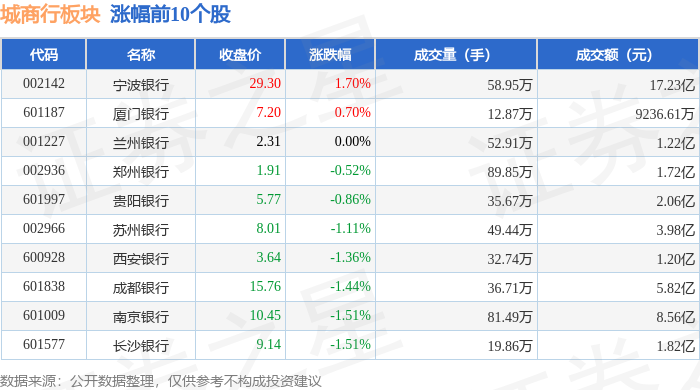
Core Viewpoint - The city commercial bank sector experienced a decline of 1.27% on January 16, with Jiangsu Bank leading the drop. The Shanghai Composite Index closed at 4101.91, down 0.26%, while the Shenzhen Component Index closed at 14281.08, down 0.18% [1]. Group 1: Stock Performance - Ningbo Bank closed at 29.30, up 1.70% with a trading volume of 589,500 shares and a transaction value of 1.723 billion [1]. - Xiamen Bank closed at 7.20, up 0.70% with a trading volume of 128,700 shares and a transaction value of 92.3661 million [1]. - Jiangsu Bank closed at 9.76, down 2.69% with a trading volume of 2,061,300 shares and a transaction value of 2.033 billion [2]. - Shanghai Bank closed at 9.64, down 2.43% with a trading volume of 961,200 shares and a transaction value of 933.3 million [2]. Group 2: Capital Flow - The city commercial bank sector saw a net outflow of 229 million from main funds, while speculative funds had a net inflow of 716 million, and retail investors experienced a net outflow of 487 million [2]. - Hangzhou Bank had a main fund net inflow of 153 million, while retail investors saw a net outflow of 113 million [3]. - Nanjing Bank recorded a main fund net inflow of 70.5 million and a retail net outflow of 131 million [3].